
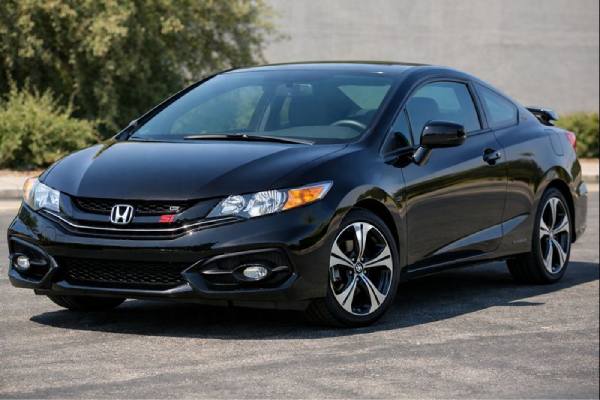
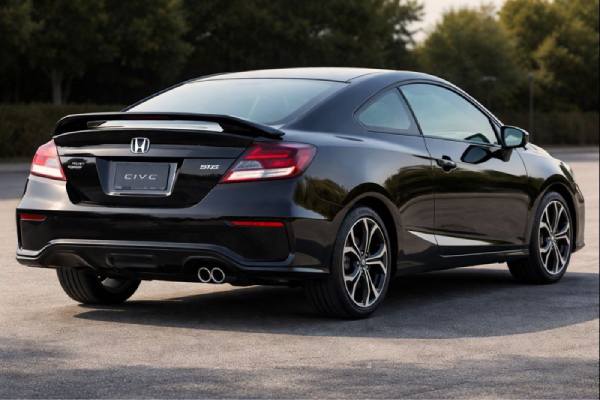
The 2014–2015 Honda Civic Si FG4 marks the most refined version of the ninth-generation Civic Si sedan. These final facelift years brought subtle but meaningful updates, including revised suspension tuning, interior improvements, and a small power increase to 205 hp from the naturally aspirated K24Z7 engine. In an era increasingly dominated by turbocharged engines and automated transmissions, the FG4 Si remained firmly analog: front-wheel drive, a six-speed manual only, and a high-revving four-cylinder that rewards driver input.
What makes the FG4 Si notable is balance. It blends everyday comfort, predictable reliability, and genuine performance without complex hardware. The larger-displacement K-series engine emphasizes usable torque, while chassis updates for 2014–2015 improved ride composure and steering feel compared with earlier ninth-generation models. For owners, this version represents the most polished expression of Honda’s naturally aspirated Si formula before the platform transitioned to turbocharging.
This guide examines the FG4 Civic Si in detail, covering its engineering fundamentals, technical specifications, trim and safety equipment, reliability patterns, maintenance requirements, real-world driving behavior, and how it compares to key rivals.
Essential Insights
- Naturally aspirated K24Z7 engine delivers strong midrange torque and a 7,200 rpm redline.
- Standard helical limited-slip differential enhances traction and corner exit control.
- 2014–2015 updates improved ride quality and interior refinement.
- Clutch and gearbox wear depend heavily on driving style and modification history.
- Manual transmission fluid service is recommended every 60,000 km (37,000 mi).
Jump to sections
- Detailed overview
- Specifications and technical data
- Trims, options, and safety
- Reliability and common issues
- Maintenance and buyer’s guide
- Driving and performance
- How it compares to rivals
Detailed overview
The 2014–2015 Civic Si FG4 represents Honda’s response to criticism of the early ninth-generation Civic. Suspension revisions, added structural rigidity, and interior updates transformed the Si into a more cohesive sports sedan. While the core mechanical layout remained unchanged, the driving experience became more refined without losing its performance edge.
At the heart of the FG4 is the K24Z7 engine, a 2.4-liter naturally aspirated inline-four with DOHC i-VTEC. Compared with earlier Si engines, it prioritizes torque over extreme high-rpm output. This makes the car easier to drive quickly in daily traffic while still rewarding drivers who explore the upper rev range. For 2014–2015, output increased slightly to 205 hp, primarily through tuning refinements.
Chassis tuning improvements addressed ride harshness noted in earlier models. Revised dampers and bushings improved compliance over broken pavement while maintaining sharp turn-in. The helical limited-slip differential remains a defining feature, reducing inside-wheel spin and making the most of the available power during aggressive driving.
From an ownership perspective, the FG4 Si appeals to drivers seeking long-term durability and mechanical honesty. There are no turbochargers, adaptive systems, or dual-clutch gearboxes. Instead, reliability depends on consistent maintenance and respectful use, especially for cars driven hard or modified.
Specifications and technical data
Powertrain and efficiency
| Item | Specification |
|---|---|
| Engine code | K24Z7 |
| Engine layout | Inline-4 |
| Valvetrain | DOHC i-VTEC |
| Valves per cylinder | 4 |
| Bore × stroke | 87.0 × 99.0 mm |
| Displacement | 2.4 L (2,354 cc) |
| Induction | Naturally aspirated |
| Fuel system | Multi-point fuel injection |
| Compression ratio | 11.0:1 |
| Max power | 205 hp (153 kW) @ ~7,000 rpm |
| Max torque | 234 Nm (173 lb-ft) @ ~4,400 rpm |
| Timing drive | Chain |
| Rated efficiency | ~8.6 L/100 km (27 mpg US / 33 mpg UK) |
| Real-world highway @ 120 km/h | ~7.8–8.2 L/100 km |
| Aerodynamics | Cd ~0.28 |
Transmission and driveline
| Item | Specification |
|---|---|
| Transmission | 6-speed manual |
| Drive type | Front-wheel drive |
| Differential | Helical limited-slip |
Chassis and dimensions
| Item | Specification |
|---|---|
| Front suspension | MacPherson strut |
| Rear suspension | Multi-link |
| Steering | Electric power assist |
| Brakes | Disc front / disc rear |
| Wheels and tyres | 215/45 R17 |
| Length | ~4,500 mm |
| Width | ~1,770 mm |
| Height | ~1,435 mm |
| Wheelbase | 2,670 mm |
| Turning circle | ~10.8 m |
| Kerb weight | ~1,320 kg |
| Fuel tank | ~50 L |
| Cargo volume | ~350 L (VDA) |
Performance and capability
| Metric | Value |
|---|---|
| 0–100 km/h | ~6.4 s |
| Top speed | ~235 km/h |
| Braking 100–0 km/h | ~36 m |
| Towing capacity | Not rated |
| Payload | ~420 kg |
Trims, options, and safety
Honda offered the Civic Si FG4 as a single trim level, simplifying the buying process and ensuring consistency across the lineup. All performance-related hardware comes standard, including the limited-slip differential, sport suspension, and six-speed manual gearbox.
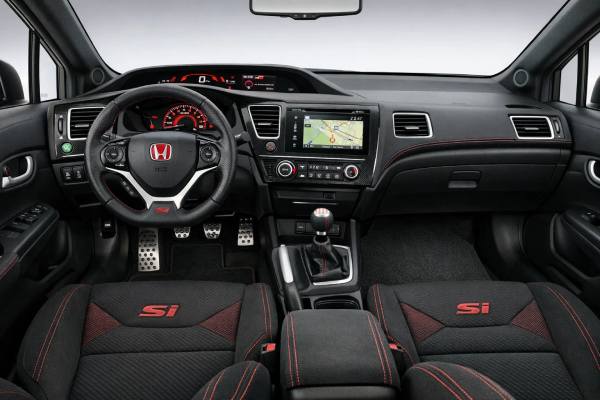
Interior updates for 2014–2015 improved materials and infotainment usability. Sport seats with revised bolstering, a leather-wrapped steering wheel, aluminum pedals, and Si-specific gauges reinforce the car’s performance intent. Exterior styling is restrained, with subtle aerodynamic elements and unique wheels distinguishing the Si from standard Civics.
Safety equipment includes multiple airbags, electronic stability control, traction control, and anti-lock braking. Child-seat anchors are provided in the rear. While modern advanced driver-assistance systems were not yet common, the FG4 benefits from a strong safety cell and predictable braking behavior.
Crash-test ratings for the Civic platform remain solid for its era, making the Si a reasonable choice for drivers who want performance without sacrificing baseline safety.
Reliability and common issues
The 2014–2015 Civic Si FG4 has a strong reliability record when maintained properly.
Common
- Clutch wear in cars driven aggressively or modified.
- Suspension bushing wear due to stiffer factory tuning.
Occasional
- Manual transmission synchro wear from repeated high-rpm shifts.
- Engine mount deterioration causing vibration.
Rare
- Timing chain noise related to oil neglect or extended service intervals.
The K24Z7 engine is known for durability. Most failures stem from poor maintenance, overheating, or low-quality modifications rather than inherent design flaws.
Maintenance and buyer’s guide
Key maintenance items
- Engine oil: Full synthetic, every 8,000–10,000 km or annually.
- Transmission fluid: Replace every 60,000 km.
- Brake fluid: Every 2–3 years.
- Coolant: Replace per manufacturer interval.
- Valve clearance: Inspect around 160,000 km.
Buyer checklist
- Evaluate clutch engagement and pedal feel.
- Check for transmission grinding during fast shifts.
- Inspect suspension components for play or noise.
- Confirm consistent oil change history.
Stock or lightly modified examples with full service records tend to offer the best ownership experience.
Driving and performance
On the road, the FG4 Si feels composed and engaging. Steering is quick and accurate, with improved feedback over earlier ninth-generation models. Body control is firm but more compliant than pre-facelift versions, making daily driving more comfortable.
The naturally aspirated engine delivers linear throttle response and strong midrange pull. While turbocharged rivals offer quicker straight-line acceleration, the Si rewards smooth driving and precise gear selection. The limited-slip differential significantly improves corner exit traction and confidence.
Noise levels are moderate, with some road and tyre noise typical of performance-oriented compacts. Fuel economy remains reasonable, though spirited driving quickly increases consumption.
How it compares to rivals
Compared with turbocharged competitors like the Volkswagen Jetta GLI and Ford Focus ST, the Civic Si FG4 trades outright power for simplicity and reliability. Its naturally aspirated engine, manual-only transmission, and predictable handling appeal to purists. While it may not be the fastest in a straight line, it remains one of the most engaging and durable sport sedans of its era.
References
- 2014 Honda Civic Si Specifications and Features 2014 (Manufacturer Specifications)
- 2015 Honda Civic 4-door sedan 2015 (Safety Rating)
- 2015 Honda Civic 2015 (Official Fuel Economy)
Disclaimer
This article is for informational purposes only and does not substitute for professional diagnosis or repair. Specifications, torque values, service intervals, and procedures vary by VIN, market, and equipment. Always verify details using official Honda service documentation. If you found this guide helpful, please consider sharing it on social platforms to support our work.