

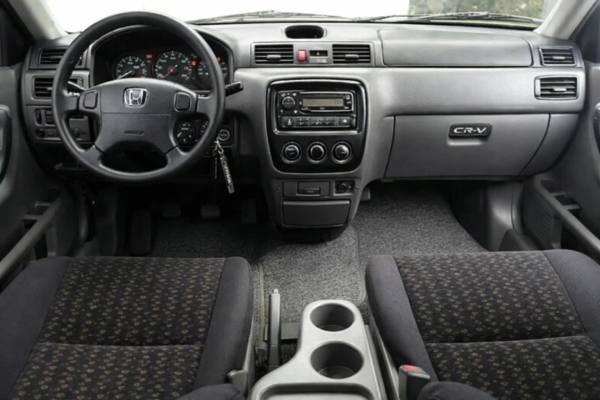
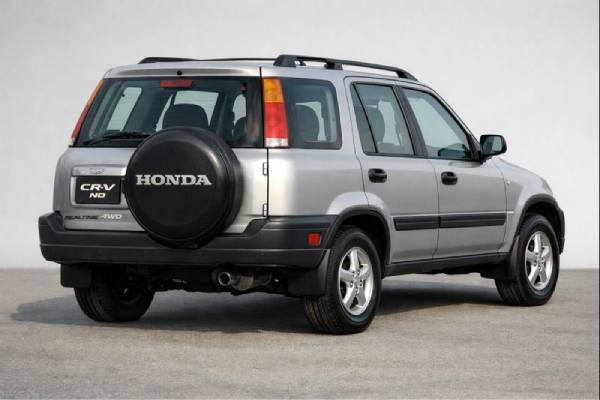
The 1998–2001 Honda CR-V RD1 with Real Time 4WD is one of those older SUVs that still makes engineering sense today: compact footprint, simple driveline logic, and a durable B-series 2.0-liter engine that rewards steady maintenance. Unlike full-time AWD, Honda’s Real Time 4WD is primarily front-driven and sends torque rearward only when the front tires slip—helpful on wet roads, gravel, and light snow without the fuel penalty of constant driveline drag.
For owners and buyers, the “make-or-break” details are usually not the horsepower number but the basics: timing-belt service history, cooling system health, and whether the rear differential has been kept on the correct fluid. Get those right, and the RD1 can be a dependable, easy-to-live-with daily driver that’s also genuinely practical for trips, pets, and weekend hauling.
Quick Specs and Notes
- Real Time 4WD adds traction in rain and snow without the feel of a heavy full-time AWD system.
- The B20Z2 is long-lived when oil changes are consistent and overheating is prevented.
- Rear differential behavior is a tell: tight-turn shudder often points to overdue Dual Pump Fluid service.
- Plan timing-belt replacement at 105,000 miles (168,000 km) or 7 years, whichever comes first.
- Expect best reliability when coolant, radiator condition, and thermostat operation are kept in check.
Jump to sections
- Real Time 4WD RD1 explained
- Technical specs for B20Z2 4WD
- Equipment, variants, and safety layout
- Known faults, TSBs, and recalls
- Service schedule and purchase tips
- How it drives in real life
- 4WD RD1 against competitors
Real Time 4WD RD1 explained
Think of the RD1 CR-V’s Real Time 4WD as “FWD most of the time, AWD when it matters.” In normal driving it behaves like a front-wheel-drive crossover, which keeps steering light and reduces wear on the rear driveline. When the front tires begin to spin faster than the rears—common on slick paint lines, wet leaves, gravel, or snowy starts—the system progressively sends torque to the rear axle to stabilize motion and help you pull away.
The key ownership benefit is how unobtrusive it feels. There’s no driver mode dial and typically no warning light telling you it’s working; it just quietly adds assistance when traction drops. The trade-off is that it is not an off-road system in the traditional 4×4 sense. Ground clearance and approach angles are modest, there’s no low range, and the clutch-based rear engagement is designed for intermittent slip rather than sustained rock-crawling or deep mud. The chassis and suspension tolerate rough roads, but the driveline is happiest when the tires have similar grip and similar circumference.
Where owners notice Real Time 4WD the most is in tight, slow turns—parking lots, U-turns, and sharp hairpins. If the rear differential fluid is old or incorrect, the internal clutch pack can bind and release in pulses. The sensation feels like a shudder, hopping, or a brief “dragging” from the rear. It is one of the most useful diagnostics on an RD1: if you feel it during a low-speed full-lock turn after the vehicle is warmed up, assume the rear diff service history is unknown until proven otherwise.
In day-to-day use, the Real Time 4WD variant is also a better winter tool than the FWD model with the same tires. It won’t shorten braking distances on ice—tires still decide that—but it can reduce the number of “one-wheel peel” moments leaving a stop or climbing a slick incline. If you plan to keep the RD1 long-term, prioritize equal tire wear (rotate on schedule) and keep the rear diff on the correct fluid. Those two habits do more for 4WD smoothness than any add-on part.
Technical specs for B20Z2 4WD
Below are the core specifications that matter for ownership, maintenance planning, and realistic expectations. Exact figures can vary slightly by market, trim, and transmission, so treat these as the typical ranges for a 1998–2001 RD1 with the B20Z2 and Real Time 4WD.
Powertrain and efficiency (B20Z2)
| Item | Specification |
|---|---|
| Engine code | B20Z2 |
| Layout | Inline-4, DOHC, 16 valves |
| Displacement | 2.0 L (1,973 cc) |
| Induction | Naturally aspirated |
| Fuel system | Multi-point fuel injection |
| Max power | 148 hp (110 kW) @ ~6,200 rpm |
| Max torque | ~183 Nm (135 lb-ft) @ ~4,200 rpm |
| Timing drive | Belt |
| Fuel grade | Unleaded, 86 AKI (RON varies by market) |
| Rated efficiency (EPA, typical) | ~11.2 L/100 km combined (21 mpg US combined) |
Transmission and driveline
| Item | Specification |
|---|---|
| Transmission (common) | 4-speed automatic |
| Optional transmission | 5-speed manual (market dependent) |
| Drive type | Real Time 4WD (on-demand rear engagement) |
| Rear differential | Dual Pump Fluid system (clutch-based) |
Chassis, dimensions, and capacities (typical)
| Item | Specification |
|---|---|
| Suspension (front/rear) | MacPherson strut / trailing arm (with stabilizer bars by trim) |
| Steering | Rack-and-pinion, hydraulic assist |
| Wheels and tires (common) | 15×6J; 205/70R15 |
| Fuel tank | 58 L (15.3 US gal) |
| Curb weight (4WD, typical) | ~1,400–1,500 kg (varies by trim/transmission) |
| Cargo (seats up / down, typical) | Practical “boxy” space; varies by measurement standard |
Fluids and key service specs (high-impact items)
| Item | Specification |
|---|---|
| Engine oil | API SJ “Energy Conserving”; 5W-30 recommended |
| Oil capacity (with filter) | 3.8 L (4.0 US qt) |
| Drain bolt torque | 44 Nm (33 lb-ft) |
| Coolant | Honda Type 2 (premixed 50/50) |
| ATF (automatic) | Honda ATF-Z1 preferred (Dexron III temporary) |
| Rear differential | Honda Dual Pump Fluid (ATF temporary only) |
| Spark plugs | NGK ZFR6F-11 / Denso KJ20CR-L11; gap 1.1 mm |
Performance (realistic expectations)
A healthy RD1 4WD is not quick by modern standards, but it feels responsive at city speeds due to modest weight and short gearing. Typical period-test acceleration is around 10–11 seconds 0–100 km/h, with top speed generally in the 165–175 km/h range depending on tires, condition, and transmission. Braking performance depends heavily on pad/rotor quality and tire grip; the chassis is stable when properly aligned.
Equipment, variants, and safety layout
Because the RD1 CR-V was sold across multiple markets and the trim naming differs, it helps to focus on what changes functionally. The big split is transmission (automatic vs manual) and whether you have ABS, which can be standard or optional depending on year/trim. Real Time 4WD itself is typically consistent in concept, but the ownership experience can still differ based on wheel/tire package, brake setup, and convenience equipment.
Trims and option patterns you’ll actually notice
Most RD1s were sold as well-equipped compact SUVs rather than stripped utility vehicles, so you’ll often see power windows, air conditioning, a split-fold rear bench, and the signature CR-V cargo area features (flat load floor and practical storage). Higher trims or option packages may add:
- Alloy wheels instead of steel wheels (often easier to spot than the badge).
- Better audio head unit and additional speakers.
- Roof rails and body-color exterior pieces.
- ABS as standard rather than optional.
- Leather seating and heated seats in certain markets.
If you are trying to identify what you’re looking at quickly, your most useful “tells” are the ABS indicator at key-on, wheel style, and whether the vehicle has a manual shifter pattern and clutch pedal. VIN decoding and build plates can confirm market configuration, but for a buyer inspection, visible equipment and service records matter more than the marketing trim name.
Safety systems: what’s there, what isn’t
This generation predates modern driver assistance systems. Expect no AEB (automatic emergency braking), no adaptive cruise control, no lane-keeping support, and no stability control. Safety is mostly “passive” (structure + restraints) and “basic active” (brakes + tires).
Common safety equipment includes:
- Dual front airbags (SRS).
- Three-point seatbelts with pretensioner logic depending on market/year.
- Child-seat top tether anchors (check exact locations and count on your specific vehicle).
- ABS availability varies—confirm by lamp check and by looking for ABS hardware at the brake system.
Crash ratings reality check
For North American buyers, the most relevant third-party data is IIHS testing for the model years in this generation. The takeaway for an RD1 is that it reflects late-1990s small SUV design: adequate in many everyday crashes, but not engineered to the same intrusion and compatibility standards as modern crossovers. If safety is your top priority, a newer vehicle will be a meaningful upgrade.
That said, you can still improve real-world outcomes with fundamentals: quality tires, properly working brakes, correct headlight aim, and keeping the suspension tight so the car stays composed in emergency maneuvers. On an RD1, “safety” is strongly linked to condition.
Known faults, TSBs, and recalls
Most RD1 issues are age-and-mileage problems rather than mysterious design flaws. That’s good news: symptoms are usually consistent, repairs are well understood, and parts availability is still decent. Below is a practical way to think about problems by prevalence and cost impact.
Common and usually low-to-medium cost
- Oil leaks (common, low/medium): Look for seepage at the valve cover gasket, distributor O-ring area, and crank seals.
- Symptoms: burnt-oil smell, oily engine block, drip marks.
- Root cause: aging rubber seals and heat cycles.
- Remedy: reseal with quality gaskets; clean and recheck.
- Cooling system aging (common, medium/high if ignored): Radiators, hoses, and thermostats degrade with time.
- Symptoms: temperature creep in traffic, coolant smell, low coolant reservoir.
- Root cause: plastic end-tank fatigue, stuck thermostat, old coolant, weak cap.
- Remedy: pressure test, replace radiator/hoses as needed, refill with correct coolant, bleed system.
- Idle and drivability quirks (common, low/medium): Older Hondas can develop sticky idle control valves and vacuum leaks.
- Symptoms: hunting idle, stalling on cold start, uneven idle with A/C on.
- Root cause: carbon buildup, brittle hoses, dirty throttle body.
- Remedy: correct diagnostics first; clean/replace parts as required.
Real Time 4WD-specific issues
- Rear diff shudder in tight turns (common when neglected, low/medium):
- Symptoms: hopping/shudder at low speed on full lock, especially when warm.
- Root cause: old/incorrect rear diff fluid; clutch pack stick-slip.
- Remedy: drain and refill with the correct Dual Pump Fluid (often improves immediately). If severe, repeat service after a short interval.
- Uneven tire circumferences (common cause of “mystery” 4WD behavior, low):
- Symptoms: driveline bind, noise, or inconsistent rear engagement feel.
- Root cause: mismatched tire brands/sizes, large tread depth difference, incorrect pressures.
- Remedy: match tires, rotate regularly, keep pressures consistent.
Occasional to rare but higher consequence
- Automatic transmission wear (occasional, medium/high): Many survive long lives, but neglect is expensive.
- Symptoms: delayed engagement, flare on shifts, harsh shifts, burnt ATF smell.
- Root cause: old fluid, heat, internal wear.
- Remedy: verify fluid condition and service history; address early.
- Suspension and steering wear (occasional, medium): Bushings, ball joints, and wheel bearings don’t last forever.
- Symptoms: clunks over bumps, wandering alignment, humming that changes with speed.
- Root cause: age, potholes, heavy loads.
- Remedy: inspection with pry-bar checks; align after repairs.
Recalls, TSBs, and how to verify
At this vehicle age, the most important step is not memorizing recall headlines—it’s verifying completion. Use an official VIN lookup and ask for dealer documentation if available. If a seller can’t show proof, treat it as incomplete until you confirm it yourself. For service bulletins, focus on those that address drivability, transmission behavior, or safety equipment function, and keep records of any dealer-performed updates.
Service schedule and purchase tips
A well-maintained RD1 feels “tight” and honest; a neglected one feels like a stack of small problems. The best buyer strategy is to confirm the big-ticket services, then budget for the predictable wear items.
Practical maintenance schedule (use distance and time)
Engine oil and filter
- Normal use: every 7,500 miles (12,000 km) or 12 months
- Severe use (short trips, dusty roads, frequent idling): every 3,750 miles (6,000 km) or 6 months
Use quality 5W-30 and do not overfill.
Timing belt and water pump (critical)
- Replace timing belt at 105,000 miles (168,000 km) or 7 years.
If history is unknown, assume it’s due. Many owners replace the water pump, tensioner, and seals at the same time because labor overlaps.
Coolant
- Use the correct premixed coolant type and keep the system healthy.
For an older RD1, condition matters more than the theoretical interval: if coolant is rusty, contaminated, or the radiator is aging, service it proactively.
Automatic transmission fluid (4-speed automatic)
- A sensible rule is every 30,000 miles (50,000 km), sooner if towing or heavy city driving.
Drain-and-fill is often safer than aggressive flushing on unknown high-mileage units.
Manual transmission fluid (5-speed)
- Common practice: 30,000–60,000 miles (50,000–100,000 km) depending on usage.
Rear differential (4WD models)
- Use Honda Dual Pump Fluid and consider 30,000 miles (50,000 km) as a conservative interval, especially if you drive in snow, do lots of tight maneuvering, or notice any shudder.
Brake fluid
- Every 2–3 years, regardless of mileage, because brake fluid absorbs moisture.
Spark plugs
- Inspect condition during tune-ups; replace on a sensible interval for conventional plugs (often 30,000 miles / 50,000 km), and confirm correct gap.
Air and cabin filters
- Check yearly; replace as needed (dusty climates require more frequent service).
Tires and alignment
- Rotate every 5,000–8,000 miles (8,000–12,000 km).
- Keep tire sizes matched and pressures correct to protect the 4WD system.
Pre-purchase checklist (high value items)
- Cold start behavior: should start cleanly without extended cranking, heavy smoke, or loud valvetrain noise.
- Cooling system evidence: look for new radiator, fresh hoses, clean coolant, stable temperature under load.
- 4WD shudder test: warm the car and do a slow full-lock circle both directions in a parking lot.
- Transmission feel: smooth engagement, no flare, no burnt fluid smell.
- Rust and underbody: check rear arches, subframes, suspension mounts, and brake/fuel lines in salted regions.
- Service records: belt/water pump proof, fluid changes, and any recall completion notes.
Long-term durability outlook
If you keep it cool, keep it sealed, and keep the rear diff serviced correctly, the RD1 CR-V 4WD can be a “years and years” vehicle. The enemy is neglect compounded by overheating—because once an aluminum engine has been cooked, every seal and gasket becomes suspect. Buy condition, not promises.
How it drives in real life
The RD1 CR-V is shaped by late-1990s priorities: upright visibility, practical packaging, and a suspension tuned for comfort over sharp sportiness. In modern traffic, it still feels easy to place on the road thanks to the tall seating position and simple controls.
Ride, handling, and NVH
Ride quality is compliant at city speeds, with a “soft edge” over broken pavement that many newer, larger-wheeled crossovers have lost. The trade-off is body lean in fast corners. Steering is light, and while it isn’t rich in feedback, it is predictable—especially if the front suspension and alignment are healthy. Worn bushings or tired shocks quickly make the car feel loose, so condition has an outsized effect on perceived handling.
Noise levels are reasonable for the era but not modern-quiet. Expect more tire roar and wind noise at highway speeds, and some engine sound under load. If cabin noise is extreme, look first at tires (aggressive tread), door seals, and wheel bearings.
Powertrain character
The B20Z2 feels strongest in the midrange rather than at the top. It’s happiest when you use moderate throttle and let it build speed smoothly. With the 4-speed automatic, kickdown is noticeable and can feel busy on hills; it’s not a fault, just an older transmission strategy with fewer ratios. The manual gearbox (where available) makes the vehicle feel more eager and gives you better control on grades, but clutch condition and synchro health become part of the buying equation.
Real Time 4WD is mostly invisible in normal driving. On wet or loose surfaces you may feel a brief moment of front slip before the rear helps—again, that is normal behavior. What shouldn’t happen is persistent binding on dry pavement; if it does, revisit tires and rear differential fluid.
Real-world efficiency (what owners should expect)
EPA combined figures around 21 mpg US translate to roughly 11.2 L/100 km. In real driving, a well-tuned RD1 often lands in these bands:
- City-heavy driving: ~11.5–13.5 L/100 km (17–20 mpg US)
- Steady highway (100–120 km/h): ~8.5–10.5 L/100 km (22–28 mpg US)
- Mixed use: ~10.5–12.0 L/100 km (19–22 mpg US)
Cold weather, short trips, roof racks, and underinflated tires can push consumption up quickly. If fuel use is abnormally high, check thermostat operation, oxygen sensor health, and whether brakes are dragging.
Load and light towing reality
The RD1 is better at carrying than towing. It’s stable with cargo, and the boxy rear space makes it easy to pack. If you tow, keep expectations conservative: use correct hitching, maintain extra following distance, and watch coolant temperature on grades. The most important “towing upgrade” is not a modification—it’s keeping the cooling system and transmission fluid in excellent condition.
4WD RD1 against competitors
If you’re shopping a 1998–2001 CR-V Real Time 4WD today, you’re usually comparing it to other compact SUVs from the same era—or deciding whether to spend more for a newer vehicle. Here’s how the RD1 tends to stack up in the ways that matter.
Versus Toyota RAV4 (late 1990s to early 2000s)
The RAV4 is typically a bit more “car-like” in feel, and some versions can feel nimbler. The RD1 often wins on interior practicality: the cargo area shape and overall packaging are extremely usable. Reliability reputations are strong on both, so condition and service history decide the winner. For winter traction, both rely heavily on tires; Honda’s system is smooth and unobtrusive, while Toyota’s approach varies by exact model year and spec.
Versus Subaru Forester (late 1990s to early 2000s)
Forester buyers usually want full-time AWD and a lower center of gravity. The Subaru’s AWD feel can be more consistent on slick surfaces, but it also brings more constant driveline complexity and, depending on condition, more potential for expensive aging-system repairs. The RD1’s advantage is simplicity and straightforward servicing—especially for general mechanics familiar with Hondas. If you prioritize “get in and go” ownership with minimal specialty knowledge, the CR-V often feels easier.
Versus Honda’s own later CR-V generations
A newer CR-V is the obvious upgrade in crash structure, braking, and modern safety engineering. If budget allows, moving up even a few generations can change the safety equation dramatically. What the RD1 still does well is cost control: parts, accessibility, and the absence of complex electronics can make it a sensible low-cost daily—if you buy a good one.
Best-fit buyer profiles
The RD1 Real Time 4WD is a strong match if you want:
- A compact SUV with a simple, proven drivetrain and practical cargo space.
- Light-duty winter confidence without full-time AWD complexity.
- DIY-friendly servicing and a large knowledge base for common repairs.
It’s a weaker match if you want modern crash protection, advanced driver assistance, or high-speed quietness. The right conclusion is often simple: the RD1 is a great tool when it’s well maintained—and a money pit when it’s been ignored.
References
- 2001 CR-V Online Reference Owner’s Manual Contents 2001 (Owner’s Manual)
- 2001 Honda CRV 2001 (Brochure)
- Gas Mileage of 2001 Honda CR-V 2001 (Fuel Economy Data)
- 2000 Honda CR-V 2000 (Safety Rating)
- Check for Recalls: Vehicle, Car Seat, Tire, Equipment | NHTSA 2026 (Recall Database)
Disclaimer
This article is for informational purposes only and is not a substitute for professional diagnosis, inspection, or repair. Specifications, torque values, fluid types, and service intervals can vary by VIN, market, model year, and equipment; always verify details using your official owner’s manual and factory service information for your specific vehicle.
If you found this guide helpful, please consider sharing it on Facebook, X (Twitter), or your favorite forum to support our work.