

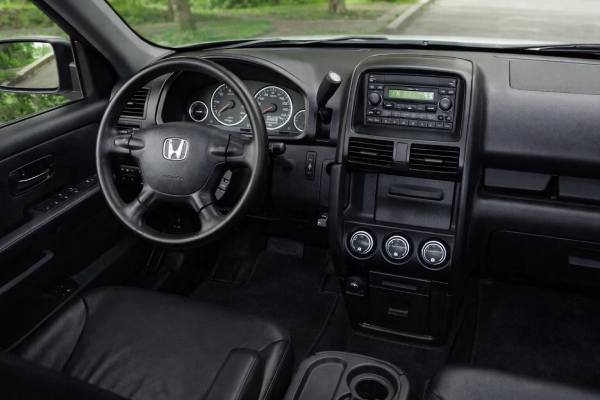
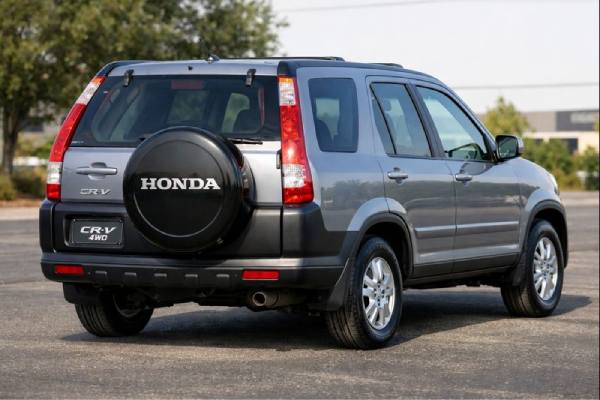
Honda’s second-generation CR-V with Real Time 4WD (RD7) is one of the most durable “do-it-all” compact SUVs of its era. The K24A1 2.4-liter engine is simple, understressed, and chain-driven, which helps long-term ownership—provided you keep oil quality high and fix small leaks early. The Real Time 4WD system is also pragmatic: it improves traction in rain, snow, and loose gravel without the cost and complexity of a full-time AWD layout.
Where this CR-V stands out is balance. It’s roomy for its footprint, easy to see out of, and tuned for comfort rather than sport. The trade-offs are typical for early-2000s crossovers: modest acceleration, limited driver-assistance technology, and safety performance that depends heavily on year and airbag equipment.
What to Know
- The K24A1 is a high-mileage engine when oil level is kept correct and service is consistent.
- Real Time 4WD helps in slippery conditions, but it’s traction support—not a low-range off-road system.
- Budget for rear differential fluid service if you notice tight-turn shudder or groaning.
- Typical engine oil interval: 8,000–10,000 km (5,000–6,000 mi) or 6 months, whichever comes first.
- For many owners, tyres and alignment have a bigger impact on stability than “upgrades.”
**Contents and shortcuts**
- RD7 Real Time 4WD explained
- K24A1 specs and measurements
- Trims, options, and safety equipment
- Issues, recalls, and fix strategy
- Maintenance plan and buyer checks
- Driving feel and real economy
- How it compares to rivals
RD7 Real Time 4WD explained
The 2002–2006 CR-V in Real Time 4WD form is built around a straightforward idea: run primarily as a front-wheel-drive vehicle, then send torque rearward only when the front wheels begin to slip. In day-to-day driving this keeps steering light, reduces driveline drag, and avoids the “always-on” feel of full-time AWD systems. When conditions worsen—wet leaves, packed snow, muddy grass—the system can improve stability and get you moving without drama.
Mechanically, this generation uses a rear differential assembly designed to engage the rear wheels under a front-to-rear speed difference. It’s not meant for rock crawling, deep ruts, or sustained wheelspin. Think of it as traction insurance for normal roads plus occasional rough access tracks. The system works best when all four tyres are close in circumference. If you run mismatched tyres, mix heavily worn with new, or drive long distances on a temporary spare, you can force the system to “think” there’s slip and create heat and wear.
What owners notice most is how “invisible” it is when healthy. There’s no low range, no driver-selectable modes, and no modern torque vectoring. It simply helps, then gets out of the way. That’s also why maintenance matters: the rear differential fluid is a service item, and ignored fluid changes can lead to tight-turn chatter or groaning. Many people misdiagnose this as a failing drivetrain when it can be corrected with the proper fluid and interval.
Advantages specific to the RD7 4WD layout include better launch traction on steep, slippery driveways, improved composure on fast wet highways, and less torque steer under heavy throttle compared with powerful FWD-only cars. The downsides are modest: a small weight increase, a minor fuel-economy penalty, and one more fluid service to keep on schedule. If you value predictable winter behavior more than maximum mpg, this CR-V configuration is one of the simplest “AWD-like” solutions Honda ever sold.
K24A1 specs and measurements
Below are practical, owner-relevant specifications for the 2002–2006 CR-V Real Time 4WD (RD7) with the K24A1 engine. Exact values can vary by market, trim, wheels, and transmission choice, so use these as a baseline and verify against your VIN-specific documentation when ordering parts or fluids.
Powertrain and efficiency (K24A1)
| Item | Specification |
|---|---|
| Engine code | K24A1 |
| Layout | Inline-4, i-VTEC, DOHC (market-dependent wording), 4 valves/cyl |
| Bore × stroke | 87.0 × 99.0 mm (3.43 × 3.90 in) |
| Displacement | 2.4 L (2,354 cc) |
| Induction | Naturally aspirated |
| Fuel system | PGM-FI (multi-point injection) |
| Compression ratio | ~9.6:1 |
| Max power | 160 hp (119 kW) @ ~5,500 rpm |
| Max torque | ~220 Nm (162 lb-ft) @ ~3,600 rpm |
| Timing drive | Chain |
| Rated efficiency (EPA reference) | ~11.2 L/100 km combined (21 mpg US) for typical 4WD automatic |
Real-world highway use at 120 km/h (75 mph) typically lands around 9.0–10.0 L/100 km (24–26 mpg US) in good mechanical condition, with a noticeable winter penalty in short-trip driving.
Transmission and driveline
| Item | Specification |
|---|---|
| Transmission | 4-speed automatic (common); 5-speed manual available in some markets/years |
| Drive type | Real Time 4WD (on-demand rear engagement) |
| Differentials | Front transaxle diff + rear differential (serviceable fluid) |
Chassis and dimensions
| Item | Specification |
|---|---|
| Suspension (front/rear) | MacPherson strut / trailing arm multi-link style rear |
| Brakes | 4-wheel disc on most markets; sizes vary by trim |
| Tyres (common baseline) | P205/70R15 |
| Length | 4,537 mm (178.6 in) |
| Width | 1,782 mm (70.2 in) |
| Height | 1,682 mm (66.2 in) |
| Wheelbase | 2,620 mm (103.1 in) |
| Track (front/rear) | 1,533 / 1,538 mm (60.4 / 60.6 in) |
| Fuel tank | 58 L (15.3 US gal / 12.8 Imp gal) |
Performance and capability (typical)
| Metric | Typical range |
|---|---|
| 0–100 km/h (0–62 mph) | ~9.8–11.0 s (transmission and trim dependent) |
| Top speed | ~175–185 km/h (109–115 mph) |
| Towing | Market dependent; many are modestly rated—verify local spec |
| Roof load | Market dependent; confirm with owner’s manual |
Fluids and service capacities (owner-useful)
| Fluid | Specification and capacity (typical) |
|---|---|
| Engine oil | 5W-20 or 5W-30 (market/climate dependent); 4.2 L without filter / 4.4 L with filter |
| Coolant | Honda-type long-life coolant; capacity varies by transmission |
| Automatic transmission fluid | Honda ATF; ~3.3 qt change (4WD), total varies |
| Rear differential fluid | Honda dual-pump fluid; ~1.1 qt change, ~1.3 qt total |
| A/C refrigerant | R-134a; 480–530 g (17.0–18.7 oz) |
Electrical basics
| Item | Specification |
|---|---|
| 12V battery (common) | ~36 Ah (5HR) / ~45 Ah (20HR), market dependent |
| Headlight bulb | H4/HB2 60/55 W (varies by market) |
Safety and assistance (era-appropriate)
| Category | What to expect |
|---|---|
| Airbags | Dual front airbags standard; side and curtain coverage depends on year/market/trim |
| Stability control | Often absent on early trims/markets; verify by VIN/trim |
| ADAS | No modern AEB/ACC/LKA; this is pre-ADAS era |
If you need a “one-glance” spec confirmation, prioritize: tyre size, brake hardware, transmission type, and whether your car has side/curtain airbags—those four points influence parts ordering and safety expectations the most.
Trims, options, and safety equipment
For the 2002–2006 CR-V, trim structure varies significantly by region, but the ownership-relevant differences tend to cluster around drivetrain pairing, interior convenience, and (most importantly) side-impact protection equipment. When you shop or verify a used RD7, treat “trim” as a shortcut—not proof of equipment. The same badge can hide different airbags, audio units, and even seat hardware depending on market.
Trims and equipment patterns that matter
Most regions offered a base trim and one or two higher grades. Typical upgrade steps included:
- Wheels and tyres: 15-inch wheels were common on base models; higher trims sometimes used larger wheels that sharpen steering but can worsen ride harshness on broken pavement.
- Climate and comfort: manual A/C vs automatic climate control; heated seats in colder markets; upgraded audio with steering-wheel controls.
- Interior practicality: rear privacy glass, roof rails, and cargo features (tie-downs, tray layouts) that affect daily use more than performance.
Real Time 4WD identifiers
Because this article focuses on Real Time 4WD (RD7), confirm you’re actually looking at the 4WD model:
- Look for rear differential and rear driveshaft hardware under the vehicle.
- Confirm 4WD-specific fluid service history (rear differential).
- Expect slightly higher curb weight and, in some markets, different gearing/tyre combinations.
Safety ratings and what they mean here
Early-2000s safety testing is not directly comparable to modern protocols, but it still reveals useful patterns:
- Frontal crash performance: This generation’s structure generally performs well in moderate-overlap style tests for its era.
- Side-impact protection: The biggest variable is whether the vehicle has side and curtain airbags. Some tests were conducted without optional side airbags, and later years in many markets moved to broader airbag coverage.
Safety systems and child-seat provisions
You’ll commonly see:
- Dual front airbags and seatbelt pretensioners.
- ISOFIX/LATCH-style anchors depending on market and year.
- ABS is common; traction control and stability control are inconsistent across early trims and regions.
There is essentially no modern ADAS suite here—no automatic emergency braking, adaptive cruise, or lane centering. Instead, safety relies on passive protection (structure, belts, airbags) and basic electronic aids (ABS, and sometimes traction control). If safety is your top priority, prioritize later build years and verify side/curtain airbags, then invest in excellent tyres—because in a pre-ADAS vehicle, grip is a safety feature you can still upgrade meaningfully.
Issues, recalls, and fix strategy
A well-kept RD7 is usually dependable, but it’s old enough that “age failures” matter as much as design weaknesses. A smart ownership strategy is to separate issues by (1) how often they happen and (2) how expensive they become if ignored.
Common issues (high prevalence)
- Rear differential shudder/groan on tight turns (low–medium cost):
Symptoms: chatter or binding feel during slow, tight parking maneuvers; sometimes a moan.
Likely cause: degraded or incorrect rear diff fluid; occasionally worn clutch packs in the rear unit if driven too long with bad fluid.
Remedy: drain-and-fill with the correct Honda-spec fluid; repeat if needed after short mileage. Confirm tyre matching. - A/C performance drop (medium cost):
Symptoms: weak cooling, compressor noise, intermittent clutch engagement.
Likely cause: compressor wear, clutch issues, leaks at seals/lines.
Remedy: leak test first; replace components based on findings, then evacuate and recharge to spec mass. - Suspension consumables (low–medium cost):
Symptoms: clunks over bumps, uneven tyre wear, wandering.
Likely cause: worn bushings, ball joints, links, strut mounts; alignment drift.
Remedy: replace worn joints/bushings, then align; don’t “align around” bad hardware.
Occasional issues (moderate prevalence)
- Oil seepage and VTEC-related gasket leaks (low cost if early):
Fix early to avoid oil on mounts and belts and to keep oil level stable. - Power steering hose seepage (medium):
Leaks can make a mess and damage rubber components; address before the pump runs low. - EVAP and check-engine lights (low–medium):
Often sensor/canister/valve related; diagnosis beats parts guessing.
Rare but costly if neglected
- Overheat damage from cooling system neglect (high):
Radiator, thermostat, cap, and old coolant can turn into a head gasket risk if ignored. Preventive cooling service is cheaper than a rebuild.
Recalls, TSBs, and completion checks
For 2002–2006 Hondas, recall history can include major safety campaigns (airbags and other safety components depending on region). The key is not memorizing campaigns—it’s verifying completion:
- Run an official VIN check and save the results.
- Ask for dealer printouts or service history showing recall work completed.
- If the seller cannot document it, treat it as “not done” and price accordingly.
Because this CR-V is pre-ADAS, “software updates” are limited compared with modern vehicles. Still, correct ECU calibration and proper idle/throttle behavior after battery work can matter. When you inherit a neglected example, prioritize: fluids (engine, transmission, rear diff, brake), cooling system health, and tyres. That sequence prevents the expensive failures that usually sour ownership.
Maintenance plan and buyer checks
A long-lived RD7 is usually the result of boring habits: clean oil, correct fluids, and catching leaks early. Use the schedule below as a practical baseline, then adjust for climate and use (short trips, heavy city driving, frequent hills, or towing).
Practical maintenance schedule (distance/time)
- Engine oil and filter: every 8,000–10,000 km (5,000–6,000 mi) or 6 months.
Check oil level monthly; K-series engines tolerate age well when oil never runs low. - Air filters:
Engine air filter every 20,000–30,000 km (sooner in dusty areas).
Cabin filter every 15,000–25,000 km or annually. - Coolant: typically 5 years / 100,000 km, then every 3 years / 60,000 km (confirm your coolant type and market guidance).
Inspect radiator tanks and hoses at each coolant interval. - Spark plugs: commonly 160,000 km (100,000 mi) for long-life plugs, but verify plug type and service history.
If you feel misfires under load, diagnose coils and plugs together. - Automatic transmission fluid: drain-and-fill every 40,000–60,000 km for mixed use; shorter if driven hard or in heat.
Avoid universal fluids unless explicitly approved for your Honda specification. - Rear differential fluid (Real Time 4WD): every 30,000–40,000 km (or sooner if you feel tight-turn chatter).
This single service prevents many “4WD is failing” complaints. - Brake fluid: every 2 years, regardless of mileage.
Brake hoses and calipers are age-sensitive. - Tyre rotation and alignment: rotate every 8,000–10,000 km; align annually or whenever tyres wear unevenly.
Keep all four tyres closely matched in tread depth. - 12V battery testing: test annually after year 4; replace on condition (cold starts, voltage drop).
Fluid specs and capacities (decision-making quick list)
- Engine oil capacity: about 4.4 L with filter (baseline).
- Fuel tank: 58 L.
- Rear differential: about 1.1 qt drain-and-fill (4WD).
- A/C refrigerant: 480–530 g of R-134a.
Essential torque values (verify by manual for your VIN)
For common service work, typical Honda-era torque anchors include wheel nuts and drain plugs. Because exact values vary by wheel and component, treat these as “sanity checks,” not final authority, and confirm before applying force.
Buyer’s guide: what to inspect first
- Cold start: listen for chain rattle (brief is normal; persistent is not), check idle stability.
- Cooling system: look for crusted coolant at the radiator end tanks, damp hoses, and weak heat (air pockets/thermostat).
- 4WD behavior: perform slow tight circles in a parking lot; any binding suggests rear diff fluid or tyre mismatch.
- Transmission: smooth engagement, no flare, no harsh 2–3 shifts; inspect fluid condition.
- Rust and structure: focus on subframes, suspension mounting points, and brake lines (climate dependent).
- Service records: evidence of regular oil changes, transmission service, and rear diff fluid changes.
Long-term durability outlook: if you buy one that’s already been kept on fluids and cooling system maintenance, it can remain a low-drama vehicle for years. If you buy a neglected one, budget upfront for “baseline service” and you’ll usually recover the cost in reliability.
Driving feel and real economy
The RD7 CR-V is tuned for confidence and comfort, not sharp performance. Visibility is strong, seating is upright, and the suspension favors compliance over cornering bite. Around town it feels light on its feet for an SUV, and on the highway it tracks steadily—especially when the suspension is tight and tyres are good. The most common reason these feel “old” is not the basic design; it’s worn bushings, tired dampers, and overdue alignment.
Ride, handling, and NVH (noise, vibration, harshness)
- Ride: generally forgiving over potholes and expansion joints, though worn struts can make it floaty.
- Steering: accurate but not talkative; expect a calm, slightly light feel rather than sporty feedback.
- Braking feel: predictable, but pedal firmness depends on fluid age and caliper condition.
- Cabin noise: wind and road noise are noticeable at modern highway speeds, and tyres make a big difference.
Powertrain character
The K24A1 delivers usable low-end torque and an easy midrange, which suits daily driving. It’s not fast, but it’s consistent. Automatics can feel busy on hills because of gear spacing; manual versions (where available) often feel more responsive in passing maneuvers. Throttle response is generally smooth, and the engine is happy cruising at moderate rpm when maintained.
Real-world efficiency (and what changes it)
Using EPA-era estimates as a reference point for this generation, a typical 4WD CR-V is around 11.2 L/100 km combined (21 mpg US). Owners often see:
- City-heavy use: ~12.0–13.5 L/100 km (17–20 mpg US), worse in winter and short trips.
- Highway 100–120 km/h: ~9.0–10.0 L/100 km (24–26 mpg US) depending on wind, tyres, and load.
- Mixed commuting: ~10.5–12.0 L/100 km (20–22 mpg US).
Biggest real-world factors are tyre choice/pressure, alignment, stuck brake calipers, and old oxygen sensors. If fuel economy has fallen sharply, don’t assume it’s “just age.” Check tyre pressures, scan for pending codes, verify thermostat behavior (engine reaching proper temperature), and confirm the brakes aren’t dragging.
Traction behavior
Real Time 4WD is best viewed as stability support. In rain and snow, it helps reduce front-wheel spin and keeps the vehicle calmer during takeoff and lane changes. It is not designed for prolonged wheelspin or deep off-road use. If you need serious trail capability, you’ll want a different platform. If you want a compact SUV that behaves predictably on bad winter roads, the RD7 nails that goal when the rear diff fluid and tyres are correct.
How it compares to rivals
In the early 2000s compact SUV class, the CR-V’s main rivals were not “better” across the board—they were better at different things. Understanding those trade-offs helps you judge whether an RD7 is the right buy today.
Toyota RAV4 (early-2000s)
- Strengths: efficient packaging, strong reliability reputation, often slightly better fuel economy.
- Trade-offs: road feel can be more car-like but sometimes harsher; equipment varies widely.
- CR-V advantage: the K24A1’s torque and the CR-V’s interior practicality often feel more “useful” for daily hauling.
Subaru Forester
- Strengths: full-time AWD, strong snow-road confidence, lower center of gravity.
- Trade-offs: more complex AWD driveline, engine layout and service accessibility differences, and potential ownership costs depending on condition.
- CR-V advantage: simpler driveline behavior and usually lower maintenance complexity for general repairs.
Nissan X-Trail and similar (market dependent)
- Strengths: often good value, flexible interiors, sometimes better feature content per price.
- Trade-offs: long-term durability depends heavily on exact drivetrain and maintenance history; parts availability can vary by region.
- CR-V advantage: broader support ecosystem and a strong track record for high-mileage survival.
Ford Escape and Mazda Tribute (platform mates in many markets)
- Strengths: sometimes punchier V6 options, more “American” ride/steering feel, abundant used supply in certain regions.
- Trade-offs: powertrain complexity and fuel use can be higher; condition varies dramatically.
- CR-V advantage: steady efficiency, durable four-cylinder layout, and generally easier long-term ownership when maintained.
Mitsubishi Outlander (early years)
- Strengths: often good pricing and family-friendly space.
- Trade-offs: drivetrain variations matter; some versions age better than others.
- CR-V advantage: fewer “unknowns” in the K24A1 + Real Time 4WD formula.
Bottom line: the RD7 CR-V Real Time 4WD is rarely the most exciting option, but it’s often the most rational. If you prioritize predictable traction, a simple and durable engine, and an ownership profile built around routine fluids rather than frequent surprises, it remains one of the safest bets in the used compact-SUV space—especially when you buy based on condition and service history rather than trim badges.
References
- 2002 Honda CR-V 4-door SUV 2026 (Safety Rating)
- Gas Mileage of 2005 Honda CR-V 2025 (Fuel Economy Database)
- Vehicle Detail Search – 2005 HONDA CR-V 4 DR | NHTSA 2026 (Recall Database)
- Honda CR-V | Safety Rating and Report | ANCAP 2026 (Safety Rating)
Disclaimer
This article is for informational purposes only and is not a substitute for professional diagnosis, inspection, or repair. Specifications, torque values, service intervals, and procedures can vary by VIN, market, drivetrain, and installed equipment. Always verify details using your official owner’s manual, factory service information, and labeling on your specific vehicle.
If you found this guide useful, consider sharing it on Facebook, X (Twitter), or your favorite forum to help others maintain their CR-V and to support our work.