

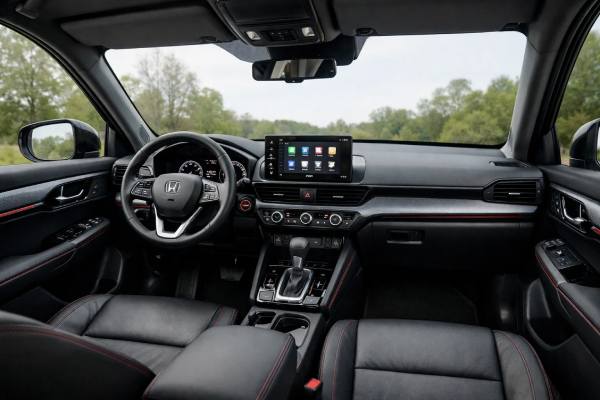

The 2023–present Honda CR-V RS4 Real Time AWD with the 1.5-liter turbo (L15BE) is built for people who want a calm daily driver that still feels engineered—quiet structure, predictable controls, and an all-weather drivetrain that asks little from the owner. This version uses Honda’s small turbo four for strong low- and mid-speed pull, paired with a CVT tuned for smoothness rather than “sport” drama. The Real Time AWD system is primarily front-driven, then sends torque rearward when the fronts slip, which keeps fuel use reasonable while improving wet and winter traction.
Ownership is mostly about staying ahead of fluids (especially the rear diff on AWD models) and keeping sensors and calibrations happy as driver-assistance systems become more involved. If you service it on time and avoid neglected tires, this CR-V tends to reward you with low fuss and solid long-term usability.
What to Know
- Real Time AWD adds confidence on wet roads and light snow without the fuel penalty of a full-time system.
- The 1.5T delivers usable torque for passing and hills, especially in the 30–100 km/h range.
- Cabin comfort and noise control are a core strength; it’s an easy long-distance crossover.
- Plan on more frequent rear differential fluid service than many owners expect, especially with short trips.
- Rotate tires every 8,000–10,000 km (5,000–6,000 mi) to protect AWD driveline behavior and tire life.
Contents and shortcuts
- RS4 AWD ownership overview
- L15BE AWD specifications
- Trims, packages, and driver assist
- Reliability issues and service actions
- Maintenance plan and buyer checklist
- Real-world driving and efficiency
- RS4 CR-V vs main rivals
RS4 AWD ownership overview
Think of the RS4 Real Time AWD CR-V as a front-drive crossover that can “call in help” when conditions demand it. In normal cruising, most torque stays at the front wheels for efficiency and predictable steering. When the fronts slip—pulling away on wet pavement, climbing a snowy driveway, or accelerating out of a tight corner on a cold road—the AWD coupling engages to send torque to the rear axle. It is not a rock-crawling system and it does not replace winter tires, but it does reduce wheelspin and the constant traction-control intervention that can make a 2WD crossover feel busy.
The L15BE 1.5-liter turbo is the other big character trait. Honda’s small turbo engines are tuned to feel strong in the middle of the rev range where people actually drive. That means steady, confident passing at highway speeds and less need to “floor it” around town. The CVT’s job is to keep the engine in its most effective band with minimal noise and minimal shifting sensation. Owners who come from traditional automatics usually adapt quickly if they treat the throttle like a volume knob, not an on/off switch.
From a packaging standpoint, the current CR-V generation is one of the roomiest in its class for day-to-day use. The driving position is upright with good sightlines, the doors open wide, and the cargo area is shaped for real objects rather than just numbers. It also benefits from a stiffer body shell and more mature suspension tuning than many compact SUVs, which shows up as fewer squeaks over time and less fatigue on rough roads.
Where owners get caught out is usually “small stuff” that becomes expensive if ignored: mismatched tires on AWD vehicles, overdue fluids, and sensor issues after windshield or bumper work. This is a modern crossover with radar and camera-based assistance; when you replace glass, align wheels, or do front-end repairs, you should budget for proper calibration and test drives—especially if warning lights appear.
L15BE AWD specifications
Below are practical, owner-focused specs for the 2023–present CR-V RS4 Real Time AWD with the 1.5T. Some values vary by market, trim, and wheel/tire package, so treat the tables as a strong baseline and confirm with VIN-specific documentation.
Powertrain and efficiency
| Item | Specification |
|---|---|
| Code | L15BE |
| Engine layout and cylinders | Inline-4, DOHC, 4 valves/cyl |
| Displacement | 1.5 L (1,498 cc) |
| Bore × stroke | 73.0 × 89.4 mm (2.87 × 3.52 in) |
| Induction | Turbocharged |
| Fuel system | Direct injection |
| Compression ratio | 10.3:1 (typical for this family) |
| Max power | 190 hp (142 kW) (market-dependent rpm rating) |
| Max torque | ~243 Nm (179 lb-ft) (typical class output; verify by market) |
| Timing drive | Chain |
| Rated efficiency (example EPA, AWD 1.5T) | ~8.1 L/100 km (29 mpg US / 35 mpg UK) combined |
| Real-world highway @ 120 km/h | Often 7.4–8.2 L/100 km (29–32 mpg US) depending on wind, tires, and load |
| Aerodynamics | Cd and frontal area vary by trim; not typically published in owner-facing documents |
Transmission and driveline
| Item | Specification |
|---|---|
| Transmission | CVT (Honda; code varies by market/VIN) |
| Drive type | Real Time AWD (on-demand) |
| Differential | Open (front and rear) |
Chassis and dimensions (typical)
| Item | Specification |
|---|---|
| Suspension (front/rear) | MacPherson strut / multi-link |
| Steering | Electric power steering (ratio varies by spec) |
| Brakes | 4-wheel discs (diameters vary by trim) |
| Wheels/tires | Common: 235/60 R18 or 235/55 R19 (market/trim dependent) |
| Ground clearance | ~208 mm (8.2 in) (varies by market) |
| Length / width / height | ~4,706 / 1,866 / 1,681 mm (~185.3 / 73.5 / 66.2 in) |
| Wheelbase | ~2,701 mm (106.3 in) |
| Turning circle (kerb-to-kerb) | ~11.0 m (36 ft) |
| Kerb weight | commonly 1,600–1,680 kg (3,530–3,700 lb) depending on trim |
| Fuel tank | ~53 L (14.0 US gal / 11.7 UK gal) |
| Cargo volume | Approx. 1,110 L (39 cu ft) seats up / 2,160 L (76 cu ft) seats down (SAE-style) |
Performance and capability (realistic expectations)
| Item | Specification |
|---|---|
| 0–100 km/h (0–62 mph) | typically ~9.0–10.0 s (trim, tires, conditions) |
| Top speed | typically limited around ~180 km/h (112 mph) |
| Braking 100–0 km/h | often ~36–40 m on quality all-season tires |
| Towing capacity | commonly ~680 kg (1,500 lb) (check market rating) |
| Roof load | market-dependent; confirm in owner literature |
Fluids and service capacities (common service reality)
| Item | Typical spec (verify by VIN) |
|---|---|
| Engine oil | 0W-20, API SP/ILSAC GF-6; ~3.7 L (3.9 US qt) with filter |
| Coolant | Honda long-life (Type 2 equivalent); capacity varies |
| CVT fluid | Honda CVT fluid (market-specific); capacity varies (drain/fill less than total) |
| Rear differential (AWD) | Honda Dual Pump style fluid (market-specific); ~1.1–1.3 L |
| A/C refrigerant | Often R-1234yf; charge varies by spec |
| Key torque specs | Wheel nuts commonly ~135 Nm (100 lb-ft) (confirm for your wheels) |
Electrical
| Item | Typical spec |
|---|---|
| 12V battery | Usually 45–60 Ah (size and CCA vary by trim) |
| Spark plugs | Iridium long-life type; gap often ~0.8 mm (0.031 in) |
Safety and driver assistance (headline)
- Modern CR-Vs score strongly in global testing when equipped as tested, and the driver-assistance suite is designed around forward AEB, lane support, and adaptive cruise. (Exact ratings depend on year, region, and equipment.)
Trims, packages, and driver assist
CR-V trim names vary by country, but the ownership decision usually comes down to three things: wheel size (ride comfort and tire cost), lighting (night visibility and safety scores), and the exact driver-assistance feature set. For the RS4 AWD 1.5T, you’re typically looking at mainstream grades rather than the hybrid-focused top trims in some markets, but equipment still changes meaningfully.
Quick trim and option cues that matter
- Wheels and tires: 18-inch packages generally ride better and cost less to maintain; 19-inch packages can look sharper but are more sensitive to potholes and tend to be noisier as tires age.
- Headlights: Higher trims often add stronger low-beam performance or adaptive elements. This can influence safety outcomes in some testing programs and, more importantly, your real night driving.
- Driver seat and comfort: Power seat adjustments, lumbar support, and heated features are “quality of life” options that matter more than many people expect on long ownership cycles.
Mechanical or functional differences by trim
Most RS4 AWD models share the same core hardware: the L15BE turbo, CVT, and the same AWD concept. Differences are more about calibration and rolling stock than hard parts. Still, a few mechanical details can shift the experience:
- Tire compound and width can change braking feel, wet traction, and even how often the AWD coupling has to work.
- Brake hardware is usually consistent, but pad compound and wheel/tire grip can change stopping distances more than the calipers themselves.
- Tow rating is often a paperwork limit tied to cooling, tires, and regional regulations—never assume towing capacity is the same across markets.
Safety ratings and what they mean for you
Safety ratings are not “one number forever.” They depend on test year, protocol version, and equipment on the tested car. For Europe, the latest-generation CR-V has been evaluated with a defined equipment configuration (“safety pack” language matters). In the U.S., IIHS recognition can depend on the exact headlight grade and whether certain crash-avoidance features are standard across trims.
Practical takeaway: if you care about safety ratings, match the tested configuration as closely as possible—especially lighting and any optional safety packages. When shopping used, verify the presence of front radar/camera systems and check that warning lights are not present at start-up.
ADAS and calibration implications after service
Modern CR-V driver assistance typically includes:
- AEB (car/pedestrian/cyclist depending on market)
- Adaptive cruise control and traffic-follow support
- Lane keeping / lane centering functions
- Traffic sign recognition in many regions
- Blind spot monitoring and rear cross-traffic alert (often trim-dependent)
If the windshield is replaced, the front bumper is repainted, or alignment is performed, the vehicle may require recalibration. Symptoms include false warnings, lane assist that “hunts,” or cruise control that disengages unexpectedly. The best ownership habit is simple: after any glass or front-end work, do a clean highway drive and confirm the system behaves normally before you call the job “done.”
Reliability issues and service actions
Overall reliability for the 1.5T AWD CR-V tends to be strong when serviced correctly, but the most important issues are patterns—things that show up often enough to plan for. Below is a practical map by prevalence and cost tier, with symptoms and the “what to do next” guidance an owner can actually use.
Common (low to medium cost) patterns
- Rear differential fluid deterioration (AWD):
- Symptoms: Groan, chatter, or vibration during tight low-speed turns; sometimes feels like “tire scrub.”
- Likely cause: Old or contaminated rear diff fluid; the AWD coupling works hard on short trips and with mismatched tires.
- Remedy: Drain and refill with the correct AWD fluid; repeat if heavily degraded. Prevent by servicing on schedule and keeping all four tires matched.
- CVT behavior changes with age:
- Symptoms: Shudder on light acceleration, “rubber band” feel getting worse, or inconsistent ratio changes.
- Likely cause: CVT fluid aging, plus driving style and heat.
- Remedy: Proper CVT fluid service (correct fluid only), then evaluate. Avoid aggressive launches and heavy towing beyond rating.
- Direct-injection intake deposits (occasionally noticeable):
- Symptoms: Rough cold idle, reduced smoothness, or misfire codes at higher mileage.
- Likely cause: Direct injection can allow deposits on intake valves over time, especially with lots of short trips.
- Remedy: Confirm ignition and fuel system health first; if deposits are confirmed, consider a professional intake valve cleaning at higher mileage.
Occasional (medium cost) issues
- Turbo and charge-air system leaks:
- Symptoms: Loss of boost, whooshing noise, reduced power, or underboost codes.
- Likely cause: Loose clamp, aging hose, or minor intercooler/pipe leak.
- Remedy: Smoke test and repair the leak; avoid “parts darts.”
- PCV and oil seepage concerns:
- Symptoms: Oil smell, light seepage near seals, or elevated oil consumption.
- Likely cause: Crankcase ventilation issues or normal aging of seals.
- Remedy: Inspect PCV system and seals; keep oil changes consistent.
Rare but higher impact items
- Steering, sensor, or electronic faults tied to updates:
- Symptoms: Repeated warning lights, ADAS faults, intermittent no-start, or infotainment glitches.
- Likely cause: Software bugs, sensor alignment issues, or module communication faults.
- Remedy: Check for ECU/ADAS software updates and technical service actions; insist on proper diagnostics before parts replacement.
Electrified-system notes (not applicable here)
This RS4 is not a hybrid variant, so you don’t have high-voltage battery aging or e-motor hardware. That is an ownership simplifier compared with hybrid trims.
Recalls and TSBs: how to stay safe
Don’t rely on memory or internet lists—recall status changes. The right approach is:
- Run your VIN in the official recall lookup tool for your country.
- Ask the dealer for completion proof in service records.
- Confirm any ADAS-related actions were followed by calibration where required.
Maintenance plan and buyer checklist
The CR-V RS4 AWD rewards routine. If you keep fluids fresh and tires matched, the drivetrain usually stays quiet and smooth. Use the schedule below as a practical baseline, then align it with your local Honda maintenance guidance and your driving conditions.
Practical maintenance schedule (distance/time)
- Engine oil and filter: every 10,000–12,000 km (6,000–7,500 mi) or 12 months, sooner for short trips, very cold climates, or heavy traffic. Use the correct 0W-20 spec and keep receipts.
- Tire rotation: every 8,000–10,000 km (5,000–6,000 mi). On AWD models, this is not optional—mismatched rolling diameter can stress the coupling.
- Cabin air filter: every 20,000–25,000 km or 12 months if you drive in dusty cities.
- Engine air filter: typically 30,000–40,000 km, sooner in dust.
- Brake fluid: every 3 years regardless of mileage.
- Coolant: often 10 years / 200,000 km first interval, then 5 years / 100,000 km (confirm for your market).
- Spark plugs: commonly 160,000 km (100,000 mi) for long-life iridium types.
- CVT fluid: every 40,000–60,000 km (25,000–40,000 mi) for severe use; longer for gentle highway use, but don’t stretch it if you plan to keep the car.
- Rear differential fluid (AWD): commonly every 30,000–50,000 km, and sooner if you do lots of short trips, mountain driving, or winter use.
- Timing chain: no routine replacement interval; inspect if you hear cold-start rattle, see timing correlation faults, or if oil changes were neglected.
- 12V battery test: yearly after year three; typical replacement window 4–6 years depending on climate.
Fluids and “decision-making” specs (owner-friendly)
- Oil: 0W-20 meeting modern API/ILSAC standards; don’t substitute heavier grades unless Honda guidance allows it for your region.
- CVT: use the exact Honda-approved CVT fluid for your market; generic “CVT fluid” can create shudder or accelerated wear.
- AWD rear diff: use the specified AWD/differential fluid (often Dual Pump style); wrong fluid is a common cause of low-speed noise after service.
Buyer’s guide: what to check before purchase
Service history must-haves
- Evidence of oil changes at sensible intervals.
- Proof of rear diff service (AWD) if the car has meaningful mileage.
- Any CVT fluid service on higher-mile examples.
Physical checks
- Tires: confirm all four match in brand, model, size, and similar tread depth.
- Test drive: do several slow full-lock turns in a parking lot; listen for groan or binding.
- Brakes: check for vibration or pulsation at moderate braking.
- Electronics: verify no persistent ADAS warnings; ensure lane and cruise features behave normally.
Best ownership picks
- If you value comfort and long-term costs, lean toward 18-inch wheel packages and proven all-season tires.
- If you drive rural roads at night, prioritize the best headlight package available in your market.
Long-term durability outlook: treat AWD and CVT fluids as “real maintenance,” not lifetime fill, and the CR-V typically stays predictable and inexpensive to live with.
Real-world driving and efficiency
On the road, the RS4 AWD CR-V is tuned to feel calm. The suspension takes the edge off broken pavement without the floaty after-bounce you get in some softer crossovers. Steering is light at parking speeds and steadier at highway speeds, with more focus on stability than feedback. That’s the right trade for a family crossover: fewer corrections in crosswinds, less fatigue on long trips, and a chassis that doesn’t feel nervous on rough roads.
Powertrain character: what it feels like daily
The 1.5T’s best feature is usable torque at normal speeds. In city driving, it steps away cleanly without needing high rpm, and on the highway it handles 80–120 km/h passing without dramatic downshifts. The CVT keeps the engine in its working zone, which makes acceleration smooth but can make the engine note more constant under heavy throttle. Owners who want the quietest experience get the best results by using moderate throttle and letting the turbo do the work rather than forcing high revs.
Drive modes (where offered) typically change throttle mapping and sometimes steering weight. They don’t transform the vehicle, but they can make it feel either more relaxed (better for commuting) or more responsive (better for merging).
Real-world efficiency: what to expect
Fuel economy depends heavily on speed, tires, and temperature:
- City-heavy driving: often 8.7–10.2 L/100 km (23–27 mpg US / 28–33 mpg UK), especially in winter or with short trips.
- Highway at 100–120 km/h: often 7.4–8.2 L/100 km (29–32 mpg US / 35–39 mpg UK).
- Mixed driving: many owners land around 8.1–9.0 L/100 km (26–29 mpg US / 31–35 mpg UK).
Cold weather usually costs you the most: thicker fluids, winter fuel blends, and more cabin heat demand. If your trips are under 8–10 km, you’ll also spend more time in warm-up, which hurts consumption and can accelerate fluid degradation.
AWD behavior and traction control
Real Time AWD is most noticeable at low speeds on slick surfaces. It reduces front wheelspin and helps the car track straighter when pulling away uphill. It does not feel like a rear-biased performance AWD system, and it will still use traction control when needed. Your biggest “traction upgrade” is still tires: quality winter tires in winter climates and a strong wet-grip all-season or summer tire elsewhere.
Load and towing
Within its rating, the CR-V stays stable, but towing and roof loads increase heat and consumption. Expect a meaningful economy penalty—often 15–30% depending on speed and terrain—and plan more frequent fluid service if you tow regularly.
RS4 CR-V vs main rivals
The compact SUV class is crowded, so the smartest comparison is not “best overall,” but “best fit for your priorities.” Here’s how the CR-V RS4 AWD 1.5T typically stacks up.
Versus Toyota RAV4 (gas or hybrid)
- CR-V advantage: quieter ride, more polished road manners, and a cabin that often feels more relaxed at speed.
- RAV4 advantage: hybrid fuel economy and long-running powertrain reputation in many markets.
- Choose CR-V if comfort and daily refinement matter more than maximizing mpg.
Versus Mazda CX-5 / CX-50
- CR-V advantage: interior space efficiency and a softer, more family-friendly ride.
- Mazda advantage: more steering feel and a more “driver’s car” vibe; some prefer the traditional automatic behavior.
- Choose CR-V if you carry people and cargo often and want easy comfort.
Versus Hyundai Tucson / Kia Sportage
- CR-V advantage: conservative, proven layout with strong resale and a less “tech-first” learning curve.
- Korean rivals advantage: feature-per-dollar and often larger screens and convenience tech for the money.
- Choose CR-V if you value predictable long-term ownership and simpler trim decisions.
Versus Subaru Forester
- CR-V advantage: stronger torque feel from the turbo and typically better cabin isolation from road noise.
- Forester advantage: symmetrical full-time-style AWD feel and excellent outward visibility.
- Choose CR-V if you want quieter refinement and stronger passing power; choose Forester if you prioritize AWD feel and visibility.
Versus Nissan Rogue
- CR-V advantage: a more established powertrain character and typically steadier long-term confidence in drivetrain feel.
- Rogue advantage: comfortable seats and strong efficiency in some trims.
- Choose CR-V if you plan to keep the vehicle a long time and want a conservative, repeatable maintenance story.
Bottom-line positioning
The RS4 AWD CR-V’s “win” is balance: enough power, enough traction help, strong comfort, and few surprises if you maintain it properly. If your top goal is fuel economy, a hybrid rival may beat it. If your top goal is sporty feel, Mazda is often the benchmark. But if you want a compact SUV that behaves the same on a random Tuesday as it does on a long road trip, the CR-V remains one of the safest bets—especially when you stay disciplined about tires and fluids.
References
- Honda CR-V 2024 (Safety Rating)
- 2024 TOP SAFETY PICKs 2024 (Safety Rating)
- 2023 Honda CR-V 2023 (Fuel Economy Data)
- NHTSA Launches New Recalls Lookup Tool 2025 (Recall Database)
Disclaimer
This article is for informational purposes only and is not a substitute for professional diagnosis, inspection, or repair. Specifications, torque values, service intervals, and procedures can vary by VIN, market, model year, and equipment, so always verify details using your official owner’s manual and service documentation for your exact vehicle.
If this guide helped, please consider sharing it on Facebook, X (Twitter), or your favorite forum/community to support our work.