

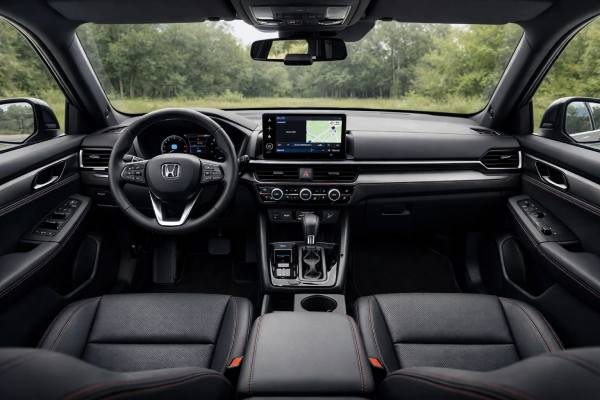
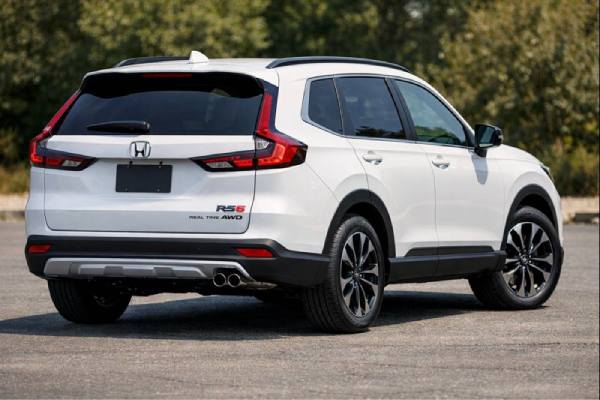
Honda’s sixth-generation CR-V in Real Time AWD hybrid form (RS6) is built around a simple promise: family-SUV space with a powertrain tuned for everyday efficiency rather than headline speed. The LFC1 2.0-liter hybrid system prioritizes smooth, electric-first driving in town, then uses the gasoline engine mainly as an energy source under light to moderate loads—an approach that tends to feel calm and predictable once you understand it. The Real Time AWD hardware adds traction confidence for rain, gravel, and winter roads without turning the CR-V into an off-road SUV, and it does so with relatively low owner complexity compared with some dual-motor AWD hybrids.
This guide focuses on what matters to owners: the exact specs and dimensions you’ll compare at purchase time, how the hybrid behaves in real driving, what commonly needs attention, and how to maintain it for long service life.
Owner Snapshot
- Smooth, quiet city driving with frequent electric running and gentle hybrid transitions.
- Real Time AWD adds wet and winter traction without major driver involvement.
- Practical cargo space and rear-seat comfort suit daily family use and long trips.
- Hybrid hardware is generally durable, but software updates and 12 V battery health matter.
- Plan on engine oil service about every 12 months or 10,000–15,000 km (6,000–9,000 miles), depending on your maintenance minder and use.
What’s inside
- CR-V RS6 AWD hybrid overview
- LFC1 AWD specs and dimensions
- Trims, options, and safety tech
- Reliability issues and service actions
- Maintenance plan and buying advice
- Real-world driving and efficiency
- How it stacks up against rivals
CR-V RS6 AWD hybrid overview
The RS6 Real Time AWD CR-V Hybrid is best understood as an “electric-drive SUV with a gasoline range extender” most of the time. In many conditions, the 2.0-liter engine runs to generate electricity, and the traction motor does the actual driving. At higher steady speeds, a clutch can couple the engine more directly to the wheels to reduce conversion losses. The result is a powertrain that feels strong at low speeds, stays smooth in stop-and-go traffic, and avoids the stepped shift behavior people associate with conventional automatics.
Real Time AWD in this CR-V is aimed at traction, not rock crawling. It is designed to send torque rearward when the front tires slip or when the system predicts the need for extra grip (for example, brisk launches on wet pavement). For owners, the practical advantage is confidence: less wheelspin pulling out of junctions in rain, more stability on snowy commutes, and fewer traction-control interventions when the road surface changes mid-corner. The trade-off is modest extra weight and a small efficiency penalty versus FWD.
From a packaging standpoint, the CR-V’s appeal is unchanged: a tall roofline, a wide rear door opening, and cargo volume that remains competitive even with the hybrid battery. Many markets quote about 587 liters (VDA, seats up) for the hybrid, with a much larger figure when loaded to the roof with rear seats folded—useful context when comparing brochures that measure differently.
Ownership character is also shaped by the “calmness” of the chassis. The CR-V typically rides with a slightly soft initial stroke, keeping rough city surfaces from feeling harsh, and the body control is tuned for predictable, safe behavior rather than sporty rotation. If you value quiet highway cruising, stable lane tracking, and a driving position that’s easy to live with every day, the RS6 hybrid tends to fit the brief.
Key advantages you’ll notice quickly:
- Electric torque for effortless urban acceleration.
- AWD traction support without complicated driver controls.
- A modern ADAS (driver-assistance) suite that can reduce fatigue—when kept correctly calibrated.
LFC1 AWD specs and dimensions
Specs can vary by market, trim, and test cycle. The tables below reflect commonly published figures for the 2023–present CR-V Hybrid with Real Time AWD and a 2.0-liter hybrid system, and they highlight the numbers that most affect ownership decisions.
Powertrain and efficiency (Hybrid AWD)
| Item | Specification |
|---|---|
| Code | LFC1 (2.0-liter hybrid system) |
| Engine layout and cylinders | Inline-4, DOHC, 16-valve (4 valves/cyl) |
| Bore × stroke | ~81.0 × 96.7 mm (3.19 × 3.81 in) |
| Displacement | 2.0 L (1,993 cc) |
| Induction | Naturally aspirated |
| Fuel system | Direct injection (market-dependent) |
| Compression ratio | High (Atkinson-cycle style; varies by market) |
| Traction motor output | 184 hp (135 kW) (often quoted as motor output) |
| Traction motor torque | 335 Nm (247 lb-ft) |
| Engine output (typical published) | 148 hp (109 kW) |
| Timing drive | Chain (typical for this family; verify by VIN) |
| Rated efficiency (example) | 6.7 L/100 km (≈35.1 mpg US / 42.2 mpg UK) |
| Real-world highway @ 120 km/h | Often ~7.2–8.0 L/100 km depending on tires, temperature, and wind |
Transmission and driveline
| Item | Specification |
|---|---|
| Transmission | eCVT-style hybrid drive (single-speed electric drive with clutch coupling at cruise) |
| Drive type | Real Time AWD (on-demand) |
| Differential | Open (traction managed by brake-based torque vectoring and AWD coupling) |
Chassis and dimensions (typical published)
| Item | Specification |
|---|---|
| Suspension (front/rear) | MacPherson strut / multi-link |
| Steering | Electric power steering; ~2.4 turns lock-to-lock |
| Brakes | 4-wheel discs (front ventilated); rotor diameters vary by market/wheel package (commonly ~320–330 mm front, ~300–310 mm rear) |
| Wheels/tires (common) | 235/60 R18 (18 in rim) |
| Ground clearance | 159 mm (6.3 in) |
| Length / width / height | 4,706 / 1,866 / 1,673 mm (185.3 / 73.5 / 65.9 in) |
| Wheelbase | 2,700 mm (106.3 in) |
| Turning circle (kerb-to-kerb) | 11.1 m (36.4 ft) |
| Kerb (curb) weight | ~1,853 kg (4,085 lb) |
| GVWR | ~2,400 kg (5,291 lb) |
| Fuel tank | 57 L (15.1 US gal / 12.5 UK gal) |
| Cargo volume (typical, VDA) | ~587 L seats up; up to ~1,710 L seats down to roof (market measurement dependent) |
Performance and capability (typical published)
| Item | Specification |
|---|---|
| 0–100 km/h (0–62 mph) | ~9.5 s |
| Top speed | ~187 km/h (116 mph) |
| Braking distance | Tire and surface dependent; expect ~36–41 m from 100–0 km/h with good tires |
| Towing capacity | Up to ~750 kg (1,653 lb) (market-dependent) |
| Roof load | Commonly ~75 kg (165 lb) (verify by market) |
Fluids and service capacities (verify by VIN/market)
Because published service capacities vary by market, use these as planning numbers only:
- Engine oil: 0W-20 (typical Honda spec), roughly 3.5–4.0 L (3.7–4.2 US qt) with filter.
- Coolant: Honda-type long-life coolant; capacity varies by system layout.
- AWD rear differential: dedicated Honda fluid; capacity is small but service is important for longevity.
- A/C refrigerant: R-1234yf in many markets; charge varies.
Key torque specs also vary by platform and brakes; the safest approach is to treat wheel lug torque and any brake caliper bracket bolts as “service-manual-only” items unless you have the exact specification for your VIN.
Trims, options, and safety tech
CR-V trim naming depends heavily on region, but the underlying decision points are consistent: wheel size, lighting performance, cabin tech, and how much driver assistance is standard rather than bundled. For the RS6 Real Time AWD hybrid, focus on features that change the ownership experience or long-term costs, not just cosmetics.
Trims and options that matter in daily use
- Wheel and tire packages
Many markets offer 18-inch wheels (often 235/60 R18) as the core setup. Larger wheels can sharpen steering response but may increase tire cost and reduce ride compliance on rough pavement. For winter climates, confirm that the trim supports a smaller winter wheel (where legal) for better snow traction and lower tire replacement costs. - Lighting (a real safety differentiator)
LED headlights are common, but performance varies by beam pattern, auto high-beam behavior, and whether adaptive functions are included. If your region publishes headlight ratings, treat this as more important than a marginal horsepower difference. - Driver-assistance packaging
Honda Sensing (or its regional equivalent) typically includes:
- Autonomous emergency braking (AEB) with pedestrian detection
- Adaptive cruise control (ACC)
- Lane keeping assist / lane centering support
- Road departure mitigation
- Traffic sign recognition (market-dependent)
Higher trims may add surround-view cameras, improved parking sensors, and traffic-jam support functions. These features are convenient, but they also add calibration requirements after windshield replacement, front-end repairs, or alignment changes.
- Cabin tech tiers
Infotainment size, wireless phone mirroring, speaker upgrades, and built-in navigation vary widely. If you plan to keep the car long-term, prioritize stable connectivity and a good camera system over gimmicks. Also check for physical HVAC controls—some owners strongly prefer them for everyday usability.
Safety ratings and what they mean
Crash-test results can differ by test year and equipment. In Europe, ratings may change based on whether a safety pack is included. In the U.S., IIHS performance can depend on headlight configuration and trim. When comparing, confirm:
- Which test protocol year is used
- Whether the tested vehicle includes optional safety equipment
- Whether your trim matches the headlight and ADAS configuration of the tested car
Practical safety notes for owners
- Child seats: Look for ISOFIX/LATCH ease of access and a rear door opening angle that makes loading simpler.
- ADAS after service: Windshield replacement, front bumper work, or suspension alignment can require camera/radar calibration. Budget time and money for this after collisions or glass damage.
- Tire condition matters: AEB and stability control work best with good tires; uneven wear can trigger traction interventions and reduce braking consistency.
Reliability issues and service actions
Honda’s recent hybrids are generally strong, but “reliability” in a modern hybrid SUV is less about catastrophic engine failure and more about software, sensors, and maintenance discipline. The CR-V RS6 hybrid’s main advantage is that its drivetrain avoids a traditional multi-gear automatic transmission, which removes a major historical wear point. Still, there are known patterns worth watching.
Common, occasional, and rare issues (with symptoms and remedies)
Common (low to medium cost):
- 12 V battery weakness (especially with short trips):
Symptoms: slow start behavior, warning lights, intermittent infotainment glitches.
Likely cause: frequent short journeys and accessory loads can stress the small 12 V system.
Remedy: test the battery and charging behavior; replace proactively if it fails load tests. Keeping software current can also help reduce parasitic draw. - Brake feel variations and surface corrosion:
Symptoms: slightly grabby brakes after rain, mild vibration after long periods without firm braking.
Cause: regen braking reduces friction brake use, allowing surface rust.
Remedy: periodic firm stops (when safe) to clean rotors; inspect pads and slide pins during service.
Occasional (medium cost):
- ADAS sensor/camera misalignment after repairs:
Symptoms: lane or cruise faults, camera unavailable messages.
Cause: minor impacts, windshield replacement, incorrect alignment.
Remedy: proper calibration with manufacturer procedures; avoid “close enough” glass installs. - Infotainment or connectivity bugs:
Symptoms: Bluetooth dropouts, slow boot, frozen screen.
Cause: software.
Remedy: dealer software updates; confirm version changes at routine visits.
Rare (higher cost, but still uncommon):
- Hybrid system fault warnings requiring diagnosis:
Symptoms: “check hybrid system” messages, reduced power mode.
Cause: could be sensor faults, wiring issues, or control module logic.
Remedy: scan for codes, follow guided diagnostics; avoid parts swapping without data.
Hybrid-specific durability considerations
- High-voltage battery health: Most owners will not see meaningful degradation early, but heat and constant high-load operation can accelerate aging. Keep cooling pathways unobstructed and avoid habitually parking the car in extreme heat with a full battery for long periods.
- Power electronics cooling: Inverters and motors rely on stable thermal management. Any coolant smell, repeated overheating warnings, or unexplained power reduction deserves immediate attention.
Recalls, TSBs, and how to verify completion
Recalls and technical service bulletins (TSBs) are market-specific. The practical approach:
- Run a VIN check in your region’s official recall database.
- Ask the seller or dealer for proof of completion (invoice or service record).
- If you’re buying used, include an “open campaigns cleared” condition in the deal.
Pre-purchase checks that pay off
- Full service history (especially oil services and brake fluid intervals)
- Evidence of software updates and campaign completion
- Tire condition and even wear (a proxy for alignment and suspension health)
- A road test that includes low-speed stop-and-go, highway cruising, and a few firm stops to evaluate brake feel and driveline smoothness
Maintenance plan and buying advice
A CR-V Hybrid can be low-stress to maintain, but it rewards consistency. The goal is to protect the engine (which may run in short bursts), keep the AWD hardware healthy, and prevent small electrical issues from becoming nuisance problems.
Practical maintenance schedule (typical planning guide)
Every 10,000–15,000 km (6,000–9,000 miles) or 12 months
- Engine oil and filter (use the correct 0W-20 spec for your market)
- General inspection: leaks, coolant level, belts/hoses, underbody damage
- Tire rotation and pressure check (include the spare if fitted)
Every 20,000–30,000 km (12,000–18,000 miles)
- Cabin air filter (more often in dusty cities)
- Brake inspection: pads, rotors, slide pins; clean/lube as needed
- Alignment check if tire wear is uneven or if the car pulls
Every 40,000–60,000 km (25,000–37,000 miles)
- Engine air filter
- Brake fluid (time-based also matters; many owners do it every 2–3 years)
AWD-specific (very important)
- Rear differential fluid: follow the manufacturer’s interval or maintenance minder. This is one of the best “cheap insurance” services on an AWD CR-V.
Longer-interval items (time and mileage dependent)
- Coolant: typically long-life, but still time-limited
- Spark plugs: often 100,000 miles class in modern Hondas (confirm for your market)
- 12 V battery: test annually after year 3; many owners replace around 4–6 years depending on climate
Fluids, capacities, and decision-making numbers
Use your VIN-specific service data for exact capacities, but when planning:
- Budget for high-quality oil and filters (hybrids still need clean oil because the engine can heat-cycle frequently).
- Budget for the correct rear differential fluid (don’t substitute universal gear oil unless explicitly approved).
Buyer’s guide: what to seek and what to avoid
Seek:
- Documented maintenance and recall completion
- A trim with strong headlights and the ADAS package you actually want
- Tires with even wear (it suggests the suspension and alignment have been cared for)
Be cautious with:
- Cars used for constant short trips with skipped oil changes (oil contamination risk)
- Vehicles with repeated camera/radar faults (could indicate poor repairs)
- Aftermarket suspension lowering kits (can upset ADAS calibration and alignment)
Long-term durability outlook
If maintained on schedule, the CR-V hybrid system is designed for high mileage. The biggest ownership pitfalls tend to be “modern car” issues—battery health (12 V), sensor calibration after repairs, and deferred fluid services on AWD components—rather than classic engine or transmission failures.
Real-world driving and efficiency
On the road, the RS6 Real Time AWD hybrid feels like a refined commuter with a strong “electric shove” at low speeds. Around town, it often pulls away smoothly and quietly, and the power delivery is easy to meter in traffic. Hybrid transitions are typically subtle: you’ll hear the engine come and go, but you won’t feel abrupt gear changes because the system doesn’t behave like a conventional automatic.
Ride, handling, and NVH
- Ride: tuned for comfort over broken pavement, with good isolation at urban speeds. Larger wheels can add sharpness over potholes.
- Handling: safe and predictable. The CR-V resists sudden oversteer and prefers steady-state cornering. It’s not sporty, but it’s confidence-inspiring.
- Steering: light to medium effort; quick enough for city maneuvering. The turning circle around 11.1 m helps in parking lots.
- Noise: low to moderate road noise depending on tires; wind noise is typically well managed at highway speeds.
Powertrain character and AWD behavior
- Throttle response: strong initial response thanks to electric torque; useful for merging and roundabouts.
- Engine behavior: under heavy acceleration, the engine may run at a steady rpm that sounds “busy.” This is normal for an eCVT-style hybrid because rpm is optimized for efficiency and power production, not for matching road speed.
- AWD traction: most noticeable on wet launches, gravel driveways, and winter intersections. It’s a traction aid, not a “trail mode” system.
Real-world efficiency (what owners actually see)
Expect consumption to vary widely with speed and temperature:
- City: often the best-case scenario for this hybrid architecture, especially in moderate weather and dense traffic.
- Highway (100–120 km/h / 60–75 mph): efficiency usually drops because aerodynamic drag dominates and the engine runs more.
- Cold weather: a meaningful penalty is normal. Cabin heat demands and a cold engine reduce electric running and increase fuel use.
A practical owner expectation for mixed driving is often in the 6.5–7.8 L/100 km (30–36 mpg US) range depending on conditions, tires, and terrain. Short trips in winter can be worse; steady moderate-speed routes can be better.
Performance metrics that matter
- 0–100 km/h: around 9–10 seconds is typical—adequate for a family SUV.
- Passing power: feels strong at 30–80 km/h thanks to motor torque; higher-speed passing depends more on engine contribution and battery state.
- Braking feel: can be slightly “different” due to blending regen and friction brakes. A well-maintained system should feel consistent and linear.
How it stacks up against rivals
The CR-V RS6 hybrid’s competitive position depends on what you value most: driving feel, space, efficiency at highway speeds, towing, or the best possible safety equipment for your market.
Versus Toyota RAV4 Hybrid AWD
- Where the CR-V often wins: ride comfort, cabin refinement, and a smooth electric-first feel in city driving. Many owners also prefer Honda’s steering and seating ergonomics.
- Where the RAV4 often wins: proven fuel economy consistency at a wide range of speeds, and sometimes stronger resale depending on region.
- Decision tip: if you do lots of long highway miles, compare real consumption reports carefully. If you do urban commuting and value quietness, the CR-V can feel more relaxed.
Versus Hyundai Tucson Hybrid AWD (and Kia Sportage Hybrid)
- CR-V strengths: generally conservative, predictable chassis tuning and a simple ownership vibe. The hybrid system feels natural once you adapt to the engine sound under load.
- Korean rivals’ strengths: often more feature content for the money (screens, cameras, options), and sometimes stronger warranty coverage depending on country.
- Decision tip: choose based on long-term simplicity and dealer support. Feature-rich trims are great, but calibration and sensor service quality matters.
Versus Ford Kuga Hybrid (where available)
- CR-V strengths: interior space and a calmer highway demeanor.
- Kuga strengths: can feel more car-like and agile in corners depending on setup.
- Decision tip: test drive on the roads you actually use. Comfort and noise levels over your local surfaces can be a bigger differentiator than brochure numbers.
The CR-V RS6 hybrid advantage in one sentence
If you want a spacious family SUV that behaves smoothly in real traffic, adds AWD traction without complicated ownership, and prioritizes comfort and predictability, the CR-V hybrid is a strong choice—especially when maintained with attention to fluids, tires, and software updates.
References
- Honda CR-V Full & Plug-in Hybrid SUV Specs | Honda UK 2026 (Specifications)
- Honda CR-V Premium Full Hybrid SUV | eHEV 2026 (Manufacturer Overview)
- Honda CR-V 2024 (Safety Rating)
- 2024 Honda CR-V 4-door SUV 2024 (Safety Rating)
- 2024 HONDA CR-V SUV AWD 2024 (Recall Database)
Disclaimer
This article is for informational purposes only and is not a substitute for professional diagnosis, inspection, or repair. Specifications, torque values, service intervals, and procedures can vary by VIN, market, model year, and installed equipment. Always verify details using official owner’s and service documentation for your exact vehicle and follow manufacturer procedures.
If you found this guide useful, please consider sharing it on Facebook, X (Twitter), or your favorite forum to support our work.