

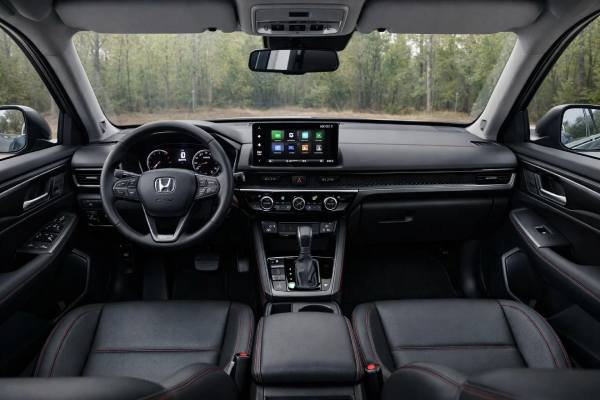
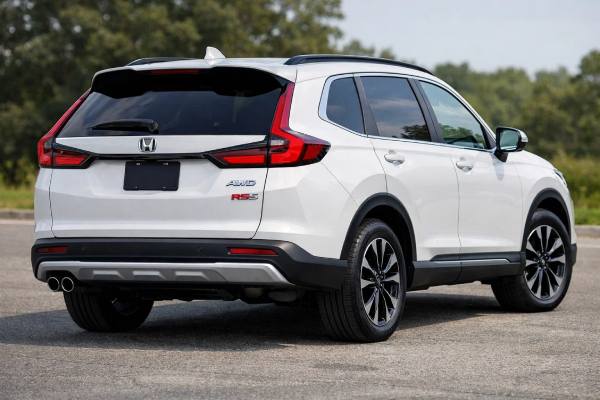
The 2023–present CR-V Real Time AWD Hybrid in RS6 form is built around Honda’s two-motor hybrid system: a 2.0-liter Atkinson-cycle engine paired with an electric drive unit that does most of the everyday work. In practice, that means a smooth, torque-forward feel in town, fewer “gear-change” events than a conventional automatic, and very competitive economy for a roomy compact SUV. AWD is primarily about traction and stability rather than rock-crawling, but it makes the CR-V Hybrid more confident in rain, slush, and loose surfaces—especially with good tires.
Ownership is generally straightforward: the hybrid hardware is designed for long service life, but like any modern SUV, the CR-V rewards owners who stay ahead on fluids, software updates, and brake maintenance. If you want a quiet, efficient family vehicle with strong resale value, this configuration is one of the most balanced CR-V picks.
Key Takeaways
- The hybrid system’s low-speed torque makes city driving feel effortless and reduces fuel use in stop-and-go traffic.
- Real Time AWD adds all-weather traction without a big penalty in everyday drivability.
- Cabin packaging is a strength: wide rear access, practical cargo shape, and good visibility for the class.
- Plan for AWD-specific service (rear drive unit fluid inspections/changes) if you keep it long-term.
- A sensible baseline interval is tire rotation every 10,000–12,000 km (6,000–7,500 mi) or 6 months, depending on use.
Jump to sections
- RS6 AWD hybrid in depth
- LFB51 204 hp specs
- Trims, packages, and ADAS
- Reliability issues and actions
- Maintenance plan and buying tips
- Road feel and efficiency
- Rivals and smart alternatives
RS6 AWD hybrid in depth
Think of this CR-V Hybrid as an EV-assisted SUV that happens to carry a gasoline engine. In most normal driving, the electric traction motor is the primary source of propulsion, while the 2.0-liter engine runs as a generator to feed the battery and electric drive unit. At higher steady speeds, the system can couple the engine more directly to the wheels through a fixed ratio, which is why highway behavior feels calm and efficient rather than “revvy.”
For owners, the benefits show up in three places:
- Smoothness: Because there are fewer traditional shift events, the power delivery is steady. You feel more of a continuous surge than stepped acceleration.
- Efficiency in real traffic: The system is at its best in urban and mixed driving where regenerative braking can recover energy, and where the engine can operate in more efficient load bands.
- Less brake wear (often): Regenerative braking takes some workload off the friction brakes, especially in city use. That can extend pad life—though it also makes regular brake inspections important to prevent rust buildup on lightly used components.
Real Time AWD in this context is tuned for traction and stability, not heavy off-road work. It can send torque rearward when the fronts slip, helping in wet weather launches, steep driveways, and light snow. The tradeoff is that it adds drivetrain complexity (and another fluid service item). For most families, it’s worth it: the CR-V’s chassis is predictable, and AWD makes it more consistent when conditions are uneven.
The LFB51 label is commonly used as an engine family identifier in certain parts and documentation contexts. What matters day-to-day is the system output and the way Honda integrates the hybrid battery, power electronics, and drive motor into a package that’s easy to live with: you still refuel in minutes, you still service it like a normal SUV, and you get hybrid efficiency without learning new habits.
LFB51 204 hp specs
Below are practical, owner-relevant specs for the 2023–present CR-V Hybrid with Real Time AWD (values can vary slightly by model year and trim).
Powertrain and efficiency
| Item | Spec |
|---|---|
| Code | LFB51 / 2.0 l hybrid system (market documentation varies) |
| Engine layout and cylinders | Inline-4 (I-4), DOHC, 16-valve (4 valves/cyl) |
| Displacement | 2.0 l (1993 cc) |
| Induction | Naturally aspirated (Atkinson-cycle operation) |
| Fuel system | Direct injection (market-specific labeling may vary) |
| Compression ratio | 13.9:1 (hybrid application) |
| Max power (system) | 204 hp (152 kW) (system output) |
| Engine max power | 145 hp (108 kW) @ 6,100 rpm |
| Engine max torque | 187 Nm (138 lb-ft) @ 4,500 rpm |
| Traction motor torque | 245 Nm (181 lb-ft) |
| Motor type and count | Electric traction motor (front axle; hybrid drive unit) |
| Battery | 1.06 kWh (hybrid battery) |
| Transmission | eCVT-style hybrid drive (single-speed e-drive behavior) |
| Drive type | Real Time AWD (on-demand AWD) |
| Rated efficiency (example AWD spec) | 6.4 L/100 km (37 mpg US) combined (typical) |
| Real-world highway @ 120 km/h | Commonly ~7.0–7.8 L/100 km depending on temperature, tires, and load |
Chassis and dimensions
| Item | Spec |
|---|---|
| Suspension (front / rear) | MacPherson strut / multi-link |
| Brakes (front / rear) | Ventilated disc / disc |
| Wheels/tyres (common AWD hybrid) | 235/60 R18 (varies by trim) |
| Ground clearance | 200 mm (7.9 in) (non-load) |
| Length | 4,706 mm (185.3 in) |
| Width | 1,866 mm (73.5 in) |
| Height (AWD) | 1,684 mm (66.3 in) |
| Wheelbase | 2,700 mm (106.3 in) |
| Turning circle (kerb-to-kerb) | 11.4 m (37.4 ft) |
| Kerb (curb) weight (AWD hybrid) | 1,822 kg (4,017 lb) |
| Cargo volume | 579 L (20.4 ft³) seats up / 1,634 L (57.7 ft³) seats down (VDA method, load to roof) |
Performance and capability (typical expectations)
| Item | Typical for this configuration |
|---|---|
| 0–100 km/h (0–62 mph) | ~7.8–8.6 s (trim and conditions dependent) |
| Top speed | Typically limited around ~180 km/h (112 mph) depending on market |
| Towing capacity | Commonly 454 kg (1,000 lb) for hybrid AWD in some markets (verify for your VIN) |
| Roof load | Market- and rail-dependent; verify in owner documentation |
Fluids, service capacities, and key torque specs (decision-grade guidance)
Manufacturers often publish exact capacities in service literature tied to VIN and equipment. Use these as high-confidence starting points, then verify for your specific vehicle.
| System | Specification | Typical notes |
|---|---|---|
| Engine oil | 0W-20, API/ILSAC as specified | Change per maintenance minder or annually; capacity varies by service method |
| Engine coolant | Honda long-life premix | Replace interval varies by market; inspect level and condition regularly |
| AWD rear drive unit fluid | Honda-approved AWD fluid | Often called out by maintenance minder; more frequent in severe service |
| Brake fluid | DOT 3/4 as specified | Replace every 2–3 years in humid climates or severe use |
| A/C refrigerant | Often R-1234yf on newer models | Charge quantity varies; service by certified technicians |
Trims, packages, and ADAS
Because equipment varies heavily by region, it helps to identify your CR-V Hybrid AWD by three practical signals: trim name (badge/infotainment), wheel size, and the presence of certain driver-assistance sensors. The hybrid AWD hardware is broadly consistent, but the ownership experience changes noticeably with the options you choose.
Trims and options that meaningfully change ownership
Most markets split CR-V Hybrid AWD into a “value” trim and one or two “comfort/tech” trims. The upgrades that matter most long-term are:
- Headlights: Higher trims often include better LED projector performance and improved night visibility. This is a real safety and fatigue benefit, not just a styling detail.
- Wheels and tires: Bigger wheels look sharp, but shorter sidewalls can reduce ride comfort and increase tire replacement cost. If your roads are rough, the more modest wheel package is often the sweet spot.
- Infotainment and connectivity: Larger screens, wireless phone integration, and better processors reduce lag and random dropouts. If you keep cars for many years, choose the more robust system.
- Seat and climate features: Heated seats and a strong HVAC system matter more in hybrids than many owners expect, because cabin heating and cooling can influence engine run time and winter economy.
Quick identifiers you can use when shopping used:
- Under-hood labels showing hybrid system warnings and orange HV cabling.
- Rear badging (Hybrid/e:HEV labeling varies) and AWD markings.
- Driver assistance camera module at the top of the windshield and radar sensor placement in the grille area.
Safety ratings and what they mean
Safety ratings can change by model year even when the vehicle looks identical, because test protocols evolve. As a rule, the CR-V’s structure is engineered to perform well in modern crash tests, but you should always match the rating to your exact year and trim (especially headlight performance).
ADAS suite: what’s typically included
A modern CR-V Hybrid AWD usually includes a package with:
- AEB (automatic emergency braking) with vehicle detection and often pedestrian detection.
- ACC (adaptive cruise control) that can maintain distance in traffic.
- Lane support (lane keeping assist and lane departure mitigation).
- Blind spot monitoring and rear cross-traffic alert (common, but not universal by base trim).
- Traffic sign recognition in many markets.
Calibration matters: windshield replacement, front-end repairs, alignment work, and even some suspension changes can require camera/radar recalibration. When buying used, ask for documentation of correct calibration after any front-end collision repair or windshield replacement—this affects both safety and warning-light headaches.
Reliability issues and actions
Honda’s two-motor hybrid systems have a reputation for durability when maintained, but the CR-V Hybrid AWD still has the same realities as any modern SUV: lots of electronics, tight packaging, and software-controlled subsystems. The best way to think about reliability is by prevalence and cost tier, so you can prioritize what to watch.
Common (usually low to medium cost)
- Infotainment glitches or phone pairing instability
Symptoms: random reboots, slow response, intermittent Bluetooth or wireless connection.
Likely cause: software bugs, phone OS conflicts, or corrupted pairing profiles.
Remedy: update software, reset/re-pair, and confirm the latest dealer campaigns are applied. - Brake noise or rotor surface rust (more common in hybrids)
Symptoms: squeal at low speed, vibration after rain, inconsistent feel when first braking.
Cause: regenerative braking reduces friction-brake use; moisture can leave film/rust.
Remedy: periodic firm stops to clean surfaces, routine inspection, and proper pad bedding after service. - 12 V battery sensitivity
Symptoms: slow starts (for system boot), odd warning lights, or random errors after sitting.
Cause: modern parasitic loads, short-trip use, or an aging 12 V battery.
Remedy: load-test the battery, keep terminals clean, consider a maintenance charger for low-use vehicles.
Occasional (medium to higher cost)
- ADAS sensor faults after windshield or front-end work
Symptoms: camera/radar errors, disabled lane or cruise functions.
Cause: misalignment, calibration missing, or non-OE glass affecting camera clarity.
Remedy: correct calibration with proper equipment; verify glass compatibility. - AWD rear drive unit fluid neglect
Symptoms: binding, groan, or inconsistent rear engagement in tight turns (varies by design).
Cause: fluid breakdown from heat and clutch work.
Remedy: service the AWD fluid on time, especially with towing, mountains, or lots of short trips.
Rare (higher cost, but worth awareness)
- Hybrid cooling airflow restrictions
Symptoms: reduced hybrid performance under load, warning messages, fan noise.
Cause: blocked intake paths (often interior vents/ducts depending on model design) or debris.
Remedy: keep vents unobstructed, clean as recommended, and address warning lights promptly.
Recalls, service bulletins, and how to verify completion
For any 2023–present CR-V Hybrid AWD, your best protection is documentation:
- Run the official VIN recall check in your market.
- Ask the seller/dealer for a printout of completed campaigns.
- If you experience recurring warning messages, request that the shop checks for software updates (powertrain, ADAS, infotainment). Many “ghost problems” are calibration-related.
A practical ownership truth: the hybrid powertrain is usually the most robust part of the vehicle. It’s the interfaces—software, sensors, and maintenance habits—that decide whether a CR-V feels flawless or fussy.
Maintenance plan and buying tips
A CR-V Hybrid AWD can be low-stress to maintain if you follow a few fundamentals: keep the fluids fresh, don’t ignore warning lights, and treat tires and brakes as core safety systems. Below is a practical schedule that works well for most owners, with notes for severe service (short trips, cold climate, heavy city use, mountains, towing).
Practical maintenance schedule (distance/time)
- Engine oil and filter: follow the maintenance minder; a conservative baseline is 12,000–16,000 km (7,500–10,000 mi) or 12 months, sooner in severe service. Use the specified 0W-20 and don’t stretch intervals if the engine runs frequently in cold weather.
- Tire rotation: 10,000–12,000 km (6,000–7,500 mi); check alignment if wear is uneven.
- Cabin air filter: typically 15,000–30,000 km (10,000–20,000 mi) depending on dust/pollen.
- Engine air filter: inspect every 20,000–30,000 km; replace as needed.
- Brake inspection: at every rotation; hybrids can hide pad wear because regen masks feel changes.
- Brake fluid: every 2–3 years (or per the official schedule), especially in humid climates.
- Coolant: follow the official interval (often long-life); inspect level/condition annually.
- AWD rear drive unit fluid: follow maintenance minder; consider earlier service if you do steep grades, snow driving, or frequent short trips.
- 12 V battery test: annually after year 3; replace proactively if it tests weak to prevent nuisance faults.
Fluids and torque values to keep in mind
For owner decision-making, the most important “spec” isn’t the exact capacity—it’s using the correct fluid type and servicing on time:
- Use the specified engine oil viscosity (0W-20 is common).
- Don’t substitute generic fluids for AWD rear drive unit service; correct friction characteristics matter.
- If brakes feel inconsistent, don’t assume it’s “just regen”—inspect pad condition, slider movement, and rotor surfaces.
Buyer’s guide: what to check before purchase
- Service history: look for oil services at sensible intervals and documented AWD fluid service if mileage is higher.
- Tire match: verify all four tires are the same brand/model and similar tread depth. Mismatched tires can stress AWD systems and upset stability control behavior.
- Hybrid health: confirm there are no hybrid warning lights; request a scan for stored codes if possible.
- ADAS function: test adaptive cruise and lane support on a clear road; verify there are no camera/radar warnings.
- Brakes: check for pulsation, pulling, or loud scraping; inspect rotor condition if the vehicle sat for long periods.
- Accident repairs: look closely at panel gaps and windshield replacement records; ask whether ADAS calibration was completed after repairs.
Long-term durability outlook is strong when maintained, and resale value tends to remain high. If you want the easiest ownership path, prioritize a trim with the lighting and infotainment you’ll be happy with for years—and then keep up with tires, brakes, and AWD fluid.
Road feel and efficiency
On the road, the CR-V Hybrid AWD aims for calm competence. The suspension is tuned for stability and comfort, with enough body control to feel secure in quick lane changes. Steering is typically light-to-moderate in weight with predictable buildup, prioritizing ease over sporty feedback. For daily commuting, that’s exactly what most owners want.
Ride, handling, and NVH
- Ride: The CR-V generally absorbs bumps well, but wheel choice matters. Smaller wheel/taller tire setups improve impact comfort and reduce rim damage risk on potholes.
- Handling balance: Neutral and confidence-inspiring. AWD helps pull the vehicle straight when traction is mixed, and stability control is usually well judged.
- Noise levels: Wind and road noise are competitive for the class. The hybrid system can make the cabin feel especially quiet at low speeds when the engine isn’t working hard.
Powertrain character and eCVT behavior
The hybrid system’s strength is how it delivers torque early. Step-off response in town is smooth, and transitions between EV-like movement and engine operation are usually subtle. Under hard acceleration, you may hear the engine hold a steady note as it produces power efficiently—this is normal for this type of hybrid drive and doesn’t indicate slipping like a traditional CVT issue would.
Drive modes (when equipped) typically adjust throttle mapping, steering weight, and hybrid aggressiveness. Eco can reduce HVAC intensity and soften response; Normal is the best all-round choice; Sport usually sharpens response without turning the CR-V into a hot hatch.
Real-world efficiency expectations
For many owners, the hybrid advantage shows up most in mixed use:
- City driving: often excellent because regen and EV-style launch reduce fuel consumption.
- Highway driving (100–120 km/h): still strong, though winter temperatures, snow tires, roof boxes, and heavy loads can push consumption up noticeably.
- Cold-weather delta: expect a meaningful drop in efficiency when heating demand is high and the engine runs more often to provide cabin heat and maintain battery temperature.
Load and towing
Hybrid AWD CR-V models often have lower tow ratings than non-hybrids. If you tow even occasionally, confirm your exact rating and cooling requirements. For light utility trailers, it’s usually fine, but sustained mountain towing is not the intended use case. If towing is a priority, a non-hybrid powertrain or a larger platform may be a better match.
Rivals and smart alternatives
The CR-V Hybrid AWD competes in one of the most crowded segments. Choosing the right rival comparison depends on what you value most: pure efficiency, sporty handling, interior packaging, or long-term simplicity.
Toyota RAV4 Hybrid AWD
- Why cross-shop: strong real-world economy and a proven hybrid reputation.
- Where CR-V can win: cabin comfort, ride polish, and often a more refined “EV-like” low-speed feel.
- Decision tip: choose based on seat comfort, noise levels, and how each system behaves in stop-and-go traffic.
Hyundai Tucson Hybrid and Kia Sportage Hybrid (AWD where available)
- Why cross-shop: feature-rich trims, modern infotainment, and strong value on paper.
- Where CR-V can win: straightforward controls, likely resale strength, and a conservative, proven packaging approach.
- Decision tip: compare warranty terms and dealer network quality in your area; ownership experience can vary widely by support.
Ford Escape Hybrid (where offered)
- Why cross-shop: efficient and often easy to park; good commuter personality.
- Where CR-V can win: rear seat space, cargo shape, and family usability.
- Decision tip: if you do lots of highway miles, test both for road noise and seat fatigue over 30–40 minutes.
Mazda CX-5 (non-hybrid)
- Why cross-shop: sharper handling and upscale interior feel.
- Where CR-V can win: fuel economy, rear seat space, and cargo practicality.
- Decision tip: if you love driving dynamics, Mazda is compelling; if you prioritize total operating cost and space, CR-V Hybrid shines.
The simple verdict
Choose the CR-V Hybrid Real Time AWD if you want an efficient, comfortable family SUV with an easy learning curve and strong all-weather confidence. Pick a rival if you have a specialized priority—maximum towing, sportiest handling, or a specific technology/warranty package that better fits your needs.
References
- 2024 CR-V Specifications and Features 2024 (Manufacturer Specs)
- Gas Mileage of 2025 Honda CR-V 2025 (Official Fuel Economy Data)
- 2026 Honda CR-V 4-door SUV 2026 (Safety Rating)
- 2025 HONDA CR-V SUV AWD 2025 (Recall Database)
- CR-V 2024 | Honda Owners Manual 2024 (Owner’s Manual)
Disclaimer
This article is for informational purposes only and is not a substitute for professional inspection, diagnosis, or repair. Specifications, torque values, service intervals, and procedures can vary by VIN, market, production date, and equipment. Always confirm details using official Honda service information for your exact vehicle and follow qualified technician guidance when required.
If you found this guide useful, please consider sharing it on Facebook, X/Twitter, or your favorite forum—it helps others find reliable ownership information.