

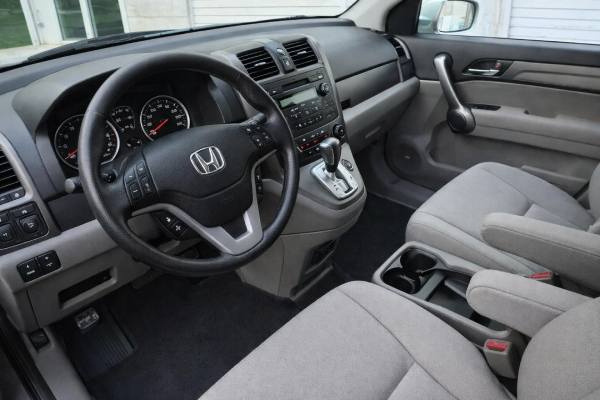

The RE3-generation Honda CR-V with front-wheel drive and the K24Z1 2.4-liter engine is a practical crossover built around simple, durable fundamentals: a timing-chain four-cylinder, a conventional automatic gearbox (in most markets), and a chassis tuned for predictable road manners. In FWD form it’s lighter, simpler, and cheaper to maintain than the AWD versions, which matters as these vehicles age into “second-owner” territory. The upside is low operating hassle and a roomy, upright cabin that still works well as a family daily driver. The trade-off is traction on steep, slick surfaces and the need to stay disciplined with fluids—especially engine oil and transmission fluid—because neglected maintenance tends to show up as noisy cold starts, driveline vibration, or transmission shift quality complaints. If you buy one with clear service history, it can be a steady long-haul vehicle.
What to Know
- Strong, chain-driven 2.4L engine with good parts availability and straightforward servicing.
- Spacious cabin packaging and cargo flexibility still competitive for real-world family use.
- FWD layout reduces AWD-related fluid services and rear driveline wear points.
- Watch for deferred transmission fluid changes and age-related rubber bushing and mount wear.
- Plan oil changes every 10,000 km (6,200 mi) or 12 months (shorter for severe use).
Explore the sections
- RE3 CR-V FWD in context
- K24Z1 specs and capacities
- Trims, equipment, and safety tech
- Common faults and service bulletins
- Maintenance plan and buying checks
- How it drives day to day
- RE3 FWD vs key rivals
RE3 CR-V FWD in context
This CR-V sits in the sweet spot between old-school compact SUVs and today’s heavier, more complex crossovers. The RE3 platform (2007–2011 model years) moved the CR-V into a more car-like driving position and cabin layout, but it kept the ownership formula Honda buyers expect: sensible ergonomics, a naturally aspirated engine, and durable mechanicals if you don’t skip fluids.
In FWD form, the CR-V is mechanically simpler than the Real Time AWD versions. That matters long-term. You avoid rear differential fluid changes, the risk of neglected dual-pump rear diff fluid causing chatter on tight turns, and some of the vibration issues that can show up in worn AWD driveline components. You also typically get slightly better fuel economy and slightly lower tire costs because you’re less likely to need perfectly matched tread depths across all four corners for driveline harmony.
The K24Z1 (2.4L) engine is the centerpiece: a DOHC i-VTEC inline-four with a timing chain and a reputation for running well beyond 250,000 km (155,000 mi) when maintained. It’s not a torque-heavy engine at very low rpm, but it’s smooth, likes to rev, and feels well matched to suburban and highway use. Most examples are paired to a 5-speed automatic; some markets offered a manual, which can be appealing if you want fewer automatic-transmission variables, but it’s rarer in the used market.
From an ownership angle, the main “age factors” are not exotic: rubber hardens, mounts sag, suspension bushings crack, and electrical components like door lock actuators and A/C-related parts can fail. The best RE3 FWD buys are the ones that were serviced consistently, not necessarily the lowest-mileage ones. A CR-V that saw regular oil changes, periodic ATF service, and prompt repairs for small leaks is usually a safer bet than a “cheap because it needs nothing” listing with no documentation.
K24Z1 specs and capacities
Specs vary by market and trim, but the tables below focus on the RE3 CR-V FWD with K24Z1 2.4L (166 hp) and the most common automatic configuration. Use your VIN label and owner documentation to confirm what your specific vehicle carries (especially tires, weights, and some service capacities).
Powertrain and efficiency
| Item | Specification |
|---|---|
| Engine code | K24Z1 |
| Layout | Inline-4 (I-4), DOHC, i-VTEC |
| Valvetrain | 4 valves/cyl (16 valves total) |
| Bore × stroke | 87.0 × 99.0 mm (3.43 × 3.90 in) |
| Displacement | 2.4 L (2,354 cc) |
| Induction | Naturally aspirated |
| Fuel system | PGM-FI (multi-point) |
| Compression ratio | 9.7:1 |
| Max power | 166 hp (124 kW) @ ~5,800 rpm |
| Max torque | 218 Nm (161 lb-ft) @ ~4,200 rpm |
| Timing drive | Chain |
| Rated efficiency (typical, FWD auto) | ~10.7 L/100 km combined (22 mpg US / 26 mpg UK equivalent) |
| Real-world highway @ 120 km/h (75 mph) | ~8.5–9.8 L/100 km (24–28 mpg US) |
| Aerodynamics | Cd / frontal area: not consistently published by Honda for all markets |
Transmission and driveline
| Item | Specification |
|---|---|
| Transmission (common) | 5-speed automatic |
| Drive type | FWD |
| Differential | Open (front) |
Chassis and dimensions
| Item | Specification |
|---|---|
| Suspension (front / rear) | MacPherson strut / multi-link |
| Steering | Power-assisted rack and pinion (ratio varies by market) |
| Brakes | 4-wheel disc with ABS (rotor diameters vary by market/trim) |
| Wheels/tires (examples) | P215/70 R16 or P225/65 R17 (varies by trim) |
| Ground clearance | 185 mm (7.3 in) |
| Length | 4,513 mm (177.7 in) |
| Width | 1,820 mm (71.7 in) |
| Height | 1,679 mm (66.1 in) |
| Wheelbase | 2,620 mm (103.1 in) |
| Turning circle (kerb-to-kerb) | 11.0 m (36.1 ft) |
| Fuel tank | 58 L (15.3 US gal / 12.8 UK gal) |
| Cargo volume (typical) | Approx. ~1,010 L (35.7 ft³) seats up / ~2,060 L (72.9 ft³) max (SAE, varies by market) |
Performance and capability (real-world ranges)
| Metric | Typical result (varies by trim, tires, and test method) |
|---|---|
| 0–100 km/h (0–62 mph) | ~10.0–11.5 s |
| Top speed | ~175–185 km/h (109–115 mph) |
| Towing capacity | Often 680 kg (1,500 lb) in many markets (confirm local rating label) |
| Payload | Check door-jamb label (varies widely by market and equipment) |
Fluids and service capacities (common service values)
| Fluid | Specification | Capacity |
|---|---|---|
| Engine oil | Honda-spec 0W-20 or 5W-20 (market dependent); API/ILSAC as specified | 4.16 L (4.4 US qt) with filter |
| Coolant | Honda Type 2 (premix) or equivalent as specified | ~5.0 L (1.32 US gal) drain/refill; ~7.12 L (1.88 US gal) total |
| Automatic transmission fluid | Honda ATF (e.g., DW-1 equivalent for service); verify by market | ~2.56 L (2.7 US qt) drain/refill; ~7.0 L (7.4 US qt) total |
| Windshield washer fluid | — | ~2.46 L (2.6 US qt) |
| Rear differential fluid | Not applicable for FWD | — |
| A/C refrigerant and oil | See under-hood label (varies by system) | — |
Electrical (common service identifiers)
| Item | Specification |
|---|---|
| 12V battery | 12V 35 Ah (common listing; check your battery label for CCA and size group) |
| Spark plugs | NGK IFR7G-11KS or DENSO SKJ20DR-M11 |
| Spark plug gap | 1.0–1.1 mm (0.039–0.043 in) |
Safety and driver assistance (era-correct)
| Item | Notes |
|---|---|
| Core safety | Front airbags and side curtain airbags common; stability/traction control availability varies by market/year |
| Crash ratings (IIHS, U.S.) | Strong front/side ratings for this generation; roof strength varies by test and configuration |
| Euro NCAP | Comparable-generation results exist in Europe, but scoring format differs by year; verify test version for your exact vehicle |
Trims, equipment, and safety tech
Trim naming depends heavily on region, but most 2007–2011 CR-V FWD lineups follow a familiar ladder: a base grade focused on value, a mid-trim with convenience features, and a top trim that adds leather, upgraded audio, and sometimes larger wheels. When shopping, focus less on the badge and more on the equipment that changes ownership costs—tires, brakes, and electronic features.
Trims and options that change the driving feel
- Wheel and tire packages: Moving from 16-inch to 17-inch wheels usually sharpens steering response a bit but can increase tire cost and road noise. On older suspension, bigger wheels can also highlight worn bushings and strut mounts.
- Climate and interior equipment: Dual-zone climate control, heated seats, and power seat mechanisms add comfort but also add age-related failure points (blowers, control modules, seat tracks).
- Audio and navigation: Factory navigation units (where offered) can be dated and expensive to repair. A clean aftermarket head unit is often a practical upgrade if the car is otherwise solid.
Quick identifiers for used listings
- Tire size on the door placard: This is the fastest way to confirm what wheel package the vehicle was built around.
- Stability control presence: Look for a dashboard indicator and a switch label (market dependent). Some years/regions made it standard later.
- Airbag coverage: Side curtain airbags are usually obvious via “SRS Curtain” tags near the A-pillar/headliner seam.
Safety ratings and what they mean for owners
This generation performed well in several crash-test categories for its era, which is one reason it remains popular as a used family vehicle. The key is to understand the “version” of the tests:
- IIHS (U.S.): The 2007–2011 CR-V is known for strong moderate-overlap front and side-impact outcomes in the original protocols. Roof strength results are more mixed—important if rollover protection is a top concern.
- NHTSA (U.S.): NHTSA star ratings (where available for your exact configuration) are useful for broad comparison, but they vary by drivetrain and year, and they don’t map directly to newer test standards.
Driver assistance and braking systems (period-correct reality)
Modern ADAS features like automatic emergency braking and lane centering were not part of this era. What you should expect instead:
- ABS is common and valuable for maintaining steering control during panic stops.
- Stability control (VSA), when equipped, is the single biggest “active safety” differentiator in slippery conditions for a FWD CR-V.
- Child-seat anchors: ISOFIX/LATCH provisions are typically present; always verify anchor condition and plastic trim integrity because older vehicles can have damaged covers or missing guides.
If you want the safest ownership experience, prioritize: intact airbags (no warning light), functioning ABS, working stability control (if equipped), and tires that match the placard spec with even tread depth.
Common faults and service bulletins
No 15–20-year-old CR-V is “issue free.” The goal is to know what tends to fail, what it costs in time and money, and what’s simply normal aging. Below is a practical map of common problems by prevalence and typical severity.
Common (expect to see on many cars)
- Suspension bushings and mounts (medium cost):
Symptoms: clunks over bumps, steering shimmy, uneven tire wear.
Likely cause: worn control-arm bushings, strut mounts, sway bar links, rear trailing arm bushings.
Remedy: replace worn components, then align; budget for tires if wear is advanced. - Engine mount sag (low-to-medium cost):
Symptoms: vibration at idle in gear, thump on acceleration.
Cause: hydraulic mount deterioration with age/heat cycles.
Remedy: replace the failed mount(s); check exhaust hangers too. - A/C performance decline (medium-to-high cost depending on root cause):
Symptoms: weak cooling, intermittent cold air, compressor noise.
Cause: leaks, compressor wear, relay/clutch issues, condenser damage.
Remedy: proper leak test and repair; avoid repeated “top-ups” without diagnosis.
Occasional (not rare, but not universal)
- Cold-start rattle (VTC actuator behavior) (medium cost):
Symptoms: brief rattle on cold start that disappears quickly.
Cause: VTC actuator or oil-drainback issues; sometimes worsened by wrong oil viscosity or long intervals.
Remedy: confirm oil condition and correct viscosity first; persistent rattle may justify actuator service. - Oil seepage and gasket aging (low-to-medium cost):
Symptoms: oil smell, wetness around valve cover or timing cover edges.
Cause: hardened seals/gaskets.
Remedy: replace gaskets; verify PCV valve operation to reduce crankcase pressure. - Door lock actuators and window switches (low-to-medium cost):
Symptoms: intermittent locking/unlocking, slow windows.
Cause: actuator motor wear, switch contact wear.
Remedy: replace actuator or switch; confirm wiring in the door jamb boot.
Rare but expensive (screen carefully)
- Automatic transmission shift quality deterioration (medium-to-high cost):
Symptoms: flare between gears, harsh engagement, delayed reverse, shudder at light throttle.
Cause: old ATF, internal wear, solenoid issues; sometimes compounded by neglected mounts.
Remedy: start with correct fluid service (drain/fill cycles using the correct Honda ATF); if symptoms persist, diagnose solenoids and line pressure before assuming a full rebuild. - Cooling system neglect leading to overheating (high risk):
Symptoms: temperature spikes, coolant loss, heater performance changes.
Cause: old coolant, weak radiator cap, hose aging, thermostat issues.
Remedy: pressure test, service coolant, replace failing components promptly—overheating is what turns a good engine into a bad one.
Recalls and service actions
This era can be affected by major industry-wide recall campaigns (notably airbag inflators on many Hondas) and smaller region-specific actions. Always check recall completion by VIN through official channels and dealer records, and treat “seller says it’s done” as unverified until documented.
Maintenance plan and buying checks
A well-maintained RE3 FWD CR-V is usually a calm ownership experience. A neglected one can quickly feel “tired,” even if it still drives. Use the schedule below as a practical baseline; tighten intervals for short trips, dusty environments, heavy traffic, or frequent full-load driving.
Practical maintenance schedule (distance/time)
- Engine oil and filter: every 10,000 km (6,200 mi) or 12 months; severe use 5,000–7,500 km (3,100–4,700 mi). Use the viscosity and specification listed for your market.
- Cabin air filter: 20,000–30,000 km (12,000–18,000 mi) or annually if you drive in dusty cities.
- Engine air filter: 30,000–45,000 km (19,000–28,000 mi); sooner in dusty conditions.
- Coolant: follow your Honda coolant type guidance; many owners use a conservative 5 years / 100,000 km (60,000 mi) refresh interval on older vehicles unless documentation proves a longer-life fill.
- Automatic transmission fluid: drain and refill every 40,000–60,000 km (25,000–37,000 mi); do not “flush” aggressively on unknown-history transmissions—use correct fluid and staged drain/fill services.
- Brake fluid: every 2 years, regardless of mileage.
- Spark plugs (iridium): often 160,000 km (100,000 mi), but shorten if misfires develop or service history is unknown.
- Serpentine belt and coolant hoses: inspect every oil service; expect replacement around 10 years depending on climate and storage.
- Tires: rotate every 10,000–12,000 km (6,000–7,500 mi); align annually or when you fit new tires.
Fluids, specs, and decision-making shortcuts
- If the oil is dark and thin right after an “oil change,” assume the interval may be stretched or the wrong oil used.
- If the ATF is burnt-smelling or very dark, budget for multiple drain/refill services and plan a more cautious purchase price.
- If coolant is rusty or mixed-color, assume the system needs a proper service and inspection.
Essential torque values (verify for your exact fasteners)
- Wheel lug nuts: typically ~108 Nm (80 lb-ft) on many Hondas of this era.
- Engine oil drain bolt: commonly ~39 Nm (29 lb-ft).
- Spark plugs: commonly ~18 Nm (13 lb-ft) when installed into clean, correct threads.
Buyer’s inspection checklist (what matters most)
- Cold start behavior: listen for extended rattles, belt squeal, and unstable idle. A brief noise can be normal; a long, harsh rattle is not.
- ATF service evidence: receipts matter. If there’s no proof, assume it needs service soon.
- Suspension test drive: find a rough road; clunks and wandering steering usually mean bushing and mount work.
- A/C performance: test at idle and at speed; inconsistent cooling often hints at a deeper issue than low refrigerant.
- Body and underbody corrosion: check rear subframe areas, brake lines, and seam edges—especially if the car lived in salted climates.
- Electronics sweep: windows, locks, mirrors, wipers, and all dash warning lights (including ABS and airbag) should behave normally.
Best ownership outlook
Choose condition over trim. A base car with complete records is usually a better buy than a top trim with deferred maintenance. Expect age-related repairs, but also expect that most fixes are conventional, widely understood, and not “special tools only.”
How it drives day to day
The RE3 CR-V’s driving character is best described as stable, predictable, and easy to place. It doesn’t feel sporty, but it also doesn’t feel truck-like. For daily commuting, school runs, and highway trips, that’s exactly the point.
Ride, handling, and NVH
- Ride quality: The suspension is tuned to absorb broken pavement without constant harshness. When it feels brittle, it’s often worn struts, tired top mounts, or overinflated tires rather than a “bad design.”
- Handling balance: The CR-V tends toward safe understeer. In FWD form, traction limits show up earlier when you accelerate out of tight corners or climb slick inclines.
- Steering feel: Light-to-moderate effort with good predictability. Excessive play or vague on-center feel usually points to alignment, tire wear, or front-end bushing wear.
- Cabin noise: Wind and tire noise rise noticeably at highway speeds compared to newer crossovers. If it’s unusually loud, check door seals, tire type, and wheel bearing condition.
Powertrain character
The K24Z1 is smooth and willing, but it’s not a low-rpm diesel-like puller. You get the best response when the engine is allowed to climb into the midrange. The automatic generally shifts unobtrusively, but:
- Hunting between gears can happen on rolling highways if the transmission fluid is old or if tires are mismatched.
- Kickdown response is adequate rather than fast; it’s a family crossover, not a performance vehicle.
Real-world efficiency (what owners actually see)
Expect fuel economy to vary more with speed and tire choice than many drivers realize:
- City: often 11–13 L/100 km (18–21 mpg US) depending on traffic and warm-up time.
- Highway (100–120 km/h): often 8.5–9.8 L/100 km (24–28 mpg US) if the engine is healthy and alignment is correct.
- Cold weather: short trips can raise consumption sharply; a sticky thermostat or tired O2 sensor can make it worse.
Traction and control in FWD form
With good all-season tires, the FWD CR-V is fine for rain and light snow. For steep driveways, heavy snow, or muddy rural roads, you’ll feel the limitation quickly. If your use case includes frequent winter hills or unpaved roads, tire choice becomes more important than most “AWD vs FWD” debates. A set of true winter tires can do more for real traction than many people expect.
RE3 FWD vs key rivals
When cross-shopping a 2007–2011 CR-V FWD today, you’re usually comparing it with similar-era compact crossovers that prioritize reliability and practicality. Here’s how it typically stacks up.
Toyota RAV4 (same era)
- Why pick the CR-V: more consistently refined cabin packaging and a calmer ride. The Honda’s interior ergonomics often feel more “everyday logical.”
- Why pick the RAV4: some powertrain options offer stronger acceleration; AWD availability is broad, and resale can be strong.
- Used-market reality: both reward maintenance; the deciding factor is usually condition and service history.
Subaru Forester
- CR-V advantage: lower mechanical complexity in FWD form, often lower running costs, and less sensitivity to tire matching than full-time AWD systems.
- Forester advantage: superior traction and winter confidence if you truly need it.
- Buyer tip: if you don’t need AWD, the CR-V FWD often makes the more rational “cost per year” choice.
Nissan Rogue (early generations)
- CR-V advantage: conventional automatic reliability tends to be easier to manage long-term than some CVT-heavy competitors from the same broad era.
- Rogue advantage: sometimes priced lower in the used market.
- Buyer tip: if your priority is predictable ownership, the Honda often wins.
Hyundai Tucson and Kia Sportage (period competitors)
- CR-V advantage: strong long-term parts ecosystem and proven engine design with many known fixes.
- Korean rivals advantage: you may find newer-for-the-money examples, sometimes with more modern convenience features.
- Buyer tip: compare corrosion, suspension wear, and documented service—not just model year.
The simple verdict
If you want a used compact crossover that’s easy to live with and supported by abundant parts and knowledge, the RE3 CR-V FWD remains one of the safer choices—especially when you buy the best-maintained example you can find. If you routinely drive steep winter terrain or need confident traction on unpaved surfaces, you may be happier paying for an AWD alternative (or budgeting for dedicated winter tires and careful driving in the FWD CR-V).
References
- 2007 Honda CR-V Online Reference Owner’s Manual 2007 (Owner’s Manual)
- 2007 Honda CR-V 2007 (Safety Rating)
- Vehicle Detail Search – 2007 HONDA CR-V | NHTSA 2007 (Recall Database)
- Honda Owners | Recalls and Updates | Honda UK 2026 (Recall and VIN Check)
Disclaimer
This article is for informational purposes only and is not a substitute for professional inspection, diagnosis, or repair. Specifications, torque values, service intervals, and procedures can vary by VIN, market, production date, and installed equipment—always verify details using your official Honda service documentation and vehicle labels.
If you found this guide useful, please consider sharing it on Facebook, X (Twitter), or your favorite forum to help others maintain their CR-V and to support our work.