

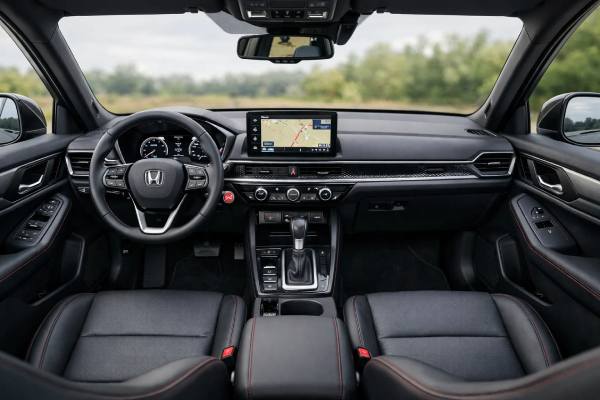
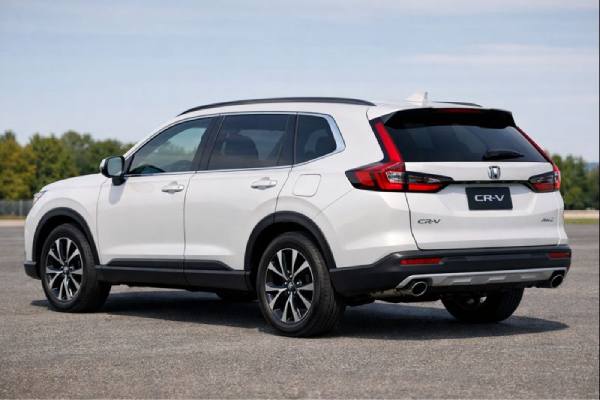
The 2023–present Honda CR-V Hybrid in FWD form is built around a practical idea: keep SUV usefulness, but make everyday driving smoother and more efficient without asking the owner to “drive a hybrid.” The RS5-generation CR-V Hybrid uses a two-motor system that can run as an EV at low loads, blend engine and motor power when you ask for more, and lock the engine in more directly at higher speeds to reduce losses. In ownership terms, that matters because the power delivery feels consistent, the drivetrain avoids step-shifts, and the brakes are designed to recover energy without a “grabby” pedal when everything is working correctly.
For buyers who prioritize quiet city commuting, predictable winter traction (even without AWD), and low fuel spend, the CR-V Hybrid FWD is a strong “set-and-forget” choice—especially if you follow a few hybrid-specific maintenance habits.
What to Know
- Strong low-speed response from the traction motor makes city driving feel effortless.
- Hybrid tuning tends to reduce stop-and-go fuel use compared with many turbo-only rivals.
- Practical packaging: big rear doors, useful cargo bay, and easy daily ergonomics.
- Ownership caveat: short-trip use can accelerate oil dilution and moisture buildup—drive long enough to fully warm the system regularly.
- Typical interval: rotate tires every 10,000–12,000 km (6,000–7,500 mi) to protect handling and braking consistency.
Contents and shortcuts
- CR-V Hybrid FWD essentials
- LFB51 specs and dimensions
- Trims, safety, and driver assist
- Reliability patterns and common fixes
- Maintenance plan and buying tips
- Real-world driving and efficiency
- How it stacks up against rivals
CR-V Hybrid FWD essentials
Honda’s CR-V Hybrid FWD (RS5) focuses on real-world efficiency without turning the SUV into a science project. Instead of a conventional automatic, it relies on a two-motor hybrid layout: one motor mainly generates electricity, and the other is the traction motor that actually drives the wheels most of the time. The gasoline engine supports the system by producing power efficiently at steady loads, and at higher speeds it can couple more directly to reduce conversion losses.
What this means behind the wheel is simple: the CR-V Hybrid feels like it always has “torque on tap” at urban speeds. Pulling away from a stop, merging into traffic, and climbing short grades typically require less drama than a small turbo engine paired with a busy transmission. For many owners, that smoothness is the main advantage—not just the fuel savings.
In FWD form, the hybrid system’s strengths show up most clearly in mixed driving: stoplights, roundabouts, short highway bursts, and frequent speed changes. The traction motor can handle these transitions quickly, and the engine can stay off more often when you’re gentle with the throttle. On longer highway runs at higher speeds, the benefit narrows, but the CR-V Hybrid still tends to be steady and quiet for the class.
A few ownership traits matter on this specific setup:
- Brake feel and tire condition influence perceived quality. Because regenerative braking is blended with friction braking, worn tires or uneven rotor surfaces can make the pedal feel inconsistent, especially at low speeds.
- Short-trip use matters more than many people expect. Like other modern engines—especially hybrids that can run cool in city use—frequent cold starts and very short drives can increase moisture and fuel dilution in the oil over time.
- Hybrid components are usually low-drama, but software calibrations are part of the ownership story. Updates can address drivability, warning lights, and ADAS behavior.
If you want a compact SUV that behaves calmly in daily use and does not punish you at the pump, the CR-V Hybrid FWD is aimed directly at that brief.
LFB51 specs and dimensions
Below are commonly published specifications for the 2023–present CR-V Hybrid with a 2.0-liter hybrid system and 204 hp system output. Exact figures can vary slightly by market, test standard, and trim. Use your VIN-specific documentation for final confirmation.
Powertrain and efficiency
| Item | Specification |
|---|---|
| Code | LFB51 (market-dependent designation) |
| Engine layout and cylinders | Inline-4, 4 cylinders, DOHC, 4 valves/cyl |
| Bore × stroke | 81.0 × 96.7 mm (3.19 × 3.81 in) |
| Displacement | 2.0 L (1993 cc) |
| Induction | Naturally aspirated |
| Fuel system | Direct injection (market-dependent naming) |
| Compression ratio | ~13.9:1 (hybrid Atkinson-cycle tuning) |
| Engine max power | ~145 hp (107 kW) @ ~6100 rpm |
| Engine max torque | ~186 Nm (138 lb-ft) @ ~4500 rpm |
| Traction motor output | ~181 hp @ 5000–8000 rpm; ~335 Nm (247 lb-ft) @ 0–2000 rpm |
| Total system power | 204 hp (ISO net) |
| Timing drive | Typically chain-driven (verify by market) |
| High-voltage battery | Lithium-ion (chemistry type not always published) |
| Rated efficiency (typical for FWD) | ~43/36 mpg US city/hwy (~5.5/6.5 L/100 km) |
| Real-world highway @ 120 km/h | Often ~6.8–7.8 L/100 km (30–35 mpg US), temperature and terrain dependent |
| Aerodynamics | Cd and frontal area vary by trim/market; not always officially published |
Transmission and driveline
| Item | Specification |
|---|---|
| Transmission | eCVT-style hybrid drive (two-motor system with fixed ratios and clutching logic) |
| Drive type | FWD |
| Differential | Open (traction and stability managed by braking and motor control) |
Chassis and dimensions
| Item | Specification (typical) |
|---|---|
| Suspension (front/rear) | MacPherson strut / multi-link |
| Steering | Electric power steering (variable ratio by market/trim) |
| Steering ratio | ~12.4:1 class (market dependent) |
| Brakes (front/rear) | Ventilated disc / solid disc (sizes vary by trim) |
| Wheels/tires | Commonly 235/60 R18 on hybrid trims; some markets offer 19 in |
| Ground clearance | ~208 mm (8.2 in) class |
| Length / width / height | ~4694 × 1866 × 1689 mm (184.8 × 73.5 × 66.5 in), market dependent |
| Wheelbase | ~2701 mm (106.3 in) |
| Turning circle (curb-to-curb) | ~11.4 m (37.3 ft) |
| Curb weight | Often ~1660–1815 kg (3660–4000 lb) depending on trim/market |
| Cargo volume | Market/test method varies; typically ~39 ft³ seats up and ~76 ft³ max (SAE, where used) |
Performance and capability
| Item | Typical value |
|---|---|
| 0–100 km/h (0–62 mph) | ~7.0–7.8 s (trim, tires, test method) |
| Top speed | Often electronically limited (market dependent) |
| Braking 100–0 km/h | Typically ~37–41 m (tire and surface dependent) |
| Towing capacity | Market dependent; many FWD hybrids are rated lower than turbo AWD rivals |
| Roof load / payload | Varies by market and homologation |
Fluids, service capacities, and key torque specs
Because capacities vary by VIN and market, use these as decision-level guidance and confirm locally:
| Item | Typical guidance |
|---|---|
| Engine oil | 0W-20 synthetic (common Honda spec); capacity ~3.7–4.2 L (3.9–4.4 US qt) with filter |
| Coolant | Honda-type long-life coolant; service life often time-based plus mileage-based (see schedule) |
| Hybrid transmission fluid | Honda-specified hybrid/eCVT fluid (service policy varies; confirm) |
| A/C refrigerant | Modern R-1234yf in many markets (confirm under-hood label) |
| Lug nuts | ~108 Nm (80 lb-ft) |
| Engine oil drain plug | ~39 Nm (29 lb-ft) typical Honda range |
Electrical (owner-relevant)
| Item | Typical guidance |
|---|---|
| 12 V battery | Conventional 12 V battery; longevity depends on use pattern and parasitic loads |
| Spark plugs | Long-life iridium type; replacement interval often 160,000 km (100,000 mi) class (confirm) |
Trims, safety, and driver assist
The CR-V Hybrid equipment story depends heavily on region. In some markets the hybrid is positioned as a mid-to-high grade with most comfort features standard; in others, hybrid trims split into “sport” and “touring” styles with clear interior and tech differences. The key is to separate appearance packages (wheels, black trim, interior accents) from functional hardware (headlights, parking sensors, cameras, and ADAS capability).
Trims and options that matter mechanically
When you compare trims, focus on items that change how the vehicle drives, stops, or ages:
- Wheel and tire size: Larger wheels can sharpen steering response but usually reduce ride comfort and increase tire cost. They can also worsen wet braking if the tire compound is not upgraded.
- Headlights: LED projector performance and beam pattern matter for safety and fatigue. Some trims add better low-beam performance and more consistent high-beam automation.
- Cooling and load equipment: If your market offers additional cooling packages or heavier-duty towing hardware, verify that it applies to the hybrid FWD. Hybrids can have conservative tow ratings depending on thermal management and homologation.
- Audio, screens, and connectivity: These don’t change mechanical reliability, but they do change owner satisfaction. If a higher trim adds a better infotainment setup or Google-based features, it can be worth it for long-term usability.
Quick identifiers when shopping used
- Hybrid models typically have distinct badging and often unique wheel designs.
- Inside, look for hybrid drive displays and regen/deceleration selectors (availability varies).
- Under the hood, you’ll see orange high-voltage cables and additional power electronics compared with non-hybrids.
Safety ratings overview
Safety ratings can differ by market and test protocol. As a general guide:
- Euro NCAP ratings reflect European test procedures and may specify whether a “safety pack” was fitted.
- IIHS ratings focus on U.S.-market vehicles and include headlight performance, crash avoidance, and overlap tests.
Always confirm that the tested configuration matches your market’s standard equipment—especially for AEB tuning, lane support behavior, and headlight spec.
Safety systems and ADAS details
Most CR-V Hybrids include a suite centered on:
- AEB (automatic emergency braking) for vehicles and often pedestrians/cyclists
- ACC (adaptive cruise control) with lane centering support
- Lane-keeping and lane departure mitigation
- Blind spot monitoring and rear cross-traffic alert (availability can be trim-based in some markets)
- Rear-seat and occupant reminders (market dependent)
A practical ownership note: after windshield replacement, suspension work, or front-end repairs, camera and radar calibrations may be required. If the calibration is skipped or done poorly, you may see warning lights, inconsistent lane centering, or reduced AEB confidence—problems that feel “electronic” but are often fixable with correct procedures.
Reliability patterns and common fixes
Modern Honda hybrids are generally durable, but the CR-V Hybrid FWD has a reliability profile shaped by software, sensors, and how the vehicle is used day to day. The best way to think about it is to separate high-cost hardware failures (rare) from annoying, frequent ownership problems (more common) that can affect confidence.
Common, lower-cost issues
- Infotainment glitches (common, low/medium cost):
Symptoms: random reboots, Bluetooth dropouts, slow startup, camera lag.
Likely cause: software bugs or module communication hiccups.
Remedy: update firmware, check for technical service bulletins, ensure the 12 V battery tests strong. - Brake noise or low-speed “grab” feel (common, low/medium cost):
Symptoms: squeal at low speeds, inconsistent pedal feel during parking maneuvers.
Likely cause: rotor surface condition, pad material behavior, regen-to-friction blending at very low speed.
Remedy: clean/lubricate hardware, bed pads correctly, verify rotor condition; if in a salty climate, plan for more frequent brake servicing even if pad wear is low. - 12 V battery sensitivity (common, low/medium cost):
Symptoms: sluggish starts, warning lights, odd electronic faults, after sitting.
Likely cause: frequent short trips, accessory use while parked, or a battery nearing end-of-life.
Remedy: battery test under load, check for software updates related to sleep/wake behavior, consider a maintenance charger if the vehicle sits.
Occasional issues to watch
- Hybrid cooling system servicing needs (occasional, medium cost):
Symptoms: reduced performance in hot weather, warning lights, fans running often.
Likely cause: coolant level issues, air in system after service, cooling fan or sensor faults.
Remedy: proper bleeding procedures and verification of cooling operation. - Driver-assistance sensor faults (occasional, low/medium cost):
Symptoms: ACC or lane support unavailable, camera/radar warnings after weather or repairs.
Likely cause: dirty sensors, misalignment, windshield replacement without calibration.
Remedy: clean sensors, check alignment, perform calibration with correct equipment.
Rare, higher-cost items
- High-voltage component failures (rare, high cost):
Symptoms: hybrid system warnings, reduced propulsion, no-ready condition.
Likely cause: inverter, DC–DC converter, contactor, or harness issues (rare in the fleet, but possible).
Remedy: dealer-level diagnosis; confirm warranty coverage and any service campaigns.
Recalls, TSBs, and how to verify
For a 2023–present vehicle, the most important “reliability move” is administrative: verify open recalls and confirm all field actions were completed. Use an official VIN lookup and keep dealer repair orders on file. When you test-drive, check for warning lights, ensure driver assistance features activate normally, and confirm the vehicle transitions between EV-like operation and engine operation without harshness.
Maintenance plan and buying tips
A CR-V Hybrid can be low-maintenance in routine use, but it rewards owners who treat it like a modern electrified drivetrain: keep fluids fresh, keep tires matched, and avoid letting small brake or battery issues linger. The schedule below blends typical manufacturer guidance with real-world “best practice” for longevity. Always defer to your market’s maintenance minder and service documentation.
Practical maintenance schedule
- Engine oil and filter: every 10,000–12,000 km (6,000–7,500 mi) or 12 months, sooner for repeated short trips, extreme cold, or heavy city use.
- Tire rotation: every 10,000–12,000 km (6,000–7,500 mi); check alignment annually or after pothole impacts.
- Cabin air filter: every 20,000–30,000 km (12,000–18,000 mi) or yearly in dusty/pollen-heavy areas.
- Engine air filter: every 30,000–45,000 km (18,000–28,000 mi); shorten in dusty regions.
- Brake fluid: every 3 years regardless of mileage (humidity-driven).
- Coolant: commonly 5 years / 100,000 km (60,000 mi) first service, then shorter intervals; confirm for your VIN and whether there are separate loops for engine and power electronics.
- Hybrid/eCVT fluid: consider inspection at 50,000–60,000 km (30,000–40,000 mi); replace earlier for heavy mountain driving, high heat, or frequent towing (where allowed).
- Spark plugs: often 160,000 km (100,000 mi) class; confirm exact interval.
- 12 V battery test: annually after year 3, or earlier if you do short trips and accessory use.
Hybrid-specific checks that prevent headaches
- Brake service even with “low wear”: Regenerative braking reduces pad wear, but corrosion and sticking hardware can still happen. Inspect slides and rotor surfaces periodically—especially in wet/salty climates.
- Cooling performance: Make sure fans run normally, coolant level is stable, and there are no repeated “hybrid system” messages after hot-weather use.
- Software updates: If drivability, warning lights, or ADAS performance seems inconsistent, ask whether updates apply before replacing parts.
Buyer’s guide for used examples
Service history to request
- Oil-change records with correct oil spec.
- Brake inspections (not just pad replacement).
- Any hybrid-system warning light documentation and the final fix.
- Recall completion proof using VIN printouts and repair orders.
Physical inspection checklist
- Even tire wear across all corners (mismatched tires can upset stability control and braking).
- Smooth low-speed braking and predictable pedal feel in parking lots.
- No repeated warning lights after a 20–30 minute drive.
- HVAC odor control and A/C performance (important for daily comfort).
- All cameras and sensors working: reverse camera, parking sensors, lane camera behavior.
Long-term durability outlook
For most owners, longevity is less about the hybrid hardware and more about consistent maintenance, correct fluids, and keeping the braking and electrical systems healthy. Treated well, this setup should deliver many years of predictable use.
Real-world driving and efficiency
The CR-V Hybrid FWD is tuned to feel “normal” to a non-hybrid driver. The traction motor does most of the work at low speeds, which makes the vehicle respond cleanly in traffic. That response is a genuine advantage in an SUV: you don’t have to wait for a turbo to build boost or for a transmission to pick the right gear.
Ride, handling, and NVH
- Ride quality: The CR-V tends to prioritize comfort over sharpness. On 18-inch wheels it usually absorbs broken pavement well, while larger wheels can add impact harshness over sharp edges.
- Handling balance: It’s stable and predictable, with safe understeer near the limit. FWD models feel lighter in the nose than you might expect because the hybrid system can deliver torque smoothly without constant gear changes.
- Steering feel: Electric steering is accurate but not chatty. Expect light effort in parking and steady weighting on the highway.
- Cabin noise: Around town, the hybrid can be impressively quiet when the engine stays off. Under heavy acceleration, you may hear the engine “hold” at a steady rpm because the system is managing power rather than shifting gears.
Powertrain character and drive modes
- Throttle response: Immediate at low speeds because the motor provides instant torque.
- Engine behavior: The engine may start to maintain battery charge or provide extra power; transitions are usually smooth, but you can sometimes feel a faint change in vibration or sound.
- Deceleration and regen: Many drivers adapt quickly to regenerative braking. If your model has selectable regen levels, use a higher setting in traffic and a lower setting on highways for smoother coasting.
Real-world efficiency (what owners typically see)
Efficiency depends strongly on speed and temperature:
- City driving: Often 5.0–6.0 L/100 km (39–47 mpg US) when traffic is moderate and temperatures are mild.
- Highway at 100–120 km/h (60–75 mph): Often 6.8–7.8 L/100 km (30–35 mpg US), with headwinds and hills pushing higher.
- Mixed use: Many drivers land around 5.8–6.6 L/100 km (36–41 mpg US) with normal commuting.
Cold weather can reduce efficiency by 10–25% because the engine runs more for cabin heat and because batteries are less efficient when cold. If you drive mostly short trips, the hybrid may never reach its best operating window—so occasional longer drives can improve both efficiency and engine-oil health.
Performance metrics that change the verdict
For a compact SUV, the CR-V Hybrid’s acceleration is brisk enough to feel confident in merges and passing. The real advantage is that it delivers that performance without needing high rpm or frequent shifts, which keeps the cabin calmer during everyday driving.
How it stacks up against rivals
The CR-V Hybrid FWD competes in one of the toughest categories on the market. Its core pitch is not extreme towing, off-road hardware, or sporty handling—it’s daily usability, refinement, and low operating cost. Here’s how it generally compares.
Versus Toyota RAV4 Hybrid
- CR-V strengths: Often feels more refined in ride quality and cabin comfort, with an easy, natural hybrid feel.
- RAV4 strengths: Very established hybrid reputation and typically strong resale, with a slightly more “mechanical” and direct power feel.
- Decision tip: Choose the CR-V if comfort and smoothness matter most; choose the RAV4 if you prioritize long-proven hybrid familiarity and a more rugged vibe.
Versus Hyundai Tucson Hybrid and Kia Sportage Hybrid
- CR-V strengths: Hybrid behavior can feel more seamless in stop-and-go driving; ergonomics tend to be simple and familiar.
- Korean rivals’ strengths: Often lead on screen tech, interior design, and feature-per-dollar—sometimes with stronger warranty terms depending on market.
- Decision tip: If you want the best value-per-feature and a more modern cabin style, cross-shop them closely. If you want an SUV that feels quietly “sorted” without fuss, the CR-V is compelling.
Versus Ford Escape Hybrid
- CR-V strengths: Cabin practicality and family-friendly packaging are standout strengths; ride comfort is typically excellent.
- Escape strengths: Light, efficient feel and strong city economy; can be very cost-effective in the right trim.
- Decision tip: If you do mostly city miles and want a lighter-driving SUV, the Escape is worth a look. If you want a more substantial cabin and rear-seat comfort, the CR-V usually wins.
Bottom line
The CR-V Hybrid FWD is one of the strongest “do everything well” choices in the segment. Its hybrid system shines in urban and mixed driving, its comfort is easy to live with, and its practical design suits long-term ownership. If you need frequent towing, harsh off-road use, or maximum winter traction, you may want AWD or a different category. For typical family use, it’s a well-judged balance.
References
- 2024 CR-V Specifications and Features 2024 (Manufacturer Specifications)
- Fuel Economy of the 2024 Honda CR-V AWD 2024 (Official Fuel Economy Database)
- 2024 Honda CR-V 2024 (Safety Rating)
- Honda CR-V 2024 (Safety Rating)
- Vehicle Detail Search – 2024 HONDA CR-V SUV AWD | NHTSA 2024 (Recall Database)
Disclaimer
This article is for informational purposes only and is not a substitute for professional inspection, diagnosis, or repair. Specifications, torque values, service intervals, and procedures vary by VIN, market, and equipment; always verify details using your official owner’s manual, service manual, and dealer documentation for your exact vehicle.
If you found this guide useful, please consider sharing it on Facebook, X (Twitter), or your favorite forum to help others find reliable, practical vehicle information.