
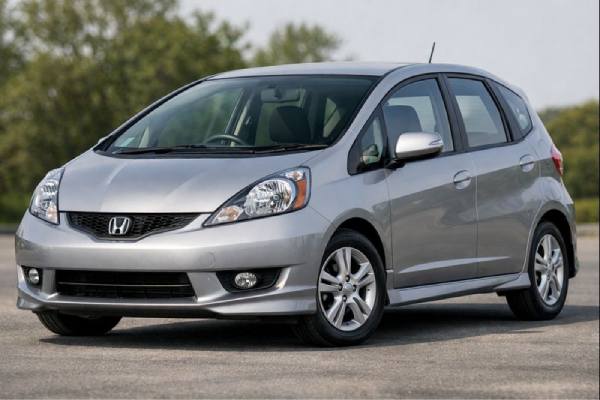
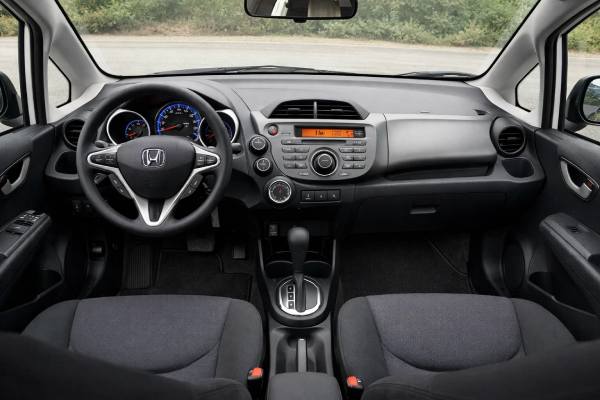
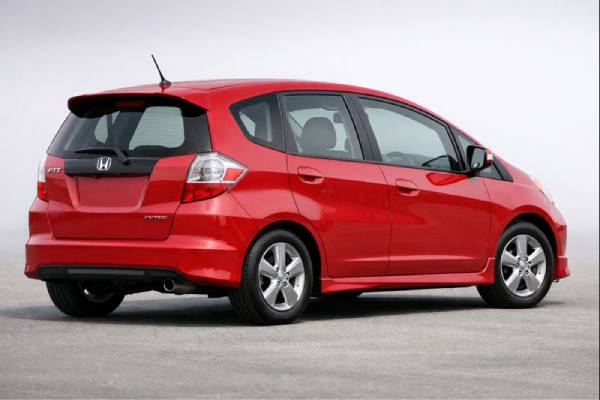
The 2008–2011 Honda Fit (GE8) with the L15A7 1.5-liter i-VTEC is one of those small cars that was engineered like a bigger one. It blends a simple, naturally aspirated drivetrain with unusually smart packaging: a tall roofline, a low cowl, and Honda’s Magic Seat layout that turns a city hatchback into a practical mini-hauler. The L15A7’s timing chain, aluminum construction, and conservative output help keep long-term ownership predictable, while the chassis stays nimble without feeling nervous at highway speeds.
That said, age is now the defining factor. Rubber parts, brakes, and suspension wear matter more than the core engine. Buy well, service it on schedule, and the GE8 Fit can still feel tight and trustworthy for many more years.
Top Highlights
- Big interior flexibility for the size, with up to 57.3 ft³ (1,623 L) cargo space (rear seats folded).
- Simple, efficient powertrain: 117 hp (87 kW) on regular fuel, no turbo heat management.
- Easy city manners: 34.4 ft (10.5 m) curb-to-curb turning diameter.
- Ownership caveat: watch for age-related leaks, worn suspension links, and A/C issues on higher-mile cars.
- Typical interval: change engine oil and filter about every 8,000–12,000 km (5,000–7,500 mi) or 12 months (depending on driving and maintenance minder behavior).
Guide contents
- Fit GE8 engineering tour
- L15A7 technical specifications
- GE8 trims, airbags, and options
- Failures, recalls, and weak spots
- Service schedule and buying advice
- Driving feel and real economy
- Fit GE8 versus key competitors
Fit GE8 engineering tour
Honda’s second-generation Fit (chassis code GE8 in many markets for the 1.5-liter) was designed around one idea: make a small footprint behave like a larger car in daily use. The tall roof and upright seating give you a “perched” driving position with excellent sight lines, but the clever part is under the floor. The fuel tank sits centrally, which frees space for the rear seat mechanisms and enables the Magic Seat system. In practice, that means you can carry tall items (plants, flat-pack furniture) without needing a long cargo bay.
The L15A7 1.5-liter i-VTEC engine fits the same philosophy. It is not tuned to feel fast; it is tuned to feel clean and consistent. Peak power comes high in the rev range, but the engine stays smooth and willing, and it is happy on regular fuel. The drive-by-wire throttle and i-VTEC valvetrain help it deliver usable torque without the surging or lag you can get from small turbo engines of the same era. For owners, that typically translates to fewer heat-related surprises and simpler troubleshooting.
Chassis-wise, the Fit uses MacPherson struts up front and a torsion-beam rear. That rear layout is space-efficient and durable, but it also means the car’s ride quality depends heavily on shock condition and rear bushing health. When everything is fresh, the GE8 feels light on its feet and easy to place in traffic. When worn, it can start to thump over sharp bumps or feel skittish on rough pavement.
If you want the “sweet spot” ownership experience today, look for a Fit with evidence of consistent fluid services and recent suspension refresh work. The core design is robust, but a 15+ year-old example benefits dramatically from renewed rubber, dampers, and brakes.
L15A7 technical specifications
Below are baseline specs for the GE8 Fit 1.5 (L15A7, 117 hp). Markets and trims vary, so treat these as a reference set and confirm against the VIN label and local handbook where needed.
Powertrain and efficiency
| Item | Specification |
|---|---|
| Code | L15A7 |
| Engine layout and cylinders | Inline-4, 16-valve SOHC i-VTEC |
| Displacement | 1.5 L (1,497 cc) |
| Bore × stroke | 73.0 × 89.4 mm (2.87 × 3.52 in) |
| Induction | Naturally aspirated |
| Fuel system | Multi-point fuel injection |
| Compression ratio | 10.4:1 |
| Max power | 117 hp (87 kW) @ 6,600 rpm |
| Max torque | 144 Nm (106 lb-ft) @ 4,800 rpm |
| Timing drive | Chain |
| Rated efficiency (EPA examples) | 7.6–8.1 L/100 km (29–31 mpg US) combined, transmission-dependent |
| Real-world highway @ 120 km/h (75 mph) | Typically ~6.5–7.5 L/100 km (31–36 mpg US) if tires and alignment are healthy |
Transmission and driveline
| Item | Specification |
|---|---|
| Transmission | 5-speed manual or 5-speed automatic (trim/market dependent) |
| Drive type | FWD |
| Differential | Open |
Chassis, brakes, and dimensions
| Item | Specification |
|---|---|
| Suspension (front / rear) | MacPherson strut / torsion-beam |
| Steering | Electric power-assisted rack and pinion, 12.7:1 ratio |
| Steering turns lock-to-lock | 2.48 |
| Brakes (front / rear) | Ventilated disc / drum, 262 / 201 mm (10.3 / 7.9 in) |
| Wheels and tyres | 175/65 R15 (base) or 185/55 R16 (Sport-style packages) |
| Wheelbase | 2,499 mm (98.4 in) |
| Length / width / height | 4,105 / 1,694 / 1,524 mm (161.6 / 66.7 / 60.0 in) |
| Turning circle (curb-to-curb) | 10.5 m (34.4 ft) |
| Kerb (curb) weight | ~1,129–1,181 kg (2,489–2,604 lb), trim and transmission dependent |
| Fuel tank | 40.1 L (10.6 US gal / 8.8 UK gal) |
| Cargo volume | 583 / 1,623 L (20.6 / 57.3 ft³), seats up / seats down |
Fluids and service capacities (common decision-making values)
| Item | Typical specification |
|---|---|
| Engine oil | Honda-spec 5W-20 or market-specified equivalent; capacity ~4.2 L (4.4 US qt) |
| Coolant | Long-life Honda-type coolant; capacity ~4.8 L (5.1 US qt) |
| A/C refrigerant | Varies by market and system; verify under-hood label |
Safety ratings and key safety features (high-level)
| Category | Summary |
|---|---|
| IIHS (US) | Model-year coverage includes strong results in several tests, with later small-overlap findings applicable to 2009–2013 coverage on the same structure |
| NHTSA (US) | Star ratings vary by body style and test category; check exact year and trim in the database |
| Standard safety hardware (typical) | ABS with EBD, stability control (on many trims/years), front and side airbags plus side curtains (market/trim dependent) |
GE8 trims, airbags, and options
Most GE8 Fit buyers are really shopping for two things: the seat and storage configuration, and the equipment package that affects day-to-day comfort. Names vary by region, but in many markets you will see a base-style model and a sport-oriented trim. The “Sport” theme usually adds larger wheels, a thicker anti-roll bar setup, exterior add-ons, and in some cases steering-wheel controls and upgraded audio. The mechanical core stays the same: the L15A7 engine and front-wheel-drive layout.
How to identify common equipment differences quickly
- Wheels and tires: 15-inch wheels often signal the more basic equipment level; 16-inch alloys commonly indicate Sport-oriented trims.
- Cabin cues: steering-wheel audio controls, cruise control buttons, and upgraded speaker counts often show up on better-equipped versions.
- Automatic transmission extras: some 5-speed automatics include a sport mode and steering-wheel paddle shifters, which is a quick visual tell.
- Magic Seat presence: the Magic Seat system is a hallmark feature, but confirm the exact configuration if you are shopping in a market where fleets or special editions exist.
Safety systems: what you should expect
For this generation, safety is mostly about structure and fundamental electronics rather than modern driver assistance. Many examples include:
- ABS and electronic brake distribution (EBD) for more stable braking on mixed-grip surfaces.
- Stability control and traction control on a large share of trims, especially later years and higher packages.
- Airbags: front airbags are a given; side torso airbags and side curtains are common but can be trim- and market-dependent, so verify the airbag markings on the seats and A-pillars.
Crash-test interpretation without confusion
If you are comparing safety ratings, keep two nuances in mind:
- Rating bodies are not interchangeable. NHTSA star ratings, IIHS ratings, and Euro NCAP scores are built on different test types and scoring methods, so compare like with like.
- Test updates matter. Over time, organizations added more demanding crash scenarios (notably small-overlap front tests). A car can score well under the earlier regime and look weaker under later test additions without the underlying car “getting worse.”
ADAS expectations (and what is not here)
Do not buy a GE8 Fit expecting today’s driver-assistance suite. Features like automatic emergency braking, adaptive cruise control, and lane centering were not typical for this generation. The advantage is simplicity: fewer sensors and fewer calibration costs after windshield replacement or front-end repairs. The downside is obvious: you must rely on basic crash protection and attentive driving rather than avoidance tech.
Failures, recalls, and weak spots
The GE8 Fit’s reputation is strong, but it is now old enough that “reliability” depends heavily on maintenance history and climate exposure. A useful way to think about it is prevalence (how often an issue shows up) and cost tier (how painful it is when it does).
Common and usually low-cost
- Sway bar links and front strut mounts
- Symptoms: clunks over bumps, vague front-end feel, minor steering vibration.
- Likely cause: worn ball joints in end links or aging top mounts.
- Remedy: replace links/mounts; align afterward if front suspension geometry is disturbed.
- Typical age band: 80,000–160,000 km (50,000–100,000 mi), earlier on rough roads.
- Hatch leaks and water in the spare tire well
- Symptoms: damp carpet, musty smell, condensation, rust around the well.
- Likely cause: aged hatch seals, blocked drains, or previous rear-end repair sealing issues.
- Remedy: reseal and clear drains; dry thoroughly to prevent corrosion and electrical issues.
- Ignition components and misfire maintenance
- Symptoms: rough idle, flashing check engine light, hesitation under load.
- Likely cause: coil aging, plug wear, or overdue valve clearance adjustment.
- Remedy: diagnose properly (misfire codes and plug inspection), replace coils as needed, and address valve lash if noise or misfires persist.
Occasional, medium-cost
- A/C compressor or clutch wear
- Symptoms: intermittent cooling, squeals, metal debris in the system (worst case).
- Likely cause: age-related compressor wear or clutch issues.
- Remedy: repair early; a failed compressor can contaminate the system and raise costs.
- Engine mounts
- Symptoms: vibration at idle, thump on engagement, harshness on acceleration.
- Likely cause: mount rubber fatigue.
- Remedy: replace the worst mount first (often the primary engine mount), then reassess.
Rare but high-impact
- Severe corrosion in salted climates
- Symptoms: brake line corrosion, suspension hardware seizure, structural rust near rear arches or substructure.
- Likely cause: winter road salt plus poor underbody washing.
- Remedy: avoid badly corroded examples; rust repair can exceed vehicle value.
Recalls, service bulletins, and how to verify
Because recall campaigns can affect airbags or driveline components on older vehicles, verification matters more than memory. The best approach is:
- Run the VIN through an official recall database.
- Ask for dealer-completed recall documentation.
- Confirm there are no open campaigns before you budget for upgrades.
Even if the car drives well, unresolved recall work can affect safety, resale, and insurability in some regions.
Service schedule and buying advice
A GE8 Fit that lasts is usually not one that was “babied,” but one that was serviced consistently. The L15A7 does not demand exotic care, yet it responds well to correct fluids, clean filters, and periodic inspection of wear items.
Practical maintenance schedule (distance or time, whichever comes first)
- Engine oil and filter: every 8,000–12,000 km (5,000–7,500 mi) or 12 months. Short trips and cold starts justify the shorter end.
- Engine air filter: inspect every 15,000 km (10,000 mi); replace around 30,000–45,000 km (20,000–30,000 mi) depending on dust.
- Cabin air filter: every 15,000–30,000 km (10,000–20,000 mi) or annually for allergy-prone drivers.
- Brake fluid: every 3 years (moisture absorption is time-based).
- Coolant: follow the long-life interval for your coolant type; many long-life coolants run roughly 5 years after the initial long interval, but confirm the exact spec used in your market.
- Spark plugs: typically 160,000 km (100,000 mi) on long-life plugs, but earlier if misfires appear or service history is unknown.
- Transmission fluid:
- 5-speed automatic: consider drain-and-fill service around 60,000–100,000 km (40,000–60,000 mi) depending on heat and city use.
- 5-speed manual: refresh fluid around 80,000–120,000 km (50,000–75,000 mi) or sooner if shifting feels notchy.
- Valve clearance (if noisy or symptomatic): inspect if you hear persistent ticking, notice rough idle, or see recurring misfire codes after ignition service.
- Serpentine belt and hoses: inspect annually; replace at the first sign of cracking, glazing, or coolant seepage.
- 12 V battery: test yearly after year 3; many last 4–6 years depending on climate.
Fluids that are worth insisting on
- Engine oil: use the viscosity and certification specified for your market (many are 5W-20 for this era), and keep the level monitored between changes.
- Automatic transmission fluid: prefer Honda-spec fluid (avoid generic “universal” ATF unless explicitly approved).
- Coolant: stick to the correct long-life coolant type to reduce corrosion risk in the aluminum cooling system.
Buyer’s guide checklist (what to inspect in 20 minutes)
- Underbody and rear arches: look for bubbling paint, crusty seams, and brake line corrosion.
- Hatch area and spare tire well: lift the floor and check for moisture or rust.
- Cold start behavior: listen for abnormal rattles; a healthy L15A7 should sound clean and settle quickly.
- Steering and suspension: clunks over bumps usually point to links/mounts, not catastrophic failures.
- A/C performance: verify stable cold air at idle and while driving.
- Service history: prioritize documented fluid services over low mileage alone.
If you want a long-term keeper, pay extra for condition and documentation. A cheaper Fit that needs suspension, tires, brakes, and deferred fluids can erase the savings quickly.
Driving feel and real economy
The GE8 Fit’s road personality is defined by lightness and visibility. Around town, it feels smaller than it looks inside. The steering is quick enough to place the car accurately, and the short turning diameter makes tight parking easy. On the highway, the Fit tracks better than many older subcompacts, but tire choice matters: cheap, hard tires can add noise and reduce wet grip.
Powertrain character
The L15A7 makes its power high, so it rewards smooth throttle and letting the engine breathe rather than short-shifting at very low rpm. With the 5-speed manual, the Fit feels lively and direct, especially in the midrange where the gearing keeps the engine responsive. The 5-speed automatic is usually tuned for calm, predictable shifts rather than aggressive kickdown. If the automatic feels “busy,” old fluid or mismatched tires can exaggerate the sensation.
Real-world efficiency
Official EPA figures for the 1.5-liter Fit cluster around:
- Manual: about 8.1 L/100 km (29 mpg US) combined, with highway numbers around 7.1 L/100 km (33 mpg US).
- Automatic: about 7.6 L/100 km (31 mpg US) combined, with highway numbers around 6.7 L/100 km (35 mpg US).
In real life, a healthy Fit driven at 100–120 km/h (60–75 mph) often returns roughly 6.5–7.5 L/100 km (31–36 mpg US). Winter short trips can push consumption higher because the engine spends more time warming up, and underinflated tires are a common hidden culprit.
Key performance metrics (typical ranges)
- 0–100 km/h (0–62 mph): roughly 9.8–11.5 seconds depending on transmission, tires, and load.
- Top speed: typically in the 170–180 km/h (105–112 mph) range.
- Braking feel: consistent when the rear drums are properly adjusted and front calipers slide freely; neglected rear brakes can make the pedal feel less confident.
Ride, handling, and NVH
- Ride: firm but not harsh when dampers are healthy; worn shocks make it choppy.
- Handling: neutral and predictable; the torsion-beam rear is stable, but mid-corner bumps can upset the car if rear bushings are tired.
- Noise: expect more tire and wind noise than a modern compact, but good tires and intact door seals make a real difference.
Overall, the Fit is less about outright speed and more about easy, efficient mobility with a surprisingly “grown-up” feel for a small hatch.
Fit GE8 versus key competitors
The GE8 Fit’s strongest argument against rivals is not horsepower. It is usable space, mechanical simplicity, and a design that ages gracefully when maintained.
Versus Toyota Yaris (similar era)
- Fit advantage: interior versatility and cargo flexibility; Magic Seat-type utility is hard to match.
- Yaris advantage: often slightly simpler rear packaging and, in some markets, a reputation for minimal drama.
- Choose the Fit if: you actually use the hatch and rear seat configurations for real cargo tasks.
Versus Mazda2
- Fit advantage: more upright cabin space and better “small van” practicality.
- Mazda2 advantage: sharper steering feel and a more playful chassis balance.
- Choose the Fit if: you want one car to do errands, commuting, and occasional hauling without feeling cramped.
Versus Ford Fiesta (early generations in this timeframe)
- Fit advantage: generally simpler long-term ownership and strong packaging.
- Fiesta advantage: often more refined ride and steering tuning, depending on spec.
- Choose the Fit if: you value predictable maintenance over a more European-style driving feel.
Versus Hyundai Accent and Kia Rio
- Fit advantage: packaging creativity, strong aftermarket support, and a well-proven engine design.
- Korean rivals’ advantage: sometimes newer for the same money, depending on your market, which can mean fewer age-related issues.
- Choose the Fit if: you find a well-kept example with service records; condition matters more than badge at this age.
Bottom-line recommendation
If your priority is maximum interior usefulness per meter of parking space, the GE8 Fit is still a standout. If your priority is the quietest cabin or the newest safety technology, you may be happier moving up to a newer generation or a larger class. For many owners, the GE8 remains a sweet spot: simple, practical, efficient, and surprisingly versatile.
References
- FiT 2008 (Fact Sheet)
- 2009 Honda Fit 2009 (Fuel Economy Data)
- 2009 Honda Fit 4-door wagon 2009 (Safety Rating)
- Vehicle Detail Search – 2009 HONDA FIT 4 DR metrics | NHTSA 2009 (Recall Database and Ratings)
Disclaimer
This article is for informational purposes only and is not a substitute for professional inspection, diagnosis, or repair. Specifications, torque values, fluid capacities, service intervals, and procedures can vary by VIN, market, production date, and equipment. Always verify details using the official owner’s manual and service documentation for your exact vehicle, and consult a qualified technician when safety-related work is involved.
If you found this guide useful, please consider sharing it on Facebook, X (Twitter), or your favorite forum to help others find it.