
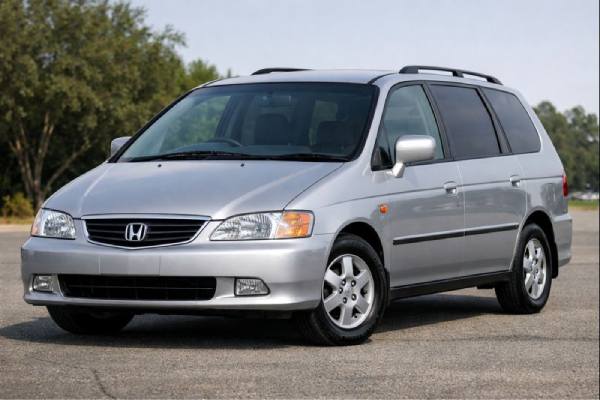
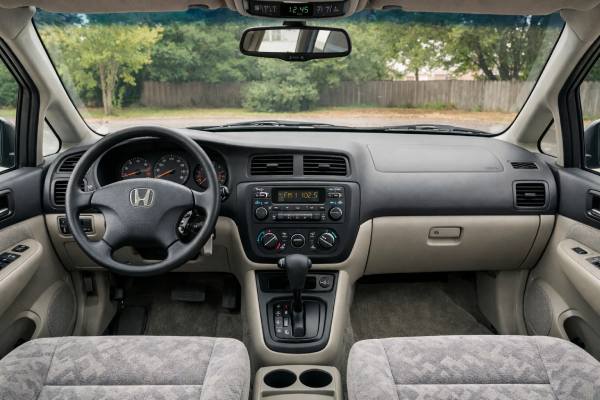

Honda’s RA3-generation Odyssey sits in a sweet spot for owners who want a compact, road-friendly minivan that still feels like a Honda from the late 1990s: light controls, efficient packaging, and a straightforward drivetrain. In FWD form with the 2.3-liter F23A7, it prioritizes smooth, quiet family transport over outright speed. The single-overhead-cam VTEC setup is tuned for usable torque and low-stress cruising, and the 4-speed automatic is calibrated for comfort rather than aggressive shifting.
What makes the RA3 compelling today is how “mechanical” and serviceable it remains—especially compared with newer vans full of integrated electronics. At the same time, age and parts history matter more than mileage alone, so the best examples are the ones with documented timing-belt service, clean cooling system maintenance, and evidence that recall-related work has been completed.
Owner Snapshot
- Comfortable, stable highway van with a sedan-like driving position and predictable handling for its size.
- The F23A7 is typically long-lived when oil and coolant health are treated as priorities, not afterthoughts.
- Expect age-related rubber and suspension wear; budgeting for bushings and engine mounts is normal.
- Timing belt service is the big interval: plan every 90,000–100,000 km (55,000–62,000 mi) or 5–7 years.
- Most owners get the best results from conservative transmission care: fluid refreshes every 40,000–60,000 km.
What’s inside
- RA3 FWD detailed picture
- F23A7 specs and measurements
- Trims, safety, and equipment
- Reliability, faults, and recalls
- Maintenance and smart buying
- Road manners and real use
- RA3 Odyssey vs its rivals
RA3 FWD detailed picture
The Honda Odyssey RA3 (1998–2001) is the “international/JDM-style” Odyssey that feels closer in footprint to a large wagon than a modern full-size minivan. In FWD form, it’s designed for paved-road family duty: predictable traction, easy parking manners, and a low step-in height that makes daily errands and child-seat life simpler. The chassis is tuned for stability at speed, and the cabin layout focuses on practical space rather than sliding-door theatrics or heavy luxury features.
At the heart of this version is Honda’s 2.3-liter F23A7—an inline-four with a single overhead cam and VTEC in a calibration aimed at smoothness and efficiency. In real ownership terms, the engine is happiest when it is not overheated and not run low on oil. Treat those two risks as “must-prevent,” and the drivetrain tends to reward you with steady, low-drama running even at higher mileage.
The RA3’s FWD drivetrain also shapes how it feels on the road. Compared with the 4WD/AWD variants, the FWD van generally carries less driveline complexity: fewer rotating parts, fewer seals, and fewer fluid circuits to maintain. That tends to lower ongoing costs and makes diagnosis easier. The trade-off is that in deep snow, steep unpaved climbs, or slippery starts with a full passenger load, it relies more on tire choice and careful throttle than on extra traction hardware.
Where the RA3 shines is in the “family highway” mission. With appropriate tires and good alignment, it tracks straight, doesn’t wander, and responds to steering inputs in a calm, confidence-building way. It’s also a vehicle that benefits from being kept stock: original wheel sizes, factory ride height, and correct load-rated tires keep braking, ride quality, and transmission shifting closer to what Honda intended.
If you’re considering one today, think in systems rather than cosmetics. Paint and interior wear are visible, but the big long-term costs come from deferred timing-belt service, neglected transmission fluid, old cooling components, and tired suspension bushings. A clean, well-serviced RA3 will feel tight and quiet; a neglected one can feel noisy, floaty, and inconsistent under braking—even if it still “runs fine.”
F23A7 specs and measurements
Specs can vary by market, grade, and production month, so treat the tables below as a practical baseline for a typical RA3 FWD (2.3 VTEC, 4AT) in the 1998–2001 window.
Powertrain and efficiency
| Item | Specification |
|---|---|
| Engine code | F23A7 |
| Engine layout and cylinders | Inline-4, SOHC, 16 valves (4 valves/cyl) |
| Displacement | 2.3 L (≈2253–2254 cc) |
| Bore × stroke | 86.0 × 97.0 mm (3.39 × 3.82 in) |
| Induction | Naturally aspirated |
| Fuel system | PGM-FI (port fuel injection) |
| Compression ratio | ≈9.3:1 |
| Max power | 150 hp (≈110 kW) @ 5,600 rpm |
| Max torque | ≈204 Nm (≈150 lb-ft) @ 4,700 rpm |
| Timing drive | Timing belt (service interval critical) |
| Rated efficiency | Commonly around 9–10.5 L/100 km (≈22–26 mpg US / 27–31 mpg UK) depending on cycle and trim |
| Real-world highway @ 120 km/h (75 mph) | Often ~8.5–10.0 L/100 km (≈24–28 mpg US / 29–34 mpg UK) when healthy and aligned |
| Aerodynamics | Cd not consistently published for all trims; expect typical late-1990s minivan drag |
Transmission and driveline
| Item | Specification |
|---|---|
| Transmission | 4-speed automatic with lock-up torque converter |
| Drive type | FWD |
| Differential | Typically open |
| Driver aids (era-correct) | ABS common; traction control depends on market/grade |
Chassis and dimensions
| Item | Typical specification (may vary) |
|---|---|
| Suspension (front/rear) | Independent layouts commonly listed as double wishbone (trim/market dependent) |
| Steering | Power-assisted rack-and-pinion (ratio varies by rack; verify on your VIN) |
| Brakes | Front discs; rear discs on many trims (diameters vary by supplier listing and grade) |
| Wheels and tires | Common: 205/65 R15 |
| Ground clearance | ~125–130 mm (≈4.9–5.1 in) |
| Length / width / height | ~4760–4770 / ~1790–1795 / ~1640–1675 mm |
| Wheelbase | 2830 mm (111.4 in) |
| Turning circle (kerb-to-kerb) | ~11.4 m (≈37.4 ft) |
| Kerb weight | Often ~1520–1600 kg (≈3350–3530 lb) depending on equipment |
| Fuel tank | 65 L (≈17.2 US gal / 14.3 UK gal) |
| Cargo volume | Varies heavily by seat layout; measure matters more than brochure numbers |
Performance and capability (typical expectations)
| Metric | Typical |
|---|---|
| 0–100 km/h (0–62 mph) | ~11.5–13.0 s (load, tires, and altitude matter) |
| Top speed | ~175–185 km/h (109–115 mph) |
| Braking 100–0 km/h | Depends on tires and brake condition; prioritize straight, stable stops over “numbers” |
| Towing and roof load | Market-specific; treat as light-duty unless your handbook explicitly approves higher ratings |
Fluids and service capacities (decision-useful basics)
| Item | Practical guidance (verify by VIN) |
|---|---|
| Engine oil | Quality 5W-30 or 10W-30 (climate dependent); capacity typically ~4.0–4.5 L with filter |
| Coolant | Honda-compatible long-life coolant; mix ratio per climate |
| Automatic transmission fluid | Honda ATF (period-correct spec); refresh intervals matter more than “lifetime” claims |
| A/C refrigerant | System-dependent; charge amount varies—use under-hood label |
| Key torque specs | Use service manual for fasteners like wheels, calipers, and suspension arms |
Electrical
| Item | Typical |
|---|---|
| 12V battery | Size varies by market tray; choose correct CCA for winter starts |
| Spark plugs | Type depends on ignition system spec; replace on schedule and check gap to spec |
| Alternator | Output depends on equipment load (A/C, audio, etc.); test under load if lights dim at idle |
Safety and driver assistance
For this era and this market segment, do not expect modern ADAS. You’re mainly relying on structure, belts, airbags, and ABS. Some RA3 variants are associated with airbag inflator-related recall actions in later years, so documentation matters more than sales claims.
Trims, safety, and equipment
RA3 Odyssey trims vary widely by market, and many vehicles have been imported, re-registered, or lightly modified over time. That means trim badges alone are not a reliable guide. A better approach is to identify the car by seating configuration, wheel size, brake hardware, and factory options visible inside the cabin.
Trims and options you’ll commonly see
- 6-seat or 7-seat layouts: Many RA3 configurations emphasize individual comfort rather than maximum passenger count. Look at the second-row arrangement and whether the seat bases slide independently.
- “S kit” or aero packages: Period Honda styling packages often add bumper lips and side skirts. These are cosmetic but can signal an enthusiast-owned example—sometimes good, sometimes a sign of rougher use.
- Climate and convenience: Dual-zone setups, rear vents, and upgraded audio are common “family comfort” options. Confirm all blower speeds work; weak airflow often points to cabin filter neglect, fan resistor issues, or debris in the intake.
- Wheels and tires: Most stock setups use 15-inch wheels with tall sidewalls for ride comfort. Oversized wheels can make the van feel harsher and increase load on suspension bushings and wheel bearings.
Quick identifiers that help you confirm equipment
- ABS check: At key-on, the ABS lamp should illuminate and then go out after startup. An illuminated ABS lamp can be a wheel speed sensor issue, wiring corrosion, or a failing ABS modulator—repairs range from simple to costly.
- Airbag system check: SRS lamp behavior matters. The light should come on at key-on and then go out. If it stays on, don’t ignore it; you want working restraints in a vehicle this age.
- Seatbelt hardware: Some late-1990s updates brought improved belt features. Check belt retraction, buckle latching, and fraying at the B-pillar.
Safety ratings: what you can and cannot assume
Formal crash-test ratings (Euro NCAP, IIHS) are often not available in a clean, directly comparable form for this specific RA3 configuration and market. Even when ratings exist for “an Odyssey,” they may refer to a different regional model with different structure and restraint tuning. Treat generic ratings as background, not proof.
Instead, evaluate safety by:
- Restraint condition: Belts, anchors, and airbags.
- Brake health: Even pad thickness is not enough—check for pulsation, fluid age, and caliper slide pin condition.
- Tire age and load rating: Old tires reduce wet braking and stability more than most owners realize.
- Lighting performance: Headlight lens haze is common; clarity and aim are real safety upgrades.
Driver assistance and stability systems
In this era, you’re typically looking at:
- ABS (common)
- Basic traction control (market/grade dependent, not universal)
- No modern lane assist or AEB (not expected)
Finally, remember that equipment changes year-to-year can be subtle. A “1999” registration date doesn’t guarantee the car’s true production month. If you need precision—especially for recall eligibility—use VIN/chassis verification and official recall search tools rather than relying on model-year assumptions.
Reliability, faults, and recalls
A well-kept RA3 Odyssey can be a dependable family vehicle, but it is now an aging platform. Reliability is less about the design and more about maintenance history, previous repairs, and parts quality. Think of it as a set of systems that must stay in balance: oil control, cooling control, and transmission health are the “big three.”
Common issues (higher prevalence)
1) Timing belt overdue (high severity if ignored)
- Symptoms: No warning until failure; sometimes squeaks from old tensioners or idlers.
- Root cause: Age and heat cycles degrade belt rubber and bearing grease in idlers/tensioners.
- Remedy: Replace timing belt, tensioner, idlers, and typically the water pump as a set. If records are unclear, assume it’s due.
2) Cooling system aging (medium-to-high severity)
- Symptoms: Slow coolant loss, overheating in traffic, weak cabin heat, fluctuating temperature.
- Root cause: Old radiator plastic end tanks, tired hoses, stuck thermostat, weak cap, or neglected coolant.
- Remedy: Pressure test the system, refresh wear parts, and keep correct coolant mix. Overheating is one of the fastest ways to turn a “good engine” into an expensive one.
3) Automatic transmission shift quality decline (medium severity, cost varies)
- Symptoms: Harsh 1–2 shift, delayed engagement, flare, shudder at light throttle, or inconsistent lock-up.
- Root cause: Old fluid, varnish buildup, or long intervals between services.
- Remedy: Conservative fluid servicing using correct ATF. Avoid aggressive “power flush” approaches on unknown-history units; staged drain-and-fill is often safer.
4) Suspension bushings and engine mounts (medium severity)
- Symptoms: Clunks over bumps, steering wobble, braking instability, vibration at idle in gear.
- Root cause: Rubber aging and road salt exposure.
- Remedy: Replace worn bushings, ball joints, and mounts. A refreshed front end can transform how the RA3 feels.
Occasional issues
- Oil seepage from seals and gaskets: Common on older Honda engines; monitor level and address leaks that reach the timing belt area.
- SRS/ABS warning lights: Often wiring, sensor, or connector issues rather than major module failure—but diagnosis is required.
- A/C performance: Leaks at O-rings or aging condensers can reduce cooling; verify pressures and fan operation.
Recalls, service actions, and why they matter now
For a vehicle from this era, recall completion is a major value and safety factor. Three categories are especially relevant:
- Engine-related oil seal concerns: Some recall actions involve oil leakage risk and preventive hardware updates.
- Multi-model recall campaigns including RA3 chassis ranges: These can involve components that age poorly or have known manufacturing issues.
- Airbag inflator campaigns: These matter because they directly affect occupant protection and may require parts availability planning.
How to verify completion (best practice)
- Ask for paperwork from previous owners or dealers showing campaign numbers and dates.
- Use official recall lookup resources for your market and chassis number.
- If unsure, call a Honda dealer parts/service desk with the chassis/VIN and request campaign status.
Pre-purchase checks to request (high value)
- Proof of timing belt kit replacement (belt, tensioner, water pump)
- Evidence of regular ATF servicing with the correct fluid
- Cooling system pressure test or at least documentation of radiator/thermostat work
- Brake inspection report (rotors, calipers, fluid age)
- Confirmation that recall campaigns tied to your chassis number are closed
A RA3 that passes these checks is often a “quietly great” used minivan. One that fails them can quickly become a project—especially if overheating or transmission neglect is involved.
Maintenance and smart buying
The best way to keep an RA3 Odyssey inexpensive is to prevent big failures with routine service. Because the vehicle is older, time-based aging now matters as much as distance. Use a schedule that covers both.
Practical maintenance schedule (distance/time)
Every 7,500–10,000 km (5,000–6,000 mi) or 6–12 months
- Engine oil and filter (short trips and hot climates = shorter intervals)
- Visual checks: coolant level, hose condition, oil leaks, belt condition, tire wear
Every 15,000–20,000 km (9,000–12,000 mi)
- Tire rotation and brake inspection (pad thickness, rotor condition, caliper slide movement)
- Cabin air and engine air filter inspection/replacement (as equipped)
Every 40,000–60,000 km (25,000–37,000 mi) or 2–3 years
- Automatic transmission fluid refresh (use correct Honda-spec fluid)
- Brake fluid replacement (critical for pedal feel and corrosion prevention)
- Alignment check (especially if you see inner-edge tire wear)
Every 90,000–100,000 km (55,000–62,000 mi) or 5–7 years
- Timing belt service: belt, tensioner, idlers, and commonly water pump
- Coolant replacement (also consider thermostat and radiator cap if age is unknown)
Every 100,000–160,000 km (62,000–100,000 mi)
- Spark plugs (interval depends on plug type and operating conditions)
- Inspect engine mounts, control arm bushings, ball joints, and sway bar links
As needed (age-driven)
- Radiator replacement if original and showing weakness
- Suspension refresh if ride becomes floaty or noisy
- A/C leak diagnosis if cooling fades
Fluids, parts choices, and what matters most
- Oil: Use a quality oil of the correct viscosity for your climate. Low oil is more dangerous than “wrong brand.”
- Coolant: Stick to Honda-compatible coolant chemistry; mixing unknown coolants can accelerate corrosion.
- ATF: Use the correct Honda-spec fluid. Transmission behavior is strongly influenced by fluid friction characteristics.
Buyer’s guide: what to seek, what to avoid
Seek
- Clean service history with timing belt documentation
- Smooth, consistent shifting when fully warm
- Stable temperature under load (long climb, traffic idle, A/C on)
- Even tire wear and a straight brake pedal with no vibration
- A dashboard free of persistent ABS/SRS warning lights
Be cautious with
- Overheating history (even “once”)
- Transmission flare, delayed engagement, or shudder during light acceleration
- Heavy steering pull, clunks, or uneven ride height (can indicate suspension fatigue or past impact)
- Cars with multiple electrical “quirks” and aftermarket wiring
Common reconditioning items to budget for
- Timing belt kit if history is unclear
- Front suspension arms/bushings and alignment
- Brake service (pads/rotors and caliper servicing)
- Engine mounts if vibration is noticeable
Long-term durability outlook
With preventive maintenance, the RA3 can remain a dependable daily family vehicle. The ownership curve is simple: the first owner neglect you inherit is what determines your first year’s costs. Once you bring fluids, timing service, and cooling health up to standard, the vehicle often settles into a steady rhythm of routine consumables.
Road manners and real use
The RA3 Odyssey’s driving experience is defined by calmness rather than excitement. It’s not a tall, top-heavy van that feels nervous in crosswinds; it’s closer to a large wagon in how it places you relative to the road. When suspension components are healthy, it feels controlled and “Honda-like”—light steering effort, clean turn-in for a family vehicle, and stable braking.
Ride, handling, and NVH (noise, vibration, harshness)
- Ride quality: Stock tire sizes and correct pressures give the best balance. Tall sidewalls help the van absorb sharp edges without crashing.
- Handling: The chassis is set up for safe understeer. Push it hard and it will lean, but it generally communicates grip loss in a progressive way.
- Highway stability: One of the model’s strengths. A good alignment and fresh suspension bushings reduce wandering and make long trips easier.
- NVH: Expect some wind and road noise by modern standards. Excessive vibration usually points to mounts, worn tires, or a drivetrain issue rather than “normal age.”
Powertrain character
The 2.3-liter F23A7 is smooth and flexible, with enough torque to keep up with traffic even when loaded, but it’s not a punchy engine. The 4-speed automatic prefers early upshifts and uses lock-up to keep revs controlled on steady cruise. If the transmission hunts between gears on gentle hills, it can indicate old fluid, incorrect tire sizing, or a throttle-position/engine-tune problem.
Practical driving notes:
- The engine feels best when the cooling system is strong; heat soak reduces performance and increases risk.
- Throttle response is predictable rather than sharp—ideal for passengers.
- Passing power is adequate, but planning helps, especially at highway speeds with a full load.
Real-world efficiency
Expect economy to be highly sensitive to:
- Tire choice and pressure
- Alignment (toe settings can quietly destroy fuel economy)
- Roof racks and cargo boxes
- City traffic and short-trip use
- A/C use and ambient temperature
Many owners see their best numbers on steady highway runs where lock-up stays engaged. If your economy is consistently poor, look first for dragging brakes, tired oxygen sensors, clogged air filters, and incorrect tire sizing.
Load behavior and practicality
The RA3 is a better “people mover” than a heavy hauler. With passengers and luggage, it remains stable, but acceleration and braking margins shrink. That makes maintenance more important, not less:
- Keep brakes and tires in top condition.
- Replace shocks/struts when control fades.
- Don’t ignore engine mount wear; it affects comfort and driveline alignment.
In daily use, the low step-in height and predictable road manners are the reasons owners keep these vans. The key is to keep it stock-ish, serviced, and mechanically tidy.
RA3 Odyssey vs its rivals
To compare the RA3 Odyssey fairly, focus on what it was meant to be: a late-1990s, road-focused minivan with Honda serviceability and a compact footprint. Its closest “rivals” depend on your market, but the trade-offs stay consistent.
Versus Toyota minivans of the era
- Strengths of the RA3: Often feels more car-like in steering and ride tuning, and the engine bay layout can be straightforward for routine service.
- Where Toyota may win: Some Toyota drivetrains from the era are more tolerant of neglect, and parts availability can be broader depending on region.
- Practical verdict: Choose the RA3 if you value driving feel and packaging. Choose Toyota if you prioritize “appliance-level” tolerance and local parts supply.
Versus Mitsubishi, Nissan, and Mazda people movers
- Strengths of the RA3: Balanced chassis, predictable controls, and a strong community knowledge base around Honda maintenance routines (timing belt discipline, fluid discipline).
- Where others may win: Certain rivals offer different seating concepts, sliding doors, or alternative engine choices that suit specific uses.
- Practical verdict: The RA3 is the “clean, sensible choice” when condition is good. Many rivals become expensive when electrical issues stack up.
Versus newer minivans (the temptation upgrade)
- Strengths of the RA3: Lower complexity, simpler diagnostics, fewer integrated modules, and often lower ownership cost if you can do basic maintenance.
- Where newer vans win: Modern crash structures, better airbags and ADAS, more power, and often better fuel efficiency at similar performance levels.
- Practical verdict: If your priority is maximum safety technology, a newer van is the rational move. If your priority is a serviceable, honest vehicle with manageable costs, a sorted RA3 can still make sense.
The “best use case” for the RA3 today
This Odyssey is at its best for owners who:
- Want a compact minivan footprint with reliable highway comfort
- Can verify service history and keep up with preventive maintenance
- Prefer simple mechanical ownership over tech-heavy features
- Don’t need deep-snow traction (or can solve it with excellent winter tires)
If you match that profile, the RA3 is often a surprisingly satisfying long-term vehicle—especially when you buy condition first and treat timing belt, cooling, and ATF as non-negotiable.
References
- Honda’s Odyssey Goes Through a Minor Model Change | Honda Global Corporate Website 1997 (News Release)
- オデッセイ、アコードなど 7車種のリコール | Honda 2000 (Recall Notice)
- オデッセイ、ライフ、ロゴなど 13車種のリコール | Honda 2002 (Recall Notice)
- ライフなど11車種のリコール | Honda 2020 (Recall Notice)
Disclaimer
This article is for informational purposes only and is not a substitute for professional inspection, diagnosis, or repair. Specifications, torque values, service intervals, and procedures vary by VIN/chassis number, market, production month, and equipment; always verify details against your official owner’s manual and service documentation before purchasing parts or performing work.
If you found this guide useful, please consider sharing it on Facebook, X (Twitter), or your favorite forum to support our work.