
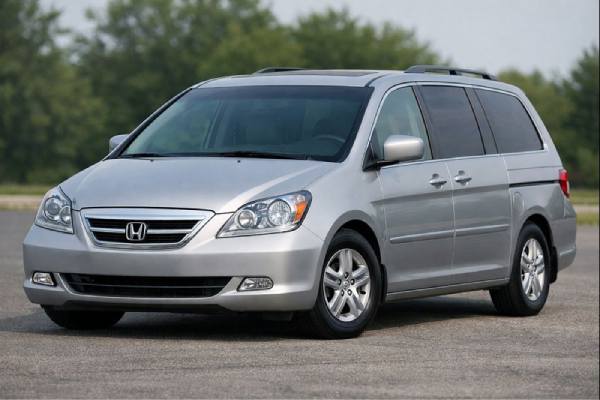


The 2005–2007 Honda Odyssey FWD (RL3) sits in a sweet spot for family buyers who want modern crash structure, a strong naturally aspirated V6, and genuinely useful packaging without today’s complexity. The J35A6 3.5-liter V6 (255 hp) delivers smooth, low-effort acceleration, and the front-wheel-drive layout keeps winter behavior predictable on good tires. Most owners love the “big car” stability at highway speeds, the wide-opening doors, and the flexible second and third rows that make daily life easier.
The trade-offs are mostly age-and-miles related: these vans reward maintenance discipline, especially with transmission fluid quality, timing-belt history, and keeping the cooling system healthy. Buy one with documented service and you can still get a durable, quiet long-distance family hauler that feels more refined than many rivals from the same era.
At a Glance
- Strong, smooth V6 power with easy highway passing and confident merging
- Practical cabin packaging with real adult-friendly third-row usability
- Good crash-test performance for its era, with full-length side curtains on many trims
- Budget for age-related wear items: sliding doors, engine mounts, and suspension bushings
- Plan on timing-belt service about every 105,000 miles (169,000 km) or 7 years
Navigate this guide
- Odyssey RL3 ownership overview
- J35A6 specs and capacities
- 2005–2007 trims and safety
- Common faults and recalls
- Maintenance plan and buying tips
- Real-world performance feel
- Odyssey vs Sienna and others
Odyssey RL3 ownership overview
Honda’s 2005 redesign brought a stiffer body, a more car-like driving position, and a powertrain that feels “right-sized” for a seven- or eight-passenger van. The J35A6 V6 is a naturally aspirated, single-overhead-cam V6 designed to make torque smoothly rather than chase high-rpm drama. In normal driving it’s quiet, and it rarely feels strained—one reason these Odysseys still make sense as long-distance family transport.
From an ownership angle, the best way to think about the 2005–2007 FWD Odyssey is “high capability, medium complexity.” You get sliding doors, a multi-zone HVAC system, lots of power accessories, and (on higher trims) additional electronics and a heavier options load. None of that is exotic, but at 15–20 years old it means your buying decision should prioritize condition and records over mileage alone.
What this generation does especially well:
- Stability and comfort: It tracks straight at speed, handles crosswinds better than many older minivans, and brakes with confidence when everything is in good shape.
- Usable space: The third row is not an afterthought, and the cargo well behind it makes daily errands easy without always folding seats.
- Power delivery: The V6 matches the vehicle’s weight well, so it doesn’t feel underpowered with a full load.
Where owners typically feel the age:
- Transmission behavior depends heavily on fluid care. A well-serviced unit can feel crisp; a neglected one may develop shuddering or flares.
- Sliding door hardware and sensors can become finicky (rollers, cables, latches, and alignment).
- Rubber parts and mounts take a beating in a heavy vehicle: engine mounts, control-arm bushings, and sway-bar links are common “refresh” items.
If you’re shopping, your goal is to find an Odyssey that’s already had the “big-ticket age services” done correctly—timing belt, water pump, spark plugs (if due), and at least routine ATF drain-and-fills. That’s the difference between a van that feels solid and one that slowly becomes a project.
J35A6 specs and capacities
Below are the core specifications you’ll care about for the 2005–2007 Honda Odyssey FWD (RL3) with the J35A6 3.5-liter V6 and 5-speed automatic. Some measurements can vary slightly by trim, wheels/tires, and market equipment, so treat the tables as a practical reference and verify against the label data and service documentation for your exact VIN.
Powertrain and efficiency
| Item | Specification |
|---|---|
| Code | J35A6 |
| Engine layout | V6, SOHC i-VTEC, 24 valves (4 valves/cyl) |
| Displacement | 3.5 L (3,471 cc) |
| Bore × stroke | 89.0 × 93.0 mm (3.50 × 3.66 in) |
| Induction | Naturally aspirated |
| Fuel system | PFI / MPFI (port injection) |
| Compression ratio | ~10.0:1 (varies by market calibration) |
| Max power | 255 hp (190 kW) @ ~5,600 rpm |
| Max torque | ~339 Nm (250 lb-ft) @ ~4,500 rpm |
| Timing drive | Belt |
| Rated efficiency (EPA, typical) | 17 city / 26 hwy / 20 combined mpg (US) (≈13.8 / 9.0 / 11.8 L/100 km) |
| Real-world highway @ 120 km/h (75 mph) | Commonly ~10–11.5 L/100 km (≈20–24 mpg US), depending on tires, load, wind, and temperature |
Transmission and driveline
| Item | Specification |
|---|---|
| Transmission | 5-speed automatic (torque converter) |
| Drive type | FWD |
| Differential | Open (traction managed by brake-based stability/traction control where equipped) |
Chassis and dimensions
| Item | Specification |
|---|---|
| Suspension (front/rear) | Independent front strut / rear multi-link (typical for this generation) |
| Steering | Rack-and-pinion, power-assisted |
| Brakes | 4-wheel discs; ABS (trim-dependent details) |
| Wheels/tires (common) | 16–17 in wheels depending on trim (sizes vary by market) |
| Length | ~5,130 mm (202 in) |
| Width | ~1,950 mm (77 in) |
| Height | ~1,740–1,780 mm (69–70 in) |
| Wheelbase | ~3,000 mm (118 in) |
| Turning circle (curb-to-curb) | ~11.1–11.4 m (36–37 ft), trim/tire dependent |
| Curb weight | ~1,990–2,050 kg (4,390–4,520 lb), equipment dependent |
| Fuel tank | ~79–80 L (≈21 US gal / 17.5 UK gal) |
Performance and capability
| Item | Typical real-world range |
|---|---|
| 0–100 km/h (0–62 mph) | ~8.0–9.0 s (tire/temperature/load dependent) |
| Highway passing (80–120 km/h / 50–75 mph) | Strong, usually one kickdown |
| Towing capacity (when properly equipped) | Often up to ~1,588 kg (3,500 lb) in North America; always verify for your market and hitch/cooling package |
| Payload | Varies widely by trim and tire rating; check doorjamb label |
Fluids and service capacities
Capacities vary by drain method and component version; use these for planning and parts-buying, then confirm exact fill procedure.
| Item | Typical spec |
|---|---|
| Engine oil | 5W-20 (common Honda spec for this era); ~4.3 L (4.5 US qt) with filter |
| Coolant | Honda-type long-life coolant; total system commonly ~7–8 L (~7.4–8.5 US qt) |
| ATF | Honda ATF (era-specific); drain-and-fill commonly ~3.0–3.5 L (3.2–3.7 US qt); total fill much higher |
| Brake fluid | DOT 3 / DOT 4 (verify cap/owner info) |
Electrical
| Item | Typical spec |
|---|---|
| 12V battery | Group and rating vary; many use a 24F-style battery in North America |
| Spark plugs | Long-life plugs (often iridium); change interval depends on service schedule |
Safety and driver assistance
| Item | Notes |
|---|---|
| Airbags | Front airbags, plus side-impact protection; many trims include full-length side curtains |
| ABS and stability | ABS common; stability control (VSA) widely fitted on this generation, but verify by trim/market |
| ADAS | No modern AEB/ACC/LKA on 2005–2007 models (era-correct: traction and stability only) |
2005–2007 trims and safety
Trim naming varies by region, but in North America most buyers will recognize a ladder that typically includes LX, EX, EX-L, and Touring. The important thing is not the badge alone, but what it tells you about equipment load, wheel size, and potential repair exposure.
Trims and options that matter in daily life
- LX (value-focused): Often the simplest configuration—still very capable, and sometimes the least expensive to keep tidy because it may have fewer high-end electronics.
- EX (sweet spot): Usually adds convenience features that families actually use (power doors, upgraded audio, extra storage), while staying simpler than top trims.
- EX-L (comfort upgrade): Leather and comfort equipment; more power accessories. Great when maintained, but more to diagnose if neglected.
- Touring (fully loaded): Typically adds premium audio/infotainment of the era, extra convenience features, and sometimes unique wheels/tires. It can be the nicest to live with—and the most expensive to refresh if everything is tired.
Quick identifiers when you’re standing next to one:
- Wheel size and brakes: Higher trims often have larger wheels. Bigger wheels can mean sharper response but higher tire cost and a firmer impact feel.
- Door behavior: Power sliding doors should move smoothly, latch confidently, and reverse cleanly when obstructed. Hesitation, repeated beeping, or “half-closes” point to alignment or sensor/roller/cable issues.
- Interior clues: Leather seating surfaces, seat heaters, power tailgate (where fitted), and upgraded audio/navigation units are common Touring/EX-L tells.
Year-to-year changes (2005 to 2007)
For most owners, the big picture is stability rather than major engineering changes. Honda tended to refine calibration and equipment packaging rather than overhaul hard parts in these years. When shopping, treat year differences as secondary to service history, rust exposure, and how the transmission behaves on a long test drive.
Safety ratings and what they mean
This generation performed well in key crash tests for its era, with strong structure in front offset testing and solid side-impact performance when equipped with side curtains. One common “weak spot” in period testing across many vehicles was whiplash protection (seat and head restraint geometry), which is heavily dependent on seat design and adjustment.
Practical takeaways for shoppers:
- A van with intact, unmodified seats and head restraints is important—avoid vehicles with questionable seat repairs or missing head restraints.
- Verify that any SRS (airbag) warning light behavior is normal (light comes on at start, then goes out). An illuminated SRS light should be treated as a no-go until properly diagnosed.
- For child seats, these vans are generally strong performers in real use because of wide openings, flexible anchors, and good belt geometry—still, always confirm anchor condition and check for seatbelt retractor smoothness.
Safety systems and driver assistance reality check
In 2005–2007 you’re mostly shopping for fundamentals:
- ABS and electronic brake distribution behavior under panic stops
- Stability and traction control intervention on slippery surfaces
- Airbag coverage (front, side torso, and full-length curtains where equipped)
You will not get today’s camera/radar-based safety tech like automatic emergency braking or adaptive cruise control. Instead, your “safety upgrade” comes from buying a well-maintained example on good tires with fresh brake fluid, strong dampers, and correct alignment.
Common faults and recalls
A well-kept 2005–2007 Odyssey can be very dependable, but it’s a heavy, feature-rich vehicle. The most useful way to plan ownership is to sort issues by how often they appear and how expensive they tend to be.
Common and usually manageable
- Sliding door wear (common, low-to-medium cost):
Symptoms: door sticks, reverses, beeps, or needs a push to latch.
Likely causes: worn rollers, dirty tracks, cable wear, latch alignment, or a weak door motor.
Remedy: clean/lube tracks correctly, adjust alignment, replace rollers/cables as needed, and verify door seals aren’t binding. - Engine mounts (common, medium cost):
Symptoms: vibration at idle in gear, thunk on shifts, harsh engagement.
Cause: aged hydraulic mounts and torque mounts on a heavy drivetrain.
Remedy: replace the failed mount(s) and confirm there isn’t a misfire or transmission harshness accelerating the wear. - Suspension bushings and links (common, low-to-medium cost):
Symptoms: clunks over bumps, steering wander, uneven tire wear.
Cause: control-arm bushings, sway-bar links, and sometimes strut mounts aging out.
Remedy: targeted bushing/arm replacement, alignment, and tire evaluation.
Occasional but important to catch early
- Transmission shift quality (occasional, medium-to-high cost if ignored):
Symptoms: shudder on light throttle, flare between gears, delayed engagement, or harsh downshifts.
Cause: fluid degradation, internal wear, or pressure-control issues that become more noticeable with heat and load.
Remedy: confirm correct fluid type, do drain-and-fill service cycles (not a “power flush” on a questionable unit), and road-test thoroughly when hot. - Power steering seepage (occasional, low-to-medium cost):
Symptoms: whining on cold starts, dampness near pump/hose joints.
Cause: aging seals or o-rings.
Remedy: replace seals/o-rings and correct fluid level with the proper spec. - Cooling system aging (occasional, medium cost):
Symptoms: temperature creep in traffic, coolant smell, crusty residue at hoses or radiator.
Cause: old hoses, tired radiator cap, radiator end tank aging, or neglected coolant.
Remedy: pressure test, replace weak components, and refresh coolant correctly.
Rarer but higher consequence
- Fuel odor and fuel system campaigns (rare-to-occasional, high consequence):
Symptoms: fuel smell, especially after refueling or in hot weather.
Cause: known campaign areas in some markets/years involving fuel-system components.
Remedy: verify recall completion through official VIN lookup and dealer records. - Brake hydraulic campaigns (varies by market, high consequence):
Symptoms: brake pedal feel changes, warning lights, fluid loss (in severe cases).
Cause: specific campaign/recall conditions on certain vehicles.
Remedy: confirm campaign completion and inspect for leaks.
Recalls, TSBs, and how to verify work
At this age, you should assume there may have been multiple recalls over the vehicle’s life (airbag-related campaigns, fuel-system campaigns, and others depending on market). The correct verification process is:
- Run the official VIN recall check for your country/region.
- Ask the seller for dealer printouts or receipts showing completion dates.
- If anything is unclear, have a dealer confirm status before you buy.
Treat “the previous owner said it was done” as incomplete proof. With safety items, the paperwork matters.
Maintenance plan and buying tips
If you want an Odyssey from this era to feel reliable, the best strategy is simple: lock down the known service items, then keep fluids fresh. Below is a practical schedule that works well for most owners, with “normal” and “severe” use guidance. Severe use includes frequent short trips, heavy city traffic, extreme temperatures, mountainous driving, or towing.
Core maintenance schedule
- Engine oil and filter: every 8,000–12,000 km (5,000–7,500 mi) or 6–12 months depending on usage and oil life monitoring (if equipped).
- Engine air filter: inspect every oil change; replace about 24,000–40,000 km (15,000–25,000 mi) in dusty areas.
- Cabin air filter: every 12 months or 20,000–30,000 km (12,000–18,000 mi) for HVAC performance.
- Coolant: typically long-life intervals (often first change around 10 years/160,000 km (100,000 mi), then more frequently). On an older vehicle with unknown history, a conservative refresh is smart.
- Spark plugs: commonly 160,000–170,000 km (100,000–105,000 mi) if long-life plugs are fitted.
- Timing belt + water pump + tensioner/idlers: about 169,000 km (105,000 mi) or 7 years (whichever comes first). Always replace related components together to avoid doing labor twice.
- Serpentine/aux belt and hoses: inspect every service; replace at the first signs of cracking, glazing, swelling, or coolant seepage.
- Automatic transmission fluid (ATF): drain-and-fill about every 40,000–60,000 km (25,000–40,000 mi) for severe use; longer for gentle highway use if shifts remain clean and consistent.
- Brake fluid: every 3 years regardless of mileage (moisture control matters).
- Brakes (pads/rotors): inspect at every tire rotation; replace based on thickness, runout, and vibration symptoms.
- Tire rotation and alignment check: rotate every 8,000–10,000 km (5,000–6,000 mi); align when tires show uneven wear or after suspension work.
- 12V battery test: yearly; many batteries last 3–5 years depending on climate.
Fluid specs and decision-making tips
- Use the correct ATF type for the vehicle and region. The wrong fluid can create shift feel problems that mimic mechanical wear.
- Keep coolant chemistry consistent. Mixing types can shorten component life.
- For an older van, a “perfect” interval matters less than consistency and correct fluids.
Essential buyer’s guide checklist
Bring this list to a pre-purchase inspection:
- Timing belt proof: receipt with date and mileage, not just a verbal claim.
- Transmission behavior hot: drive at least 20–30 minutes; check for shudder on light throttle and smooth engagement from Park to Drive.
- Sliding door test: open/close both doors repeatedly, on level ground and a slight incline; listen for strain and watch for hesitation.
- Cooling system condition: look for dried coolant residue, soft hoses, and fan operation in traffic.
- Brake feel: no pulsation, no pulling, and a firm pedal; verify ABS light behavior.
- Rust hotspots: rear subframe areas, rocker seams, and underbody hardware (varies by climate).
- Electrical sanity check: HVAC modes, rear HVAC, window switches, locks, mirrors, and instrument cluster lights.
- Tires: mismatched tires can hide handling issues and stress the stability/traction systems.
Which years and trims to seek
- Best value: a mid-trim (often EX) with documented service—enough features to be convenient, fewer high-end electronics to chase.
- Best comfort: EX-L or Touring only if the van is clearly cared for and everything works (doors, HVAC, and infotainment).
- Avoid: examples with unknown belt history, obvious transmission complaints, or sliding door problems the seller minimizes. Those repairs can stack quickly.
Long-term durability outlook: the engine is typically not the limiting factor—ownership success hinges on preventive service and catching wear items early.
Real-world performance feel
Even by modern standards, the 255 hp J35A6 gives this Odyssey relaxed pace. It doesn’t need high rpm to move; instead, it leans on strong midrange torque. That makes it easy to drive smoothly—exactly what you want in a family van.
Ride, handling, and NVH
- Ride quality: More controlled than many older minivans, with a “big sedan” sense of stability. It absorbs highway expansion joints well when the dampers and bushings are healthy. If the ride feels busy or noisy, suspect worn struts, tired control-arm bushings, or cheap tires.
- Handling balance: Predictable front-heavy behavior—safe understeer at the limit. On good tires, it feels planted, not floaty.
- Steering feel: Light-to-moderate effort, tuned for easy parking rather than feedback. Excess play or clunks are usually suspension wear rather than “normal.”
- Cabin noise: Generally quiet at cruise for the era. Wind noise often points to door seal aging or prior body repairs.
Powertrain character and transmission logic
- Throttle response: Smooth and progressive. If it feels lazy off the line, look for maintenance issues (spark plugs, air filter) or transmission behavior rather than blaming the engine design.
- Kickdown and passing: Strong. Expect a downshift for quick passes; it should be clean and decisive, not delayed or flaring.
- Heat sensitivity: Like many automatics, shift quality often reveals its true condition when fully warmed up—so always evaluate it after a long drive.
Real-world efficiency
Official fuel economy for the 2005 Odyssey is commonly listed around 17 mpg city / 26 mpg highway / 20 mpg combined (US) (≈ 13.8 / 9.0 / 11.8 L/100 km). In real life, families typically see:
- City-heavy use: ~13–16 L/100 km (≈15–18 mpg US), especially with short trips and winter warmups
- Highway at 100–120 km/h (60–75 mph): often ~10–11.5 L/100 km (≈20–24 mpg US)
- Mixed driving: ~11.5–14 L/100 km (≈17–20 mpg US)
What moves the needle most is tire choice and pressure, roof boxes, heavy cargo, and stop-and-go traffic.
Load and towing behavior
When properly equipped, the Odyssey can tow moderate loads confidently, but it’s still a front-drive minivan—tongue weight management and cooling health matter. Expect:
- More frequent downshifts on grades
- Noticeably higher fuel consumption under load
- The need for stricter ATF service intervals if towing is a regular task
If towing is part of your plan, choose the best-maintained example you can find, and don’t treat the transmission as a “fill-for-life” component.
Odyssey vs Sienna and others
In the 2005–2007 used-market context, the Odyssey’s real competitors are the Toyota Sienna (same era), Dodge/Chrysler minivans (Grand Caravan/Town and Country), and Kia Sedona. Each has a distinct “ownership personality.”
Odyssey vs Toyota Sienna (mid-2000s)
- Driving feel: The Odyssey typically feels more “tied down” and responsive, with steering and body control that resemble a large car more than a van. The Sienna leans more toward soft comfort.
- Powertrain: Both offer strong V6 performance. The Honda often feels quicker in real passing because of its responsive midrange and gearing.
- Reliability profile: Toyota ownership is often praised for “low drama,” while Honda rewards maintenance discipline—especially ATF care and timing-belt history.
- Cabin usability: Both are excellent; Odyssey packaging and seat functionality are standout strengths.
Verdict: choose the Odyssey if you care about driving confidence and packaging, choose Sienna if you prioritize softer ride and a conservative reliability reputation—then buy the best-maintained example regardless of badge.
Odyssey vs Dodge Grand Caravan and Chrysler Town and Country
- Value: Domestic minivans can be cheaper to buy, often with lots of features for the money.
- Driving and refinement: The Odyssey usually feels more refined in steering, braking consistency, and cabin quietness.
- Aging behavior: Domestic vans can have their own wear patterns (electronics, interior trim durability, transmission variants depending on year). A cheap purchase price can become less attractive if multiple systems need attention at once.
Verdict: the Odyssey tends to be the better “one-vehicle household” choice when you want long trips to feel calm and controlled, but it may cost more up front.
Odyssey vs Kia Sedona (mid-2000s)
- Space and features: Often strong, sometimes underappreciated.
- Service network and parts familiarity: Honda typically wins on technician familiarity and the depth of model-specific service knowledge in many markets.
- Resale and documentation: Odysseys are more likely to come with a thick folder of receipts—because so many families kept them long-term.
Verdict: a well-kept Sedona can be a bargain, but the Odyssey remains the safer “known quantity” if your goal is predictable ownership.
Bottom line
A 2005–2007 Odyssey FWD is at its best when you buy it like an engineer: verify the big maintenance items, test systems repeatedly, and budget for rubber-and-hardware refreshes. Do that, and it can still outperform many newer crossovers in real family usefulness.
References
- 2005 Honda Odyssey 2005 (Safety Rating)
- Fuel Economy of the 2005 Honda Odyssey 2005 (Fuel Economy)
- Vehicle Detail Search – 2005 HONDA ODYSSEY 4 DR FWD 2005 (Recall Database)
- NHTSA Datasets and APIs 2026 (Official Database Guide)
- Honda Odyssey | Safety Rating & Report | ANCAP 2005 (Safety Rating)
Disclaimer
This article is for informational purposes only and is not a substitute for professional diagnosis, inspection, or repair. Specifications, torque values, service intervals, and procedures can vary by VIN, market, production date, and equipment. Always verify details using official service information and the documentation that applies to your specific vehicle.
If you found this guide useful, please consider sharing it on Facebook, X (Twitter), or your favorite forum to help others find it and support our work.