

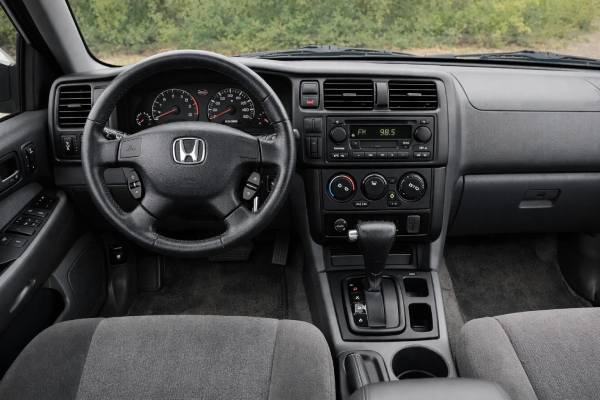
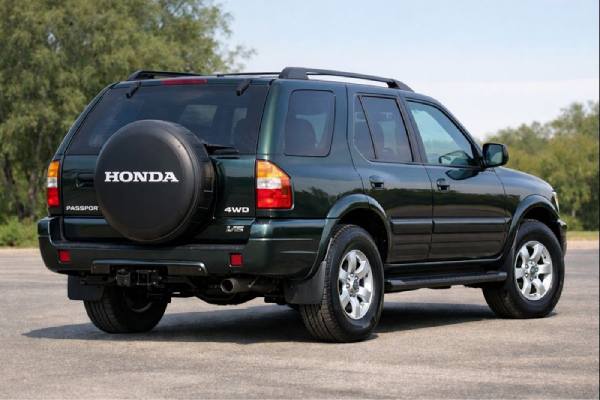
The 2000–2002 facelift Honda Passport is a classic “honest tool” SUV: body-on-frame toughness, a simple 3.2-liter V6, and a practical interior that still works well as an everyday runabout. This late-run version matters because it benefits from structural and airbag refinements versus earlier years, while keeping the rugged Isuzu-based underpinnings that owners value for durability and straightforward repairs. The 6VD1-W V6 makes 205 hp—enough for calm, steady acceleration rather than quick sprinting—and the truck’s strengths show up in bad weather traction (when equipped with 4WD), towing usefulness, and long-term parts availability. The tradeoffs are typical of its era: modest fuel economy, older crash-test outcomes compared with modern SUVs, and corrosion risks in salt climates that deserve a careful pre-purchase inspection.
What to Know
- Strong body-on-frame toughness and 4WD capability for snow, gravel, and light off-road use.
- Simple, naturally aspirated 3.2 V6 with widely available service parts.
- Comfortable, upright driving position with practical cargo space for daily hauling.
- Rust can be the deal-breaker—inspect rear suspension bracket areas and frame seams carefully.
- Plan for engine oil changes about every 8,000 km (5,000 mi) or 6 months, depending on use.
Quick navigation
- Honda Passport facelift 2000-2002 explained
- Honda Passport 3.2 V6 specs table
- Honda Passport trims, safety and tech
- Reliability and known 6VD1 issues
- Maintenance plan and buying checks
- Road feel and real economy
- Passport versus late-90s SUV rivals
Honda Passport facelift 2000-2002 explained
Think of the 2000–2002 Passport as a “last good chapter” for this generation: the mechanical formula stayed familiar, but the details improved. You still get a traditional body-on-frame structure, a naturally aspirated V6, and a no-nonsense SUV layout built to tolerate rough roads and real work. Where the facelift years earn extra attention is in the incremental safety-related changes and the overall maturity of the platform. In practice, that shows up as a truck that feels a bit more settled and better resolved than earlier examples—especially in how it behaves in a frontal impact evaluation and how the cabin structure is described in period testing.
For ownership today, the Passport’s appeal is less about luxury and more about honest utility. The driving position is upright and commanding, visibility is good by modern standards, and the cabin is simple enough that most controls and repairs are straightforward. If you’re shopping for a second vehicle, winter beater, or a weekend-hauler that can pull a small trailer, the 2000–2002 Passport can still make sense—provided you buy the right one.
The key is understanding what “right one” means:
- Rust management matters more than mileage. A high-mile but rust-free example is often the safer bet than a low-mile salt-belt truck with frame scaling.
- Maintenance history matters more than options. Regular oil changes, cooling-system care, and timely drivetrain fluid service predict fewer expensive surprises.
- Expect truck tradeoffs. Fuel economy is modest, handling is secure but not sporty, and modern driver-assist tech is absent.
If you treat it like the traditional SUV it is—inspect it carefully, keep fluids fresh, and stay ahead of corrosion—these facelift Passports can still deliver dependable, practical service with a pleasantly mechanical feel that many newer crossovers no longer offer.
Honda Passport 3.2 V6 specs table
Below is a practical spec pack for the 2000–2002 facelift Passport with the 6VD1-W 3.2-liter V6 (205 hp). Exact figures can vary slightly by trim, tire package, 2WD vs 4WD, and market. When you’re comparing listings, use these tables as a “sanity check” and confirm the details on the door-jamb label, under-hood decals, and the vehicle’s own documentation.
Powertrain and efficiency
| Item | Specification |
|---|---|
| Engine code | 6VD1-W |
| Layout and cylinders | V6, 6 cylinders |
| Displacement | 3.2 L (3165 cc) |
| Induction | Naturally aspirated |
| Max power | 205 hp |
| Compression ratio | 9.3:1 |
| Timing drive | Belt (service interval varies by market and schedule) |
| Fuel | Regular gasoline (typical) |
| EPA economy (example, 2002) | 2WD Auto: 15 / 20 / 17 mpg (city/hwy/comb); 4WD Auto is typically slightly lower |
Real-world highway @ 120 km/h (75 mph): many owners see roughly 13–15 L/100 km (16–18 mpg US) depending on tires, load, wind, and drivetrain condition.
Rated economy reference (2002): FuelEconomy.gov lists 17 mpg combined for the 2WD automatic (15 city / 20 highway).
Driveline and capability
| Item | Specification |
|---|---|
| Drive type | 2WD or 4WD depending on configuration |
| Transmission | Commonly a 4-speed automatic or 5-speed manual (availability varies by year/market) |
| Max trailer weight | 4500 lb (2040 kg) |
| Max tongue weight | 450 lb (204 kg) |
Dimensions (from owner documentation)
| Item | Value |
|---|---|
| Wheelbase | 106.4 in (2700 mm) |
| Length (spare under floor) | 178.8 in (4540 mm) |
| Length (spare on tailgate) | 182.6 in (4637 mm) |
| Width (most trims) | 70.4 in (1788 mm) |
| Width (EX-L noted) | 72.0 in (1830 mm) |
| Height (with 245/70R16 tires) | 69.3 in (1761 mm) |
| Height (with 255/70R16 tires) | 69.7 in (1770 mm) |
Chassis basics
| Item | Specification |
|---|---|
| Front suspension | Independent (torsion bar) |
| Rear suspension | 4-link with coil springs |
| Brakes | Front and rear disc (diameters vary by supplier/market; verify when ordering parts) |
| Wheels/tires | Commonly 16-inch wheels with 245/70R16 or 255/70R16 depending on trim |
Fluids and service capacities (decision-useful)
| System | Specification / notes |
|---|---|
| Engine oil | API grade noted in owner documentation; capacity depends on service state (with filter) |
| Spark plugs | NGK BKR6E-11 |
| Spark plug gap | 1.1 mm (0.04 in) |
| Wheel nut torque | 87 lb-ft (118 N·m) |
Safety and crashworthiness snapshot
This generation is from the pre-advanced-airbag, pre-ESC-as-standard era. In IIHS moderate overlap frontal testing for the 2002 Passport (rating applied to 2002 models), the overall evaluation is Marginal, with notes about dummy kinematics and head contact during rebound. Structurally, the “structure and safety cage” line item is described as Good, but injury measures pull the overall result down.
Honda Passport trims, safety and tech
Most 2000–2002 Passports you’ll see are built around a simple trim ladder, with the main decision usually being 2WD vs 4WD and whether you want comfort upgrades (leather, upgraded audio, sunroof depending on market). Because these trucks often live long lives and pass through multiple owners, trim badges don’t always tell the whole story—wheels, seats, and audio units get swapped. A quick walkaround and a short test drive can reveal more than the badge on the tailgate.
Trims and options that change real ownership
Look for options that change function, not just appearance:
- 4WD hardware and condition (if equipped): confirm engagement works smoothly and that there’s no binding, clunking, or warning lights. A neglected 4WD system can turn into a time-consuming troubleshooting project.
- Towing readiness: the Passport is rated for meaningful light-duty towing in period, but the actual towing experience depends on cooling-system health, transmission condition, and whether the truck has been set up with a proper hitch, wiring, and maintained fluids.
- Tire package: the factory tire size affects ride height and gearing feel. Trucks running oversized all-terrains may feel slower and consume more fuel—but can be more stable on rough surfaces.
If you’re trying to identify equipment quickly, focus on these “tells”:
- Leather seating and seat condition often indicate a higher trim or an option package.
- Factory roof rails and a clean, integrated hitch setup often signal a more utility-oriented original buyer.
- ABS light behavior on key-on can indicate whether the system is functioning normally or has been bypassed.
Safety ratings and what they mean here
The most useful period data point for this facelift run is the IIHS moderate overlap frontal test rating, which is applied to 2002 models and lands at Marginal overall. The key nuance is that this does not mean the structure is universally weak; rather, it highlights how restraint performance and occupant motion management can dominate outcomes. In the IIHS notes, rebound head contact is explicitly mentioned as a contributor to concerns in the test narrative.
In day-to-day terms, this suggests two practical owner takeaways:
- Seat belts matter even more. Always confirm belt retractors work smoothly and that the buckles latch cleanly.
- Airbag system integrity matters. Any SRS light, deployed airbag history, or “mystery” steering-wheel swap is a serious red flag.
Driver assistance and safety systems (era-appropriate)
Do not expect modern ADAS (automatic emergency braking, adaptive cruise, lane assist). This era is about fundamentals:
- Front airbags and basic occupant protection architecture
- ABS (anti-lock brakes) to maintain steerability under hard braking
- Basic traction aids depending on configuration
- Child-seat anchors: confirm the rear seating positions and anchoring points match your intended child-seat setup, and verify that the seat belts lock properly for installation
In short: treat safety here as a combination of vehicle condition and driver habits, because the technology is not going to “cover” for neglected maintenance or worn tires the way a modern SUV’s systems sometimes can.
Reliability and known 6VD1 issues
A well-kept facelift Passport can be reliable in the old-school way: it tolerates use, it’s serviceable, and it responds well to preventive maintenance. But it also has known patterns—some minor and annoying, some expensive if ignored. The best approach is to classify issues by how common they are and how costly they get, then match that to the truck’s service history and your risk tolerance.
Common (plan for it)
- Oil leaks and seepage (low to medium cost):
Symptoms: burning-oil smell near exhaust, drips after parking, greasy underbody.
Likely causes: aging seals and gaskets (valve covers, front seals, oil pan area).
Remedy: fix leaks before they foul rubber bushings or soak belts; use correct PCV service to reduce crankcase pressure. - Cooling-system aging (medium cost if neglected):
Symptoms: temperature creep in traffic, heater performance changes, coolant odor.
Likely causes: old hoses, tired radiator, weak cap, neglected coolant.
Remedy: pressure test, replace suspect hoses, keep coolant fresh, and confirm fan operation. - Transmission shift quality drift (medium to high cost):
Symptoms: delayed engagement, flare between gears, harsh shifts when hot.
Likely causes: old fluid, internal wear, solenoid issues depending on transmission variant.
Remedy: start with correct fluid service and diagnosis—don’t “flush and pray” on a high-mile unknown unit.
Occasional (inspect carefully)
- 4WD system wear (medium cost):
Symptoms: clunks on take-up, vibration, inconsistent engagement, leaks at transfer case or axle seals.
Remedy: check for leaks, inspect CV boots, confirm 4WD engages and disengages properly, and ensure tire sizes match on all corners. - ABS and wheel speed sensor faults (low to medium):
Symptoms: ABS warning light, intermittent activation at low speed.
Remedy: inspect sensor wiring, bearing play, and tone rings; avoid “parts cannon” replacements.
Rare but high impact (do not ignore)
- Severe corrosion at rear suspension mounting areas (high safety risk):
Symptoms: clunking from the rear under acceleration/braking, visible metal flaking near suspension brackets, alignment instability.
Remedy: treat as a safety issue. Insist on a thorough underbody inspection, and verify recall/repair history where applicable.
Recalls, service actions, and how to verify
For this generation, corrosion-related actions are especially important in salt climates. The safest verification process is:
- Run a VIN recall check through official databases.
- Request documentation from the seller (dealer printout, service invoices).
- Inspect for physical evidence of completed corrosion countermeasures or bracket work where applicable.
The big practical point: if rust has progressed beyond the “treatable” stage, even a recall-based fix may not restore long-term integrity. A clean underbody is the best reliability “option” you can buy on a 20+ year-old Passport.
Maintenance plan and buying checks
A 2000–2002 Passport rewards owners who treat maintenance like a schedule, not a reaction. Most big bills on these trucks come from overheating events, neglected drivetrain fluids, and corrosion—all avoidable with routine checks and timely service.
Practical maintenance schedule (distance/time)
Use this as a conservative, owner-friendly plan and adjust based on your driving mix:
| Item | Interval (typical) | Notes |
|---|---|---|
| Engine oil and filter | 8,000 km (5,000 mi) or 6 months | Short trips, towing, and hot climates benefit from the shorter side |
| Engine air filter | 24,000 km (15,000 mi) or yearly | Replace sooner in dusty areas |
| Cabin air filter (if equipped) | Yearly | Not all markets/configs are identical |
| Coolant | Every 3–5 years | Replace sooner if condition is unknown |
| Brake fluid | Every 2 years | Helps prevent corrosion in ABS components |
| Transmission fluid | 40,000–60,000 km (25,000–40,000 mi) | Use correct spec fluid; adjust based on towing/heat |
| Differential / transfer case oils (4WD) | 40,000–60,000 km (25,000–40,000 mi) | Fresh gear oil is cheap insurance |
| Spark plugs | 80,000–100,000 km (50,000–60,000 mi) | Correct plug type and gap matter |
| Timing belt service | Commonly around 100,000 km (60,000 mi) or 6–7 years | Confirm your exact schedule by VIN/market |
| Serpentine belt and hoses | Inspect each service; replace as needed | Cracks, glazing, swelling = replace |
| Tire rotation and alignment check | 8,000–10,000 km (5,000–6,000 mi) | Especially important on 4WD |
Fluids and specs (ownership-useful)
- Spark plugs: NGK BKR6E-11; gap 1.1 mm (0.04 in).
- Wheel nuts: torque to 87 lb-ft (118 N·m).
- Trailer limits: up to 4500 lb (2040 kg) trailer weight and 450 lb (204 kg) tongue weight when properly equipped and in good mechanical condition.
(Always verify the exact fluid and capacity specs for your VIN and market; 2000–2002 Passports can differ by transmission and drivetrain.)
Pre-purchase inspection checklist (what really saves money)
Rust and structure (highest priority):
- Rear suspension bracket areas and frame rails
- Body seams, floor pans, and rocker areas
- Signs of “fresh undercoating” applied to hide scale rust
Engine bay:
- Coolant condition and any dried coolant residue
- Oil leaks onto exhaust areas
- Smooth idle and clean throttle response (no hunting or stalling)
Drivetrain:
- Transmission engagement quality from Park to Drive/Reverse
- No shudder under light throttle
- 4WD engagement test (on appropriate surface), listen for binding or clunks
Brakes and steering:
- ABS light self-test behavior
- Brake pedal feel (firm, consistent)
- Steering play and front-end clunks over bumps
Long-term durability outlook
If you buy a structurally clean example and keep up with fluids, belts, and cooling-system care, the facelift Passport can remain dependable. If you buy rust, deferred maintenance, or “unknown history,” you can easily spend more catching up than the truck is worth. This model is a smart buy when it’s clean underneath and honestly serviced—not when it’s merely shiny on top.
Road feel and real economy
The facelift Passport drives like what it is: a traditional SUV with truck roots. That’s not a criticism—it’s the charm. The ride is generally compliant over broken pavement, the seating position is upright and confidence-inspiring, and the chassis feels sturdy. Compared with modern crossovers, you’ll notice more body movement over quick transitions and more road texture through the structure, but you also get a sense of durability and mechanical directness.
Powertrain character
The 3.2 V6 is smooth for its age and makes its power in a straightforward, naturally aspirated way. There’s no turbo surge—just steady pull that feels best in the midrange. With the automatic, expect relaxed shifting rather than fast responses. A healthy transmission should:
- engage promptly from Park to Drive,
- shift without flare (rpm jump) under moderate throttle,
- and avoid harsh bangs when hot.
If shifts get sloppy after a long test drive, treat that as a sign to budget for deeper diagnosis.
Handling, steering, and braking feel
Steering is typically light-to-moderate with a practical focus. On the highway, the Passport tracks steadily, especially on good tires with correct alignment. In corners, it prefers smooth inputs. If you feel wandering or shimmy, suspect tires, alignment, worn steering/suspension joints, or uneven brake rotor wear.
Brakes are easy to modulate in normal driving, but don’t expect modern short stopping distances. The best upgrade you can “install” is fresh brake fluid, quality pads/rotors, and tires with strong wet grip.
Real-world fuel economy
EPA figures for the 2002 Passport 2WD automatic are listed as 15 mpg city / 20 mpg highway / 17 mpg combined, which equates to roughly:
- City: ~15.7 L/100 km
- Highway: ~11.8 L/100 km
- Combined: ~13.8 L/100 km
At 120 km/h (75 mph), many owners see consumption drift into the 13–15 L/100 km range depending on wind, load, roof racks, and tire choice. A lift kit, aggressive all-terrain tires, or worn oxygen sensors can easily worsen those numbers.
Towing and load behavior
The Passport’s rated towing capability can be genuinely useful for small campers, utility trailers, or watercraft—if the truck is mechanically healthy. Under tow, pay attention to:
- cooling stability on long grades,
- transmission shift hunting,
- and braking confidence.
As a rule of thumb, towing can increase fuel use by 20–40% depending on speed and trailer aerodynamics. Keep speeds moderate, service fluids early, and ensure the hitch setup is correctly installed and rated.
Passport versus late-90s SUV rivals
The 2000–2002 Passport sits in a very specific competitive pocket: midsize, body-on-frame SUVs that were designed before crossovers took over. If you’re shopping this segment today, you’re likely cross-shopping durability, winter capability, towing, and repairability—more than touchscreen features.
Versus Toyota 4Runner (late 1990s to early 2000s)
- 4Runner advantages: typically stronger resale value, broad aftermarket support, and a reputation for long-term durability.
- Passport advantages: often cheaper to buy upfront, straightforward mechanical layout, and can be a good value when rust-free.
- Verdict: If budget allows and you find a clean example, the 4Runner is usually the “safer” long-term bet. The Passport can match the utility if you buy carefully.
Versus Nissan Pathfinder (R50 era)
- Pathfinder advantages: comfortable road manners, good everyday usability, strong availability in many markets.
- Passport advantages: more traditional truck feel and useful towing ratings when properly equipped.
- Verdict: Choose based on condition. A clean Passport can be a better utility buy; a clean Pathfinder can feel more refined.
Versus Ford Explorer (early 2000s)
- Explorer advantages: huge parts ecosystem, many examples on the market, often more interior space depending on configuration.
- Passport advantages: simpler cabin, less “feature complexity,” and a distinct mechanical character.
- Verdict: Explorers are easy to find; Passports are often bought by people who specifically want this style of SUV. Let rust and maintenance history decide.
Versus Jeep Grand Cherokee (WJ era)
- Grand Cherokee advantages: strong engines available, excellent low-speed 4WD capability, and a more premium feel in some trims.
- Passport advantages: simpler ownership when you prioritize basic reliability and straightforward service.
- Verdict: If you want off-road prowess and can tolerate more variability in upkeep, Jeep can be rewarding. If you want a simpler workhorse, the Passport can be the calmer choice.
Bottom line
The Passport’s best argument is value—when it’s structurally clean and correctly maintained. It’s not the newest, fastest, or most efficient option, but it can still be a durable, practical SUV that does “truck things” without pretending to be something else.
References
- 2002 Passport Online Reference Owner’s Manual 2002 (Owner’s Manual)
- Gas Mileage of 2002 Honda Passport 2002 (Fuel Economy Data)
- 2002 Honda Passport 2002 (Safety Rating)
- Check for Recalls: Vehicle, Car Seat, Tire, Equipment | NHTSA 2026 (Recall Lookup)
Disclaimer
This article is for informational purposes only and is not a substitute for professional diagnosis, inspection, or repair. Specifications, torque values, service intervals, and procedures can vary by VIN, market, drivetrain, and installed equipment. Always verify details using your official owner’s manual and service documentation, and consult a qualified technician when safety is involved.
If you found this guide useful, please consider sharing it on Facebook, X (Twitter), or your favorite forum—your support helps us keep publishing detailed, practical ownership resources.