
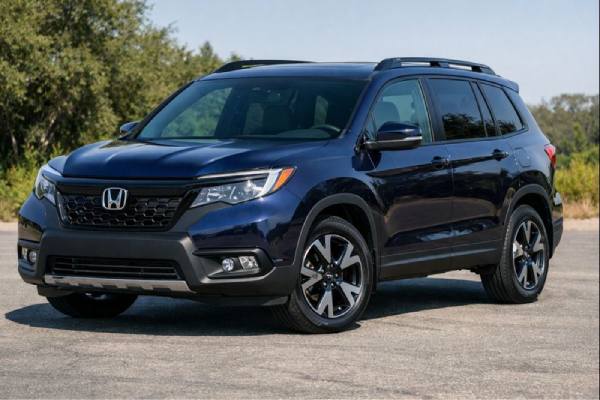
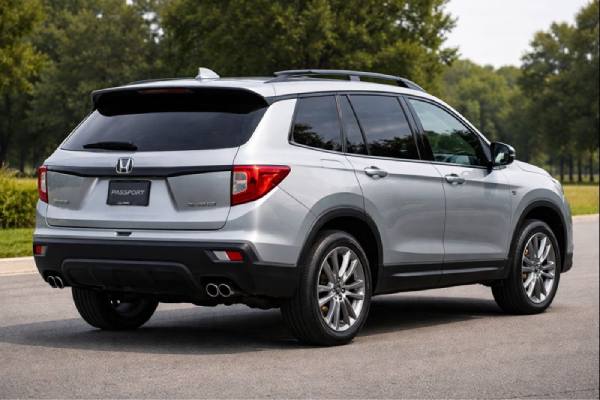
The 2019–2021 Honda Passport (YF7) in front-wheel drive (FWD) form is the “two-row Pilot” idea done with a more straightforward ownership angle: one strong V6, one automatic transmission, and fewer driveline parts than the AWD versions. With the J35Y6 3.5-liter V6 rated at 280 hp, it’s quick enough to feel effortless in daily traffic, and it carries adult-sized comfort for five with a genuinely useful cargo bay. The FWD version also tends to be a touch lighter and simpler underneath, which can help reduce long-term wear items tied to rear driveline service.
That said, this Passport is still a modern, electronics-heavy Honda SUV. A smart buyer focuses on service history, software updates, and careful inspection of known trouble spots (especially infotainment behavior and transmission shift quality) before calling it a safe bet.
What to Know
- Strong V6 performance with confident passing power, even when loaded.
- Spacious cabin and wide cargo opening make it easy to live with day to day.
- FWD trims can cost less to maintain than AWD due to fewer driveline fluids and parts.
- Watch for rough or inconsistent 9-speed shifting on poorly maintained examples.
- Plan on oil service about every 10,000 miles (16,000 km) or 12 months (sooner in severe use).
Guide contents
- Honda Passport YF7 FWD ownership profile
- Honda Passport YF7 J35Y6 data sheets
- Honda Passport YF7 equipment and safety
- Common faults and recall watch
- Service schedule and buying tips
- On-road performance and efficiency
- Alternatives to consider
Honda Passport YF7 FWD ownership profile
Think of the 2019–2021 Passport FWD as a midsize SUV for people who want V6 strength without the footprint of a three-row. The platform is built for stability and comfort first: a rigid body structure, a long-ish wheelbase for ride quality, and suspension tuning that favors control over harshness. In FWD form, you lose the extra traction tricks of the AWD system, but you also gain simplicity—no rear differential service, no prop shaft, and fewer seals and bearings that can age out over time.
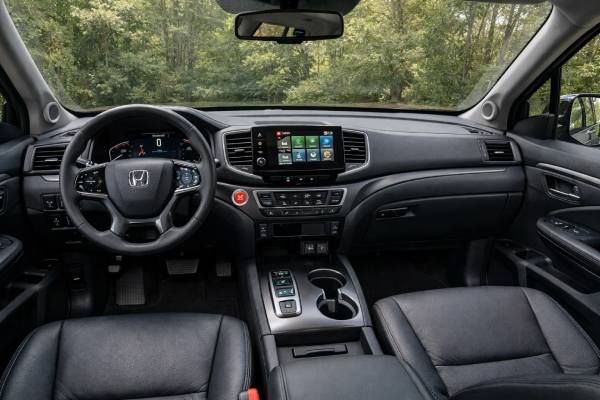
Where the Passport stands out is usable space. The rear seat is adult-friendly, the cargo floor is wide and low enough to load heavy items without drama, and the cabin has the “Honda practical” layout—big door pockets, sensible controls, and a driving position that suits long trips. If you’re coming from compact SUVs, it feels like a step up in shoulder room and in how relaxed the V6 is at highway speeds.
Ownership is mostly about staying ahead of maintenance rather than constantly fixing things. A well-kept Passport typically rewards basic consistency: correct oil, correct ATF, clean filters, and attention to braking and tires. It’s also a vehicle where tires and alignment matter more than many owners expect. The chassis is heavy enough that cheap tires can make it feel noisy and vague, while a good tire set makes it quieter and calmer.
Who should choose FWD?
- You drive mostly on paved roads, with winter conditions that are manageable on quality all-season or winter tires.
- You want lower complexity and you don’t need maximum tow rating or off-pavement traction.
Who should consider AWD instead?
- You live in steep, snowy areas, tow frequently, or routinely travel on loose surfaces where traction is unpredictable.
Honda Passport YF7 J35Y6 data sheets
Below are practical, ownership-relevant specifications for the 2019–2021 Passport FWD with the J35Y6 3.5L V6 (280 hp). Some figures vary slightly by trim and wheel package, so treat exact capacities and weights as VIN-specific.
Powertrain and efficiency
| Item | Specification |
|---|---|
| Engine code | J35Y6 |
| Layout and valvetrain | V6, SOHC i-VTEC, 24 valves (4 valves/cyl) |
| Bore × stroke | 89.0 × 93.0 mm (3.50 × 3.66 in) |
| Displacement | 3.5 L (3,471 cc) |
| Induction | Naturally aspirated |
| Fuel system | Direct injection (market-dependent calibration) |
| Compression ratio | ~11.5:1 (typical for this family; verify by VIN) |
| Max power | 280 hp (209 kW) @ ~6,000 rpm |
| Max torque | 355 Nm (262 lb-ft) @ ~4,700 rpm |
| Timing drive | Timing belt |
| Transmission | 9-speed automatic |
| Drive type | FWD |
| Rated efficiency (typical FWD) | 10.7 L/100 km combined (22 mpg US / 26 mpg UK) |
| Real-world highway @ 120 km/h | ~9.8–10.6 L/100 km (22–24 mpg US), load and wind dependent |
Dimensions and capacities
| Item | Specification (approx.) |
|---|---|
| Length | 4,839 mm (190.5 in) |
| Width | 1,996 mm (78.6 in) |
| Height | ~1,800–1,820 mm (~70.9–71.7 in) depending on tires/roof equipment |
| Wheelbase | 2,819 mm (110.9 in) |
| Turning circle (kerb-to-kerb) | ~11.8 m (~38.7 ft) |
| Ground clearance (FWD) | ~190 mm (~7.5 in) |
| Curb weight | ~1,850–1,930 kg (~4,080–4,250 lb), trim-dependent |
| Fuel tank | ~74 L (19.5 US gal / 16.2 UK gal) |
| Cargo volume | ~1,167 L (41.2 ft³) seats up / ~2,206 L (77.9 ft³) seats down (method varies) |
Performance and capability
| Item | Typical result |
|---|---|
| 0–100 km/h (0–62 mph) | ~6.6–7.2 s (conditions and tires matter) |
| Top speed | ~190 km/h (~118 mph) governed |
| Braking 100–0 km/h | ~36–39 m (varies with tires) |
| Towing capacity (FWD) | commonly up to ~1,588 kg (3,500 lb) when properly equipped |
| Payload | commonly ~430–520 kg (~950–1,150 lb), trim-dependent |
Fluids and service capacities (verify by VIN and service manual)
| System | Specification (typical) |
|---|---|
| Engine oil | 0W-20; ~5.0–5.7 L (~5.3–6.0 US qt) with filter depending on calibration and pan |
| Coolant | Honda Type 2 premix; capacity varies by market and cooling package |
| ATF | Honda-spec fluid for the 9-speed application; capacity depends on drain/fill vs overhaul |
| Brake fluid | DOT 3 (or Honda equivalent), flush interval time-based |
| A/C refrigerant | R-1234yf on many 2019–2021 examples (confirm under-hood label) |
Electrical (typical)
| Item | Specification |
|---|---|
| 12V battery | Group size and CCA vary by market; test annually after year 3 |
| Alternator | Output varies by equipment load (audio, heated seats, etc.) |
| Spark plugs | Iridium/platinum type; gap and part number VIN-specific |
Safety and driver assistance (market-dependent equipment)
| Category | Notes |
|---|---|
| Stability and braking | ABS, stability control, traction control, brake assist |
| Airbags | Front, front-side, and curtain airbags; check for trim-specific additions |
| Driver assistance | Many trims include a forward-collision system and lane support features; confirm exact package by year/trim |
| Crash ratings | Ratings vary by test body and year; use VIN and model-year lookups for exact results |
Honda Passport YF7 equipment and safety
For 2019–2021, the Passport lineup generally centers on a few trims with clear “daily-use” differences rather than major mechanical changes. In the U.S. market, FWD is most commonly found on lower trims (often Sport and many EX-L examples), while upper trims frequently default to AWD. From a buyer’s perspective, the key is to identify what changes your experience: wheels/tires, driver-assistance content, seating comfort features, and audio/infotainment capability.
Trims and options that matter
Common trim pattern (market dependent):
- Sport / base-style trims: usually the simplest interior, smaller wheels, and fewer luxury touches. These often ride a bit better due to taller tire sidewalls.
- EX-L / mid trims: typically the best value for many owners because they add comfort and convenience (power tailgate, upgraded seating materials, more driver memory features in some markets).
- Touring / Elite-style trims: more premium audio, parking aids, and appearance upgrades; often paired with AWD rather than FWD.
What to look for when identifying a vehicle quickly:
- Wheel size: 18-inch wheels often indicate lower trims; 20-inch wheels are common higher up.
- Exterior cues: roof rails, parking sensors, and trim-specific fascia details can help, but always verify using the build sheet or VIN decoding.
- Interior cues: seat material, memory seat buttons, and audio branding/tier can reveal whether you’re looking at a true “comfort” trim or a base model.
Safety ratings, interpreted like an owner
Crash ratings are only useful if you understand what they represent. Different organizations run different tests, and the same vehicle can score differently under different protocols or updated test methods. With the Passport platform, a common theme is strong structure in many tests, with attention needed on the details: headlight performance, passenger-side small-overlap results in some programs, and the exact calibration of crash-avoidance systems.
What this means for your buying decision:
- Treat high-level scores as a baseline, not a guarantee.
- Prioritize functioning seat belts, intact airbags, and verified collision repair quality over “perfect” scores on paper.
Driver assistance systems and service implications
Many Passports are equipped with forward-collision mitigation and lane-keeping/lane-departure functions. These systems can improve safety when they’re correctly calibrated and the windshield, bumper sensors, and camera areas are clean and undamaged. After a windshield replacement or front-end repair, correct calibration is not optional—it can affect how the vehicle brakes or warns.
Practical checks before purchase:
- Confirm warning lights are off and no “camera obstructed” messages persist in normal weather.
- Test adaptive cruise and lane support on a clear road (briefly and safely).
- Inspect for mismatched windshield glass, poorly fitted bumper covers, or signs of prior front-end impact.
Common faults and recall watch
The Passport (YF7) is not defined by chronic engine failures; it’s defined by how consistently it has been maintained and how well prior owners handled software updates and drivability complaints. Below are common patterns, grouped by prevalence and cost tier. Mileage bands are broad because age, climate, and driving style matter as much as odometer readings.
Common issues (most likely to encounter)
- 9-speed shift quality complaints (medium cost, variable severity)
- Symptoms: harsh 1–2 or 2–3 shifts, delayed engagement, “busy” shifting at low speed.
- Likely causes: old or incorrect ATF, adaptation values needing reset, or software/logic sensitivity.
- Remedy: correct fluid service using the right spec, then evaluate adaptation and update status. Avoid quick fixes that mask the cause.
- Infotainment glitches (low to medium cost)
- Symptoms: freezing screen, slow boot, Bluetooth dropouts, camera lag.
- Likely causes: software bugs, weak 12V battery, or module hiccups after low voltage events.
- Remedy: battery test first, then confirm system updates and service bulletins.
- Battery and low-voltage sensitivity (low cost if caught early)
- Symptoms: random warnings, stop-start odd behavior, intermittent electronic faults.
- Likely cause: aging 12V battery or poor charging health.
- Remedy: load-test the battery; replace proactively if marginal, especially before winter.
Occasional issues (less frequent, but worth screening)
- Engine mount or vibration concerns (medium cost)
- Symptoms: vibration at idle or during cylinder deactivation transitions (if equipped).
- Likely cause: mount wear or sensitivity to calibration and driving conditions.
- Remedy: verify mounts, update software if applicable, and ensure engine is running cleanly.
- A/C performance decline (medium cost)
- Symptoms: weak cooling, intermittent output, or oil residue near components.
- Likely cause: leaks or component wear; refrigerant type and service procedures matter.
- Remedy: leak check with correct equipment; avoid “top-off” guesswork.
Rare but high-impact checks
- Collision repair quality and calibration problems (high impact)
- Symptoms: persistent ADAS warnings, uneven tire wear, steering pull, unusual wind noise.
- Likely cause: poorly repaired structure, incorrect alignment, or missed sensor calibration.
- Remedy: pre-purchase inspection with scan tool checks and alignment readout.
Recalls, TSBs, and how to verify
Rather than memorizing recall headlines, use a repeatable process:
- Run the VIN through the official recall lookup tools (and confirm “remedy completed”).
- Ask for dealer service history printouts if available.
- Confirm key modules (instrument cluster, camera systems) behave normally after cold start and after a short drive.
If the seller can’t document recall completion, assume you will need to schedule it. It’s usually free, but your time is not.
Service schedule and buying tips
Honda’s “Maintenance Minder” logic can vary intervals based on use, but a buyer’s guide should be simple, conservative, and repeatable. The schedule below is a practical baseline for a Passport FWD that sees mixed driving. If the vehicle does short trips, heavy city use, towing, or extreme temperatures, shorten intervals.
Practical maintenance schedule (baseline)
- Engine oil and filter: every 16,000 km (10,000 mi) or 12 months; severe use: 8,000 km (5,000 mi).
- Tire rotation: every 8,000–10,000 km (5,000–6,000 mi); align annually or at any sign of uneven wear.
- Cabin air filter: every 24,000 km (15,000 mi) or yearly if dusty/urban.
- Engine air filter: inspect every 24,000 km; commonly replace around 48,000 km (30,000 mi) depending on conditions.
- Brake fluid: every 3 years regardless of mileage.
- Coolant: commonly first service around 160,000 km (100,000 mi) or 5 years, then shorter intervals (confirm for your market).
- Spark plugs: commonly around 168,000 km (105,000 mi).
- Timing belt: plan around 168,000 km (105,000 mi) or 7 years unless your service documentation specifies otherwise.
- Automatic transmission fluid: conservative approach is 60,000–100,000 km (40,000–60,000 mi) depending on use; severe service should be sooner.
Fluids and specs: what matters for decision-making
- Use the correct 0W-20 engine oil spec for the market.
- Treat the transmission as fluid-sensitive: correct spec ATF and correct procedure matter more than “universal” fluids.
- Don’t neglect brake fluid; it’s cheap protection for an expensive braking system.
Essential torque values (common owner-facing items)
- Wheel lug nuts are typically around 127 N·m (94 lb-ft) for many Hondas in this class, but confirm for your wheels and model year.
- If you do any brake work, follow the service manual torque chart—over-torqued caliper bolts and under-torqued wheel nuts both cause real problems.
Buyer’s inspection checklist (high signal, low effort)
- Cold start: listen for belt squeal, abnormal ticking, or long cranking.
- Test drive (low speed): feel for harsh engagement and “busy” shifting; do gentle stop-and-go.
- Highway: check for steering vibration (tires), pulling (alignment), and wind noise (prior repairs).
- Underbody: look for oil seepage, coolant residue, and damage to plastic undertrays.
- Brakes: confirm smooth stops; pulsing may mean rotor issues or uneven pad deposits.
- Electronics: confirm cameras, parking sensors (if equipped), and driver aids work without warnings.
Long-term outlook: a Passport that’s been serviced on time and kept on quality tires tends to age well. The expensive surprises usually come from neglected fluid service, ignored electrical quirks tied to a weak 12V battery, or unresolved software-related annoyances.
On-road performance and efficiency
The Passport’s driving personality is defined by a strong naturally aspirated V6 and a chassis that’s tuned for stability. Around town, the engine feels relaxed because it doesn’t need boost to make torque; you get predictable response and clean passing power without waiting for a turbo to spool. That’s a real advantage for merging and for quick lane changes in busy traffic.
Ride, handling, and NVH
Ride quality is generally composed for a midsize SUV, especially on trims with more tire sidewall. Larger wheels can look great but may add sharpness over broken pavement. The Passport feels planted at speed, with a calm body motion over long highway dips. Steering is typically accurate rather than chatty—easy to place, not sports-car communicative. Brakes have good initial bite when healthy, but like many heavy crossovers, they reward fresh fluid and quality pads if you want consistent pedal feel.
Noise-wise, you’ll hear some road roar on coarse surfaces (tire choice matters a lot), while wind noise is usually reasonable unless there’s a prior repair or misaligned trim.
Powertrain character and transmission behavior
The V6 is the star: smooth, strong, and comfortable at higher rpm when you ask for power. The 9-speed automatic can be excellent when it’s in good health and properly serviced, but it can also be the source of complaints. In a good example, shifts are quick and unobtrusive. In a neglected example, you may feel abrupt low-speed changes or indecision in gentle driving. That’s why test-driving in slow traffic is as important as highway cruising.
Real-world fuel economy
Official ratings for the FWD model are typically in the low 20s mpg combined, but real-world results depend on speed and terrain more than most owners expect. At 120 km/h (75 mph), the Passport often lands around 9.8–10.6 L/100 km (22–24 mpg US) in calm weather. City driving with short trips can push consumption into the 12–14 L/100 km range, especially in winter or heavy traffic.
Cold-weather deltas: expect a noticeable drop if your driving includes frequent cold starts, short trips, or heavy HVAC use.
Load and towing (FWD realities)
FWD Passports can tow modestly when properly equipped, but traction and temperature management matter. If you tow regularly, keep the transmission fluid service conservative and watch for tire wear—front tires do all the driving and a lot of the work under load. For occasional towing and road-trip cargo, the Passport is stable and confident, but it’s not the best choice for repeated heavy towing compared with AWD versions or body-on-frame SUVs.
Alternatives to consider
The Passport FWD sits in a competitive midsize space where “best” depends on what you value most: comfort, sportiness, off-road ability, or fuel economy. Here’s how it typically stacks up.
If you want a smoother, more comfort-first cruiser
- Nissan Murano (FWD): often quieter with a softer ride character. The tradeoff is powertrain feel—its CVT behavior is not everyone’s preference, and towing/heat tolerance is not its strong suit.
- Hyundai Santa Fe (depending on engine): efficient and feature-rich, often with strong value. Turbo engines can feel punchy, but long-term maintenance discipline matters more with boosted powertrains.
If you want more “driver’s SUV” feel
- Ford Edge: can feel more eager in handling depending on trim, and it’s a strong highway tool. Powertrain and interior materials vary widely by year and package, so shop carefully.
If you want real off-pavement toughness
- Toyota 4Runner: body-on-frame strength and proven off-road hardware. The price is daily comfort and fuel consumption; it usually feels older-school and less refined.
- Jeep Grand Cherokee (varies by generation): can offer excellent capability and strong engines, but ownership experience depends heavily on exact year, engine, and service history.
If you want the “best long-trip, family flexibility” option
- Honda Pilot: the Passport’s three-row sibling. If you sometimes need extra seating, the Pilot may be the more logical buy—often for similar money used.
Why Passport FWD still makes sense: it’s a rare mix of V6 simplicity, usable space, and everyday refinement without forcing you into a three-row footprint. If you don’t truly need AWD, the FWD version is often the more rational long-term ownership play.
References
- Gas Mileage of 2021 Honda Passport 2021 (Official Economy Data)
- 2021 Honda Passport 2021 (Safety Rating)
- Vehicle Detail Search – 2020 HONDA PASSPORT SUV AWD | NHTSA 2020 (Recall Database)
- Manuals Search – MyGarage – Honda 2025 (Owner’s Manual Portal)
Disclaimer
This article is for informational purposes only and is not a substitute for professional diagnosis, inspection, or repair. Specifications, torque values, service intervals, and procedures can vary by VIN, market, model year, and installed equipment. Always confirm details using official Honda service information and your vehicle’s documentation before purchasing parts or performing work.
If you found this guide useful, please consider sharing it on Facebook, X (Twitter), or your favorite forum to support our work.