

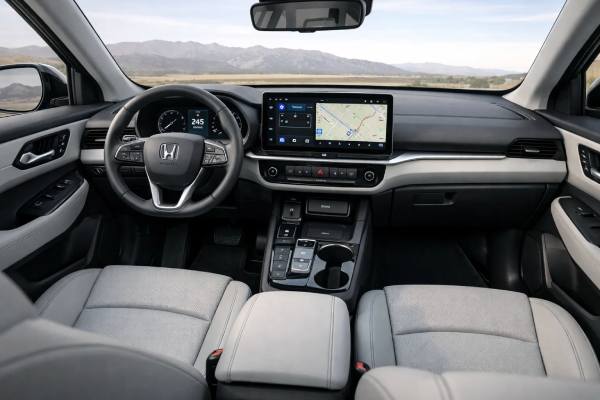
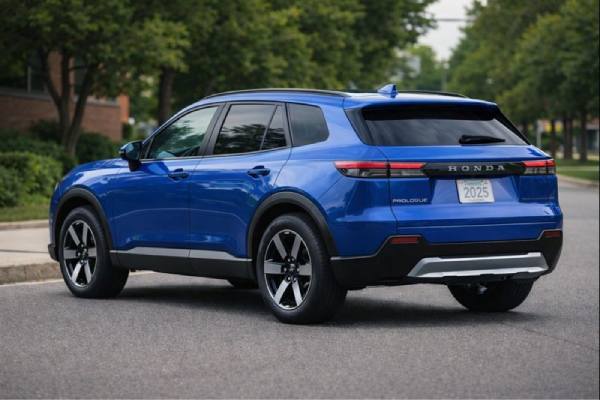
The 2025–present Honda Prologue AWD is the higher-output, dual-motor version of Honda’s mid-size electric SUV—built for buyers who want confident all-weather traction without giving up day-to-day comfort. With 300 hp and 355 lb-ft, it has the torque you expect from an EV, but its personality is more “quiet and composed” than “hot hatch.” The big ownership story is balance: a large 85 kWh battery, a practical EPA range rating (trim-dependent), and fast-charge behavior aimed at road-trip usefulness rather than headline-chasing peak numbers.
For most owners, the decision comes down to wheel size and equipment. The Prologue’s AWD range drops with the larger Elite wheels, and the curb weight is substantial, so tires, alignment, and brake care matter more than many first-time EV buyers assume. Done right, it’s an easy EV to live with.
What to Know
- Dual-motor AWD gives strong low-speed pull and better wet and snow stability than the 2WD model.
- The 85 kWh battery supports road-trip charging with a 20–80% DC session listed at 35 minutes.
- Touring AWD’s EPA range rating is higher than Elite AWD due to wheel and tire differences.
- Plan for tire rotation about every 12,000 km (7,500 mi) to protect range and reduce uneven wear.
- If you fast-charge often, keep an eye on charge-port condition and DC session tapering as the pack warms.
Contents and shortcuts
- Honda Prologue AWD 300 hp in practice
- Honda Prologue AWD 300 hp technical specs
- Honda Prologue AWD trims and safety tech
- Reliability issues, recalls, and fixes
- Maintenance plan and used buying tips
- Real range, charging, and performance feel
- How the Prologue AWD stacks up
Honda Prologue AWD 300 hp in practice
Think of the Prologue AWD as a “set-and-forget” EV: quiet, stable, and predictable, with enough torque to feel effortless in normal driving. The dual-motor layout brings two practical benefits. First, it improves traction when you’re pulling away on wet paint lines, cold pavement, or slushy snow—situations where a single-motor EV can spin a tire before traction control gathers itself. Second, it reduces the need to rely on aggressive brake-based stability control in corners, because the car has more flexibility in how it meters torque.
The numbers back up the character. Honda lists 300 hp and 355 lb-ft for the AWD configuration, which is a meaningful step over the 2WD setup. It’s not a performance SUV in the traditional sense (it’s heavy, and you feel that in quick direction changes), but it is comfortably quick for merging and passing—especially from 30–90 km/h where EV torque makes daily driving easier.
The ownership “gotcha” is that the AWD model’s efficiency and range depend heavily on trim. Honda lists an EPA range rating of 294 miles for AWD on the less aggressive wheel setup, while the Elite AWD drops to 283 miles—a real, noticeable difference if you drive long highway routes or live somewhere with cold winters. That range gap is usually more about wheels, tires, and rolling resistance than the motors themselves, so it’s also a reminder that tire choice later on can quietly change your real-world range.
One more practical point: the Prologue AWD’s curb weight is over 5,000 lb depending on trim, which raises the importance of tires, alignment, and brake maintenance. EVs can hide wear because they’re quiet—so the best owners are proactive, not reactive. If you keep tire pressures correct, rotate on schedule, and address any steering pull early, you’ll preserve both efficiency and road manners.
Honda Prologue AWD 300 hp technical specs
Powertrain and battery
| Spec | Value |
|---|---|
| Drivetrain | Dual motor all-wheel drive (AWD) |
| Max power (SAE net) | 300 hp |
| Max torque (SAE net) | 355 lb-ft |
| Traction battery capacity | 85 kWh |
Range and charging metrics
| Spec | Value |
|---|---|
| EPA range rating (AWD) | 294 miles (AWD trims) |
| EPA range rating (Elite AWD) | 283 miles |
| DC fast charge time (20% to 80% SOC) | 35 min |
| DC fast charge add (miles in 10 minutes) | 63 miles (AWD trims) / 62 miles (Elite) |
| 240 V AC Level 2 rate (miles per hour) | 34.1 mi/h |
Chassis and dimensions
| Spec | Value |
|---|---|
| Front suspension | Multi-link |
| Rear suspension | Multi-link |
| Steering type | Belt-drive assist electric power steering (EPS) |
| Steering ratio | 18.6:1 |
| Steering turns lock-to-lock | 3.5 |
| Wheelbase | 121.8 in |
| Ground clearance (unladen, AWD) | 8.1 in |
| Approach / departure angles (AWD) | 17.4° / 18.3° |
Weights and capacities
| Spec | Value |
|---|---|
| Curb weight (AWD) | 5,086 lb (EX AWD) / 5,207 lb (Touring AWD) / 5,273 lb (Elite AWD) |
| AWD weight distribution (front/rear) | 54.5% / 45.5% (EX AWD) • 54% / 46% (Touring AWD) • 54.1% / 45.9% (Elite AWD) |
| Max towing capacity | 1,500 lb |
| Cargo volume (behind 2nd row) | 23.7 cu ft (Touring/Elite) |
| Cargo volume (behind 1st row) | 54.5 cu ft (Touring/Elite) |
Safety and driver assistance (key items)
| Spec | Value |
|---|---|
| Airbag systems listed | Front airbags, front knee airbags, front side airbags, side curtain airbags |
| Child-seat anchors | LATCH: lower anchors (2nd-row outboard), tether anchors (2nd-row all) |
| Standard driver assistance suite | Forward collision alert, automatic emergency braking, front pedestrian braking, lane keep assist, adaptive cruise control, blind zone steering assist, side blind zone alert, lane change alert, rear cross traffic alert |
Honda Prologue AWD trims and safety tech
For 2025–present, the Prologue AWD experience is shaped less by “powertrain choice” (AWD is consistently 300 hp) and more by equipment and wheel/tire decisions. In practice, you can think of the AWD lineup as two personalities: the range-friendlier AWD trims (EX AWD and Touring AWD) and the feature-heavy Elite AWD that trades some range for a more upscale package.
Trim walk (what changes in the real world):
- EX AWD is the most straightforward way to get dual-motor traction. It’s the trim that tends to make the most sense for buyers who value range consistency and lower replacement-tire costs over premium wheel designs.
- Touring AWD is often the sweet spot for many owners because it adds comfort and convenience upgrades while retaining the higher 294-mile AWD EPA range rating. If you road-trip, this trim typically offers the best “features per mile of range.”
- Elite AWD is the luxury-leaning choice. Honda lists 283 miles of EPA range here, and that drop is usually connected to the larger wheel and tire package and the way it affects rolling resistance and highway efficiency. The payoff is a more fully loaded feel.
Quick identifiers when shopping (especially useful for used inventory):
- Confirm AWD on the window sticker/build listing and match it to Honda’s listed AWD output (300 hp).
- Check wheel size visually: larger wheels often mean higher tire replacement costs and slightly more road noise, plus the real-world efficiency penalty that mirrors the EPA range difference between AWD trims.
- Test the parking-lot behavior: a healthy Prologue should be smooth at very low speed with no clunks when transitioning from regen to a complete stop.
Safety ratings and what they mean here:
Crash ratings can vary by test body and by the exact test version used in a given year. The Prologue is evaluated by the IIHS, which publishes detailed sub-scores for front overlap tests, side impact performance, and pedestrian front crash prevention. Rather than chasing a single headline rating, look at the pattern: strong structural performance, plus consistently good ADAS performance, is what reduces fatigue and lowers crash risk in everyday driving.
ADAS and calibration realities (important after service):
Honda lists a broad suite of driver-assist features on the Prologue (AEB, pedestrian braking, lane keep assist, ACC, blind-zone alerts, and rear cross-traffic functions). The practical ownership point is that these systems can require recalibration after windshield replacement, bumper work, or suspension alignment changes. When shopping used—or after a repair—confirm:
- The car tracks cleanly in lane-centering modes on a straight road.
- There are no recurring warning lights or “camera blocked” alerts in normal weather.
- Parking sensors and rear cross-traffic features behave consistently (no constant false alarms).
If you want the lowest drama day-to-day, Touring AWD tends to be the safest bet: strong equipment, higher AWD range rating, and fewer compromises than the Elite wheel package.
Reliability issues, recalls, and fixes
Because the Prologue is still early in its lifecycle, reliability is best understood as a mix of “new-model teething” and common EV ownership patterns. The good news is that EV powertrains eliminate a lot of classic failure points—no engine oil leaks, no automatic transmission shift issues, and no exhaust hardware. The flipside is that software, sensors, and charging hardware play a much bigger role in day-to-day satisfaction.
Below is a practical issue map for the Prologue AWD, organized by prevalence and cost tier.
Common (low to medium cost):
- Tire wear and alignment sensitivity
Symptoms: steering pull, uneven inner/outer tread wear, increased road noise, range decline.
Likely causes: curb weight + EV torque + missed rotations; alignment drift after potholes.
Remedy: rotate on schedule, align at the first sign of pull, keep pressures correct (especially in cold weather). - Brake noise or surface corrosion (regen-heavy driving)
Symptoms: scraping or groan after rain, light vibration at low speed.
Likely cause: friction brakes aren’t used hard enough to clean rotors.
Remedy: periodic firm braking from speed (when safe) to exercise pads and rotors; regular brake inspections.
Occasional (medium cost):
- Charge-port and latch quirks
Symptoms: charging session fails to start, latch feels sticky, intermittent public-charger disconnects.
Likely causes: debris or ice around the door and latch; connector fitment variation at public stations.
Remedy: keep the port clean and dry; avoid forcing connectors; document patterns and involve the dealer if repeatable. - Infotainment and connectivity glitches
Symptoms: slow boot, intermittent Bluetooth/CarPlay behavior, navigation or app syncing issues.
Likely cause: software bugs or configuration conflicts.
Remedy: ensure the vehicle software is current; perform a clean re-pair of devices; request dealer support if problems persist.
Rare (high cost, but important to understand):
- HV isolation or sensor faults
Symptoms: warning messages, reduced power mode, charging disabled, persistent fault codes.
Likely causes: moisture ingress into a connector, a sensor drift, or a hardware fault.
Remedy: professional diagnosis only—high-voltage systems require correct isolation testing and safe handling.
Software and calibrations (the “quiet” reliability factor):
In modern EVs, updates can materially change charging behavior, thermal management strategies, and even the smoothness of brake blending (the handoff between regenerative and friction braking). If you experience repeatable charging failures, unexpected range drops, or persistent ADAS alerts, it’s reasonable to ask whether a software update is the official remedy before replacing hardware.
Recalls, TSBs, and campaign verification:
Early-production vehicles across the industry can see suspension or steering-related recalls. The most practical advice is consistent:
- Run an official VIN recall check before buying.
- Ask the seller (or dealer) for proof of completion in service records.
- If the car is still in warranty, confirm open campaigns are scheduled and documented.
A Prologue AWD that has complete recall compliance, a clean charging history (no repeat failures), and even tire wear is usually a solid bet—because those are the areas that most often signal how carefully it has been owned.
Maintenance plan and used buying tips
EV maintenance is simple compared with combustion vehicles, but it is not “no maintenance.” The Prologue AWD’s weight and torque shift attention toward tires, brakes, coolant loops, and the 12-volt battery. The schedule below is a practical, owner-friendly baseline. If you drive in extreme heat/cold, tow, or DC fast-charge constantly, use the severe-duty mindset: shorten intervals and inspect more often.
Practical maintenance schedule (distance or time, whichever comes first):
- Every 12,000 km (7,500 mi) or 12 months: tire rotation; tire pressure check; inspect tread depth and shoulder wear; quick suspension and steering inspection.
- Every 24,000 km (15,000 mi) or 24 months: cabin air filter replacement (so HVAC airflow and defogging stay strong); brake inspection (pads/rotors/slide pins); underbody inspection for impacts to shields and battery-area panels.
- Every 40,000–50,000 km (25,000–30,000 mi) or 24–36 months: brake fluid condition check and service as needed (time matters more than miles); alignment check (especially if you see uneven wear).
- Every 3–5 years: 12-volt battery test annually starting year 3; replace proactively if weak (EVs are sensitive to low 12V voltage because it supports control modules and contactors).
- Seasonally: before winter, confirm tire condition and consider a true winter tire if you see snow—AWD helps you go, but tires help you stop and steer.
EV-specific care that protects long-term reliability:
- Regen-brake exercise: once every week or two, do a few firm stops (when safe) to keep brake hardware clean.
- Charging habits: for daily use, avoid living at very high state-of-charge unless you need it for a trip. For road trips, fast charging is fine—just expect faster tapering at higher SOC and when the pack is warm.
- Cooling system awareness: EVs rely on thermal management. If you ever smell sweet coolant or see a puddle, treat it as urgent—small leaks can become big problems.
Used-buyer checklist (high value, low effort):
- Battery health in plain language: ask the seller to show real-world range behavior over a normal week. If the car can’t meet anything close to its EPA rating in mild weather, find out why (tires, driving speed, HVAC use, or a real issue).
- DC fast-charge behavior: do at least one public DC session if possible. Watch for stable charging, no repeated error messages, and normal tapering after the initial high-power phase.
- Charging hardware condition: inspect the port, door, seals, and latch. Look for cracked plastic, bent pins, or evidence of water intrusion.
- Tires as a “truth test”: uneven wear often signals alignment neglect. On a 5,000+ lb EV, that can become an expensive pattern.
- ADAS and cameras: verify lane and braking assists behave consistently and don’t throw frequent warnings.
- Recall and campaign proof: run the VIN through an official recall tool and confirm completion in records.
Which AWD trim to seek or avoid?
- Seek Touring AWD if you want the best balance of equipment and the higher AWD EPA range rating.
- Choose Elite AWD if you value the upscale package more than the range hit and higher tire replacement cost.
- Avoid any trim with chronic charging faults, missing recall documentation, or significant uneven tire wear—those are stronger red flags than a slightly higher odometer reading.
Real range, charging, and performance feel
In daily driving, the Prologue AWD feels like a refined commuter with extra passing punch. The dual motors deliver smooth torque from a stop, and the car’s mass helps it feel planted at speed. The flip side of that stability is agility: quick lane changes reveal the weight, and you’ll notice that the Prologue prefers clean, calm inputs rather than abrupt direction changes.
Ride, handling, and NVH (noise and vibration):
- Ride quality: the Prologue is tuned to be comfortable first. Over broken pavement, it tends to feel controlled rather than floaty, though larger wheels usually add impact sharpness.
- Steering: electric steering is light-to-moderate in effort, with more emphasis on stability than road feel.
- Cabin quiet: EV silence can make tire noise the main soundtrack. That’s why tire model and wheel size matter more than people expect.
Power delivery and drive modes:
With 300 hp and 355 lb-ft, step-off response is immediate. In normal driving, it’s easy to modulate smoothly. In wet conditions, AWD traction helps the car launch without the front-end scrabble you can get in a powerful 2WD EV. Drive modes mainly shape throttle mapping and how assertively the car holds speed versus coasts.
Real-world efficiency and range—what changes it most:
EV range is a three-part equation: speed, temperature, and tires.
- Highway speed: range drops noticeably above ~110–120 km/h (70–75 mph). Aerodynamic drag rises quickly, and heavy SUVs pay for it.
- Cold weather: cabin heat and battery temperature management reduce range; short trips are the worst-case scenario because the car spends more time warming up per kilometer driven.
- Wheels and tires: Honda’s own EPA range ratings show the effect clearly: AWD trims at 294 miles versus Elite AWD at 283 miles.
A practical ownership approach is to treat the EPA figure as a “mild-weather mixed driving” target. If you do mostly highway at 120 km/h, plan for a meaningful buffer. If you do mostly city and suburban speeds, you can often do better than your winter highway worst case.
Charging behavior (home and road trips):
Honda lists an AWD DC charge add of about 63 miles in 10 minutes on compatible fast charging, and a 20–80% DC session time of 35 minutes. At home on a 240 V Level 2 setup, Honda lists 34.1 miles of range per hour of charging. In real ownership terms:
- Overnight Level 2 charging is the easiest path—plug in, wake up full enough for the day.
- On road trips, aim to arrive at a DC charger with a lower SOC (state of charge) so the session starts faster, then charge to the level that gets you comfortably to the next stop rather than pushing to 100% every time.
Towing and load:
Honda lists 1,500 lb towing capacity. Expect a substantial range hit when towing—often the largest single efficiency penalty an EV owner will see—especially at highway speeds or into headwinds. If towing is part of your life, the best strategy is slower cruise speeds, conservative spacing between chargers, and keeping tire pressures and trailer setup perfect.
How the Prologue AWD stacks up
The Prologue AWD competes in a crowded space: two-row electric SUVs that promise “family practicality with modern tech.” The way it stands out is not a single killer spec—it’s the overall ownership balance.
Where the Prologue AWD is strong:
- Everyday drivability: It’s tuned like a mainstream Honda: predictable controls, comfortable ride, and a calm cabin that doesn’t demand constant attention.
- Useful charging targets: Honda’s published DC charging metric (20–80% in 35 minutes) and “miles added per 10 minutes” framing align with how people actually road-trip.
- Trim clarity: The range difference between AWD trims is straightforward and tied to hardware choices, making it easier to shop intentionally.
Where rivals can beat it (depending on what you value):
- Peak charging power and long-distance pace: Some competitors chase higher peak kW or hold higher charge rates longer, which can shave minutes off multi-stop road trips. If you do frequent 800–1,000 km days, this can matter.
- Efficiency-first alternatives: More aerodynamic or lighter EVs can deliver better highway efficiency, especially in cold weather.
- Performance variants: If you want sharp handling or sport-sedan acceleration, there are sportier EV crossovers that feel more eager.
How to choose intelligently:
- Choose the Prologue AWD if you want an EV that behaves like a well-sorted daily SUV, with strong traction, good real-world comfort, and straightforward trim trade-offs.
- Choose a range-max or efficiency leader if your driving is mostly high-speed highway and you want the best possible winter buffer.
- Choose a charging-speed specialist if you road-trip constantly and want the shortest possible stops—even if the ride is firmer or the cabin noisier.
My practical verdict for most buyers: Touring AWD tends to be the smartest Prologue AWD configuration because it keeps the higher AWD EPA range rating while delivering the features people actually use every day. Elite AWD makes sense if you accept the range trade and tire-cost reality as the price of the most premium setup.
References
- 2025 Prologue Features & Specs 2025 (Specifications)
- Honda Prologue 4-door SUV 2025 (Safety Rating)
- 2025 Fuel Economy Guide 2025 (Official Efficiency Guide)
- NHTSA Recalls 2026 (Recall Database)
- Combined Charging System (CCS) 2025 (Charging Standard)
Disclaimer
This article is for informational purposes only and is not a substitute for professional diagnosis, repair, or safety inspection. Specifications, torque values, service intervals, and procedures can vary by VIN, market, model year, and equipment. Always confirm details using official Honda documentation and qualified service support for your specific vehicle.
If you found this guide helpful, please consider sharing it on Facebook, X (Twitter), or your favorite forum—your support helps us keep publishing detailed, practical ownership content.