


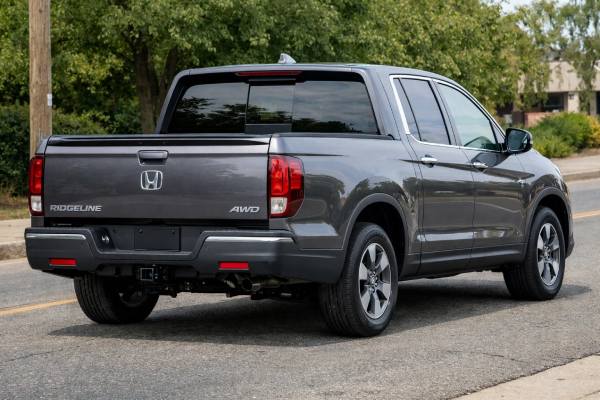
The facelift-era second-generation Ridgeline is the “truck you live with,” not the truck you tolerate. From 2020 onward, the formula stays consistent: a 3.5-liter V6 (J35Y6) making 280 hp, a 9-speed automatic, and Honda’s i-VTM4 torque-vectoring AWD that can send power side-to-side at the rear axle for confident traction on wet pavement, snow, and boat ramps. What separates the Ridgeline from body-on-frame rivals is its unibody platform and fully independent rear suspension, which deliver calmer ride quality, stable braking, and a cabin that feels closer to a crossover than a traditional midsize pickup.
If you’re shopping the facelift range, focus less on “can it tow?” (it can) and more on details that shape ownership: trim-level equipment, headlight performance by year, and keeping drivetrain fluids fresh if you tow or drive in harsh conditions.
Owner Snapshot
- Unibody chassis and independent rear suspension make it one of the most comfortable midsize trucks for daily driving.
- i-VTM4 AWD is excellent in low-traction conditions and helps stability when the bed is loaded.
- The in-bed trunk and dual-action tailgate add real utility that rivals often can’t match.
- Watch trim- and year-specific headlight performance, and confirm all recall/TSB work is documented.
- Plan on AWD rear-diff fluid service about every 24,000–48,000 km (15,000–30,000 mi) if you tow, run heavy loads, or do lots of low-speed traction work.
What’s inside
- Honda Ridgeline AWD YK3 facelift basics
- Honda Ridgeline AWD YK3 core specs
- Honda Ridgeline AWD YK3 trims and safety
- Common faults, recalls, and fixes
- Maintenance plan and buying tips
- Real-world driving and efficiency
- Rivals worth cross-shopping
Honda Ridgeline AWD YK3 facelift basics
Think of the facelift-era Ridgeline as a midsize pickup engineered around stability, comfort, and clever packaging. The core structure is a unibody platform with a reinforced bed and fully independent rear suspension, which is a big reason it rides with less hop over broken pavement than leaf-spring trucks. That design also helps steering precision and braking confidence when the truck is lightly loaded—exactly how most owners drive day to day.
Power comes from Honda’s 3.5-liter V6 (J35Y6) rated at 280 hp and 262 lb-ft. It’s tuned for broad, usable torque rather than a peaky feel, and it pairs with a 9-speed automatic that keeps the engine in its torque band without constant high-rpm noise. For the facelift range (as you’ve defined it), the drivetrain character is consistent: smooth pull from low speed, strong passing power, and no turbo lag.
AWD is the other headline. Honda’s i-VTM4 system can overdrive the rear axle and actively send more torque to the outside rear wheel in a turn. In practice, that means:
- Better traction when you’re starting on snow or wet grass with a trailer attached.
- More stable behavior on slick roads when the bed is empty (a common weakness for many pickups).
- Less “one-tire fire” on uneven surfaces compared to simpler open-diff AWD setups.
Utility is where Ridgeline owners usually become loyal. The in-bed trunk gives secure storage for straps, tools, or muddy gear, and the dual-action tailgate (down or swing-out) makes loading easier in tight parking spots. The bed is short by traditional truck standards, but it’s square, usable, and paired with a cabin that comfortably seats adults in the second row.
The ownership mindset that fits this Ridgeline best: frequent commuting, family duty, weekend projects, and occasional towing—done with less fatigue than most midsize competitors.
Honda Ridgeline AWD YK3 core specs
Below are the most useful “decision specs” for the 2020–present facelift era. Exact values can vary slightly by model year, wheel/tire package, and trim, so treat these as a practical reference and verify against the spec sheet for your exact VIN.
Powertrain and efficiency (J35Y6)
| Item | Specification |
|---|---|
| Engine code | J35Y6 |
| Layout | V6, 6 cylinders, 24-valve SOHC i-VTEC |
| Fuel system | Direct injection |
| Induction | Naturally aspirated |
| Bore × stroke | 89.0 × 93.0 mm (3.50 × 3.66 in) |
| Displacement | 3.5 L (3,471 cc) |
| Compression ratio | 11.5:1 |
| Max power | 280 hp (209 kW) @ 6,000 rpm |
| Max torque | 355 Nm (262 lb-ft) @ 4,700 rpm |
| Timing drive | Belt (verify interval by market/service info) |
| Cylinder deactivation | VCM (variable cylinder management) |
| Rated efficiency (typical AWD) | 11.2 L/100 km combined (21 mpg US) |
| Real-world highway @ 120 km/h | Typically ~9.5–11.0 L/100 km (21–25 mpg US), wind/tires/load dependent |
Transmission and driveline
| Item | Specification |
|---|---|
| Transmission | 9-speed automatic |
| Drive type | AWD (i-VTM4) |
| Differential | Active rear torque vectoring (system-controlled), no driver-selectable lockers |
Chassis and dimensions (typical)
| Item | Specification |
|---|---|
| Suspension (front/rear) | Independent / independent |
| Steering | Electric power steering; ratio 15.86:1 |
| Brakes (front/rear) | Ventilated discs; 320 mm (12.6 in) / 330 mm (13.0 in) |
| Wheels/tires (popular) | 245/60 R18 (varies by trim) |
| Ground clearance | 193 mm (7.6 in) |
| Length / width / height | 5,339 mm (210.2 in) / 1,996 mm (78.6 in) / 1,798 mm (70.8 in) |
| Wheelbase | 3,180 mm (125.2 in) |
| Turning circle (kerb-to-kerb) | 13.2 m (43.4 ft turning diameter) |
| Curb weight | ~2,005–2,071 kg (4,420–4,565 lb) |
| GVWR | ~2,730 kg (6,019 lb) |
| Fuel tank | 73.8 L (19.5 US gal / 16.2 UK gal) |
| Cargo volume (bed) | 960 L (33.9 ft³) |
| In-bed trunk volume | 207 L (7.3 ft³) |
Performance and capability (practical expectations)
| Item | Typical figure (varies) |
|---|---|
| 0–100 km/h (0–62 mph) | ~6.8–7.5 s |
| Top speed | ~170–185 km/h (105–115 mph), often limited |
| Braking 100–0 km/h | ~39–43 m (surface/tires dependent) |
| Towing capacity (braked) | 2,268 kg (5,000 lb) |
| Payload | ~685–718 kg (1,509–1,583 lb) |
Fluids and service capacities (check VIN-specific documentation)
Because Honda’s published capacities can differ between “dry fill” and “service fill,” use these as planning numbers and confirm before ordering fluids:
- Engine oil: typically ~5.4 L (5.7 US qt) with filter; use the specified Honda oil standard for your market (often 0W-20).
- Coolant: long-life Honda coolant, usually a 50/50 mix; capacity varies by service method.
- ATF: use the specified Honda ATF for the 9-speed; service fill varies depending on drain/fill vs overhaul.
- Rear differential: use the required Honda rear-diff fluid for i-VTM4; service fill varies by procedure.
Key torque specs (verify for your exact wheels and model year):
- Wheel lug nuts: commonly 127 Nm (94 lb-ft)
- Engine oil drain bolt: commonly ~39 Nm (29 lb-ft)
Safety and driver assistance (facelift-era summary)
| Item | Typical equipment |
|---|---|
| Core structure | Honda ACE body structure |
| Stability systems | ABS, ESC, traction control; hill start assist |
| Airbags | Front, side, and curtain airbags (count/coverage varies by year/trim) |
| Child seats | LATCH/ISOFIX provisions (position details vary) |
| ADAS (Honda Sensing) | Forward collision warning and AEB, lane departure warning and lane keeping support, adaptive cruise control (availability varies by year/trim/market) |
Honda Ridgeline AWD YK3 trims and safety
Trim strategy is straightforward: all facelift-era Ridgelines share the same V6 and 9-speed, so most shopping comes down to comfort, tech, and “how much rugged” you want. Typical U.S. trim families across recent years include Sport, RTL, TrailSport, and Black Edition (availability and naming can shift by year). If your local market uses different grade names, the logic still holds—look for the equipment clusters below.
How to spot trims quickly
- Sport: usually the value pick—cloth seating, fewer luxury touches, but still the same powertrain and core utility features.
- RTL: often the “sweet spot” for daily ownership with leather, comfort upgrades, and a better tech mix.
- TrailSport: aims at mild off-pavement use (appearance cues, tires/wheels depending on year), and is attractive if you drive winter roads, gravel, or access trails—but it’s not a rock crawler.
- Black Edition: top-trim styling and comfort; often adds premium audio, unique wheels, and interior trim themes.
Option packages and functional differences to check
Even when engines match, small hardware differences can matter:
- Wheels/tires: tire model and size can change ride feel, wet traction, snow behavior, and braking distances.
- Tow equipment: confirm if the factory hitch, wiring, and transmission cooling provisions are installed—especially if you intend to tow near the limit.
- Interior durability: leather vs cloth isn’t just taste; it affects how the cabin wears if you carry tools, pets, or kids daily.
Safety ratings: what matters in practice
Safety is a strong Ridgeline talking point, but it’s worth being precise about which tests and which equipment. IIHS results can be very good in crash structure tests, yet headlight performance can range from Good on certain trims/years to Marginal on others. That’s not academic: headlights are a real safety feature, and on a truck used for winter commuting or rural roads, you want the best beam pattern you can get.
Practical shopping advice:
- If you drive unlit roads, prioritize trims/years with the better headlight rating and aim/condition.
- Confirm that camera and radar-based safety features are functioning properly after windshield replacement or front-end repair; calibration matters.
- Check that any “driver assist” features you care about (adaptive cruise, lane keeping support, blind spot monitoring) are standard on your specific model year and trim—not just “available somewhere in the lineup.”
ADAS and service implications
Honda Sensing systems rely on sensors that can be knocked out of calibration by:
- Windshield replacement (camera alignment)
- Front bumper repairs (radar placement)
- Suspension lifts/leveling kits (changes sensor angles)
If you’re buying used, ask for documentation showing any required recalibration was performed by a qualified shop. If you’re modifying tires or ride height, expect to re-check alignment and verify driver-assistance behavior afterward.
Common faults, recalls, and fixes
Overall durability is a Ridgeline strength, but “reliable” doesn’t mean “issue-free.” The smart approach is to map problems by prevalence and cost exposure—then focus your inspection where it matters.
Common (seen often)
- Rear differential fluid deterioration (AWD i-VTM4)
- Symptoms: groan or chatter on tight turns, vibration at low speed, inconsistent traction behavior.
- Likely cause: fluid shearing/contamination accelerated by towing, steep grades, or frequent traction events.
- Remedy: service the rear diff with the correct Honda fluid and follow the right procedure; don’t substitute “universal” gear oil.
- Brake wear patterns and rotor vibration
- Symptoms: steering wheel shimmy during braking, pulsation, uneven pad wear.
- Likely cause: heat cycling from towing or mountain driving, or caliper slide issues from corrosion.
- Remedy: inspect pad thickness and caliper slides; replace rotors/pads as a set when needed and flush brake fluid on schedule.
- Battery sensitivity with stop/start systems (where equipped)
- Symptoms: slow cranking, stop/start disabled messages, or electrical oddities.
- Likely cause: aging battery, frequent short trips, or high accessory use.
- Remedy: load-test the 12 V battery and verify charging voltage; replace with the correct spec battery.
Occasional (depends on use or climate)
- Tailgate and bed accessory wear
- Symptoms: tailgate doesn’t latch smoothly, wiring issues with bed camera/lighting, water intrusion around bed add-ons.
- Remedy: inspect harness routing, seals, and latch adjustment; avoid slamming a tailgate that is already misaligned.
- Cabin water leaks (rare but annoying)
- Symptoms: damp carpet, musty odor, fogging windows.
- Likely cause: clogged drains, poor sealing after glass work, or body seam issues from prior repairs.
- Remedy: verify drains, check windshield/cowl area, and inspect for signs of previous collision repair.
Rare but high-cost
- Transmission drivability complaints
- Symptoms: harsh shifts, hunting between gears, delayed engagement.
- Likely cause: fluid condition, software calibration needs, or previous towing abuse.
- Remedy: confirm correct ATF is used; check for software updates and service history; test drive hot (after full warm-up).
Recalls, TSBs, and service actions: how to handle them
Treat recall status as non-negotiable:
- Run an official VIN check.
- Ask for dealer service printouts showing completion.
- Confirm that safety items and updates were performed before you negotiate.
Even if the truck drives fine, open campaigns matter for resale value and long-term risk. If you see evidence of repeated repairs for the same symptom (for example, repeated battery replacements or recurring drivetrain vibrations), treat that as a clue to dig deeper rather than a reason to walk away immediately.
Maintenance plan and buying tips
Honda’s Maintenance Minder system adjusts oil and service intervals based on use, so there isn’t one perfect schedule for every Ridgeline. Still, you can use a practical baseline and then tighten it for harsh use (towing, heavy city driving, short trips, extreme heat/cold).
Practical maintenance schedule (baseline)
- Engine oil and filter: typically every 10,000–12,000 km (6,000–7,500 mi) or 12 months, sooner for short trips or towing.
- Tire rotation and brake inspection: every 8,000–10,000 km (5,000–6,000 mi).
- Cabin air filter: every 20,000–30,000 km (12,000–18,000 mi) (more often in dusty areas).
- Engine air filter: every 30,000–45,000 km (18,000–28,000 mi); inspect sooner if you drive gravel roads.
- Brake fluid: every 3 years, regardless of mileage (moisture absorption is time-based).
- Spark plugs: often around 160,000 km (100,000 mi) in many Honda applications; verify for your model year.
- Coolant: commonly 5 years / 160,000 km (100,000 mi) first, then shorter intervals; confirm your exact service spec.
- Rear differential fluid (AWD i-VTM4): every 24,000–48,000 km (15,000–30,000 mi) if towing/harsh use; otherwise follow Minder prompts.
- ATF (9-speed): plan a conservative service window around 48,000–96,000 km (30,000–60,000 mi) depending on use; towing and heat push you toward the earlier end.
Timing components
The J-series V6 family commonly uses a timing belt. If your service documentation confirms belt drive, treat it as a major maintenance event:
- Typical belt interval is often around 170,000 km (105,000 mi) or 7 years (varies by market and engine spec).
- If you can’t prove it’s been done on an older high-mileage truck, budget for it—belt, tensioner, idlers, and usually the water pump.
Buyer’s guide: what to inspect first
Bring a flashlight and spend time on these:
- Service history: evidence of correct ATF and rear diff fluid changes matters more than “regular oil changes.”
- Rear diff behavior: do slow, tight circles in a parking lot when warm; listen and feel for chatter or binding.
- Brakes and tires: uneven wear can indicate alignment issues or suspension wear; check inner tire shoulders.
- Underbody condition: look for corrosion on suspension hardware and brake lines if the truck lived in road-salt areas.
- Electronics: test every camera view, parking sensors, keyless entry, and infotainment responsiveness—small faults are negotiable, but they add up.
Long-term durability outlook
If you keep fluids fresh (especially AWD rear diff and ATF), avoid overheating it while towing, and don’t ignore small drivability symptoms, the Ridgeline tends to reward owners with consistent year-round usability. It’s a truck that lasts best when maintained like a family vehicle—not treated like a disposable work tool.
Real-world driving and efficiency
The Ridgeline’s biggest performance advantage isn’t a drag-race number—it’s how easy it is to drive well. The unibody structure and independent rear suspension give it a settled, “one-piece” feel on the highway, with less bobbing over expansion joints than many leaf-spring competitors. Around town, it steers more like a large crossover than a traditional pickup: predictable turn-in, stable lane changes, and fewer steering corrections on uneven pavement.
Powertrain character
The 3.5-liter V6 is smooth and confident. Throttle response is clean for a naturally aspirated engine, with enough low-rpm torque to pull away without drama even when loaded. The 9-speed automatic usually keeps revs modest during gentle driving, but it will drop gears quickly for passing. What to watch on a test drive:
- Cold start and idle quality: should be stable and quiet within moments.
- Kickdown behavior: it should feel decisive, not confused or delayed.
- Low-speed smoothness: creeping in traffic should be consistent; any repeated surging deserves investigation.
Ride, handling, and NVH
- Ride: firm enough to feel controlled, but noticeably less choppy than many midsize trucks—especially when the bed is empty.
- Handling: safe, stable cornering; it doesn’t feel top-heavy for a pickup, and AWD helps composure in wet conditions.
- NVH (noise, vibration, harshness): generally low for the segment; tires make a bigger difference than most people expect, so listen for coarse road noise on worn all-terrain sets.
Real-world efficiency
EPA figures depend on trim and tires. As a practical guide, many drivers see:
- City: roughly 12.5–14.5 L/100 km (16–19 mpg US) depending on traffic, temperature, and short-trip frequency.
- Highway (100–120 km/h): often 9.5–11.0 L/100 km (21–25 mpg US).
- Mixed: commonly around 11–12.5 L/100 km (19–21 mpg US).
Cold weather, short trips, and aggressive tires can add noticeable consumption. If fuel cost matters, prioritize proper tire pressures, alignment, and conservative warm-up habits (short idling, gentle first kilometers).
Towing and load behavior
At moderate tow weights, the Ridgeline feels stable and less “floaty” than many trucks because of its chassis design. Still, towing changes everything:
- Plan for a meaningful fuel consumption penalty (often 20–40% depending on speed and trailer shape).
- Keep ATF and rear diff fluid service on the conservative side if you tow regularly.
- Use a proper brake controller where required and confirm trailer brake function before long downhill grades.
Rivals worth cross-shopping
The Ridgeline is easiest to judge when you compare it by use case rather than by truck stereotypes. Here’s how it typically stacks up against key midsize rivals.
If you want maximum off-road hardware
- Toyota Tacoma (4×4) and Jeep Gladiator are usually the picks for low-range gearing, higher clearance variants, and more trail-focused aftermarket support.
- Tradeoff: they often ride more stiffly on broken pavement and can feel less composed when empty. If your driving is 90% road and 10% trail, the Ridgeline’s comfort advantage is real.
If you tow often or want a more “traditional” truck feel
- Chevrolet Colorado / GMC Canyon and Ford Ranger are common alternatives if you want more conventional truck architecture and some configurations with stronger towing-focused setups.
- Tradeoff: ride quality and cabin refinement can be less relaxing for daily commuting, depending on tire and suspension packages.
If you want the most car-like daily driver with a bed
- This is the Ridgeline’s home turf. Its closest “feel” competitors tend to be crossovers with utility trailers—except the Ridgeline gives you a real bed, in-bed trunk storage, and pickup practicality without the constant compromises of body-on-frame dynamics.
Buying decision shortcut
Choose the Ridgeline if you want:
- A midsize pickup that’s easy to live with every day
- AWD stability in winter and rain
- Smart cargo solutions (tailgate + in-bed trunk)
- Predictable road manners with occasional towing
Choose a body-on-frame rival if you want:
- More serious off-road geometry or low-range 4×4
- A broader range of bed lengths/cab styles
- A platform built around heavier-duty work and aftermarket specialization
For most owners who commute, carry family, do weekend projects, and tow occasionally, the Ridgeline’s engineering priorities line up with real life—and that’s exactly why it earns repeat buyers.
References
- Specifications – 2026 Honda Ridgeline 2025 (Manufacturer Specifications)
- Specifications – 2020 Honda Ridgeline 2019 (Manufacturer Specifications)
- 2024 Honda Ridgeline 2024 (Safety Rating)
- Fuel Economy of 2024 Honda Ridgeline 2024 (Official Fuel Economy Data)
- Vehicle Detail Search – 2024 HONDA RIDGELINE PU/4WD | NHTSA 2024 (Recall Database)
Disclaimer
This article is for informational purposes only and is not a substitute for professional diagnosis, inspection, or repair. Specifications, torque values, service intervals, and procedures can vary by VIN, market, model year, and equipment. Always verify details using official owner and service documentation for your exact vehicle and consult qualified technicians when needed.
If you found this guide useful, please consider sharing it on Facebook, X (Twitter), or your favorite forum to help others find reliable ownership information.