


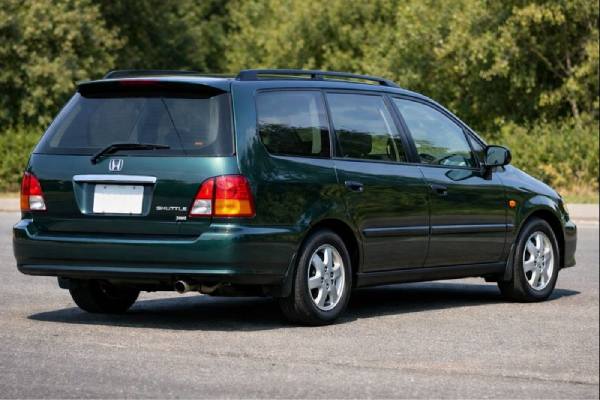
The facelift-era Honda Shuttle (RA1) with the F22B-family 2.2-liter engine is best understood as a “sedan-engineered” people-mover: front-wheel drive packaging, a low step-in height, and suspension geometry closer to Honda’s passenger cars than to tall, truck-like vans of the same period. In day-to-day use, that translates to predictable handling, stable highway tracking, and an easy-to-live-with cabin layout that can genuinely carry families and cargo without feeling clumsy.
This guide focuses on the RA1 in 2WD/FWD form and the ownership reality that matters most today: what the drivetrain layout implies for traction and maintenance, which specs are worth knowing, how performance feels with a mid-size SOHC four-cylinder, what commonly ages out on 1990s Hondas, and how to keep one reliable without over-servicing it. If you want a practical classic that still behaves like a Honda, this is the appeal.
At a Glance
- Stable, confidence-building road manners thanks to FWD packaging and car-like suspension design.
- Efficient space use: wide-opening rear cargo area and flexible seating make it a true utility vehicle.
- Simple SOHC 4-cylinder design is generally serviceable and parts-friendly compared with more complex vans.
- Budget for age-related rubber and cooling-system refreshes; neglect here causes most “mystery” problems.
- Plan engine oil changes about every 6 months or 7,500 km (4,700 mi) in typical mixed driving, sooner with short trips.
Jump to sections
- RA1 model overview
- F22B8 specs and dimensions
- Facelift trims and safety
- Reliability and known issues
- Maintenance and buyer’s guide
- Driving and real-world economy
- Rivals and smart alternatives
RA1 model overview
The RA1 Shuttle is a front-engine, front-wheel-drive (2WD) platform designed to behave more like a passenger car than a traditional van. That engineering choice shows up in three important areas: packaging, handling balance, and service access.
Packaging and layout. In FWD form, the engine sits transversely (sideways) and drives the front wheels through a compact transaxle. This frees cabin space because there’s no long driveshaft running to the rear axle, and the rear floor can stay flatter. For owners, it also means fewer drivetrain components to maintain versus AWD/4WD versions (no rear differential, prop shaft, or transfer hardware). In real life, fewer parts generally means fewer leaks and fewer bearings that can start humming after decades.
What “FWD” means for how it drives. FWD vans tend to feel stable and predictable, especially in the wet, because the driven wheels are also the wheels carrying most of the powertrain weight. You don’t get the lively rear-end rotation of RWD, but you do get easy traction when pulling away on slippery pavement. The trade-off is that heavy throttle in tight turns can produce mild understeer and can stress front tires a bit more—especially if alignment is off or the suspension bushings are tired.
What “FWD” means for maintenance. Most “high-impact” RA1 maintenance work happens at the front of the vehicle: timing belt service, accessory drive belts, cooling system, mounts, and the transmission. Suspension wear also shows up early at the front due to steering and drive loads (ball joints, tie rods, bushings). If you’re choosing between a very clean FWD example and a tired 4WD one, the FWD is often the simpler long-term bet—particularly if you live in a region where severe winter traction isn’t a daily requirement.
Facelift focus (1997–2000). The facelift years typically bring small but meaningful improvements: equipment packaging becomes more sensible, minor NVH (noise/vibration/harshness) tweaks are common, and earlier “optional safety” features may become easier to find. That said, with any 1990s van, the condition and service history usually matter more than the brochure year: a well-maintained earlier build can be a better buy than a neglected later one.
F22B8 specs and dimensions
This section concentrates on the specs that change real ownership decisions: what the engine is, what the drivetrain layout implies, and the measurements that affect parking, tires, and ride quality. Depending on market and documentation, you may see output listed around the mid-140s PS with some references rounding to “about 150 hp.” Treat that as the same practical performance tier: brisk enough for family duty, not a performance van.
Powertrain and efficiency (key specs)
| Item | Spec (RA1 FWD, F22B-family) |
|---|---|
| Code | F22B (F22B8 commonly associated with Shuttle application) |
| Engine layout and cylinders | Inline-4, transverse, water-cooled |
| Valvetrain | SOHC, 16 valves (4 per cylinder), belt-driven cam |
| Bore × stroke | 85.0 × 95.0 mm |
| Displacement | 2.156 L (2156 cc) |
| Induction | Naturally aspirated |
| Fuel system | Electronic fuel injection (PGM-FI) |
| Compression ratio | 8.8:1 |
| Max power | ~145 PS (net) @ 5,600 rpm (often described as ~150 hp class) |
| Max torque | 20.0 kgm @ 4,600 rpm (≈196 Nm) |
| Timing drive | Belt |
| Rated efficiency (period test cycle) | Around 10.2 km/L (≈9.8 L/100 km) in lighter trims; around 9.2 km/L (≈10.9 L/100 km) in heavier ones |
| Real-world highway @ 120 km/h (75 mph) | Commonly lands in the ~9–11 L/100 km range depending on tires, load, and wind |
| Aerodynamics | Cd varies by body details; not consistently published for this model |
Transmission and driveline
| Item | Spec |
|---|---|
| Transmission | 4-speed electronically controlled automatic with lock-up (typical RA1 fitment) |
| Drive type | FWD (front wheels driven) |
| Gear ratios | 1st 2.736 / 2nd 1.566 / 3rd 1.081 / 4th 0.731 / Reverse 2.047 |
| Final drive | 4.428 (FWD) |
| Differential | Open (typical) |
Chassis and dimensions
| Item | Spec |
|---|---|
| Suspension (front/rear) | Double wishbone (front and rear) |
| Steering | Rack and pinion |
| Brakes | Hydraulic disc front and rear (typical specification) |
| Wheels/tires | Commonly 205/65 R15 (speed/load rating varies) |
| Ground clearance | About 155 mm |
| Length / width / height | About 4750 mm / 1770 mm / 1645 mm (height varies slightly by drivetrain/trim) |
| Wheelbase | 2830 mm |
| Turning circle (kerb-to-kerb) | About 5.7 m |
| Fuel tank | About 65 L (FWD) |
| Kerb weight | Often in the ~1470–1600 kg range depending on trim and equipment |
Fluids and service capacities (decision-useful)
| System | Spec and notes |
|---|---|
| Engine oil | Capacity around 4.9 L (fill level depends on filter and drain time). Use the viscosity grade recommended for your climate; many owners run 5W-30 in temperate regions. |
| Coolant | Typically a glycol-based long-life coolant; exact capacity varies—verify by VIN and radiator type. |
| ATF | Use the correct Honda-spec ATF for the era; capacity varies by drain/fill vs full rebuild. |
| A/C refrigerant | Typically R-134a on many late-1990s vehicles; charge quantity varies—confirm on the under-hood label. |
| Key torque specs | Confirm in the service literature for your exact build; common Honda-era figures are used widely but can vary by wheel and brake package. |
If you want one “spec takeaway” for the RA1: it’s a relatively large vehicle (long wheelbase, long body) with a modest-output, low-stress SOHC four-cylinder and a simple FWD driveline. That combination is why it ages better than many contemporaries—provided you stay ahead of heat management and rubber components.
Facelift trims and safety
With 1990s Hondas, trims are less about flashy styling and more about how the vehicle was equipped from the factory: seating configuration, convenience features, and (importantly) safety equipment. For the RA1 generation, you’ll commonly encounter variations that change day-to-day usability far more than they change the driving experience.
Trims and options that matter in practice
Seating layout (6 vs 7). Some configurations prioritize easier walk-through access and captain’s-style seating, while others go for maximum seats. When shopping used, count the seatbelts and look at mounting points; “missing seats” is common on older MPVs because owners store them and then sell the van without re-installing.
Climate and interior convenience. Automatic climate control, rear ventilation arrangements, and higher-grade upholstery can make a bigger difference than you expect—especially if you plan to keep the car through summer heat. Check that the blower speeds work, the heater reaches temperature quickly, and the A/C cycles normally without rapid clutch chatter.
ABS and airbags. Early implementations often had ABS as an option, and SRS (airbags) could be driver-only or dual, depending on the year/trim/market. On an older vehicle, presence is only half the story—confirm the SRS light behavior during startup (it should illuminate briefly and then go out). If it stays on, budget diagnosis rather than guessing.
Wheels/tires packages. Most examples sit on 15-inch wheels with comfort-oriented tires. If you find an example on oversized wheels, check for rubbing, harsh ride, and stressed suspension joints. The RA1’s strengths are ride quality and stability; extreme wheel changes usually harm those.
Safety ratings: what you can and cannot expect
A key point for owners: formal modern safety ratings (as people think of “Euro NCAP stars” or “IIHS Top Safety Pick”) are often not available or not directly comparable for this era and model. Testing protocols evolved rapidly from the late 1990s onward, and many vehicles from this period were never tested under today’s consumer-facing programs.
So instead of chasing a star rating that may not exist, evaluate safety in three practical ways:
- Equipment present on the specific car: airbags, ABS, head restraints, seatbelt condition, child-seat anchoring provisions if fitted for your market.
- Structural condition: accident repairs, corrosion at key load paths, and door/hood alignment. A straight, rust-free shell is a safety feature.
- Tires and brakes: a 1990s van on old, hardened tires is dramatically less safe than the same van on fresh tires and serviced brakes.
Driver assistance and “ADAS” reality
True modern ADAS—automatic emergency braking, lane centering, adaptive cruise—is not part of the RA1’s era. Your “assistance” systems are mostly mechanical and hydraulic: power steering feel, brake modulation, and (if equipped) ABS behavior. That means the best safety upgrades you can make today are maintenance-led:
- Quality tires with correct load rating
- Fresh brake fluid and properly sliding calipers
- Proper alignment to keep emergency stability predictable
- Bright, correctly aimed headlights (and clear lenses)
In short: the facelift RA1 can be a very safe-feeling, stable vehicle for its time, but it will never behave like a 2020s car in crash compatibility or driver assistance. Buy accordingly, and maintain accordingly.
Reliability and known issues
The RA1’s reliability reputation is earned, but age is undefeated. Most “unreliable” experiences today come from deferred maintenance, overheating events, or electrical and rubber parts that have simply reached end-of-life. The best way to think about RA1 reliability is to separate issues by prevalence and by cost severity.
Common, low-to-medium cost issues (plan for them)
Cooling system aging (common, medium severity). Radiators, hoses, thermostat housings, and caps degrade over time. Symptoms are temperature creep in traffic, coolant smell, or intermittent overheating that appears only with A/C on. Remedy is straightforward: pressure test, replace weak components proactively, and use correct coolant mix.
Oil leaks and seepage (common, low-to-medium). Valve cover gaskets, cam seals, and distributor-area seals are frequent culprits on 1990s Honda fours. Watch for oil on the exhaust side (burning smell) and for oil contamination around ignition components.
Idle and drivability quirks (common, low). Dirty idle air passages, aging vacuum hoses, and carbon buildup can cause hunting idle or stalling when coming to a stop. The fix is usually cleaning and hose replacement rather than expensive parts.
Engine mounts (common, medium). With a transverse engine and automatic transmission, mounts work hard. A tired mount set shows up as a “thump” into Drive/Reverse or vibration at idle. Replacing mounts restores refinement more than most owners expect.
Occasional, medium-to-high cost issues
Automatic transmission wear (occasional, higher cost). Many older Hondas are sensitive to correct ATF, correct fill level, and timely drain-and-fill service. Symptoms include harsh shifts, flare (rev rise between gears), or lock-up shudder at steady speeds. A neglected unit can become expensive fast. A well-maintained one can last a very long time.
Power steering leaks (occasional, medium). Aging seals and hoses can sweat or leak. A whining pump on cold starts is often low fluid or aeration from a small leak.
Suspension joints and bushings (occasional, medium). Double wishbone designs ride well, but worn bushings and ball joints make the van feel loose. Listen for clunks over bumps and check for uneven tire wear.
Rare but important (don’t ignore)
Overheating history (rare but high severity). Any sign of prior overheating (coolant loss, oil milkiness, persistent bubbles in the overflow) should trigger a careful inspection. A single severe overheating event can compromise head gasket sealing on many engines.
Electrical ignition switch concerns (recall-related). Some vehicles in this broader Honda era have had ignition switch-related recall actions in certain markets. The practical advice: verify recall completion and ensure the key and switch feel consistent—no intermittent “dead dash,” no sudden engine cut-outs.
Recalls, TSBs, and how to verify completion
Because this model is often imported, documentation can be fragmented. Your best approach is:
- Run the vehicle’s VIN/chassis number through the official recall lookup for the market where it was originally sold (or the closest equivalent).
- Ask a Honda dealer (or a specialist with Honda diagnostic tools) to check historical campaign completion if the vehicle was ever serviced in-network.
- Keep paper proof: recall completion stickers, service invoices, and parts receipts.
Even when a recall targets a specific production band, the existence of an official campaign is useful information: it tells you which component families deserve extra scrutiny during inspection.
Maintenance and buyer’s guide
A well-maintained RA1 feels “tight” even with high mileage; a neglected one feels old in every control input. The goal is to focus on maintenance that protects the engine and transmission first, then restore ride quality and braking confidence.
Practical maintenance schedule (distance/time)
Use this as a realistic baseline for a classic daily driver. Adjust earlier if you do many short trips, live in extreme heat/cold, or carry heavy loads often.
- Engine oil and filter: every 7,500 km (4,700 mi) or 6 months.
- Air filter: inspect every 15,000 km; replace around 30,000 km (sooner in dusty areas).
- Cabin filter (if equipped): 15,000–30,000 km depending on dust and odor.
- Coolant: every 2–3 years unless a long-life coolant is confirmed for your exact market and radiator type.
- Brake fluid: every 2 years (moisture absorption is the enemy).
- ATF (automatic): drain-and-fill every 30,000–50,000 km, using the correct spec fluid; avoid “universal” fluids unless verified compatible.
- Spark plugs: typically 40,000–100,000 km depending on plug type; inspect leads and distributor components at the same time.
- Timing belt system: replace the belt at the manufacturer’s interval; for many 1990s Honda belts, owners use a cautious ~100,000 km or ~7 years rule-of-thumb, especially if history is unknown. Replace tensioners and inspect the water pump during the job.
- Valve clearance (if applicable): check/adjust periodically; noisy valvetrain or rough idle can be a clue it’s overdue.
- Tires and alignment: rotate about every 10,000 km; alignment whenever you replace suspension parts or see uneven wear.
- 12V battery test: annually; replace proactively if cranking slows or voltage drops.
Fluid specifications and “don’t get clever” rules
- Oil viscosity: choose the grade recommended for your climate in the official literature; many owners run 5W-30 for moderate climates, but hot regions may suit thicker grades.
- Coolant: stick to a known-compatible coolant chemistry; mixing types is a common cause of sludge and radiator issues.
- ATF: the RA1’s shift quality and longevity depend heavily on correct fluid. If you don’t know what’s in it, do a few gentle drain-and-fills over time rather than an aggressive flush.
Essential torque values (confirm for your exact build)
Older Hondas often share common torque practices, but wheels and brake packages can vary. Use these only as planning guidance and verify with a service manual for your VIN:
- Wheel lug nuts: often around 108 Nm (80 lb-ft)
- Spark plugs: often around 18 Nm (13 lb-ft) (varies with plug type and seat design)
- Oil drain plug: often around 39 Nm (29 lb-ft) (verify thread and washer type)
Buyer’s guide: what to inspect before purchase
Service history that matters most
- Timing belt/water pump proof
- Regular oil changes
- ATF service records
- Cooling system refreshes (radiator, hoses, thermostat)
Inspection checklist (high yield)
- Cold start: listen for belt squeal, lifter/valve noise, or harsh idle vibration
- Temperature behavior: does it warm up steadily and hold a stable gauge reading in traffic?
- Transmission: smooth shifts, no flare, no shudder at steady cruise
- Steering and suspension: clunks over bumps, wandering at highway speed, uneven tire wear
- Brakes: consistent pedal, no pulling, no overheating smell after a test drive
- Rust/corrosion: focus on suspension mounting points, brake/fuel lines, and underbody seams
- Electrical: power windows, HVAC blower speeds, dash illumination, and wiper speeds
Which examples to prioritize
- Stock ride height, stock wheel size, and a clean underside
- A car with boring, consistent maintenance receipts
- A car that feels “quiet” and vibration-free at idle and at 100–120 km/h
If you’re choosing between a higher-mileage example with proof of timing belt and cooling work versus a lower-mileage example with no records, the maintained one is usually the safer bet.
Driving and real-world economy
The RA1’s driving personality is more “large wagon” than “big van.” That’s the payoff of its platform philosophy: keep the center of gravity relatively low, use passenger-car suspension geometry, and rely on FWD stability.
Ride, handling, and NVH
Ride quality. When the suspension is healthy, the RA1 absorbs broken pavement with a controlled, non-bouncy motion. Worn dampers or bushings change that quickly—suddenly it feels floaty on highway undulations or crashes over sharp bumps. If the van feels harsh, don’t blame the design first; check tire pressures, tire sidewall stiffness, and whether the car is running oversized wheels.
Steering and stability. The steering is typically light at parking speeds and more settled at highway speeds. With proper alignment, the long wheelbase helps it track straight. If you feel nervous wander, it’s usually tires, front-end bushings, or uneven alignment—not “just how it is.”
Cabin noise. Expect more wind and road noise than modern MPVs. The good news is that most “new” noises have straightforward causes:
- A low hum that rises with speed: wheel bearings or cupped tires
- A droning at specific speeds: tire pattern resonance, worn engine mounts, or exhaust hangers
- A rattling on bumps: interior fasteners, hatch trim, or aged door seals
Powertrain character
The F22B-family SOHC four-cylinder is tuned for usable midrange rather than exciting top-end. In city driving, it feels cooperative and predictable. On highway merges, it’s capable but not effortless—especially with a full passenger load. Plan your acceleration, and it rewards you with smoothness.
The 4-speed automatic’s behavior is strongly affected by:
- ATF condition and level
- Throttle cable adjustment (where applicable) and general engine health
- Load (passengers and cargo)
A healthy transmission should shift cleanly and lock up smoothly at cruise. If it “hunts” between gears, check for maintenance issues before assuming it needs major work.
Real-world efficiency
Classic MPVs are sensitive to speed. At 90–100 km/h, the RA1 can be reasonably economical for its size. At 120–130 km/h, consumption rises noticeably due to aerodynamic load and gearing.
Typical owner experience (varies widely by condition and load):
- City: higher consumption due to weight and stop-start cycles
- Highway (100–120 km/h): moderate consumption if the engine and transmission are healthy
- Mixed: usually lands between the two, heavily influenced by tire choice and driving style
Cold weather tends to reduce efficiency further because of longer warm-up time and denser air.
Key performance metrics (practical expectations)
Many sources quote 0–100 km/h times in the low double digits for similar 2.2–2.3L RA1-era vans. The important real-world point is passing performance: it’s adequate, but you’ll get the best results by letting the transmission downshift decisively rather than trying to accelerate gently uphill in a tall gear.
For braking and emergency response, the RA1 can feel reassuring when the brake system is serviced and the tires are fresh. Old brake fluid and sticky calipers are the most common reasons these vans stop poorly today.
Rivals and smart alternatives
If you’re considering an RA1 Shuttle, you’re probably balancing three priorities: space, reliability, and a driving experience that doesn’t feel like a bus. The good news is that the 1990s Japanese MPV market had several strong options—each with its own personality.
Toyota Ipsum / Picnic (market-dependent naming)
Why it’s a rival: Similar mission and family usability.
Where the Honda often wins: Steering feel and car-like handling balance.
Where Toyota often wins: Some buyers find parts sourcing and ownership familiarity easier in certain regions, and Toyota automatics of the era can be perceived as less picky about fluid—though maintenance still matters.
Nissan Prairie / Prairie Joy (and similar compact MPVs)
Why it’s a rival: Practical cabin packaging, often good visibility.
Where the Honda often wins: Overall refinement and long-term durability when maintained.
Where Nissan can win: Depending on engine and trim, some examples prioritize softer ride comfort and may be cheaper to buy.
Mazda MPV (depending on year/market)
Why it’s a rival: Strong practicality and family-hauling reputation.
Honda advantage: The RA1’s car-like dynamics and generally straightforward engine bay service access.
Mazda advantage: In some configurations, torque and load-handling can feel stronger.
Mitsubishi Chariot / Space Wagon family
Why it’s a rival: Often very practical and sometimes available with interesting equipment.
Honda advantage: “Honda smoothness” and predictable handling feel.
Mitsubishi advantage: Market availability and pricing can be attractive, but condition is everything.
Why the RA1 still makes sense today
Choose the RA1 if you want:
- A classic MPV that feels more like a large wagon than a van
- FWD simplicity (fewer drivetrain components to age out)
- Straightforward 4-cylinder ownership with a strong service ecosystem
Consider a rival if you need:
- More low-end torque for frequent mountain driving
- A later model year with more modern safety engineering
- A vehicle with a strong local parts supply where the RA1 is rare
Ultimately, the best “rival” is often the one with the cleanest body, the best maintenance history, and the fewest electrical surprises. The RA1’s advantage is that, when cared for, it tends to deliver that classic Honda sense of “everything works the way it should.”
References
- ODYSSEY 1994.10|プレスインフォメーション|Honda公式サイト 1994 (Specifications)
- オデッセイ、アコードなど 7車種のリコール | Honda 2000 (Recall Notice)
- オデッセイ、CR-V、ステップワゴンのリコール | Honda 2006 (Recall Notice)
- Euro NCAP | Timeline 2026 (Safety Rating Program)
Disclaimer
This article is for informational purposes and is not a substitute for professional inspection, diagnosis, or repair. Specifications, torque values, service intervals, and procedures can vary by VIN, market, and equipment; always verify details against the official owner’s manual and service documentation for your exact vehicle.
If you found this guide useful, please consider sharing it on Facebook, X (Twitter), or your favorite forum to support our work.