
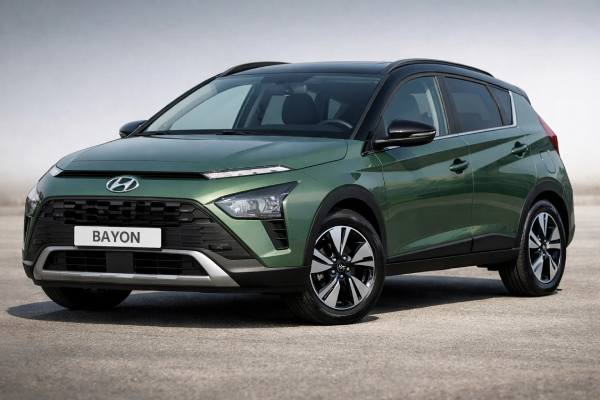
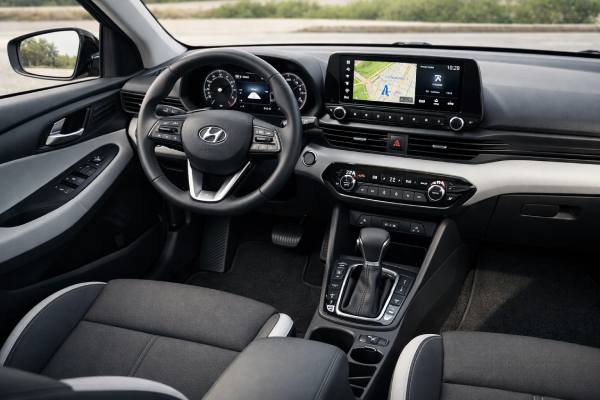
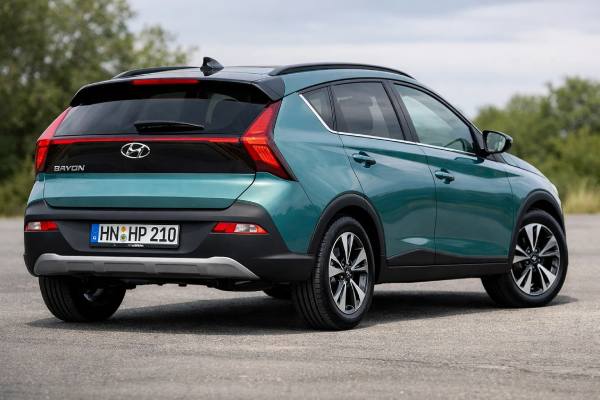
The Hyundai BAYON is a Europe-focused small crossover built for buyers who want SUV style, easy city size, and useful day-to-day practicality without the cost or bulk of a larger vehicle. In 1.0 T-GDi 100 form, it pairs a compact turbocharged three-cylinder engine with front-wheel drive, modest weight, and a cabin layout that makes everyday use simple. The key ownership story is straightforward: the BAYON works best as an efficient, sensible, well-equipped small family car rather than a sporty crossover. Its raised seating position, strong boot space, and broad safety technology are real strengths. The main things to watch are trim differences, gearbox choice, and service history on cars that have spent most of their life on short urban trips. The 2024 refresh also matters, because it brought meaningful design and technology improvements rather than minor cosmetic changes.
Owner Snapshot
- The BAYON offers very good boot space for its size, with 411 L in normal seat-up form.
- The 1.0 T-GDi 100 is the most balanced engine choice for many owners, especially with the manual gearbox.
- Safety equipment is one of the model’s stronger points, and the 2024 update improved cabin tech.
- The 7DCT should be tested carefully at low speed, and 48V cars need a complete service record.
- A sensible oil-service rhythm is every 10,000 to 15,000 km or 12 months, whichever comes first.
Guide contents
- Hyundai BAYON BC3 Essentials
- Hyundai BAYON BC3 Data
- BAYON BC3 Trims and Safety
- Reliability and Service Actions
- Maintenance and Buyer’s Guide
- Driving and Real-World Efficiency
- Bayon Versus Small SUV Rivals
Hyundai BAYON BC3 Essentials
Hyundai launched the BAYON as a crossover designed specifically for Europe, and that focus explains most of its character. It is shorter and easier to place than a typical family SUV, but Hyundai gave it a tall seating position, a useful rear cabin, and one of the better cargo areas in the class. The result is a car that suits urban driving, tight parking, and small-family duty better than rough-road use or enthusiastic driving. It gives buyers the look they want, but the engineering brief is clearly efficiency, visibility, and everyday convenience.
In 100 PS trim, the 1.0-litre T-GDi engine is the version many buyers end up preferring. It is strong enough for regular motorway use, lighter and thriftier than stepping up to more powerful alternatives, and offered with either a 6-speed manual or a 7-speed dual-clutch transmission depending on year and market. Some markets also paired the 100 PS engine with Hyundai’s 48-volt mild-hybrid system, which helps stop-start smoothness and trims fuel use in mixed driving. That means used-car shopping is less about engine output alone and more about finding the right mix of manual versus DCT, mild-hybrid versus non-hybrid, and pre-facelift versus facelift.
The 2024 update is more meaningful than it first appears. Hyundai reshaped the front and rear, added the Seamless Horizon lighting signature, revised wheel designs, and improved cabin technology. The refresh also pushed the BAYON closer to the rest of Hyundai’s newer range in both appearance and user experience. Standard cabin tech improved, while upper trims kept the more desirable features such as the larger digital cluster, Bose audio, and extra ambient lighting. For a used buyer, that means 2024 cars often feel newer inside than earlier ones, even when the underlying body and chassis layout stayed broadly similar.
Why does this matter in ownership terms? Because the BAYON’s strengths are easy to identify. It is easy to drive, easy to park, relatively light on fuel, and usually better equipped for driver assistance than many base rivals. Its weak spots are not dramatic, but they are typical of a modern small turbo crossover: trim complexity, some gearbox sensitivity at low speeds on DCT cars, and a need for disciplined maintenance on short-trip vehicles. Buy it as a practical small crossover with good boot space and strong safety content, and it makes sense. Buy it expecting the refinement and highway composure of a larger C-segment SUV, and it feels more ordinary.
Hyundai BAYON BC3 Data
The table below consolidates the core factory-style data for the 1.0 T-GDi 100 PS BAYON. Exact figures can vary slightly by market, wheel size, trim, gearbox, and emissions specification, so VIN-specific documentation still matters when buying parts or confirming service information.
Powertrain and efficiency
| Item | 1.0 T-GDi 100 6MT | 1.0 T-GDi 100 7DCT |
|---|---|---|
| Code | 1.0 T-GDi / Smartstream-family 3-cyl turbo petrol | 1.0 T-GDi / Smartstream-family 3-cyl turbo petrol |
| Layout and cylinders | Inline-3, DOHC, 12-valve | Inline-3, DOHC, 12-valve |
| Bore × stroke | 71 x 84 mm (2.80 x 3.31 in) | 71 x 84 mm (2.80 x 3.31 in) |
| Displacement | 998 cc (1.0 L) | 998 cc (1.0 L) |
| Induction | Turbocharged | Turbocharged |
| Fuel system | Direct injection | Direct injection |
| Compression ratio | 10.5:1 | 10.5:1 |
| Max power | 100 PS / 74 kW / 99 hp @ 6,000 rpm | 100 PS / 74 kW / 99 hp @ 6,000 rpm |
| Max torque | 172 Nm (127 lb-ft) @ 1,500–3,500 rpm | up to 200 Nm (148 lb-ft) on some later 7DCT specifications |
| Timing drive | Chain | |
| Rated efficiency | about 5.5–5.9 L/100 km (42.8–39.9 mpg US / 51.4–47.9 mpg UK), trim-dependent | about 5.5–5.8 L/100 km (42.8–40.6 mpg US / 51.4–48.7 mpg UK), trim-dependent |
| Real-world highway @ 120 km/h | usually mid-6s L/100 km in mild weather | usually mid- to high-6s L/100 km in mild weather |
Transmission, chassis, and dimensions
| Item | Value |
|---|---|
| Transmission | 6-speed manual or 7-speed dual-clutch automatic |
| Drive type | FWD |
| Differential | Open |
| Front suspension | MacPherson strut |
| Rear suspension | Coupled torsion beam axle |
| Steering | Electric power steering |
| Brakes | 280 mm (11.0 in) front ventilated discs / 262 mm (10.3 in) rear solid discs |
| Wheels and tyres | 195/55 R16 or 205/55 R17 depending on trim |
| Ground clearance | around 165 mm (6.5 in), market-dependent |
| Length | 4,180 mm (164.6 in) |
| Width | 1,775 mm (69.9 in) |
| Height | 1,500 mm (59.1 in) |
| Wheelbase | 2,580 mm (101.6 in) |
| Turning circle | about 10.4 m kerb-to-kerb (34.1 ft) |
| Kerb weight | about 1,095–1,205 kg manual / 1,120–1,230 kg DCT |
| GVWR | about 1,630–1,660 kg (3,594–3,660 lb) |
| Fuel tank | 40 L (10.6 US gal / 8.8 UK gal) |
| Cargo volume | 411 L / 1,205 L (14.5 / 42.6 ft³), VDA |
| Towing | 910 kg braked / 450 kg unbraked (2,006 / 992 lb) |
| Payload | about 425–540 kg (937–1,190 lb) |
Performance and safety
| Item | Value |
|---|---|
| 0–100 km/h (0–62 mph) | about 11.3 s manual / 12.4 s DCT |
| Top speed | about 179 km/h manual / 175 km/h DCT (111 / 109 mph) |
| 100–0 km/h braking | not commonly published in factory owner-facing literature |
| Euro NCAP | 4 stars |
| Adult occupant | 76% |
| Child occupant | 82% |
| Vulnerable road users | 76% |
| Safety assist | 67% |
| IIHS / headlight rating | Not applicable; BAYON is a Europe-focused model |
A few points stand out here. First, the BAYON’s numbers explain why it works well in Europe: modest size, useful cabin packaging, and enough torque for normal road use without chasing performance headlines. Second, the manual is usually the cleaner technical match to the engine. Third, public owner-facing materials are often stronger on dimensions, safety, and WLTP-style data than on workshop-level fluid quantities for every market variant, so exact service specifications should always be checked by VIN.
BAYON BC3 Trims and Safety
Trim names depend heavily on market, so used buyers should not rely on a badge alone. On earlier cars, many markets split the range into value, mid, and upper trims with the same basic structure: entry cars on 16-inch wheels, upper trims on 17s, and the better infotainment, climate, parking, and audio features reserved for higher grades or option packs. By the 2024 refresh in some markets, Hyundai used trim ladders such as Advance, Premium, and Ultimate. The important point is that the mechanical differences are usually small, but the ownership differences are not. Wheel size, parking sensors, camera setup, climate control type, and infotainment spec can change the day-to-day experience more than the engine itself.
Quick identifiers help more than trim names. A 16-inch wheel car is usually an entry-grade setup. A 17-inch car is usually mid or upper trim. Bose branding, a sunroof, extra ambient lighting, automatic climate control, front parking sensors, and wireless charging usually point to a better-equipped version. Facelift cars are easier to identify because of the front light bar and the cleaner, newer front-end design. Inside, later cars also feel more modern thanks to revised display layouts and updated connectivity features.
Safety is one of the BAYON’s more convincing selling points. Euro NCAP tested the BAYON in 2021 and scored it at 4 stars, with 76% for adult protection, 82% for child protection, 76% for vulnerable road users, and 67% for safety assist. That does not make the BAYON class-leading in every single measure, but it does mean a 2021 to 2024 example still comes with a credible modern safety baseline.
In practical terms, the standard and available ADAS content matters most. Hyundai offered Forward Collision-Avoidance Assist, Lane Following Assist, Lane Keep Assist, Intelligent Speed Limit Assist, eCall, seatbelt reminders, and driver monitoring. Higher-spec or later cars may add or broaden the availability of features such as blind-spot monitoring, rear cross-traffic systems, navigation-linked functions, and stronger parking-camera support. After any windscreen replacement, front-camera disturbance, or battery-voltage issue, it is sensible to confirm that the car has had the correct calibration and software checks. Modern small SUVs depend on that more than many buyers realize.
For families, the child-seat story is solid. ISOFIX mounting points, sensible rear access, and a manageable cabin size make the BAYON easy to live with if it needs to handle regular school-run duty. It is not a large family car, but it is thoughtfully packaged for the role it was designed to fill.
Reliability and Service Actions
The right way to think about BAYON reliability is to separate proven official evidence from sensible used-car risk. The model has generally been positioned with strong manufacturer support and a long new-car warranty in several European markets. That is a good sign, but it does not remove the need for careful inspection. On later cars especially, condition and software history matter almost as much as pure mechanical wear.
Here is the practical watch list I would use on a used 1.0 T-GDi 100:
- Common, low to medium cost: tired 12 V batteries, weak stop-start behaviour, and occasional warning lights on cars that do lots of short trips.
- Occasional, medium cost: 7DCT hesitation, shunt, or awkward crawling behaviour in dense traffic if clutch adaptation is poor or wear is beginning.
- Occasional, low to medium cost: camera or radar-related ADAS faults after windscreen work, battery weakness, or missed recalibration.
- Occasional, medium cost: rough running or weaker response on neglected direct-injection engines that have seen long oil intervals and mostly short, cold starts.
- Rare, medium cost: mild-hybrid support-component faults on 48V cars with patchy maintenance history or repeated low-voltage issues.
That list is deliberately careful. The BAYON is not widely known for one dominant, public, model-specific failure pattern that overwhelms the ownership picture. Instead, the real risk is buying the wrong usage history: lots of short trips, missed servicing, weak battery condition, or a DCT car that has spent most of its life inching through traffic.
The remedy path is usually straightforward. Symptoms such as hesitant starts, gearbox awkwardness, or warning-light clusters should send you first toward a battery test and diagnostic scan, then toward software status, then toward mechanical parts. On later cars, infotainment and map updates are part of the ownership picture rather than an afterthought. On 48V cars, confirm that the system behaves smoothly during stop-start transitions and that there are no stored charging or battery-management faults. On DCT cars, drive the vehicle both cold and fully warm, including reverse, parking maneuvers, hill starts, and repeated stop-start traffic.
For recalls and service actions, do not rely on a seller saying everything has been completed. Verify by registration or VIN and ask for dealer records. Campaign applicability is market- and VIN-specific, so proper proof matters more than verbal reassurance. A complete service history, clear recall status, and a clean diagnostic report do more to support BAYON reliability than any badge or trim level.
Maintenance and Buyer’s Guide
For long-term durability, the BAYON benefits from a conservative maintenance plan rather than the longest possible interval. The 1.0 T-GDi is a small turbocharged direct-injection engine, so clean oil and regular use matter. A good real-world plan looks like this:
| Item | Practical interval |
|---|---|
| Engine oil and filter | every 10,000–15,000 km or 12 months |
| Engine air filter | inspect yearly, replace around 30,000 km sooner in dusty use |
| Cabin filter | every 12 months or 15,000–20,000 km |
| Spark plugs | inspect by about 45,000 km, usually replace by about 60,000 km |
| Brake fluid | every 2 years |
| Tyre rotation | every 10,000–12,000 km |
| Alignment check | yearly, or after major pothole strikes |
| Coolant | inspect at every service; replace strictly by market manual schedule |
| 12 V battery test | yearly from year 3 onward |
| 7DCT behaviour check | every service visit on automatic cars |
| 48V system health check | include with annual diagnostic scan on MHEV cars |
That schedule is practical guidance, not a substitute for VIN-specific Hyundai service literature. It errs on the safe side for mixed European driving.
Public owner-facing material is not always generous with workshop-level fluid capacities for every exact variant, so these are the safe maintenance principles:
- Use the exact oil grade and approval stated for your VIN and market.
- Do not guess manual or DCT fluid specifications.
- Replace brake fluid only with the correct specification.
- Treat coolant chemistry as non-negotiable.
- Ask for written proof if a seller claims recent fluid service.
For the buyer’s inspection, focus on six things. First, start the engine fully cold and listen for rattles, uneven idle, or hesitation. Second, test every camera and ADAS function. Third, on DCT cars, do a slow-traffic drive, not just a fast-road test. Fourth, inspect tyres for uneven wear that may suggest alignment issues or suspension knocks. Fifth, check the service book and invoices closely. Sixth, verify recalls and campaign history through official channels.
The best buys are usually well-maintained manual 100 PS cars in mid or upper trim, or facelifted 2024 cars if budget allows. The examples to approach more carefully are lightly serviced urban DCT cars with poor battery condition, warning-light history, or weak evidence of software and campaign completion. Long term, the BAYON looks durable enough when maintained properly, but it is not a car that rewards neglect.
Driving and Real-World Efficiency
On the road, the BAYON 1.0 T-GDi 100 behaves like a sensible European supermini crossover, which is mostly a compliment. It is light, easy to place, and naturally at home in town. Visibility is good, the seating position is usefully elevated, and the chassis feels predictable rather than playful. Straight-line stability is fine at motorway speed, but this is not a particularly heavy or planted car, so crosswinds and coarse surfaces are more noticeable than in a larger SUV. Steering is light and accurate enough for its job, but feedback is modest. Ride quality is generally more forgiving on 16-inch wheels and slightly firmer on 17s. The cabin is not especially quiet at speed, yet it remains acceptable for the class.
The engine’s character suits the car. Around town it has enough torque to feel alert, and on faster roads it is happier when used in its mid-range rather than lugged at very low revs. The manual is usually the more natural pairing because it lets the driver use that torque band cleanly and keeps the car feeling a little lighter on its feet. The 7DCT is convenient and can be smooth at speed, but it is the version that deserves the hardest test in crawling traffic, hill starts, and repeated low-speed maneuvers.
Official efficiency figures place most 100 PS BAYON variants in roughly the mid-5 L/100 km range, depending on trim, wheel size, and gearbox. In real use, that usually means this:
- City: around 6.0–7.2 L/100 km depending on trip length and traffic
- Highway at 100–120 km/h: around 5.8–6.8 L/100 km
- Mixed driving: around 5.6–6.4 L/100 km
In US mpg terms, that is roughly mid-30s to low-40s. In UK mpg terms, think low-40s to low-50s when driven sensibly. Cold weather, short trips, winter tyres, and heavier 17-inch wheel setups all hurt the result. The 48V mild-hybrid versions usually help most in traffic and repeated stop-start use, not in steady fast cruising.
Performance is adequate rather than exciting. Around 11.3 seconds to 100 km/h for the manual means overtaking needs a little planning, especially with passengers. The upside is that the BAYON rarely feels strained in normal use, and its modest outputs help keep running costs in check. Braking feel is reassuring for daily driving, while the compact dimensions and tight turning circle are genuine urban advantages. If your priorities are easy commuting, small-family practicality, and lower fuel spend, the BAYON delivers. If you want a small SUV that feels especially polished on fast roads, some rivals feel more mature.
Bayon Versus Small SUV Rivals
The BAYON’s natural rivals include the Kia Stonic, Toyota Yaris Cross, Volkswagen T-Cross, and Renault Captur. The right comparison is less about outright performance and more about what kind of ownership experience you want.
| Rival | Where the BAYON wins | Where the rival may win |
|---|---|---|
| Kia Stonic | Better boot utility, stronger safety-tech impression, more crossover-like packaging | Simpler trim logic in some markets and a slightly more straightforward used-car story |
| Toyota Yaris Cross | Strong value, useful luggage space, conventional petrol feel | Better urban fuel economy and stronger hybrid appeal |
| Volkswagen T-Cross | Often better value per feature, strong safety content | More polished cabin feel and more flexible rear-seat packaging |
| Renault Captur | Easy controls and a less fussy ownership proposition | Softer ride in some versions and wider powertrain choice |
The BAYON’s strongest argument is balance. It is not the most premium, not the most efficient in absolute terms, and not the most powerful. But it packages space, visibility, safety technology, and reasonable fuel economy very well. That makes it a strong fit for buyers who do not want a hybrid price premium, do not need AWD, and care more about easy ownership than image.
Against the Yaris Cross, the BAYON makes sense if you value purchase price, boot usability, and a more conventional petrol driving feel. Against the Stonic, it feels like the slightly more practical and safety-led choice. Against the T-Cross, it usually wins on value but loses some cabin richness. Against the Captur, it feels more straightforward and less style-driven.
My verdict is simple. The BAYON 1.0 T-GDi 100 is one of the better rational small crossovers of its era. The best version for many buyers is a manual mid-spec car with complete service history. The most desirable used examples are often 2024 facelift cars if price is still sensible. Choose it for practicality, safety, and everyday ease, and it compares well. Choose it chasing performance or premium feel, and a rival may suit you better.
References
- Hyundai BAYON | Specifications | Hyundai Motor UK 2026 (Technical Specifications)
- Hyundai Bayon | Technical data | June 2024 2024 (Technical Data)
- Official Hyundai BAYON 2021 safety rating 2021 (Safety Rating)
- New Bayon: A stylish SUV with class-leading practicality 2024 (Press Release)
- 5-Year Warranty | New Cars | Hyundai Motor UK 2026 (Warranty)
Disclaimer
This article is for informational purposes only and is not a substitute for professional diagnosis, repair, or VIN-specific workshop guidance. Specifications, torque values, maintenance intervals, fluid requirements, and repair procedures can vary by VIN, market, transmission, mild-hybrid status, and trim, so always verify against the correct official Hyundai owner and service documentation for the exact vehicle.
If this guide helped you, please consider sharing it on Facebook, X, or other social platforms to support our work.