
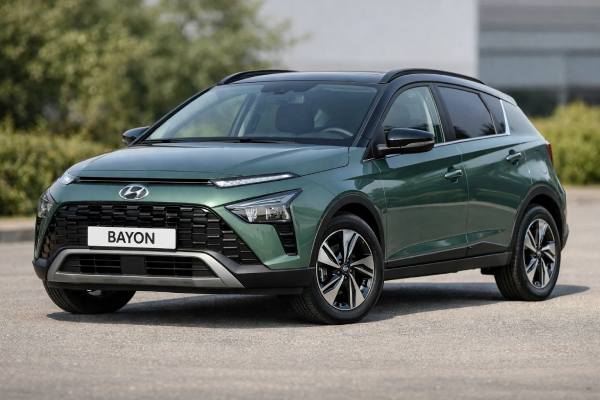
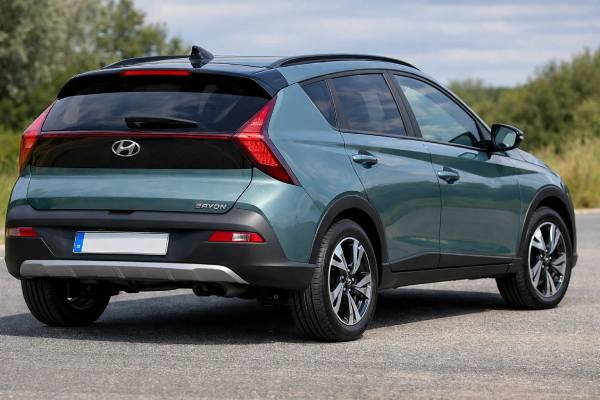
The 2021–2024 Hyundai BAYON 1.2 MPi is the simple, low-stress version of Hyundai’s small European crossover. It skips the turbocharger, mild-hybrid hardware, and dual-clutch gearbox found elsewhere in the range, and instead pairs a naturally aspirated 1.2-litre four-cylinder petrol engine with a 5-speed manual transmission. That makes it slower than the turbo models, but also easier to understand, cheaper to service, and often the safer used buy for owners who care more about durability than outright pace.
The bigger story is balance. The BAYON stays compact enough for tight city streets, yet it offers a genuinely useful 411-litre boot and a slightly raised seating position that many owners prefer over a regular supermini. For commuting, school runs, and mixed urban use, this version makes a lot of sense. Its main trade-off is motorway performance: when fully loaded, it needs planning and frequent downshifts.
Owner Snapshot
- The 1.2 MPi is the simplest BAYON powertrain, with no turbocharger, no direct injection, and no DCT gearbox.
- A 411 L boot and compact exterior make it one of the more practical small crossovers for city life.
- Light weight helps fuel economy and keeps routine tyre and brake costs reasonable.
- Performance is modest, so steep roads, fast overtakes, and full-load motorway driving require patience.
- For severe use such as short trips, heavy traffic, or dusty conditions, treat 7,500 km or 6 months as the oil-service ceiling.
Guide contents
- Hyundai BAYON BC3 overview
- Hyundai BAYON BC3 specs
- Hyundai BAYON BC3 trims and safety
- Reliability, faults and recalls
- Maintenance and buyer checks
- Driving feel and economy
- BAYON 1.2 versus rivals
Hyundai BAYON BC3 overview
The BAYON sits in Hyundai’s B-segment crossover class, closely related to the i20 underneath but packaged to give buyers a taller body, easier access, and more luggage flexibility. In 1.2 MPi form, it represents the range at its most straightforward. Instead of chasing headline acceleration, Hyundai tuned this version for predictable response, low running costs, and easy ownership. That matters because many small crossovers spend most of their lives in town, not on unrestricted autobahns.
This engine is a naturally aspirated 1.2-litre multipoint-injection unit with four cylinders and a timing chain. On paper, it is the least exciting BAYON, but in daily use it also avoids several common complexity points seen in modern downsized rivals: no turbocharger, no gasoline particulate filter drama, no 48-volt mild-hybrid parts, and no dual-clutch transmission. For a buyer shopping used, that simplicity is a real advantage.
The rest of the package is sensible. The BAYON is compact enough to park easily, yet the cabin does not feel cramped in front, and the luggage area is stronger than many expect from a crossover this size. The 411-litre boot is a genuine selling point, especially for pushchairs, airport bags, or weekly shopping. Rear-seat room is adequate rather than generous, but the wheelbase helps it avoid the pinched feel of some style-first rivals.
Hyundai also gave the BAYON a strong everyday equipment story. Even lower trims in many markets offered a rear-view camera, parking sensors, a modern infotainment screen, and key safety tech. The 2024 facelift sharpened the styling and expanded digital features, but the basic character of the 1.2 model stayed the same: honest, practical, and easy to live with.
That said, the trade-off is clear. With about 84 PS rather than turbo-style mid-range shove, this version is happiest in urban and suburban driving. It can cruise, but it does not have much reserve for fast passing or steep, loaded motorway climbing. If your routine is mostly short to medium trips, relaxed A-road use, and normal family duty, that will not be a deal-breaker. If you regularly drive at high speed with four adults and luggage, the turbo models or a larger vehicle make more sense.
For the right owner, though, the BAYON 1.2 is one of those cars that becomes more appealing the longer you keep it.
Hyundai BAYON BC3 specs
For this exact 2021–2024 BAYON 1.2 MPi, the key numbers tell the story well: light curb weight, decent cargo room, modest output, and a straightforward manual front-wheel-drive layout. One point worth noting is naming. Hyundai marketed this engine in Europe as an 84 PS unit, which is roughly 83 hp in strict conversion, but many English-language listings round it to 84 hp. That is why you will see both forms in the market.
Powertrain and efficiency
| Item | Hyundai BAYON 1.2 MPi |
|---|---|
| Code | Smartstream G1.2 MPi |
| Engine layout and cylinders | Inline-4, 4 cylinders, 16-valve DOHC |
| Bore × stroke | 71.0 × 75.6 mm (2.80 × 2.98 in) |
| Displacement | 1.2 L (1,197 cc) |
| Induction | Naturally aspirated |
| Fuel system | MPi / multipoint electronic injection |
| Compression ratio | 11.0:1 |
| Max power | 84 PS / about 83 hp (62.6 kW) @ 6,000 rpm |
| Max torque | 117.6 Nm (86.7 lb-ft) @ 4,200 rpm |
| Timing drive | Chain |
| Rated efficiency | 5.6 L/100 km (42.0 mpg US / 50.4 mpg UK) combined WLTP |
| Real-world highway at 120 km/h | Typically about 6.0–6.7 L/100 km, depending on load, wind, and tyres |
Transmission and driveline
| Item | Hyundai BAYON 1.2 MPi |
|---|---|
| Transmission | 5-speed manual |
| Drive type | FWD |
| Differential | Open |
Chassis and dimensions
| Item | Hyundai BAYON 1.2 MPi |
|---|---|
| Front suspension | MacPherson strut |
| Rear suspension | Coupled torsion beam axle |
| Steering | Electric power steering |
| Brakes | 280 mm front ventilated discs, 262 mm rear solid discs |
| Common tyre sizes | 185/65 R15 or 195/55 R16 |
| Length | 4,180 mm (164.6 in) |
| Width | 1,775 mm (69.9 in) |
| Height | 1,500 mm (59.1 in) |
| Wheelbase | 2,580 mm (101.6 in) |
| Turning circle | 10.4 m (34.1 ft) |
| Kerb weight | From about 1,045 kg (2,304 lb) |
| GVWR | 1,580 kg (3,483 lb) |
| Fuel tank | 40 L (10.6 US gal / 8.8 UK gal) |
| Cargo volume | 411 L seats up / 1,205 L seats down (14.5 / 42.6 ft³), VDA |
Performance and capability
| Item | Hyundai BAYON 1.2 MPi |
|---|---|
| 0–100 km/h | 13.5 s |
| 0–62 mph | 13.5 s |
| Top speed | 165 km/h (102.5 mph) |
| Payload | Up to about 530 kg (1,168 lb) |
| Towing capacity | Market-dependent; verify by VIN plate and local handbook |
| Braking distance | Not consistently published in the open Hyundai literature reviewed |
Fluids and service capacities
| Item | Hyundai BAYON 1.2 MPi |
|---|---|
| Engine oil | SAE 0W-20; 3.4 L (3.6 US qt) drain and refill |
| Coolant | Hyundai long-life coolant; about 4.66 L (4.9 US qt) |
| Manual gearbox oil | API GL-4 SAE 70W; about 1.3–1.4 L (1.37–1.48 US qt) |
| Brake and clutch fluid | DOT 4; about 0.7–0.8 L (0.74–0.85 US qt) |
| A/C refrigerant | Check under-bonnet label; value varies by exact system |
| A/C compressor oil | Check under-bonnet label |
| Key torque spec | Wheel nuts: about 108–127 Nm (80–94 lb-ft) |
Safety and driver assistance
| Item | Hyundai BAYON 1.2 MPi |
|---|---|
| Euro NCAP | 4 stars |
| Adult Occupant | 76% |
| Child Occupant | 82% |
| Vulnerable Road Users | 76% |
| Safety Assist | 67% |
| IIHS | Not applicable in this market |
| ADAS availability | FCA, LKA, LFA, ISLA, eCall common; ACC, blind-spot and rear cross-traffic features depend on year and trim |
The most important takeaway from the data is not speed. It is that the 1.2 MPi combines light mass, good boot volume, and uncomplicated mechanicals in a size that still feels modern and useful.
Hyundai BAYON BC3 trims and safety
Trim naming changed by market, so there is no single global BAYON ladder. That said, the equipment pattern is easy to understand. Early mainland-European cars often followed a progression such as L, GL, GLS, and TOP, while later markets and facelift cars used different names. The 1.2 MPi usually sat in the lower to middle parts of the range, where Hyundai focused on value and everyday practicality rather than performance upgrades.
In practical terms, trim differences were mostly about convenience, lighting, wheel size, and cabin tech rather than major mechanical changes. The 1.2 MPi remained front-wheel drive with a 5-speed manual, so you were not choosing between different differentials, suspension tunes, or aggressive performance packages. That makes used-car shopping easier than on some rivals.
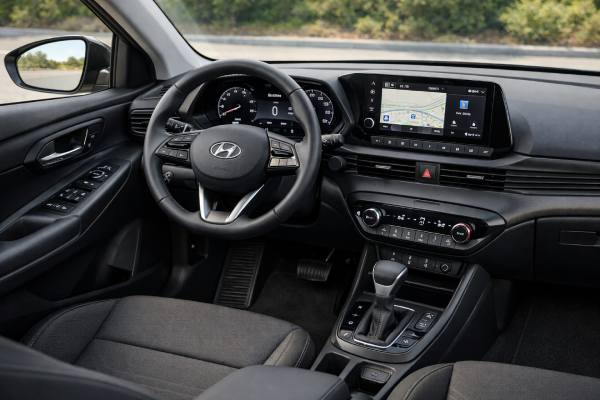
Typical entry-level equipment included a 10.25-inch central screen in later cars or better-specced markets, a 4.2-inch cluster display, rear parking sensors, a rear-view monitor, USB charging, and core safety systems such as Forward Collision-Avoidance Assist, Intelligent Speed Limit Assist, and Lane Following Assist. Mid trims often added 16-inch alloys, LED headlamps, folding mirrors, more digital instrumentation, and ambient lighting. Upper trims usually brought extras such as privacy glass, automatic climate control, wireless charging, rear USB charging, a luggage board or net, and a fuller lighting package.
Quick visual identifiers help when browsing used listings. Steel wheels or small alloys usually signal the lower trims. LED headlamps, more elaborate rear lamps, privacy glass, and a fully digital cluster point to the mid or upper grades. Inside, items such as wireless charging, armrest-mounted rear charging ports, or a premium audio system usually indicate a higher trim or optional pack.
Safety was a solid selling point, though not class-leading on paper. Euro NCAP awarded the BAYON four stars, with strong child-occupant performance and decent scores for vulnerable road users. The rating applies across the BAYON line, and the 2024 facelift review retained the same 2021 rating basis. That is respectable, but buyers who prioritize the very highest crash-test headline may notice that some rivals achieved five stars under comparable protocols.
The hardware list is still good for the class. The BAYON used front, side, and curtain airbags, ISOFIX child-seat mounts, ABS, ESC, and autonomous emergency braking functions. Depending on trim and year, the driver-assistance menu could include lane-keeping, lane-following, speed-limit recognition, driver attention monitoring, high-beam assist, rear seat alert, navigation-based smart cruise control, blind-spot monitoring, rear cross-traffic collision avoidance, and, on newer cars, junction-turning functionality within the forward-collision system.
There is one ownership detail many buyers overlook: calibration. If the BAYON has had a windscreen replacement, front-end repair, or bumper work, camera- and radar-based systems may need checking and recalibration. A used example with unexplained ADAS warnings or lane-support errors deserves a proper diagnostic scan before purchase.
Reliability, faults and recalls
If you want the least risky BAYON from a mechanical point of view, this is usually the one to buy. The 1.2 MPi and 5-speed manual combination removes several expensive complexity points from the broader BAYON range. There is no turbocharger, no direct-injection carbon build-up concern, no 48-volt mild-hybrid system, and no dual-clutch gearbox. That does not make it flawless, but it does make it easier to own long term.
A sensible way to view BAYON 1.2 reliability is by prevalence and cost.
Common, usually low to medium cost
- Weak 12-volt battery behaviour on cars that mostly do short trips.
- Front brake corrosion or uneven pad wear on lightly used cars.
- Tyre wear or road-noise complaints if alignment has drifted or cheap replacement tyres were fitted.
- Minor infotainment or connectivity glitches that often improve after updates.
Occasional, medium cost
- Clutch wear, shudder, or a high bite point on urban cars with lots of stop-start use.
- Parking sensor, camera, or ADAS warning messages after bumper or windscreen work.
- Interior trim rattles, hatch-area noises, or dash creaks on rough roads.
Rare, but more important
- VIN-specific fuel-pump recall actions on some 2021–2023 BAYONs.
- A DCT control-unit recall campaign on certain 2023–2024 BAYONs, mostly relevant to automatic turbo cars rather than this 1.2 manual.
For this engine itself, the pattern is encouraging. The timing drive is a chain, not a belt, and there is no strong public pattern of widespread chain failure in the BAYON 1.2. Still, listen for persistent cold-start chain rattle, rough idle, or timing-correlation fault codes on higher-mileage cars. Those symptoms are uncommon, but they are the right ones to watch. Because this is a multipoint-injection engine, it is also less exposed to intake-valve carbon build-up than many direct-injection competitors.
Cooling-system faults are not a headline weakness, but used cars still deserve a careful look around hose joints, the water pump area, and the thermostat housing for seepage. On city-driven cars, the clutch is a bigger concern than the engine. A heavy pedal, chatter on take-off, or a slipping feel under load means budgeting for clutch work.
Software matters too. Hyundai issued updates across the BAYON family for safety and control functions, and many small complaints are solved by dealer-level checks rather than hard parts. That is especially true for eCall, infotainment, camera-based assistance, and warning messages that appear after body repairs.
Before buying, ask for three things: full service history, proof that recall and campaign work has been completed, and evidence that the car has not lived on the cheapest tyres and overdue maintenance. Then do a cold start, check for battery weakness, drive it long enough to test clutch take-up, listen for suspension knocks, and make sure every warning light goes out properly.
Mechanically, the 1.2 MPi BAYON is not a car with many famous disaster points. Its real enemy is neglect.
Maintenance and buyer checks
The best maintenance strategy for the BAYON 1.2 is simple: do not stretch the basics just because the engine itself is simple. Fresh oil, clean filters, good tyres, a healthy battery, and up-to-date software do more for this car than chasing exotic preventative work.
A practical ownership schedule looks like this:
| Item | Sensible interval for the 1.2 MPi |
|---|---|
| Engine oil and filter | At least every 12 months; use 7,500 km or 6 months in severe service |
| Engine air filter | Inspect every service; replace around 30,000 km sooner in dusty use |
| Cabin air filter | About every 15,000–20,000 km or yearly |
| Spark plugs | 75,000 km or 60 months |
| Coolant | First change at 210,000 km or 10 years, then every 30,000 km or 24 months |
| Manual gearbox oil | Inspect for leaks at every service; renew around 120,000 km if use is severe or shift quality declines |
| Brake fluid | Check regularly and replace to the schedule in the service book for your market |
| Brake pads and rotors | Inspect at every service |
| Tyre rotation | Around every 10,000–12,000 km |
| Wheel alignment | Check after pothole hits, tyre-edge wear, or steering pull |
| 12 V battery test | Yearly after year three |
| Timing chain | No routine replacement interval; inspect if rattle, rough running, or correlation faults appear |
| Auxiliary belts and hoses | Inspect yearly and replace on condition |
For fluids, the key figures are straightforward. Engine oil capacity is about 3.4 litres on a drain-and-refill service. Manual gearbox oil is roughly 1.3 to 1.4 litres and should meet the correct GL-4 70W specification. Coolant capacity is about 4.66 litres, and brake or clutch hydraulic fluid is around 0.7 to 0.8 litres. Wheel-nut torque sits in the usual Hyundai range of about 108 to 127 Nm. These are useful decision-making numbers, but always confirm them against the exact VIN and workshop literature before repair work.
As a used buy, the sweet spot is usually a clean 2022–2024 car with full history, no warning lights, and a trim level that gives you the camera, parking sensors, and the safety kit you actually want. Mid trims with 16-inch wheels often strike the best balance. Fifteen-inch wheel cars can ride more softly and cost less to tyre. High-spec cars are nice, but more equipment also means more small things to test.
What should you avoid? Cars with a weak battery, mismatched tyres, an unexplained clutch feel, missing recall history, or ADAS faults after repair. Also be cautious if the seller cannot explain overdue servicing on a short-trip car. This engine is tolerant, but not immune.
The long-term outlook is good if you maintain it like an appliance rather than a gadget. The BAYON 1.2 rewards boring, regular care.
Driving feel and economy
On the road, the BAYON 1.2 feels exactly like a light, honest small crossover should. The controls are easy, visibility is good, and the raised seating position gives new or nervous drivers a bit more confidence in traffic. Around town, the engine is smooth enough, the clutch is easy to judge, and the car’s compact footprint makes parking simple. That is where it feels most at home.
Ride quality is generally tidy rather than plush. On 15-inch wheels, the BAYON tends to absorb broken urban surfaces better, while larger wheels add a little more edge and tyre noise. The suspension is not sporty, but it stays predictable, and body roll is well controlled for a small crossover. Steering is light and accurate enough, though feedback is limited. It is a car that aims for security and ease, not involvement.
The engine character is the clearest separator from turbo rivals. There is no turbo lag because there is no turbo, but there is also no big low-rpm torque surge. You need to use the gearbox, especially when climbing, overtaking, or driving with a full load. At motorway speeds, the BAYON can cruise steadily, yet it becomes noisier and feels short on reserve if you ask for quick acceleration. Owners who mainly drive in cities may not mind that at all. Drivers who spend hours at 120 km/h every week probably will.
Real-world economy is respectable for a simple petrol crossover. In mixed use, many drivers should expect about 5.6 to 6.4 L/100 km. Urban driving usually pushes it into roughly 6.2 to 7.2 L/100 km, while a steady highway run often lands around 6.0 to 6.7 L/100 km at 120 km/h. Winter use, roof loads, and cold starts can add around 0.4 to 0.8 L/100 km.
Braking feel is predictable, and straight-line stability is fine, though this is not the type of crossover that encourages late braking or fast corner exits. Under load, it simply reminds you what it is: a practical small crossover with enough power, not abundant power.
If your idea of good performance is smooth commuting, easy placement, and low-stress operation, the BAYON 1.2 delivers. If your idea is effortless overtaking, it does not.
BAYON 1.2 versus rivals
The BAYON 1.2 makes the most sense when you compare it against other small crossovers through the lens of ownership rather than brochure excitement. Against turbocharged rivals such as the Nissan Juke 1.0 DIG-T, Skoda Kamiq 1.0 TSI, or Peugeot 2008 1.2 PureTech, the Hyundai is slower and less punchy. But it can also be mechanically simpler, especially versus rivals that rely on turbocharging, direct injection, and more complex transmissions.
Its closest relative is the Kia Stonic 1.2. The Stonic feels more like a lifted supermini, while the BAYON leans harder into practicality. The Hyundai’s cargo space and overall packaging are among its strongest arguments, and many buyers will prefer its cleaner cabin layout and strong feature content. In used form, the decision often comes down to condition and price, because the mechanical philosophy is similar.
Against the Toyota Yaris Cross hybrid, the Hyundai loses on outright efficiency and low-speed effortless response. The Toyota is quicker in real traffic and can be dramatically thriftier in town. But it is also a more complex and usually more expensive car to buy. The BAYON 1.2 remains attractive for owners who want a simple petrol manual with lower entry cost and easier DIY familiarity.
Compared with a budget choice like the Dacia Sandero Stepway, the BAYON typically feels more modern in safety tech, infotainment, and overall finish. The Dacia can undercut it on price and simplicity, but the Hyundai usually gives you the more polished cabin and a stronger feature set.
The main caution comes from safety headlines. A four-star Euro NCAP result is solid, but some buyers will prefer rivals with five-star results if crash-test ranking is a top priority. The other caution is performance. If you want strong motorway pace, a turbo crossover will suit you better.
So where does the BAYON 1.2 land? It is one of the better choices for buyers who value simplicity, cargo room, easy city manners, and predictable long-term ownership over speed. It is not the most exciting car in the class. It may be one of the more sensible ones.
References
- The all-new Hyundai BAYON: a stylish and sleek crossover SUV 2021 (Press Kit)
- Official Hyundai BAYON 2021 safety rating 2021 (Safety Rating)
- New Bayon: A stylish SUV with class-leading practicality 2024 (Press Release)
- The BAYON | Trims & Prices | Hyundai Motor Europe 2024 (Model Specifications)
- Recalls by manufacturer (2025) 2025 (Recall Database)
Disclaimer
This article is for informational purposes only and is not a substitute for professional diagnosis, repair, or factory service information. Specifications, torque values, service intervals, fluid requirements, and repair procedures vary by VIN, market, production date, and equipment, so always verify details against official Hyundai service documentation and the labels on the vehicle before carrying out work.
If this guide helped you, please consider sharing it on Facebook, X, or another social platform to support our work.