
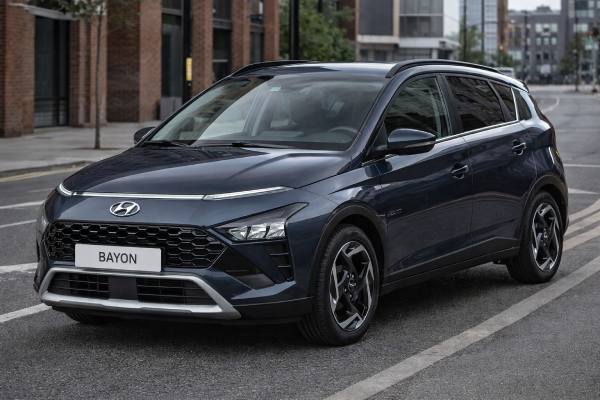
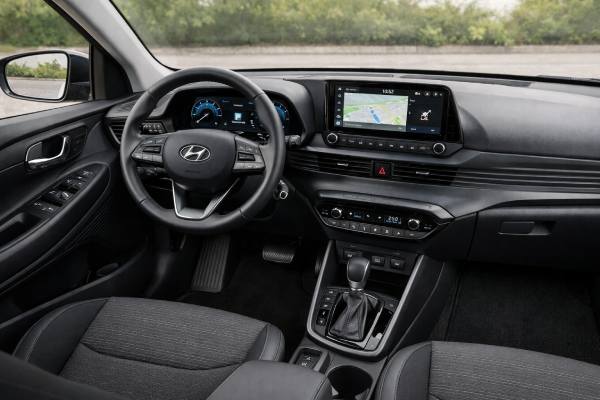
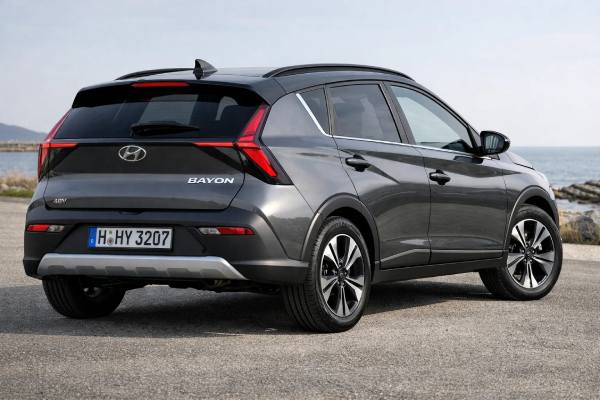
The facelifted Hyundai BAYON 1.0 T-GDi 100 hp is a small crossover built around a simple idea: give buyers SUV style, compact dimensions, and useful family space without the size, weight, and running costs of a larger vehicle. For the 2024 update, Hyundai sharpened the exterior, standardized LED lighting across the range, refreshed the cabin, and kept the formula focused on a light 1.0-litre turbo three-cylinder with front-wheel drive and either a 6-speed manual or 7-speed dual-clutch gearbox. The result is not a hot hatch in disguise, but it is easy to place in traffic, practical for daily use, and strong on standard safety equipment and luggage space. The one catch is that “2024–present” does not mean identical in every market, because Hyundai later revised trim and powertrain naming in some regions. This guide focuses on the facelift-era 100 hp version introduced in 2024 and flags the ownership details that matter most.
Owner Snapshot
- Big 411 L boot and compact exterior make it easier to live with than many larger SUVs.
- Standard LED lighting and a strong core safety package are real strengths for everyday use.
- The 6-speed manual is quicker on paper, while the 7DCT gives stronger peak torque in traffic.
- Early 7DCT cars deserve a recall and software-completion check before you buy.
- Keep servicing on time every 12 months and stay within Hyundai’s 30-day or 1,000-mile grace window for warranty protection.
Guide contents
- BAYON BC3 Facelift Overview
- BAYON 100 Specs and Data
- BAYON Trims Safety and Tech
- Reliability Issues and Campaigns
- Maintenance Plan and Buying Tips
- Road Manners and Efficiency
- BAYON vs Small SUV Rivals
BAYON BC3 Facelift Overview
The facelifted BAYON sits at the sensible end of the small-SUV class. It is shorter and easier to park than a family SUV, but it still gives buyers the higher seating position, tall hatch opening, and useful boot that push many people out of ordinary superminis and into crossovers. Hyundai’s 2024 refresh did not try to reinvent the car. Instead, it improved the details that owners see every day: LED headlights and taillights across the range, a full-width Horizon-style LED DRL signature, updated bumpers and wheel designs, fresher interior lighting, and broader comfort and convenience equipment. That matters, because this is a car that wins on daily usability more than showroom drama.
Mechanically, the headline version is the 998 cc 1.0 T-GDi three-cylinder petrol with 100 PS. In facelift launch form, Hyundai paired it with either a 6-speed manual or a 7-speed dual-clutch transmission. The manual version makes 172 Nm, while the DCT version is tuned for a higher 200 Nm peak. On paper, that gives the manual the better 0–62 mph time and the automatic the more relaxed low-speed character in town. Both remain front-wheel drive, both use a compact B-segment chassis with MacPherson struts at the front and a coupled torsion beam axle at the rear, and both are aimed at economical everyday use rather than outright pace.
Where the BAYON makes its strongest ownership case is in balance. It offers all-round disc brakes, a 40-litre tank, a 411-litre VDA boot, and a straightforward cabin layout with a standard 10.25-inch driver display and 10.25-inch touchscreen navigation in the UK launch range. New buyers also got Hyundai’s five-year unlimited-mileage warranty in the UK, which remains a real selling point in the used market because the remaining cover can still add peace of mind on newer cars.
One important note for shoppers: “facelift 2024–present” is not perfectly uniform across every market. Hyundai UK later moved the BAYON to a revised two-trim strategy with a different 90 PS powertrain. That means buyers should decode the exact car by build date, market, trim, gearbox, and VIN rather than assuming every facelift BAYON after 2024 has identical equipment. For this article, the target car is the facelifted 1.0 T-GDi 100 hp model introduced in 2024.
BAYON 100 Specs and Data
For the 2024 facelift 100 hp version, Hyundai’s public launch data is strong on dimensions, performance, weights, towing, and equipment, but noticeably thinner on workshop-level fill capacities and torque settings. That is worth stating clearly, because many spec pages online mix official figures with scraped database values. The tables below stay anchored to Hyundai’s public facelift technical sheet unless noted otherwise.
| Powertrain and driveline | 6MT | 7DCT |
|---|---|---|
| Engine code family | 1.0 T-GDi petrol | 1.0 T-GDi petrol |
| Layout | Inline-3, DOHC | Inline-3, DOHC |
| Cylinders / valves | 3 / 12 | 3 / 12 |
| Valves per cylinder | 4 | 4 |
| Displacement | 1.0 L (998 cc) | 1.0 L (998 cc) |
| Bore × stroke | 71 × 84 mm (2.80 × 3.31 in) | 71 × 84 mm (2.80 × 3.31 in) |
| Induction | Turbocharged | Turbocharged |
| Fuel system | Direct injection | Direct injection |
| Compression ratio | 10.5:1 | 10.5:1 |
| Max power | 100 hp (74 kW) @ 6,000 rpm | 100 hp (74 kW) @ 6,000 rpm |
| Max torque | 172 Nm (127 lb-ft) @ 1,500–3,500 rpm | 200 Nm (148 lb-ft) @ 2,000–2,500 rpm |
| Transmission | 6-speed manual | 7-speed dual-clutch |
| Drive type | FWD | FWD |
| Emissions standard | Euro 6e | Euro 6e |
| Chassis, dimensions, and capacities | Figure |
|---|---|
| Front suspension | MacPherson strut |
| Rear suspension | Coupled torsion beam axle |
| Steering | Motor Driven Power Steering |
| Front brakes | 280 mm ventilated discs (11.0 in) |
| Rear brakes | 262 mm solid discs (10.3 in) |
| Length | 4,180 mm (164.6 in) |
| Width | 1,775 mm (69.9 in) |
| Height | 1,500 mm (59.1 in) |
| Wheelbase | 2,580 mm (101.6 in) |
| Tyres, Advance | 195/55 R16 |
| Tyres, Premium / Ultimate | 205/55 R17 |
| Kerb weight | 1,095–1,205 kg (2,414–2,657 lb) manual; 1,120–1,230 kg (2,469–2,712 lb) DCT |
| GVWR | 1,630 kg (3,594 lb) manual; 1,660 kg (3,660 lb) DCT |
| Payload | 425–535 kg (937–1,179 lb) manual; 430–540 kg (948–1,190 lb) DCT |
| Fuel tank | 40 L (10.6 US gal / 8.8 UK gal) |
| Cargo volume, VDA | 411 L seats up (14.5 ft³); 1,205 L seats down (42.6 ft³) |
| Roof load | 70 kg (154 lb) |
| Towing, braked / unbraked | 910 / 450 kg (2,006 / 992 lb) |
| Performance and efficiency | 6MT | 7DCT |
|---|---|---|
| 0–100 km/h (0–62 mph) | 11.3 s | 12.4 s |
| Top speed | 179 km/h (111 mph) | 175 km/h (109 mph) |
| WLTP combined | 5.5 L/100 km (42.8 US / 51.4 UK mpg) | 5.5 L/100 km (42.8 US / 51.4 UK mpg) |
| WLTP low phase | 7.2–7.3 L/100 km | 7.0 L/100 km |
| WLTP high phase | 4.6–4.7 L/100 km | 4.6–4.7 L/100 km |
| WLTP extra-high phase | 5.7–5.8 L/100 km | 5.8 L/100 km |
| CO₂ | 124–126 g/km | 124–125 g/km |
| Safety data | Figure |
|---|---|
| Euro NCAP overall | 4 stars |
| Adult Occupant | 76% |
| Child Occupant | 82% |
| Vulnerable Road Users | 76% |
| Safety Assist | 67% |
Publicly unavailable in Hyundai’s open 2024 facelift sheet are the detailed steering ratio, ground clearance, engine oil capacity, coolant capacity, DCT fill quantity, A/C refrigerant charge, compressor oil charge, and key fastener torque specs. For those items, use VIN-specific workshop documentation, not generic internet databases.
BAYON Trims Safety and Tech
At the 2024 UK facelift launch, the BAYON 100 hp came in three trims: Advance, Premium, and Ultimate. Even the entry car was not bare-bones. Advance included 16-inch alloys, LED headlights, LED taillights, the front LED light bar, rear parking sensors, rear camera, cruise control, automatic headlights, power-folding heated mirrors, a 10.25-inch instrument cluster, and a 10.25-inch navigation screen with smartphone integration. That means the basic facelift BAYON already covers the needs of most everyday owners without feeling like a fleet special.
Premium moved the car into the sweet spot for many private buyers. It added 17-inch wheels, automatic climate control, rain-sensing wipers, front parking sensors, privacy glass, rear USB-C, heated front seats, and a heated steering wheel. Mechanically, it stayed the same, so the upgrade was almost entirely about comfort and convenience. Ultimate then layered on the nicer extras: BOSE audio, wireless charging, smart key entry and start, Blind Spot Collision Warning, and the electric tilt-and-slide glass sunroof. In other words, the trim walk is clear and logical: Advance covers the essentials, Premium feels properly complete, and Ultimate is for buyers who want the full small-SUV convenience package.
Safety is one of the BAYON’s stronger selling points if you stay realistic about the class. Hyundai gave the facelift launch cars driver, front passenger, side, and curtain airbags, plus Lane Follow Assist, Lane Keep Assist, Forward Collision-Avoidance Assist for car, pedestrian, and cycle detection, Intelligent Speed Limit Assist, second-generation eCall, and a rear-view camera as standard. Premium and Ultimate added front parking sensors, while a Driver Assistance Pack on higher trims could add Smart Cruise Control with Stop and Go, FCA 1.5, and Blind Spot Collision-Avoidance Assist. That makes the BAYON feel modern in daily traffic, though buyers should remember that standard and optional ADAS content can vary by year and market.
The crash-test story is solid rather than class-leading. Euro NCAP awarded the BAYON four stars, with 76% for Adult Occupant, 82% for Child Occupant, 76% for Vulnerable Road Users, and 67% for Safety Assist. The useful detail is in the rating-validity note: Euro NCAP reviewed the facelift in May 2024 and kept the existing BAYON rating in force. That gives facelift buyers a more direct line between the published crash result and the updated car than on some model refreshes where equipment changes can muddy the picture. Euro NCAP also notes ISOFIX provision and a strong child-seat installation check, which is relevant for family buyers.
The only catch is late-cycle market drift. By late 2025 into 2026, Hyundai UK had already shifted the BAYON to Black Line and Tech Line trims with a revised 90 PS setup. So when shopping used, badges alone are not enough. Ask for the brochure, VIN, registration date, and original order sheet if possible. On a Bayon, equipment differences matter almost more than they do on the mechanical side, because the chassis and cabin space are broadly the same while the convenience and ADAS package can vary noticeably.
Reliability Issues and Campaigns
The honest reliability verdict on the facelifted BAYON 100 hp is that it is still too young for a deep, public long-term failure pattern to be fully settled. That is not the same as saying “trouble free”; it means you should separate official, documented issues from forum noise. In the official material reviewed here, the main BAYON-specific service action that overlaps the facelift era is the 2024 i20/Bayon BC3 DCT and TCU campaign. Affected cars built between late March 2023 and mid-January 2024 could suffer a shift error if the limp-home mode failed to activate, causing unintended deceleration. For a used facelift BAYON, that is the first thing to verify on any early 7DCT car.
In practical terms, the symptom chain on an affected car is straightforward: odd shift behavior, warning messages, hesitation, or loss of drive response under a transmission fault condition. The likely root cause is software logic in the DCT/TCU safety strategy, and the official remedy is campaign completion through the dealer network. That does not automatically make every 7DCT a bad buy. It simply means the dual-clutch car carries one more must-check item than the manual. A manual BAYON is mechanically simpler, and for buyers who intend to keep the car long after warranty expiry, that simplicity is a real advantage.
The second useful reliability point is negative rather than positive: the later fuel-pump recall cited for earlier BAYON production generally falls into the pre-facelift period rather than the normal 2024 facelift target car. So while it matters if you are cross-shopping older BAYONs, it is not the headline risk for the facelift 100 hp version most buyers will be looking at.
Outside official campaigns, most ownership risk is ordinary small-turbo-petrol risk rather than BAYON-specific drama. On any inspection, pay close attention to cold start behavior, idle quality, warning lights, clutch bite point on manuals, shift smoothness on the DCT, tyre wear patterns, and the condition of the 17-inch wheels. Also check every camera and sensor-based feature, because a modern small SUV with several electronic safety systems can feel fine until an ADAS warning appears after purchase. Hyundai’s service network also checks and applies recommended updates during routine servicing, which is worth having documented.
The bottom line is simple. There is no clear public evidence here of a widespread facelift-era engine design crisis for the 100 hp BAYON. There is, however, a very clear reason to verify recall completion, dealer history, and software status on early cars, especially the DCT. That is what separates a smart buy from a cheap-looking one.
Maintenance Plan and Buying Tips
Because Hyundai’s public facelift BAYON documentation is far more detailed on performance than on workshop fill data, the best way to approach maintenance is to combine official servicing discipline with a sensible owner plan. Hyundai states that services must be completed within 30 days or 1,000 miles of the scheduled interval to protect warranty coverage, and retailers check for recommended updates during routine service work. So the right first principle is not chasing the longest possible interval. It is staying on time, keeping records, and treating software history as part of the maintenance file.
A practical owner plan for this car looks like this:
| Item | Sensible owner rhythm |
|---|---|
| Engine oil and filter | Every 12 months maximum; earlier for repeated short trips, lots of idling, or hard urban use |
| Tyres and pressures | Check monthly; inspect tread wear at every wash or fuel stop |
| Brake pads, discs, and hoses | Inspect at every service |
| Cabin filter | Every 12–24 months depending on dust, allergies, and city use |
| Engine air filter | Inspect every service; replace sooner in dusty use |
| Brake fluid | Every 2 years |
| Spark plugs | Around 40,000–45,000 miles is a sensible planning point on a small turbo petrol |
| Coolant | Follow VIN-based Hyundai schedule exactly; inspect condition and level regularly |
| 12 V battery | Test yearly after year 3, especially on low-mileage cars |
| DCT software and adaptation | Check for updates and shift quality concerns at service visits |
| Alignment | Check after pothole strikes, kerb damage, or uneven tyre wear |
That schedule is intentionally conservative, because public BAYON launch documents do not publish the full open workshop chart for oil grades, fill quantities, or torque settings. For actual fluid specifications and capacities, use the car’s VIN, market-specific service book, and dealer workshop data. Do not buy any BAYON on the basis of a seller saying “it just had a service” without an itemized invoice. Warranty terms are clear that invoices should show parts, fluids, grades, quantities, mileage, and date.
For buyers, the strongest used-car pick in the 2024 launch range is usually the Premium manual. It gives you the heated seats, heated wheel, climate control, rain sensor, front parking sensors, and 17-inch look without forcing you into the more complicated gearbox or the highest price point. The Ultimate is worth paying for if you genuinely want the better audio, keyless start, blind-spot warning, and sunroof. The one I would inspect most carefully is an early 7DCT example with vague history, because that is where the recall question and gearbox behavior matter most.
On any test drive, look for straight tracking, no steering vibration, smooth cold starts, no drivetrain hesitation, clean camera image, working parking sensors, even brake feel, and no clunks from the front end over sharp ridges. Also inspect the load floor and rear-seat fold action, because a BAYON’s practicality is part of its value. If those basics are right and the history is tidy, the long-term durability outlook is promising for the class.
Road Manners and Efficiency
The BAYON 100 hp drives like a light, modern supermini-based crossover, which is mostly a compliment. Around town it is easy to place, easy to see out of, and easy to park. The steering is light rather than chatty, the controls are simple, and the engine has enough mid-range shove to stop the car feeling underpowered in normal use. On a country road, it stays neat and predictable, but this is not the version to buy if your main priority is handling flair. It is set up to feel safe and approachable first. The 16-inch wheel cars should be the better bet for ride comfort, while the 17-inch cars trade a little softness for a tidier look and slightly firmer response.
There is a clear split between the two transmissions. The manual is the quicker car on paper, reaching 0–62 mph in 11.3 seconds rather than the DCT’s 12.4, and it feels like the more direct fit for the modest output. The DCT counters with a fatter peak torque figure of 200 Nm and should feel easier in traffic, but official figures make clear that convenience does not translate into better straight-line pace. For a buyer who spends most time in town, the DCT still makes sense. For the cleaner long-term ownership argument, the manual is easier to recommend.
Fuel use is one of the car’s strongest points if you keep expectations in line with a non-hybrid petrol crossover. Official WLTP combined consumption is about 5.5–5.6 L/100 km depending on trim and gearbox, with the low-speed phase around 7.0–7.3 and the extra-high phase around 5.7–5.8. In plain English, that suggests a realistic mixed daily result in the mid-5s to low-6s L/100 km for gentle driving, while cold urban short-hop use can climb into the high-6s or low-7s. A steady 120 km/h motorway run should usually sit near the official extra-high figure or a little above it depending on wind, temperature, tyre choice, and load. With a 40-litre tank, that translates into a practical touring range of roughly 600 to 700 km before reserve in normal use. That is respectable for a small petrol SUV.
Braking and load-carrying figures also show where the BAYON fits. All versions get disc brakes front and rear, towing is capped at 910 kg braked and 450 kg unbraked, and payload sits in the mid-400 kg range depending on transmission and trim. So this is a light-duty family crossover, not a heavy hauler. It will take bikes, luggage, a small trailer, or a compact holiday load without complaint, but once you ask for regular motorway towing or full-load mountain work, the engine and gearbox are working at the edge of the car’s comfort zone. For its intended job, though, the BAYON feels honest and well judged.
BAYON vs Small SUV Rivals
The BAYON’s place among small SUVs is easy to understand once you stop expecting it to win every category. It is not the obvious choice for buyers chasing the sharpest handling, the richest interior, or the strongest hybrid-town fuel economy. What it does offer is a tidy all-round package: compact dimensions, a large boot for the class, generous standard safety kit, straightforward controls, and Hyundai’s strong warranty story when bought newer. That makes it a rational rather than emotional buy, which is often exactly what this class needs.
Against the usual B-segment crowd, the BAYON is best seen as a value-and-usability play. It is worth cross-shopping with the Ford Puma, Volkswagen T-Cross, Renault Captur, Skoda Kamiq, and Toyota Yaris Cross, but its strongest case is to buyers who care more about daily ease, equipment, and ownership confidence than about image or sportiness. If you want the simple answer, the BAYON suits drivers who mostly do commuting, school runs, errands, and weekend trips, and who want a small SUV that feels easy to own rather than demanding to impress.
My pick of the range is the 2024 facelift Premium manual. It has the best balance of comfort equipment, reasonable complexity, and running-cost logic. The Ultimate is the nicer car, but only worth the jump if you truly want its extra tech and convenience features. The most cautious buy is an early 7DCT example without clear campaign history. For many owners, the BAYON is at its best when treated as a compact, honest, well-equipped daily tool rather than a budget substitute for a larger SUV.
References
- Hyundai Motor UK reveals New Bayon pricing and specification 2024 (Press Release)
- Hyundai Bayon | Technical data | June 2024 2024 (Technical Data)
- Official Hyundai BAYON 2021 safety rating 2021 (Safety Rating)
- Hyundai Warranty Terms and Conditions 2022 (Warranty)
- Recalls by manufacturer (2024) 2024 (Recall Database)
Disclaimer
This article is for informational purposes only and is not a substitute for professional diagnosis, inspection, or repair. Specifications, torque values, service intervals, procedures, and equipment can vary by VIN, market, build date, and trim, so always verify against the vehicle’s official service documentation and dealer records before carrying out maintenance or making a buying decision.
If this guide helped you, please consider sharing it on Facebook, X, or another social platform to support our work.