
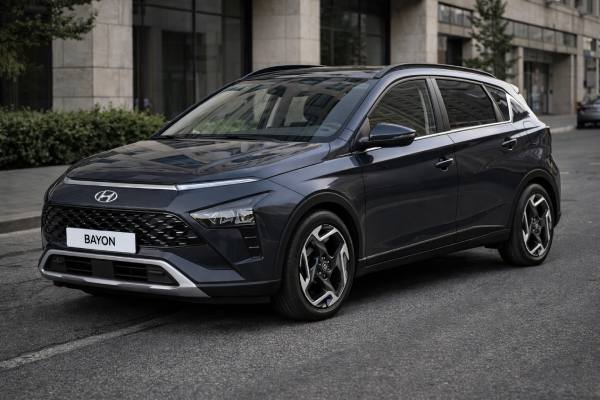
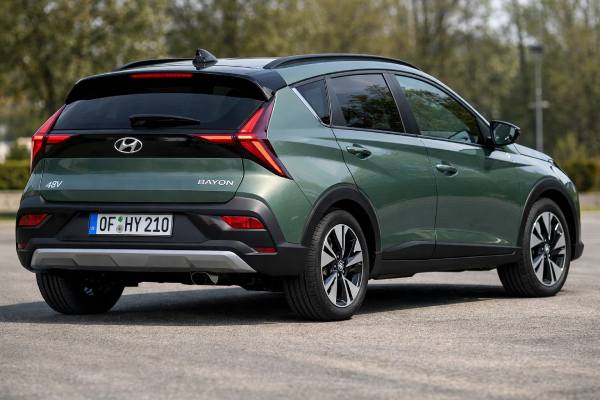
The facelifted Hyundai BAYON remains one of the more rational small crossovers for drivers who want low running costs, a raised seating position, and useful luggage space without moving up to a larger SUV. In this 1.0 T-GDi 48V 100 hp form, it is not a full hybrid in the Toyota-style sense, but a mild-hybrid petrol model designed to smooth stop-start operation and trim fuel use. The 2024 update mainly sharpened the design, refreshed cabin technology, and kept the Bayon’s core strengths intact: a 411-litre boot, compact footprint, and a broad Hyundai SmartSense safety package. The key ownership question is not whether it is quick, because it is not meant to be. The real question is whether you value efficiency, city-friendly packaging, and modern driver aids more than outright performance or premium materials. For many buyers, that balance is exactly why the facelifted Bayon makes sense.
Quick Specs and Notes
- The 411 L boot is a real strength for a compact B-segment crossover.
- The 1.0 T-GDi 48V setup improves efficiency and smooths urban driving without turning the car into a complex full hybrid.
- Hyundai SmartSense covers the main modern safety needs, including forward collision assist, lane support, and speed-limit support.
- Used 7DCT cars deserve extra attention for software updates and clean low-speed shift behaviour.
- Plan on a service visit every 12 months and confirm recall completion by VIN before buying.
Navigate this guide
- BAYON BC3 facelift basics
- BAYON 100 hp 48V specs
- BAYON trims and safety tech
- Reliability and service actions
- Maintenance and buying advice
- Road manners and efficiency
- BAYON versus key rivals
BAYON BC3 facelift basics
The facelifted BAYON is Hyundai’s Europe-focused small crossover, aimed at drivers who want SUV-style access and visibility without the weight, width, and fuel bills that often come with larger family crossovers. The 2024 refresh did not try to reinvent the formula. Instead, Hyundai sharpened the styling with a more assertive nose, a full-width front LED daytime-running-light signature, revised bumpers, and updated wheel designs. Inside, the changes focus on the areas owners notice most: display tech, connectivity, lighting, and everyday usability.
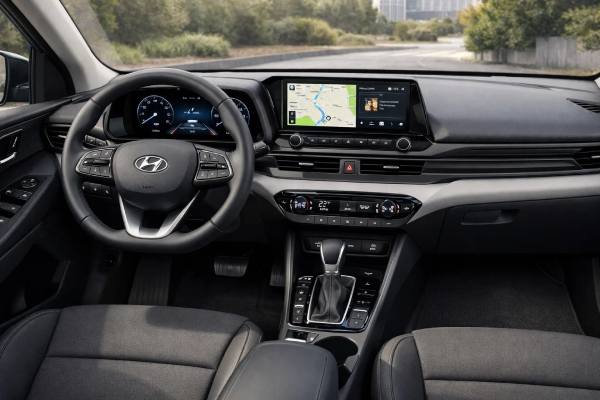
That matters because the Bayon’s appeal has always been practical rather than emotional. At 4,180 mm long, it still fits easily into tight city spaces, yet it offers the sort of cabin and boot usefulness that many buyers expect from a larger vehicle. The facelift keeps one of the model’s strongest numbers intact: a 411-litre luggage compartment, which is very competitive for a small crossover. Add the upright driving position, available dual 10.25-inch screens, USB-C ports, wireless charging on higher trims, and connected navigation functions, and the Bayon feels more substantial than its size suggests.
For this specific 1.0 T-GDi 48V 100 hp version, the powertrain is best understood as a mild-hybrid petrol setup rather than a conventional hybrid. The 48V system uses a small battery, a belt-driven starter-generator, and supporting power electronics to recover energy and help the engine during certain low-load conditions. In daily use, the benefit is smoother stop-start behaviour and modest fuel savings, especially in town and mixed driving, rather than silent EV-only running. Buyers expecting full-hybrid behaviour will misunderstand the car. Buyers wanting a more efficient small turbo petrol will get the point immediately.
A useful ownership detail is that Hyundai equipment and published figures vary slightly by country. That means a Bayon sold in one European market may differ in trim naming, gearbox availability, tyre size, or assistance systems from an apparently identical car sold elsewhere. The safest approach is always to verify the exact VIN, build specification, and market code before ordering mechanical parts or assuming a feature is fitted.
As an ownership proposition, the facelifted Bayon is strongest when judged as a daily tool. It is compact, easy to place, well equipped in safety terms, and still unusually practical for its exterior size. Buyers chasing excitement will look elsewhere. Buyers who care about ease of use, packaging, and low operating stress will understand why the Bayon continues to attract sensible interest.
BAYON 100 hp 48V specs
For this version, the most dependable publicly available figures come from Hyundai’s current model information and official brochure material for the facelift. Where Hyundai does not publish a value in open-access material, it is better to mark that clearly than to guess. That matters most with service capacities, torque settings, some brake dimensions, and certain towing figures, all of which can vary by VIN, transmission, wheel package, and market.
Powertrain and efficiency
| Item | Hyundai BAYON 1.0 T-GDi 48V / 100 hp |
|---|---|
| Code | Verify by VIN |
| Engine layout and cylinders | Inline-3 petrol |
| Valvetrain | DOHC; exact valves per cylinder should be verified by VIN-specific documentation |
| Bore × stroke mm (in) | Verify by VIN |
| Displacement | 1.0 L (998 cc) |
| Motor | 48V mild-hybrid starter-generator system |
| Induction | Turbocharged |
| Fuel system | Direct injection |
| Compression ratio | Verify by VIN |
| Max power | 100 hp (74 kW) @ 6,000 rpm |
| Max torque | 172 Nm (127 lb-ft) @ 1,500–3,500 rpm, with some market documents also showing 200 Nm (148 lb-ft) depending on transmission and calibration |
| Timing drive | Verify by VIN |
| Rated efficiency | About 5.2–5.5 L/100 km (45.2–42.8 mpg US / 54.3–51.4 mpg UK) |
| Real-world highway @ 120 km/h (75 mph) | Usually higher than the WLTP combined figure; exact result depends strongly on weather, tyres, and load |
Transmission and driveline
| Item | Data |
|---|---|
| Transmission | 6-speed manual or 7-speed dual-clutch automatic, depending on market |
| Drive type | FWD |
| Differential | Open |
Chassis and dimensions
| Item | Data |
|---|---|
| Suspension front / rear | Verify by VIN-specific technical data |
| Steering | Electric power steering; ratio not commonly published in open-access material |
| Brakes | Verify by VIN and wheel package |
| Wheels and tyres (most common) | 195/55 R16 on 16-inch alloy wheel in many published facelift specs |
| Ground clearance | Up to 183 mm (7.2 in), depending on wheel size and market |
| Length | 4,180 mm (164.6 in) |
| Width | 1,775 mm (69.9 in) |
| Height | 1,500 mm (59.1 in), depending on roof rail specification |
| Wheelbase | 2,580 mm (101.6 in) |
| Turning circle (kerb-to-kerb) | Verify by market data |
| Kerb weight | Roughly 1,095–1,230 kg (2,414–2,712 lb), depending on transmission and trim |
| GVWR | Verify by VIN |
| Fuel tank | Verify by VIN and market literature |
| Cargo volume | 411 L (14.5 ft³) seats up |
| Cargo volume seats down | Verify by market method and specification sheet |
| Roof load | 70 kg (154 lb) |
Performance and capability
| Item | Data |
|---|---|
| 0–100 km/h (0–62 mph) | About 11.3 s for 6MT / 12.4 s for 7DCT in published facelift data |
| Top speed | About 179 km/h (111 mph) for 6MT / 176 km/h (109 mph) for 7DCT |
| Braking distance | Not commonly published in official open-access spec sheets |
| Towing capacity | Verify by VIN and market |
| Payload | Verify by VIN |
Fluids and service capacities
| Item | Data |
|---|---|
| Engine oil | Use VIN-specific specification and viscosity grade; capacity varies by engine code and service procedure |
| Coolant | Use Hyundai-approved coolant to the correct standard and mix ratio; verify capacity by VIN |
| Transmission fluid and ATF | Verify by transmission code |
| Differential / transfer case | Not applicable as a separate rear-drive unit on this FWD model |
| A/C refrigerant | Verify by under-bonnet label or service data |
| A/C compressor oil | Verify by service data |
| Key torque specs | Always verify against official service documentation |
These figures explain the Bayon’s character. It is not especially quick, but it is competitive enough for a light B-SUV, and the 48V system is there to improve efficiency and smoothness rather than add performance drama. One notable detail is that some published brochure data shows the manual version reaching 100 km/h faster than the 7DCT version, which underlines the Bayon’s comfort-and-efficiency focus rather than any sporting intent.
BAYON trims and safety tech
Trim naming for the BAYON varies more than many buyers expect. In one market you may see names such as Executive or Premium-style grades, while in another the same car may be packaged differently or sold with fewer combinations of engine and gearbox. For the facelift Bayon, trim name alone is not enough. You need to confirm the gearbox, wheel size, digital-display package, climate-control setup, and ADAS content on the exact car you are considering.
The main functional differences tend to revolve around transmission choice, infotainment specification, cabin convenience, exterior trim, and higher-level driver assistance. The facelift Bayon’s best equipment highlights include the optional dual 10.25-inch display layout, navigation with connected features, USB-C ports, wireless phone charging on selected trims, and upgraded audio on some versions. These are not just brochure extras. They affect daily satisfaction over several years of ownership, especially in a class where many rivals still hide good tech inside option packages.
Safety remains one of the Bayon’s strongest arguments, though not a flawless one. Euro NCAP awarded the model four stars, with good child-occupant protection and solid vulnerable-road-user performance, but not the sort of all-round score that makes it class-leading by current standards. In practice, that means the Bayon is well equipped and well engineered for a small crossover, but buyers who want the strongest possible headline crash rating may still compare it carefully against newer five-star rivals.
In equipment terms, the Bayon covers the main modern assistance needs well. Depending on trim and market, Hyundai SmartSense can include Forward Collision-Avoidance Assist with pedestrian, cyclist, and junction support, Lane Keeping Assist, Lane Following Assist, Intelligent Speed Limit Assist, Driver Attention Warning, Blind-Spot Collision Warning, Blind-Spot Collision-Avoidance Assist, Rear Cross-Traffic support, Parking Assist, and navigation-based cruise functions. That gives the Bayon a strong technology profile for a vehicle in this class, especially for buyers who spend time in heavy traffic or on mixed urban and motorway journeys.
Family usability is solid too. ISOFIX and i-Size provisions matter in a car that already scores well for boot space and urban practicality. A high-set rear opening and sensible cabin layout help the Bayon work as a young-family car even though it sits in the smaller end of the crossover market.
One important ownership caveat is calibration after repair. On a Bayon with a forward camera, radar-based systems, or parking-collision technology, windscreen replacement, front-end body repairs, wheel alignment changes, or bumper work can require ADAS recalibration. On a used example, proof of proper post-repair calibration matters nearly as much as proof that the damaged parts were replaced correctly. That is now part of responsible ownership on most modern crossovers, and the Bayon is no exception.
Reliability and service actions
The facelifted 2024-present Bayon is still a relatively young vehicle, so the best reliability picture available today comes from official recalls, service-action databases, platform familiarity, and early ownership patterns rather than from decades of long-term fleet data. That means a careful buyer should lean on documented evidence, not online myth or sweeping claims.
The clearest official issue affecting Bayon ownership is a recall covering certain BC3 i20 and Bayon vehicles where an error in the DCT transmission control logic could cause a shift problem because limp-home protection did not activate as intended. For any 7DCT Bayon, this matters. Even if the car drives well during a short test drive, you still want documented proof that the official remedy has been completed where applicable.
There is also an official recall affecting some earlier Bayon production related to fuel-pump performance, with the potential for power loss, stalling, or a non-start condition. That issue is more relevant to earlier cars than to the facelift itself, but it still matters because many buyers compare late pre-facelift Bayons with 2024-on facelifted stock. In that situation, recall history becomes part of the value decision, not just a technical footnote.
Outside the recall record, the likely watchpoints are more ordinary. On mild-hybrid cars used mainly for short trips, electrical health and software condition matter more than on a basic naturally aspirated supermini. A weak 12 V battery, poor charge state, or overdue software update can first show up as inconsistent stop-start behaviour, nuisance warnings, or small electrical faults rather than a dramatic breakdown. The Bayon’s 48V system is not unusually exotic, but it does add another layer of components that deserve proper diagnosis rather than guesswork.
For the 7DCT, pay attention to symptoms, not internet panic. A healthy car should not flare badly between gears, bang into drive, hesitate sharply once warm, or show gearbox warnings. Some low-speed awkwardness can be normal in a dual-clutch transmission, especially during parking manoeuvres, but repeated harshness or unpredictable engagement is not. On any used example, a long test drive that includes stop-start traffic, reversing, hill starts, and warm restarts is worth far more than a quick spin around the block.
Chassis and braking issues are less dramatic but still worth checking. Lightly used small crossovers often pick up pad glazing, disc corrosion, and uneven tyre wear before owners notice anything wrong. Because the Bayon is often chosen as an urban runabout, short-trip usage can be harder on brakes and batteries than owners expect. A car with low mileage is not automatically a better car if most of that mileage came from cold starts and short hops.
The safest way to verify a Bayon is straightforward. Use an official recall and service-campaign checker with the VIN or registration, then confirm completion with dealer records. For a used purchase, that single step is often more valuable than many cosmetic details that dominate dealer listings.
Maintenance and buying advice
Because publicly accessible facelift Bayon material does not always include a full workshop-style matrix with every fluid capacity, torque figure, and service note, the smart ownership strategy is practical rather than speculative. Use a sensible maintenance plan, then let the VIN-specific owner’s manual and dealer service data override generic advice. That is especially important on modern small turbo cars with mild-hybrid hardware and ADAS.
A practical maintenance schedule for the 1.0 T-GDi 48V looks like this:
| Item | Practical schedule |
|---|---|
| Engine oil and filter | Every 12 months or according to the VIN-specific maintenance schedule; shorten the interval for heavy short-trip use |
| Engine air filter | Inspect at each annual service; replace earlier in dusty conditions |
| Cabin air filter | Usually every 12 months |
| Spark plugs | Check the official interval for the exact engine code; treat as a planned medium-term service item |
| Coolant | Inspect level and condition annually; replace only to the official schedule |
| Fuel filter | Verify whether it is serviceable separately on the exact market specification |
| Timing components | Verify by VIN; inspect for abnormal noise or timing-related faults and follow official replacement guidance where applicable |
| Auxiliary belt and hoses | Inspect at each annual service |
| Brake fluid | Check yearly and replace to official time-based schedule |
| Brake pads and rotors | Inspect every service |
| Tyre rotation | About every 10,000–12,000 km, depending on wear pattern |
| Alignment check | Whenever tyre wear becomes uneven or after impact damage |
| 12 V battery | Test from around year 3 onward, earlier if stop-start weakens |
| 48V system | Check for faults and software updates during routine servicing |
| 7DCT transmission | Confirm fluid and inspection requirements by transmission code |
| ADAS | Recalibrate after windscreen, bumper, suspension, or sensor-related repairs |
The buyer’s checklist is equally clear. Ask for complete service history, recall proof, evidence of software updates, and tyre replacement records. On a test drive, check cold-start smoothness, stop-start operation, idle stability, and how the car behaves in traffic once fully warm. Look for uneven tyre wear, bumper scuffs, cracked lower trim, and signs of windscreen replacement without documented camera recalibration.
For a nearly new purchase, the facelift is usually the safer long-term bet than a slightly cheaper earlier car if the price gap is reasonable. You get the refreshed front-end components, the newer cabin presentation, and less exposure to early production history. If buying used, a well-documented manual car is the easiest ownership proposition. A good 7DCT can still be a fine choice, but documentation matters even more there.
Common reconditioning items on used small crossovers tend to be tyres, front brakes, wiper systems, batteries, scratched wheels, and parking-damage repairs. None of that is unusual. What matters is whether the car has been maintained in a timely way and whether any accident repair work was followed by proper calibration and inspection.
The long-term durability outlook is promising rather than bulletproof. The Bayon benefits from a mainstream Hyundai small-car foundation, good packaging, and straightforward front-wheel-drive layout. The turbo engine, 48V hardware, and dual-clutch option simply mean service history matters more than it would on the most basic naturally aspirated economy car.
Road manners and efficiency
From behind the wheel, the Bayon makes the most sense when judged by how easily it fits into daily life. The raised seating position, compact dimensions, and light steering make it very friendly in town. Visibility is good, parking is simple, and the car feels smaller than a family crossover while still giving you the commanding view that many crossover buyers want. That ease of use is a major part of the Bayon’s appeal.
The 1.0 T-GDi engine is a sensible match for the car’s mission. It is a three-cylinder turbo petrol, so it has more character than a basic naturally aspirated engine, but the mild-hybrid system is there to smooth the experience rather than add excitement. In everyday use, the powertrain should feel most comfortable in low- and mid-speed driving, where the turbo torque and energy management help the car feel alert enough without demanding high revs.
There is one interesting detail in published performance data: the 6-speed manual is quicker to 100 km/h than the 7-speed dual-clutch in some official brochure figures. That does not automatically make the manual better for every owner, but it does suggest the automatic tune is aimed more at comfort, emissions, and smoothness than sharp response. Buyers in heavy traffic may still prefer the 7DCT. Buyers who want slightly better response and a simpler ownership path may prefer the manual.
Official combined efficiency for the current 100 hp 48V Bayon sits around 5.2 to 5.5 L/100 km, depending on trim and transmission. In real use, the important point is where the system helps most. Expect the best results in mixed commuting, suburban driving, and stop-start urban use, where the 48V support and energy recovery can contribute most. At a steady 120 km/h motorway cruise, fuel consumption will rise above the WLTP combined figure, especially in cold weather, with larger wheels, or when the car is fully loaded.
Ride and handling are tuned for security and comfort rather than entertainment. The Bayon is meant to feel stable, predictable, and easy, not sporty. That will suit most buyers in this class. On rougher roads, the relatively tall stance helps everyday usability, while the short overall length keeps the car agile in small spaces. Steering feel is usually light rather than richly detailed, which again matches the car’s role.
Cabin noise should be judged fairly. As a small crossover with a three-cylinder turbo engine, it is not likely to be as hushed as a larger and heavier family SUV at motorway speed, but it is well positioned for buyers moving up from a supermini. In normal use, the Bayon’s strengths are comfort, low effort, and straightforward operation. It is the kind of car that feels easier to live with than its size or price might suggest.
BAYON versus key rivals
The Hyundai Bayon competes in one of Europe’s busiest segments, so it is best judged against other practical small crossovers rather than against larger family SUVs. Rivals such as the Ford Puma, Renault Captur, Toyota Yaris Cross, and Volkswagen T-Cross all bring different strengths. The Bayon’s strongest case is the way it combines compact dimensions, a large boot for the class, easy controls, and a generous safety-tech offering.
Where the Bayon often wins is practicality per metre. A 411-litre boot in this footprint is a serious advantage, and the facelifted cabin tech now feels current enough that the car no longer relies on value alone. The digital displays, connected features, and broad SmartSense package help it feel more modern than some budget-focused rivals. If you value smart packaging and useful equipment over badge image, the Bayon makes a strong argument.
Where rivals may beat it depends on your priorities. A full-hybrid rival such as the Yaris Cross usually makes a stronger low-speed economy case because it can drive electrically at times. A Ford Puma is generally more engaging to drive. A Renault Captur can feel more flexible inside depending on trim and rear-seat layout. A Volkswagen T-Cross may appeal more to buyers who prefer a conservative, mature interior atmosphere. The Bayon does not dominate every category, but it avoids major weaknesses better than many rivals.
Its main drawbacks are easy to define. The Euro NCAP result is good rather than class-leading, the trim structure can be confusing between countries, and the 48V turbo plus 7DCT route is mechanically more involved than the simplest naturally aspirated alternatives. None of that makes it a poor choice. It simply means the ideal Bayon buyer is someone who wants modern features, useful packaging, and low-stress ownership, and who understands that documented servicing matters as much as mileage.
Overall, the facelifted 1.0 T-GDi 48V 100 hp Bayon is one of the better rational buys in the small-crossover class. It is practical, efficient, easy to use, and modern enough in safety and infotainment terms to stay relevant. It becomes an even better buy when you choose the right trim, confirm the recall record, and stay disciplined about maintenance.
References
- New Bayon: A stylish SUV with class-leading practicality 2024
- The BAYON | Features | Hyundai Motor Europe 2026
- Official Hyundai BAYON 2021 safety rating 2021
- Recalls by manufacturer (2024) 2024
- Recalls by manufacturer (2025) 2025
Disclaimer
This article is for informational purposes only and is not a substitute for professional diagnosis or repair. Specifications, torque values, intervals, procedures, and equipment can vary by VIN, market, trim, transmission, and factory options, so always verify details against the correct official service documentation for the exact vehicle.
If this guide was useful, please consider sharing it on Facebook, X/Twitter, or other social platforms to support our work.