
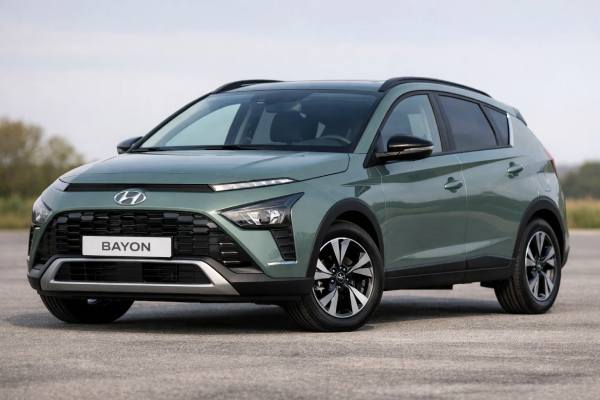
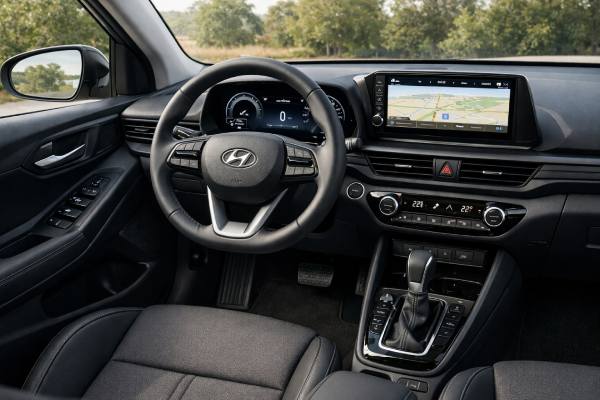
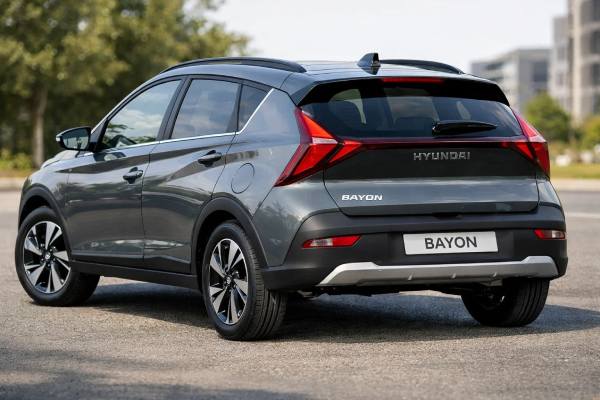
The Hyundai BAYON 1.0 T-GDi 48V 100 hp sits in a practical sweet spot of the small-crossover market. It is not designed as a performance SUV or a premium mini-crossover. Instead, it combines a light B-segment platform, a turbocharged 998 cc three-cylinder petrol engine, Hyundai’s 48-volt mild-hybrid hardware, and either a 6-speed intelligent manual or 7-speed dual-clutch transmission. That combination gives it a strong mix of low running costs, decent real-world response, and easy urban usability. It also helps that the BAYON shares much of its engineering logic with the i20, which keeps servicing knowledge and parts support familiar across Europe. Buyers should still remember that trim content, WLTP economy figures, and some cargo data vary by market and facelift year, especially in 2024. For the exact 100 hp 48V version, the clearest baseline remains the early European technical data, with later facelift details added where relevant.
Quick Specs and Notes
- The 1.0 T-GDi 48V mild-hybrid setup gives the BAYON useful low-rpm torque, light overall weight, and a simpler ownership picture than a full hybrid.
- Official early figures put the 6iMT car at 0–100 km/h in 10.7 seconds, with a 1,110 kg braked towing rating.
- Trim, market, and facelift year matter; later 2024 cars gained updated infotainment and ADAS, while some specifications became more region-specific.
- Oil and filter service is best treated as annual or every 15,000 km, with harder use justifying a shorter interval.
- Check the VIN for open recalls and service campaigns, especially on early-build cars affected by the later fuel-pump-related action.
Guide contents
- Hyundai BAYON BC3 overview
- Hyundai BAYON BC3 specs and data
- Hyundai BAYON BC3 trims and safety
- Reliability, issues and service actions
- Maintenance and buying advice
- Real-world driving and efficiency
- Bayon BC3 versus rivals
Hyundai BAYON BC3 overview
The BAYON is Hyundai’s Europe-focused small crossover, built on the BC3 architecture and sized to sit neatly between a supermini and a family SUV. In 1.0 T-GDi 48V 100 hp form, it uses Hyundai’s mild-hybrid system with a 48-volt battery, a Mild Hybrid Starter Generator, and a low-voltage DC converter. That setup does not turn the BAYON into an EV, but it does support smoother stop-start operation, torque fill, and coasting strategies that help fuel economy without adding the weight and complexity of a full hybrid drivetrain.
For many buyers, this is the sweet-spot engine. The 100 hp version has enough torque for normal motorway use, but it remains lighter and usually cheaper to buy than larger or more powerful alternatives. Hyundai paired it with a 6-speed intelligent manual transmission, which can decouple the engine during coasting, or a 7-speed dual-clutch automatic for drivers who want easier commuting. Interestingly, the official performance numbers favor the manual, with the 6iMT posting a quicker acceleration time than the 7DCT in the early technical data.
The BAYON’s broader appeal comes from packaging. At just over 4.18 meters long, it is easy to park and thread through narrow streets, yet it still offers a raised driving position and a useful boot. Early official data for the 48V car quotes 334 liters VDA with the seats up and 1,205 liters with the rear seats folded. Later facelift literature in some markets quotes larger luggage numbers, so buyers comparing listings should always match cargo claims to model year and brochure source rather than assuming every BAYON is identical.
In ownership terms, the BAYON makes sense for drivers who want a modern, efficient petrol crossover without stepping into heavier electrification. It is especially well suited to mixed urban and suburban use, short family trips, and buyers who value warranty coverage and an easy-to-understand controls layout. It is less convincing as a fast-road crossover or as a heavy-load tow car, but that was never really its mission. As a daily tool, the mild-hybrid 100 hp BAYON is engineered to be more sensible than flashy, and that is exactly why it works.
Hyundai BAYON BC3 specs and data
The figures below focus on the 1.0 T-GDi 48V 100 hp BAYON as documented in Hyundai’s early UK technical sheet and owner literature. Facelift-era 2024 cars kept the same general layout, but depending on market they could show different WLTP values, weights, equipment mixes, and even published cargo figures.
| Item | Hyundai BAYON 1.0 T-GDi 48V 100 hp |
|---|---|
| Engine family | Smartstream G1.0 T-GDi (48V) MHEV |
| Layout | Inline-3, DOHC, 4 valves per cylinder |
| Displacement | 1.0 L (998 cc) |
| Bore × stroke | 71.0 × 84.0 mm |
| Induction | Turbocharged |
| Fuel system | Direct injection |
| Compression ratio | 10.5:1 |
| Hybrid hardware | 48V Mild Hybrid Starter Generator, 48V Li-ion polymer battery |
| Battery voltage | 48 V |
| Battery output | 12 kW |
| Max power | 100 PS (73.5 kW) @ 4,500–6,000 rpm |
| Max torque | 172 Nm (127 lb-ft) @ 1,500–4,000 rpm |
| Transmission and driveline | Data |
|---|---|
| Transmission choices | 6-speed iMT or 7-speed DCT |
| Drive type | Front-wheel drive |
| Differential | Open differential |
| Chassis and dimensions | Data |
|---|---|
| Front suspension | MacPherson strut |
| Rear suspension | Coupled torsion beam axle |
| Steering | MDPS, 2.7 turns lock-to-lock |
| Turning circle | 5.2 m |
| Front brakes | 280 mm vented discs |
| Rear brakes | 262 mm solid discs |
| Popular wheel and tyre sizes | 195/55 R16 or 205/55 R17 |
| Length | 4,180 mm |
| Width | 1,775 mm |
| Height | 1,500 mm |
| Wheelbase | 2,580 mm |
| Fuel tank | 40 L |
| Cargo volume | 334 L seats up / 1,205 L seats down (VDA, early 48V data) |
| Weights, performance and utility | 6iMT | 7DCT |
|---|---|---|
| Kerb weight range | 1,120–1,230 kg | 1,145–1,255 kg |
| GVWR | 1,660 kg | 1,680 kg |
| Payload range | 430–540 kg | 425–535 kg |
| 0–100 km/h | 10.7 s | 11.7 s |
| Top speed | 182 km/h | 180 km/h |
| Braked towing | 1,110 kg | 1,110 kg |
| Unbraked towing | 450 kg | 450 kg |
| Fluids and service capacities | Data |
|---|---|
| Engine oil | SAE 0W-20, API SN PLUS/SP or ILSAC GF-6; 3.6 L |
| Coolant | Ethylene glycol-based coolant for aluminum radiator; 5.85 L |
| Manual gearbox fluid | API GL-4 SAE 70W; 1.5–1.6 L |
| 7DCT fluid | API GL-4 SAE 70W; 1.6–1.7 L |
| iMT actuator fluid | DOT-4 LV / ISO 4925 Class 6; 0.082 L |
| Brake and clutch fluid | DOT-4; 0.7–0.8 L |
| A/C refrigerant | R-1234yf; verify charge from under-hood label |
| Key torque values | Verify by VIN-specific workshop documentation |
Official combined fuel economy for the 100 hp mild-hybrid BAYON lands around the low-5 L/100 km range in some European-market specifications. Real motorway use at a steady 120 km/h will usually sit above that figure, especially with 17-inch wheels, passengers, winter fuel, or headwinds.
Hyundai BAYON BC3 trims and safety
For the early European launch period, the 100 hp 48V BAYON was offered in a clear trim ladder. In the UK that meant SE Connect, Premium, and Ultimate. SE Connect already covered the basics well with 16-inch alloys, roof rails, rear camera, rear parking sensors, cruise control, air conditioning, an 8-inch display with Apple CarPlay and Android Auto, and a 10.25-inch digital cluster. Premium added 17-inch wheels, heated front seats and steering wheel, automatic climate control, LED headlamps and rear lamps, folding mirrors, wireless charging, and 10.25-inch navigation with connected services. Ultimate added more premium touches, keyless entry and start, Bose audio, Blind Spot Collision Warning, and Lane Follow Assist. That means used buyers should not treat all BAYONs as equally equipped, because the jump from SE Connect to Premium or Ultimate is noticeable in daily use.
The 2024 facelift did not radically change the engineering, but it did modernize the presentation and safety-tech conversation. Hyundai gave the BAYON a new front lighting signature, revised bumpers, new wheel designs, updated USB provision, a standard 10.25-inch AVN screen on the refreshed model, and broader availability of driver-assistance functions such as Lane Following Assist, Forward Collision-Avoidance Assist with pedestrian, cyclist, and junction-turning functions, Navigation-based Smart Cruise Control, Blind-Spot Collision-Avoidance Assist, Driver Attention Warning, and Leading Vehicle Departure Alert. Exact standard-versus-optional fit depends on country and trim, so buyers of 2024 cars need to read the local market brochure rather than rely on generic listings.
Safety results are respectable rather than class-leading. Euro NCAP gave the BAYON a four-star rating, with 76 percent for Adult Occupant, 82 percent for Child Occupant, 76 percent for Vulnerable Road Users, and 67 percent for Safety Assist. Euro NCAP noted decent child-protection performance and useful speed and lane-support systems, but it was less impressed by some autonomous emergency braking results, especially in car-to-car testing.
For ownership, the practical safety point is calibration. If a BAYON has had windshield replacement, front-end repair, or even a bumper respray on a car with camera- or radar-based assistance, make sure recalibration was done properly. Modern ADAS hardware is only as good as its alignment. Likewise, a base SE Connect may still be a sound buy, but a Premium or Ultimate is usually the better long-term package because the extra comfort equipment and stronger lighting are features you notice every day, not just on the options sheet.
Reliability, issues and service actions
The BAYON is still a relatively young model, so the most reliable evidence comes from official campaigns, service logic, and the known behavior of small turbo mild-hybrid drivetrains rather than from long-term age-related history. The encouraging part is that there is no strong public record yet of a single Bayon-specific catastrophic failure pattern dominating the model. The caution is that young direct-injection turbo cars can look healthy right up until neglected servicing starts to catch up with them. In practice, service history matters more than reputation here.
The clearest official service-action item is the later fuel-pump-related recall affecting certain Hyundai i20, i20 N, and BAYON vehicles built between April 1, 2021 and January 4, 2023. The published symptom was reduced fuel-pump performance, which could lead to sudden loss of power, stalling, or a non-start condition. That is exactly the kind of recall that should be checked by VIN before purchase, because a seller may not even realize the campaign is open if the car otherwise runs normally. Hyundai’s own recall and service-campaign portal is the first place to verify completion, followed by dealer history.
Outside formal recalls, most concerns on this engine and drivetrain are best treated as inspection priorities rather than proven widespread defects. The 1.0 T-GDi wants regular oil changes, the correct 0W-20 oil, and a healthy cooling system. On a cold start, listen for anything that sounds harsher than ordinary three-cylinder chatter. On the test drive, pay attention to misfire under load, hesitation after a hot restart, or unexplained coolant loss. None of those symptoms proves a Bayon-wide defect, but they are the right red flags for any lightly stressed turbo petrol of this type.
Transmission behavior is another place to stay alert. The 6iMT can feel unfamiliar if you expect a completely traditional manual, because the system is designed to work with coasting and stop-start logic. The 7DCT is convenient, but like many small dual-clutch units it deserves a careful crawl-speed test in traffic, on an incline, and during repeated parking maneuvers. A smooth example should engage cleanly and predictably. Any persistent shudder, delayed take-up, or erratic low-speed behavior should push you toward a dealer inspection, software check, or adaptation reset before you commit.
The same applies to electronics. A lightly used BAYON may show stop-start inactivity, warning lights, or occasional odd infotainment behavior simply because the 12 V and 48 V systems do not like weak state of charge. That is usually a maintenance and usage issue rather than a major failure. Check battery age, charging health, software currency, and any signs of repeated battery support. Also inspect the rear camera, parking sensors, and ADAS functions for consistent operation.
Maintenance and buying advice
For this mild-hybrid BAYON, disciplined routine servicing matters more than expensive repair work later. Hyundai’s owner literature identifies the correct lubricants and capacities clearly, and that alone is useful because many problems on small turbo engines start with the wrong oil or stretched service intervals. Treat 15,000 km or 12 months as the normal-service baseline, and shorten that for hard city use, frequent cold starts, repeated short trips, or hot-climate operation.
| Maintenance item | Practical interval |
|---|---|
| Engine oil and filter | Every 15,000 km or 12 months |
| Severe-use oil service | About every 7,500 km or 6 months |
| Engine air filter | Inspect regularly; replace by condition or scheduled service |
| Cabin air filter | Inspect annually; commonly due around 30,000 km / 24 months |
| Spark plugs | Around 75,000 km or 60 months |
| Coolant | First replacement around 90,000 km or 5 years, then about every 30,000 km / 24 months |
| Brake fluid | Inspect regularly; replace about every 30,000 km / 24 months |
| MHEV belt and ancillary belts | Inspect every service |
| Manual or DCT fluid | Earlier checks for hard use; fluid service is worth discussing before high mileage |
| 12 V battery | Test annually after year 3 |
| 48 V system check | Inspect during annual service or when stop-start or coasting behavior changes |
| Brakes and tyres | Inspect every service; rotate tyres as wear pattern requires |
The buyer’s checklist is straightforward. Ask for stamped or invoice-backed servicing, not just verbal claims. Confirm the correct oil grade was used. Check that recall work is complete. Look for even tyre wear and inspect the wheels closely if the car sits on 17-inch rims, because low-profile tyres hide curb damage and pothole shock less effectively. Watch for dampness around intercooler pipework, inspect coolant level and color, and make sure the engine idles cleanly from cold. On the road, test parking-speed transmission behavior, hill starts, stop-start restart quality, steering straightness, and every camera or warning function fitted.
A good used example is usually a Premium or Ultimate with full dealer history, sensible wheel condition, and clean software and recall records. Those trims give you the equipment most owners actually value, without changing the core mechanical layout. The cars to be more careful with are short-trip urban examples that have had irregular servicing, repeated battery issues, or rough-feeling DCT behavior that the seller dismisses as normal. Rust is not yet a defining BAYON problem, but in salted climates you should still inspect the underside, brake lines, rear axle area, and hatch seams. Long-term durability looks promising if the car is serviced on time and not treated like a maintenance-free hybrid, because this is still fundamentally a small turbo petrol with hybrid assistance.
Real-world driving and efficiency
On the road, the BAYON 1.0 T-GDi 48V 100 hp feels like a small crossover engineered for everyday Europe rather than for brochure drama. The raised seating position and light controls make it easy to place in town, and the modest footprint keeps it stress-free in tight parking spaces. The chassis layout is simple, but not crude. MacPherson struts at the front and a coupled torsion-beam rear axle are normal for the class, and the BAYON generally trades razor-sharp handling for predictability and comfort. Buyers moving from a supermini will find it mature enough. Buyers moving from something like a Ford Puma may find it calmer, but less playful.
The 100 hp engine’s character is better than the headline number suggests because the important part of the story is the 172 Nm torque plateau from low rpm. In normal traffic, that gives the car enough shove to feel alert without requiring constant high-rev work. The mild-hybrid hardware helps smooth the stop-start behavior and supports the coasting strategy built into the iMT logic. Hyundai also offered Eco, Normal, and Sport modes, and those do subtly change the car’s response. In practice, the manual suits drivers who want the most natural connection and the better official acceleration figure, while the DCT suits commuting but is not the faster setup on paper.
At speed, the BAYON is competent rather than hushed. A three-cylinder turbo will always sound a little busier than a larger four-cylinder, and highway noise depends heavily on tyre choice and road surface. The 16-inch wheel package is usually the better ownership choice if comfort, tyre cost, and poor-road compliance matter more than appearance. The 17-inch setup looks better and sharpens the stance, but it can add a harder edge over patched urban roads. Braking hardware is adequate for the car’s mass, and the relatively light kerb weight helps the BAYON feel more willing than some heavier small SUVs.
Fuel economy is where the mild-hybrid system earns its keep. Official figures vary by market, tyre, and publication, but the 100 hp 48V car can post low-5 L/100 km combined numbers in favorable European specifications. In real life, mixed driving in the mid-5s to low-6s is a sensible expectation for a healthy, gently driven car, while a steady 120 km/h motorway run usually pushes consumption above the brochure figure. Winter weather, full passenger load, short-trip use, and 17-inch tyres all move the result upward.
Towing and load use are best kept moderate. Hyundai rated the early 100 hp car for 1,110 kg braked towing, which is useful for a small crossover, but the short wheelbase and small-displacement turbo engine mean it is happier with light trailers than with regular heavy work. As a daily driver, though, the BAYON is easy to recommend: light steering, tidy visibility, useful torque, reasonable fuel use, and no need to change your habits around charging.
Bayon BC3 versus rivals
Against its closest rivals, the BAYON’s personality is clear. It is not the most fun small crossover, not the cleverest hybrid, and not the most premium-feeling cabin. What it does offer is a balanced, low-drama ownership package with strong equipment, compact size, and easy driving manners. That matters more in this class than headline glamour.
Compared with the Ford Puma 1.0 mild hybrid, the Hyundai usually feels less sporty but more straightforward. The Puma is the sharper driver’s car. The BAYON is the calmer, more conservative choice for people who value simple controls, comfortable daily use, and Hyundai’s reassuring warranty culture. Compared with the Toyota Yaris Cross Hybrid, the Hyundai is less sophisticated in stop-go city economy because the Toyota’s full-hybrid system can do more electric running. The BAYON fights back with a more conventional feel, simpler petrol-like behavior at speed, and often a less intimidating used-buy proposition.
Versus Volkswagen Group alternatives such as the VW T-Cross or Skoda Kamiq 1.0 TSI, the Hyundai competes well on packaging, standard kit, and long warranty appeal. The German rivals may feel a touch more mature on a long motorway drive, but the BAYON is often easier to buy sensibly because its trim ladder is clearer and its ownership story is less image-driven. Against the Renault Captur, the Hyundai again wins more on clarity than charisma. The Captur can feel richer inside, but the BAYON is the kind of car that often makes more sense after three years of ordinary use.
That is really the key verdict. The BAYON 1.0 T-GDi 48V 100 hp is a rational rival, not an emotional one. It suits buyers who want a compact crossover that is easy to own, well equipped in the right trims, efficient without needing a plug, and modern enough to feel current without becoming complicated. In a crowded class, that is a real advantage.
References
- BAYON – Pricing Specification and Technical information 2021
- BAYON (BC3 CUV) Owners Manual 2021 2021 (Owner’s Manual)
- Official Hyundai BAYON 2021 safety rating 2021 (Safety Rating)
- New Bayon: A stylish SUV with class-leading practicality 2024
- Home | Hyundai Recalls & Service Campaigns 2026 (Recall Database)
Disclaimer
This article is for informational purposes only and is not a substitute for professional diagnosis, repair, or VIN-specific technical advice. Specifications, torque values, service intervals, software status, and procedures vary by VIN, market, transmission, model year, and equipment, so always verify them against Hyundai’s official service documentation before carrying out maintenance or buying parts.
If this guide helped you, please consider sharing it on Facebook, X/Twitter, or another social platform to support our work.