


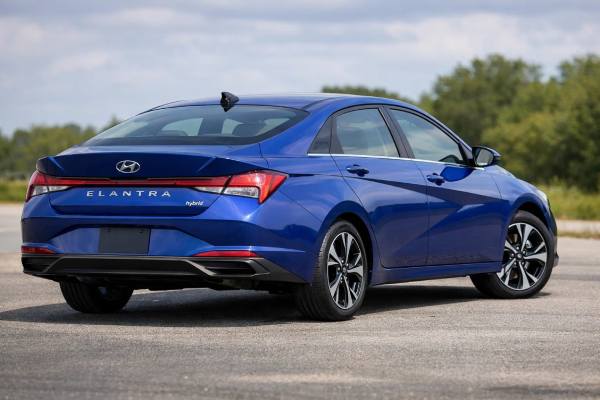
The Hyundai Elantra CN7 2.0 MPI Atkinson is a compact sedan that makes a strong case for simple, modern ownership. It combines sharp styling, a roomy cabin, a light-effort driving character, and a naturally aspirated 2.0-litre petrol engine tuned more for efficiency than excitement. For 2021–2023, this version of the Elantra offered 147 hp, front-wheel drive, and Hyundai’s Smartstream Intelligent Variable Transmission in the main U.S.-market trims, creating a package aimed at commuting, family use, and low-stress daily driving. The biggest engineering advantage is straightforwardness: multi-point fuel injection, a timing chain, and no turbocharger help keep long-term maintenance more predictable than in many small turbo rivals. The biggest caution is that trim and feature content changed during the 2021–2023 run. Safety hardware, wheel size, parking brake type, and convenience features can differ more than buyers expect, so the right Elantra is the one with the right VIN history and equipment list, not just the right badge.
Key Takeaways
- The 2.0 MPI Atkinson engine is simple, chain-driven, and usually easier to own long term than a comparable turbo engine.
- Cabin space is excellent for the class, and the trunk is genuinely useful for everyday family use.
- Standard safety tech is strong on most trims, especially from the 2021 redesign onward.
- Certain 2021–2022 cars should have seat belt pretensioner recall work verified before purchase.
- A practical oil and filter interval is every 12 months or about 12,000 km, with shorter intervals in severe service.
Jump to sections
- Elantra CN7 Everyday Character
- Elantra CN7 2.0 Specs
- Elantra CN7 Trims and Safety
- Known Issues Updates and Recall Work
- Maintenance Routine and Smart Shopping
- Daily Driving Range and Refinement
- Where CN7 Beats or Lags Rivals
Elantra CN7 Everyday Character
The CN7 Elantra arrived with a much stronger visual identity than earlier generations. Hyundai pushed the sedan toward a sharper, more angular “four-door coupe” shape, but importantly, it did not sacrifice the core things a compact sedan needs to do well. The body still packages a useful back seat, a sensible trunk, and a low, stable driving position. For most owners, that is what matters more than the design language. The CN7 feels modern, but it is still built around practical packaging.
The 2.0 MPI Atkinson version is the calm, mainstream heart of the lineup. It is not the hybrid, and it is not the N Line. It is the everyday car. That matters because its engineering priorities are obvious: low running costs, predictable response, and a cleaner long-term ownership story than a turbocharged direct-injection alternative might bring. The engine uses port injection and dual continuously variable valve timing, then pairs that with an Atkinson-cycle tune to favor efficiency. The result is a smooth, linear power delivery that suits commuting and longer trips better than aggressive driving.
Hyundai also used the redesign to improve cabin usability. The front seating position is low enough to feel car-like rather than crossover-like, but not cramped. The rear seat benefits from a 2,720 mm wheelbase, which gives the Elantra more rear legroom than many buyers expect. That matters in real ownership, because the difference between “compact” and “comfortable compact” is often measured in rear-seat space and ease of access. The CN7 gets both right more often than many rivals.
On the road, the Elantra’s basic character is composed and easygoing. Steering is light, visibility is decent once you are used to the sharp body creases, and the chassis is tuned for stability rather than cornering drama. Hyundai did not try to turn the 2.0 MPI sedan into a sport sedan. It aimed for a car that feels well sorted in traffic, calm on the highway, and inexpensive to operate. The transmission choice reflects that. In the U.S. market, the 2.0 engine is paired with the Smartstream IVT, which keeps the engine in its efficient range and helps the car deliver strong EPA numbers.
Year-to-year, the biggest changes were about packaging and equipment rather than mechanical redesign. The 2021 model was all-new. The 2022 2.0-litre cars were largely carryover in this basic form. For 2023, Hyundai revised equipment packaging on the 2.0 range, especially around SEL Convenience content, where more features became standard and the prior package structure shifted. That means buyers should always compare the actual equipment on a car rather than assuming all SELs or Limiteds are identical across three model years.
In simple terms, the CN7 2.0 MPI is the version to buy if you want the new-generation Elantra’s better structure, better safety story, and stronger packaging without stepping into the more complex parts of the lineup.
Elantra CN7 2.0 Specs
For the 2021–2023 Elantra CN7 2.0 MPI Atkinson, the clearest open-source specification baseline comes from Hyundai Motor America’s official specification sheets. Those documents confirm the engine, output, dimensions, weight range, EPA figures, and much of the core chassis hardware for SE, SEL, and Limited trims.
| Powertrain and efficiency | Figure |
|---|---|
| Code | Smartstream/Nu 2.0 MPI Atkinson family |
| Engine layout and cylinders | Inline-4, DOHC, 4 cylinders |
| Valves per cylinder | 4 |
| Bore × stroke | 81.0 × 97.0 mm (3.19 × 3.82 in) |
| Displacement | 2.0 L (1,999 cc) |
| Induction | Naturally aspirated |
| Fuel system | MPI / port injection |
| Compression ratio | 12.5:1 |
| Max power | 147 hp (110 kW) @ 6,200 rpm |
| Max torque | 179 Nm (132 lb-ft) @ 4,500 rpm |
| Timing drive | Chain |
| Rated efficiency, 2021 SE | 7.1 / 5.5 / 6.4 L/100 km city / highway / combined |
| Rated efficiency, 2021 SEL and Limited | 7.6 / 5.7 / 6.7 L/100 km city / highway / combined |
| Rated efficiency, 2023 SE | 7.1 / 5.6 / 6.4 L/100 km city / highway / combined |
| Rated efficiency, 2023 SEL and Limited | 7.8 / 5.9 / 6.9 L/100 km city / highway / combined |
| Real-world highway @ 120 km/h | Usually around 6.4–7.3 L/100 km in healthy condition |
| Transmission and driveline | Figure |
|---|---|
| Transmission | Smartstream Intelligent Variable Transmission (IVT) |
| Drive type | FWD |
| Differential | Open |
| Chassis and dimensions | Figure |
|---|---|
| Suspension, front | MacPherson strut |
| Suspension, rear | Coupled torsion beam axle |
| Steering | Column-mounted Motor Driven Power Steering |
| Steering ratio | 12.9:1 |
| Turning circle, kerb-to-kerb | 10.8 m (35.4 ft) |
| Brakes | Front 280 mm (11.0 in) ventilated discs; rear 262 mm (10.3 in) solid discs |
| Wheels and tyres | 195/65 R15, 205/55 R16, or 225/45 R17 depending on trim |
| Ground clearance | 135 mm (5.3 in) on most 2.0 trims |
| Length | 4,676 mm (184.1 in) |
| Width | 1,826 mm (71.9 in) |
| Height | 1,415 mm (55.7 in) |
| Wheelbase | 2,720 mm (107.1 in) |
| Kerb weight | 1,236–1,301 kg (2,725–2,868 lb) depending on trim |
| GVWR | 1,750 kg (3,858 lb) |
| Fuel tank | 47.0 L (12.4 US gal / 10.3 UK gal) |
| Cargo volume | 402 L (14.2 ft³), SAE-style |
| Passenger volume | 2,815 L (99.4 ft³) |
| Performance and capability | Figure |
|---|---|
| 0–100 km/h (0–62 mph) | Hyundai does not prominently publish this figure for the 2.0 MPI sedan; in normal real-world terms it is adequate rather than quick |
| Top speed | Not prominently published in Hyundai’s consumer-facing CN7 2.0 spec sheets |
| Braking distance | No dependable open official figure for the exact 2.0 MPI trim |
| Towing capacity | Market dependent; verify from VIN and local handbook |
| Payload | Label and market dependent |
| Fluids and service capacities | Figure |
|---|---|
| Engine oil | API/ILSAC-approved oil; 5W-30 is the common practical baseline, with climate-specific allowances for other approved viscosities |
| Engine oil capacity | 4.3 L (4.5 US qt) including filter |
| Coolant | Phosphate-based ethylene glycol coolant, typically mixed 50:50 |
| Coolant capacity | Hyundai published a full-system figure as TBD in public spec sheets; verify with VIN-specific workshop data |
| Transmission fluid | Hyundai-approved IVT fluid only |
| Differential / transfer case | Not applicable |
| A/C refrigerant | R-134a; verify exact charge on the vehicle label |
| A/C compressor oil | Verify from service label or workshop manual |
| Key torque specs | Use VIN-specific workshop documentation for drain plug, wheel nut, caliper, and spark-plug torque values |
| Safety and driver assistance | Figure |
|---|---|
| IIHS | Good in all main crashworthiness tests for applicable 2021–23 sedans |
| Headlight rating | Good with certain headlights, Poor with others depending on trim and option |
| Front crash prevention | Standard system rated Superior vehicle-to-vehicle; standard pedestrian system rated Advanced on the IIHS 2021 page |
| ADAS suite | Depending on trim: FCA, lane departure warning, lane following and lane keeping support, blind-spot and rear cross-traffic warnings, smart cruise control, and highway driving assistance |
The takeaway from the table is that the CN7 2.0 MPI wins by balance. It offers enough power, strong economy, generous dimensions, and few mechanical surprises.
Elantra CN7 Trims and Safety
The 2.0 MPI Elantra CN7 was sold in SE, SEL, and Limited trims in the main U.S. market across 2021–2023, but those names do not tell the whole story. Hyundai changed how equipment was packaged, especially around the SEL, and those changes matter to used buyers.
The base SE is the simple choice. It uses the 2.0 MPI engine, the IVT, smaller wheels, a straightforward interior, and the essential safety structure of the CN7 platform. That makes it attractive to buyers who care most about lower purchase price, smaller tyres, and fewer luxury items to repair later. It is not stripped, but it is clearly built around value.
The SEL is where the Elantra becomes more interesting for most owners. In 2021 and 2022, the SEL could be enhanced with packages that added features such as heated front seats, wireless charging, dual automatic climate control, upgraded digital displays, navigation, smart cruise control, and more sophisticated collision-avoidance hardware. For 2023, Hyundai reworked this formula. The 2023 model-year changes document shows that SEL Convenience gained 17-inch alloy wheels, a 10.25-inch TFT-LCD cluster, and 10.25-inch navigation as standard, while the older SEL Premium Package on 2.0-litre cars was removed. That makes 2023 SEL Convenience cars especially attractive because they bundle the most useful features without forcing buyers into the Limited.
The Limited is the most complete 2.0 MPI sedan. It adds more upscale trim, larger screens, stronger convenience equipment, and broader driver-assistance tech. If your priority is features, it is the natural pick. If your priority is the simplest long-term ownership case, a well-equipped SEL is often the smarter compromise because it avoids some of the extra trim cost without losing the best daily-use features.
Safety is a major strength of the CN7. The IIHS 2021 Elantra page shows Good ratings in driver-side small overlap, passenger-side small overlap, moderate overlap front, side impact, roof strength, and head restraints. The same page also lists a Superior rating for standard front crash prevention vehicle-to-vehicle, an Advanced rating for the standard pedestrian daytime system, and notes that the award applies only to cars with specific headlights. That is important because headlight performance varies by trim and option. In other words, not every Elantra is equally strong in the full IIHS picture, even if the structure is the same.
Feature-level safety content is also impressive for the class. By 2023, Hyundai’s features guide shows standard six-airbag coverage, blind-spot and rear cross-traffic systems, lane keeping and lane following support, driver attention warning, high beam assist, safe exit warning, and on many trims forward collision avoidance with pedestrian detection. Higher trims or optioned SEL cars can add sensor-fusion collision avoidance, smart cruise control with stop and go, junction-turning support, highway driving assist, and parking collision-avoidance assist.
The practical buying lesson is simple. A 2021 or 2022 SEL without the right package can be much less well equipped than a 2023 SEL Convenience. A Limited is not automatically the only “good” choice, and a base SE is not automatically too basic. The right trim depends on whether you value simplicity, driver assistance, or comfort most.
Known Issues Updates and Recall Work
The CN7 2.0 MPI Atkinson does not have a notorious engine reputation, and that is an important advantage. Its common issues are usually ordinary compact-car issues rather than one defining mechanical disaster. That said, the model is not free of known concerns, and buyers should still inspect carefully.
The most important official campaign item for many 2021–2022 cars is the seat belt pretensioner recall. Hyundai’s official recall documentation for campaign 223 states that certain 2021–2022 Elantras contained pretensioners from specific production lots that could deploy abnormally. In a crash, that abnormal deployment could allow fragments to enter the cabin. This is a high-priority safety item, and completion should be verified before purchase. It is the sort of recall that sounds rare but matters enough that you should not assume it was done just because the car was dealer serviced once.
Outside recalls, the reliability pattern is more normal. Ignition coils, spark plugs, weak batteries, and dirty throttle bodies can all create rough idle, weak response, or harder-than-normal starting. These are low- to medium-cost issues and often feel more serious than they are. A healthy 2.0 MPI should start quickly, idle steadily, and respond smoothly. If it does not, the first suspects are usually maintenance items, not internal engine damage.
Cooling-system faults are another place to inspect closely. This engine is not especially delicate, but like most modern aluminium engines it does not tolerate repeated overheating well. Look for coolant smell, unexplained top-ups, dried residue near hose joints, or an owner who cannot explain past cooling-system work. Small leaks are manageable; ignored heat is not.
Transmission behavior is usually more about software feel than true failure. Hyundai’s IVT is tuned for economy, so some drivers mistake its normal operation for weakness. What matters is smoothness, shudder-free takeoff, and the absence of unusual flare, warning lights, or harsh engagement. On a test drive, the transmission should feel consistent rather than abrupt. Any obvious hesitation paired with warning lights or limp behavior deserves proper diagnosis.
Suspension wear is predictable. Front lower-arm bushes, stabilizer links, dampers, rear beam bushes, and wheel bearings will all age, especially on cars with poor tyres or repeated pothole use. The CN7 is a good-riding compact when healthy, but it loses that advantage quickly when several wear items go off at once. A used example with a noisy front end or choppy rear response often needs a catch-up suspension bill more than it needs anything exotic.
Unlike a GDI engine, the MPI layout also removes one common concern: routine intake-valve carbon build-up is not a central ownership issue here. That makes the 2.0 MPI the easier engine to recommend for buyers who want the least complicated CN7.
In summary, the CN7 2.0 MPI is better judged as a car that needs normal maintenance and confirmed campaign history, not as a car with one famous fatal flaw. That is good news, but it still means buyers should stay disciplined.
Maintenance Routine and Smart Shopping
A practical maintenance plan for the CN7 2.0 MPI should be conservative enough to protect the engine and transmission without becoming excessive. Hyundai’s public documents do not publish every workshop torque value or full cooling-system fill in an easy consumer format, so the sensible approach is to combine official oil and fluid requirements with a real-world owner schedule.
| Item | Practical interval | Notes |
|---|---|---|
| Engine oil and filter | Every 12,000 km or 12 months | Severe use: every 6,000 km or 6 months |
| Engine air filter | Inspect every service, replace around 24,000–48,000 km | Earlier in dusty use |
| Cabin air filter | About every 24,000 km or 24 months | Replace sooner if airflow drops |
| Spark plugs | Follow the long-life schedule in the owner’s manual, but inspect earlier if idle quality changes | Replace sooner on misfire |
| Coolant | Use long-life interval as baseline, but monitor age and level closely | Never ignore repeated top-ups |
| Brake fluid | Every 2–3 years | Time matters as much as mileage |
| IVT fluid | Use only Hyundai-approved fluid and service by condition and duty cycle | Do not improvise with generic CVT fluid |
| Drive belts | Inspect regularly from mid-life onward | Replace on cracks or tensioner noise |
| Tyres and alignment | Check monthly and at each service | Uneven wear often reveals suspension issues |
| Battery and charging test | Yearly after age 4 | Weak voltage can mimic larger faults |
| Timing chain system | No fixed replacement interval | Inspect if noisy or fault codes appear |
For fluids, the safe baseline is simple. Use a correctly approved 5W-30 engine oil unless the manual for the exact car and climate clearly specifies another approved grade. Oil capacity is 4.3 litres including the filter. The transmission is more sensitive to fluid type than many owners realize, so never treat the IVT as if it can accept a generic belt-CVT fluid without checking the official requirement. Coolant should be the correct phosphate-based ethylene glycol formula, mixed properly and kept free of contamination.
As a buyer, start with the VIN history and the basic condition of the car before looking at trim. Confirm the seat belt pretensioner recall status. Then inspect the cold start, idle, transmission takeoff, and steering feel. A good CN7 should feel calm, smooth, and easy. It should not shudder away from a stop, idle roughly, or show warning lights. Check the tyres carefully. Cheap mismatched tyres tell you a lot about how the car was maintained, and they also ruin the Elantra’s ride and steering feel.
The best-value picks in the range are usually 2023 SEL Convenience cars or clean 2021–2022 SELs with the right package content, because they combine the 2.0 MPI engine with strong daily-use equipment. The best “simple ownership” pick is still the SE, but only if you do not mind fewer comfort features. The Limited is worthwhile if you specifically want the full safety and convenience loadout and the car’s history is excellent.
The ones to avoid are not “all 2021s” or “all IVTs.” They are the individual cars with missing recall work, poor service records, warning lights, cheap tyres, or obvious evidence of deferred maintenance. The CN7 is good enough to deserve selective buying.
Daily Driving Range and Refinement
The CN7 2.0 MPI is a better daily driver than its modest output figure suggests. It feels light, smooth, and easy to place, which is exactly what many compact-sedan buyers want. Around town, the steering is light, the visibility is acceptable once you adapt to the sharp body lines, and the IVT keeps the engine operating in a calm, efficient range. There is no sporty kick, but there is also no awkwardness. That consistency becomes one of the car’s biggest strengths over time.
The engine itself is tuned for economy, so low-rpm response is respectable rather than strong. It does not have the mid-range punch of a small turbo motor. Instead, it gives you a smooth, linear climb in speed and a drivetrain that generally feels relaxed. That makes the Elantra easy to drive smoothly, even if it never feels urgent. For most owners, that is the right trade. This is a commuter sedan, not a sport compact.
Ride quality is one of the CN7’s quieter advantages. On 15- and 16-inch wheel packages, the car rides better than many sharply styled compact sedans do. It settles well over ordinary surfaces, stays calm on the highway, and feels more mature than its price bracket suggests. The 17-inch cars look better and often bring better equipment, but they also ride more firmly and are more sensitive to poor tyres. A used Limited on cheap rubber can feel worse than a properly maintained SE, which is why the tyre brand and suspension condition matter so much in a test drive.
Noise levels are decent for the class. Engine sound is subdued in gentle use, more noticeable when the IVT allows revs to rise under heavy acceleration, and generally acceptable on long drives. Wind and tyre noise are present, but not to an unreasonable degree. The cabin feels more polished than older Elantras, and that matters because refinement is often what separates a merely functional used sedan from one that still feels worth keeping.
Fuel economy is one of the CN7 2.0 MPI’s best real-world arguments. The official figures translate well into everyday use. Expect roughly 7.0–8.2 L/100 km in city driving depending on traffic, weather, and route. A steady highway run usually lands near 6.4–7.0 L/100 km if the car is healthy and the tyres are correct. Mixed daily use commonly falls in the high-6s. Those are very respectable numbers for a naturally aspirated compact sedan of this size, especially one that still has useful interior space and a conventional petrol powertrain.
Braking feel is straightforward and easy to judge. The system should feel firm and progressive, not grabby or long-travel. Because the CN7 is so calm in normal use, any pull, vibration, or rear brake drag stands out quickly on a test drive. That is helpful for buyers because the car’s baseline behavior is so predictable.
The driving verdict is simple. The CN7 2.0 MPI is not exciting, but it is genuinely well rounded. It delivers comfort, economy, and low-effort daily usability in a way that is still easy to appreciate.
Where CN7 Beats or Lags Rivals
The Elantra CN7 2.0 MPI compares best when judged as an ownership package rather than as a driver’s car. Against rivals such as the Toyota Corolla, Honda Civic, Mazda3, Nissan Sentra, Kia Forte, and Volkswagen Jetta, it does not win every category. But it makes a strong case by being roomy, efficient, well equipped, and mechanically simple.
Compared with a Corolla, the Elantra often feels more style-led and, in many trims, more generously equipped for the money. Toyota still has the stronger default reputation, but the Hyundai often counters with more rear-seat room and more visible tech at the same price. Against a Civic, the Elantra usually gives away a little steering precision and drivetrain polish, but it often wins on value and straightforward equipment. Against a Mazda3, the CN7 is less engaging to drive, yet usually softer-riding and more obviously tuned for comfort.
The car’s strongest point against its rivals is simplicity. Many small sedans in this era moved toward turbocharged engines or more complicated trim and package structures. The Elantra’s 2.0 MPI engine, chain timing, and conventional daily-use tuning make it easier to recommend to buyers who want fewer mechanical question marks. That matters more in the used market than it did when these cars were new.
The CN7 also stands out on interior packaging. It uses its wheelbase well, and the rear seat is more useful than many class rivals manage. Buyers who regularly carry adults in the back or want a sedan that can handle real family duty will notice that. The trunk is also competitive enough that the Elantra does not feel like a compromise compared with some midsize sedans from a decade earlier.
Where it lags is emotional appeal. The 2.0 MPI is not the engine for drivers who want strong mid-range punch, crisp manual-shift engagement, or a playful chassis. The IVT also asks you to accept a more efficiency-focused driving experience than a traditional geared automatic would give. For some buyers that is a flaw. For the intended buyer, it is simply part of the car’s logic.
Within the CN7 family, the 2.0 MPI is the rational center. The hybrid is more efficient, but more complex. The N Line is more energetic, but also more involved and less simple. That leaves the 2.0 MPI as the version that best captures the Elantra’s all-round mission.
The short conclusion is that the CN7 2.0 MPI is one of the smartest choices in the compact-sedan class for buyers who value practical space, strong safety, and low-stress ownership more than outright driving excitement. In the used market, that is a very strong position.
References
- 2021 Elantra Specifications 2021 (Technical Data)
- 2023 Elantra Features 2022 (Features Guide)
- Hyundai 2023 Model Year Changes 2022 (Model Year Changes)
- 2021 Hyundai Elantra 2021 (Safety Rating)
- Recall 223: Seat Belt Pretensioner Replacement 2022 (Recall Database)
Disclaimer
This article is for informational purposes only and is not a substitute for professional diagnosis or repair. Specifications, torque values, service intervals, procedures, and equipment vary by VIN, market, trim, and production date, so always verify details against the vehicle’s official service documentation and recall history before carrying out maintenance or making a purchase decision.
If this guide was useful, please consider sharing it on Facebook, X, or another platform to support our work.