
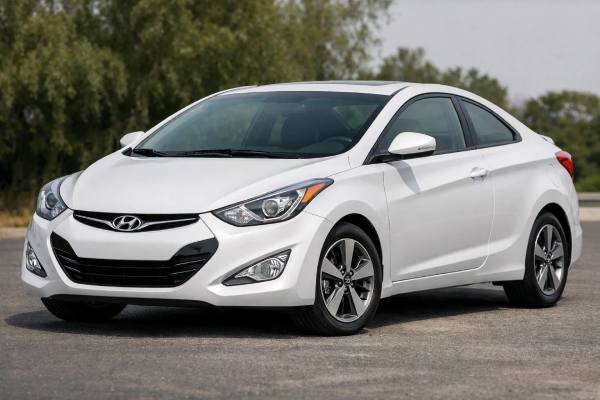
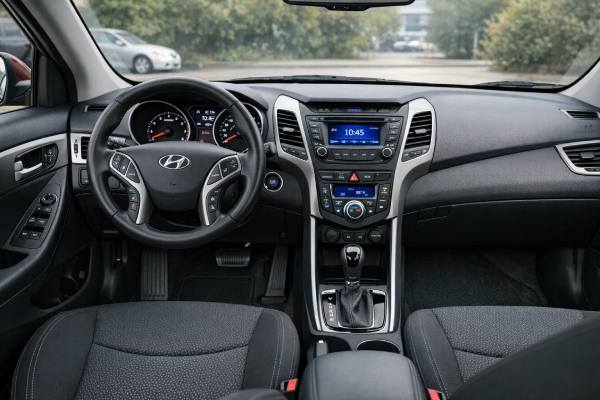
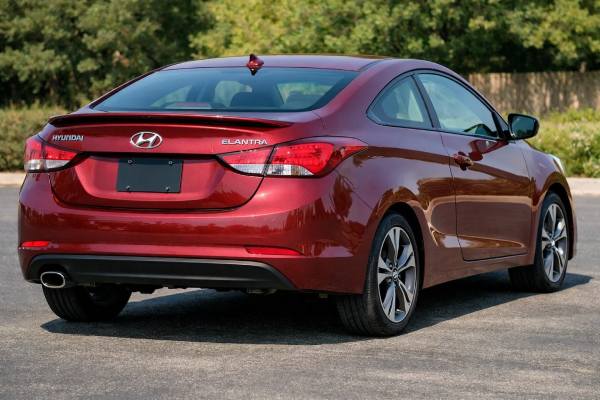
The 2014 Hyundai Elantra Coupe JK is the one-year version that turned the Elantra Coupe from a stylish economy two-door into something closer to a genuine sport compact. The big change was under the hood: Hyundai replaced the earlier 1.8 MPI engine with a 2.0-litre direct-injection unit rated at 173 hp in standard form. That gave the Coupe stronger mid-range pull, a more convincing match for its shape, and a noticeable step up in straight-line pace. At the same time, it kept the basic virtues that made the Elantra family easy to live with: good interior space for a coupe, low weight, simple front-wheel-drive packaging, and manageable parts cost.
The trade-off is that this facelifted 2.0 GDI version is also the more complex JK Coupe. Direct injection, known service campaigns, and a few well-documented Hyundai wear points mean ownership depends heavily on recall completion, oil-change discipline, and careful pre-purchase inspection. Done right, though, it remains one of the more interesting value coupes of its era.
Core Points
- The 2.0 GDI facelift Coupe is the strongest Elantra Coupe, with a useful jump in power and torque over the earlier 1.8 MPI car.
- Cabin space and trunk volume remain better than many buyers expect from a compact two-door.
- Standard 17-inch wheels, spoiler, and stronger feature content make the 2014 car feel more complete than the earlier version.
- The biggest ownership caveats are engine-monitoring campaign history, ABS recall status, and direct-injection maintenance discipline.
- A practical oil-service target is every 10,000–12,000 km or 12 months, with shorter intervals for repeated short-trip use.
Section overview
- Hyundai Elantra Coupe JK profile
- Hyundai Elantra Coupe JK data guide
- Hyundai Elantra Coupe JK grades and protection
- Known faults and factory actions
- Ownership schedule and used-buy advice
- Road feel and fuel use
- Facelift JK against competitors
Hyundai Elantra Coupe JK profile
The 2014 Elantra Coupe is easy to misunderstand if you judge it only by the badge. It still belongs to the Elantra family, still sends power through the front wheels, and still uses compact-car architecture. But compared with the 2013 1.8-litre Coupe, the 2014 facelift car is meaningfully different. Hyundai gave it a 2.0-litre GDI engine, more standard sporty trim, and a stronger feature mix that finally made the Coupe feel like the image model it always wanted to be.
That matters because the earlier 1.8 MPI Coupe looked quicker than it really was. The 2014 version closes that gap. With 173 hp in standard form, or 166 hp in certain PZEV calibrations, the facelift car has enough extra shove to make highway merging, passing, and uphill acceleration feel more natural. It is still not a true performance coupe in the way a Civic Si or turbocharged sport compact is, but it no longer depends on styling to create its sense of purpose.
The rest of the package stays familiar. The JK Coupe remains a front-drive two-door with a six-speed manual or six-speed automatic, a roomy front cabin, and one of the more useful trunks in the class. Hyundai also kept its focus on equipment. By 2014, the Coupe came with a stronger standard spec than many entry-level two-doors from the same era, including heated front seats, 17-inch wheels, rear spoiler, four-wheel disc brakes, stability control, and several cosmetic upgrades that had been optional before.
The Coupe’s biggest practical strength is that it still behaves like an Elantra in daily use. Visibility is decent for a coupe, the trunk is genuinely useful, and the suspension is tuned to be livable on real roads rather than only appealing on smooth test routes. It is a better commuter than its body style suggests. That is important, because most used buyers looking at this car today want a distinctive daily driver, not a weekend-only toy.
There is, however, a more serious maintenance side to the 2014 car. The 2.0 GDI engine adds complexity compared with the 1.8 MPI version. Direct injection brings stronger output and better response, but it also raises the usual concerns about intake-valve deposits, fuel-system cleanliness, and stricter oil-service discipline. In addition, Hyundai later issued engine-monitoring logic campaigns and warranty extensions for certain Nu 2.0 GDI vehicles, including the 2014 Elantra Coupe. That does not make the car a bad bet. It simply means buyers need to shop with more care.
In summary, the facelift JK Coupe is the Elantra Coupe that most closely matches its styling promise. It is still practical, still efficient enough, and still easy to drive, but it adds enough performance to feel less like a regular compact in a dress shirt.
Hyundai Elantra Coupe JK data guide
The 2014 Elantra Coupe’s headline number is the 2.0-litre GDI engine. In regular ULEV form, Hyundai rated it at 173 hp and 154 lb-ft. Some PZEV versions were listed lower, which is why older sales listings can show more than one power figure for the same model year. From a buyer’s perspective, the important difference is less about the exact number and more about the fact that all 2014 Coupes moved to the larger direct-injection engine.
Powertrain and efficiency
| Item | Hyundai Elantra Coupe (JK) 2.0 GDI |
|---|---|
| Code | Nu 2.0 GDI with D-CVVT |
| Engine layout and cylinders | Inline-4, 4 cylinders, DOHC, 4 valves per cylinder |
| Bore × stroke | 81.0 × 97.0 mm (3.19 × 3.82 in) |
| Displacement | 2.0 L (1,999 cc) |
| Induction | Naturally aspirated |
| Fuel system | GDI / gasoline direct injection |
| Compression ratio | About 11.5:1 |
| Max power | 173 hp (129 kW) @ 6,500 rpm; some PZEV forms about 166 hp |
| Max torque | 209 Nm (154 lb-ft) @ 4,700 rpm |
| Timing drive | Chain |
| Rated efficiency | Automatic Coupe: 9.8 / 7.1 / 8.7 L/100 km city/highway/combined |
| Rated efficiency in mpg | Automatic Coupe: 24 / 33 / 27 mpg US |
| Real-world highway @ 120 km/h | Typically about 7.0–8.0 L/100 km depending on load, tyres, and terrain |
Transmission and driveline
| Item | Hyundai Elantra Coupe (JK) 2.0 GDI |
|---|---|
| Transmission | 6-speed manual or 6-speed automatic |
| Drive type | FWD |
| Differential | Open |
Chassis and dimensions
| Item | Hyundai Elantra Coupe (JK) 2014 |
|---|---|
| Suspension (front/rear) | MacPherson strut / coupled torsion beam |
| Steering | Electric power steering with driver-selectable modes on equipped versions |
| Brakes | Four-wheel disc brakes with ABS, EBD, and Brake Assist |
| Wheels and tyres | 17-inch alloy wheels standard on the facelift Coupe; 215/45 R17 common |
| Length | 4,539 mm (178.7 in) |
| Width | 1,775 mm (69.9 in) |
| Height | 1,435 mm (56.5 in) |
| Wheelbase | 2,700 mm (106.3 in) |
| Passenger volume | About 95.4 ft³ |
| Cargo volume | 14.8 ft³ (about 420 L) |
| Kerb weight | Roughly 1,260–1,310 kg (2,778–2,888 lb), depending on trim and gearbox |
| Fuel tank | About 48 L (12.7 US gal / 10.6 UK gal) |
Performance and capability
| Item | Hyundai Elantra Coupe (JK) 2.0 GDI |
|---|---|
| 0–100 km/h | About 7.8–8.5 s depending on transmission and test method |
| 0–62 mph | About 7.8–8.5 s |
| Top speed | About 200 km/h (124 mph) |
| Braking distance | Varies by tyre and test setup; typically stronger than the 1.8 car because of tyre and suspension package |
| Towing capacity | Not a highlighted capability; verify by market documentation before towing |
| Payload | Check door-jamb label; depends on trim and tyre specification |
Fluids and service capacities
| Item | Hyundai Elantra Coupe (JK) 2.0 GDI |
|---|---|
| Engine oil | SAE 5W-20 preferred where specified; about 4.1–4.3 L (4.3–4.5 US qt) with filter |
| Coolant | Ethylene-glycol base coolant for aluminum systems; about 5.9–6.1 L (6.2–6.4 US qt) |
| Manual transmission fluid | API GL-4 type manual transaxle fluid; about 1.9–2.0 L (2.0–2.1 US qt) |
| Automatic transmission fluid | SP-IV specification; about 7.1–7.3 L (7.5–7.7 US qt) total |
| Brake fluid | DOT 3 or DOT 4 |
| A/C refrigerant | R-134a; verify exact charge under hood |
| Key torque specs | Wheel lug nuts 88–107 Nm (65–79 lb-ft) |
Safety and driver assistance
| Item | Hyundai Elantra Coupe (JK) 2014 |
|---|---|
| Crash ratings | Closely related 2014 Elantra platform testing was strong in several major IIHS categories |
| Headlight rating | Not a standard IIHS headlight-era result for this model |
| ADAS suite | No AEB, ACC, blind-spot monitoring, rear cross-traffic alert, or lane-centering |
The raw data shows the facelift’s main advantage clearly. It did not reinvent the Elantra Coupe, but it added enough engine, tyre, and feature content to make the car feel more complete. That, more than any single spec line, is why the 2014 version stands apart from the 2013 model.
Hyundai Elantra Coupe JK grades and protection
The 2014 Elantra Coupe range was simpler than many buyers expect because Hyundai effectively moved the Coupe upscale. Instead of offering a very wide spread between basic and loaded trims, Hyundai packaged the car so that even standard versions looked and felt more like sporty specials than stripped commuter cars. That is useful for used buyers because it means most 2014 Coupes start from a reasonably strong equipment baseline.
For the facelift year, the Coupe received several formerly optional appearance and comfort items as standard or package-driven content. Standard visual cues included the rear spoiler, 17-inch alloy wheels, leather-wrapped steering wheel and shift knob, and the black-chrome grille treatment. These changes matter because they make the 2014 car easier to identify and easier to distinguish from the earlier 1.8-litre version at a glance.
The feature structure also became more concentrated around package content. Heated front seats were part of the standard comfort story. Higher package content could add navigation, rearview camera, premium audio, proximity key entry with push-button start, dual-zone automatic climate control, and a power sunroof. In practical terms, a well-equipped 2014 Coupe can still feel modern enough inside for daily use, especially compared with many bargain coupes from the same period.
Mechanically, the facelift configuration also narrowed the gap between style and substance. The 2.0 GDI engine was the big news, but Hyundai also emphasized sport-tuned steering and suspension calibration for the Coupe’s positioning. That does not turn the car into a genuine track-ready machine, yet it does help justify the standard 17-inch wheels and the more aggressive exterior presentation.
Quick identifiers are simple. A real 2014 facelift Coupe should have the 2.0-litre GDI engine, 17-inch alloy wheels, integrated rear spoiler, and the updated coupe-specific trim details. If a seller lists a 2014 car with 1.8 MPI numbers or missing standard facelift cues, check the paperwork carefully. Confusion between early and later Elantras is common in used listings.
On safety, the Coupe offered a good passive and stability-control package for the time. Standard safety hardware included six airbags, electronic stability control, traction-related support functions, ABS, brake-force distribution, Brake Assist, and tire-pressure monitoring. Hyundai also continued to structure the Elantra family around a relatively stiff body shell and a broad baseline equipment level, which helped the car compare well with many compact rivals on paper.
What the Coupe does not have is modern active safety. No forward emergency braking, no adaptive cruise, no lane-centering, and no blind-spot alert. That simplifies long-term ownership because there are fewer sensors and no camera calibrations to worry about after glass or bumper work. But it also means the 2014 Coupe’s safety case is built around its structure and restraint systems, not the preventive technology buyers now expect.
For shopping purposes, the best-equipped 2014 Coupe is attractive, but the smarter buy is the cleanest car with the strongest recall and maintenance history. The trim sheet matters. The service records matter more.
Known faults and factory actions
The 2014 Elantra Coupe’s reliability story is more nuanced than the earlier 1.8 MPI car’s. The chassis and basic body hardware are generally straightforward, but the 2.0 GDI engine and wider Hyundai campaign history introduce a few issues that buyers need to understand before purchase. This is not a car with a single guaranteed failure point. It is a car with a few documented areas that deserve real attention.
A practical map looks like this:
Common and usually low to medium cost
- Front sway-bar links and bushes.
- Engine mounts causing added vibration at idle.
- Rear-brake drag or corrosion on lightly used cars.
- Interior trim rattles, especially around coupe-specific panels.
- Weak batteries on short-trip cars.
Occasional and medium cost
- Steering-column coupler wear creating a click or knock in the wheel.
- Clock spring faults affecting warning lights, horn, or steering-wheel controls.
- Air-conditioning seepage from age-related seals.
- Automatic shift roughness if fluid changes were ignored.
Higher-risk or higher-cost
- Engine knock or abnormal bearing noise tied to Nu 2.0 GDI campaign history.
- Unresolved ABS-module recall work.
- Carbon-related drivability issues from direct-injection operation and neglected maintenance.
The most important reliability topic is the Nu 2.0 GDI engine’s service-campaign history. Hyundai later expanded knock-sensor detection software campaigns and warranty coverage to certain 2014 Elantra Coupe 2.0 GDI cars to detect abnormal engine-bearing noise before severe damage. For used buyers, that means two things. First, a 2014 Coupe should be checked for campaign completion. Second, any persistent knock, flashing MIL history, or P1326-related story deserves serious diagnosis before you buy.
Unlike the 1.8 MPI engine, the 2.0 GDI also brings normal direct-injection ownership concerns. Intake-valve deposits are not guaranteed, but they are more plausible over time because fuel is injected directly into the chamber rather than over the valves. On cars used mainly for short trips or fed poor-quality maintenance, that can show up as rough idle, hesitant response, or reduced smoothness. It is not a reason to avoid the car. It is simply part of owning an older GDI engine.
The steering-coupler issue is better known and usually less serious. Wear in the flexible coupling inside the electric steering system can create a clicking or thudding sensation at low speed. It is annoying, common enough to check during a test drive, and generally more of a medium-cost nuisance than a major risk.
The ABS-module fire-risk recall is the most important safety-related campaign to verify. On affected vehicles, internal brake-fluid leakage in the ABS module can create an electrical short and raise the risk of an engine-compartment fire. This is not a “fix later” issue. It is a before-purchase issue. Any seller who cannot prove recall completion should expect the car to be valued accordingly.
A smaller but still relevant earlier recall involved deterioration of the brake-pedal stopper pad, which could lead to continuously illuminated brake lamps, warning lights, or shift-lock symptoms. It is another reminder that Hyundai’s campaign history on this platform matters.
The good news is that most of these issues are already well understood. The bad news is that a stylish compact coupe often attracts owners who care more about appearance than paperwork. On this car, paperwork matters.
Ownership schedule and used-buy advice
The best maintenance strategy for the 2014 Elantra Coupe 2.0 GDI is slightly stricter than the car’s affordable image suggests. The chassis and transmissions are conventional enough, but the direct-injection engine rewards clean oil, quality fuel habits, and on-time service. The goal is not to over-maintain it. The goal is to stay ahead of the predictable trouble points.
A sensible ownership schedule looks like this:
| Item | Practical interval |
|---|---|
| Engine oil and filter | Every 10,000–12,000 km or 12 months; 7,500 km in severe service |
| Engine air filter | Inspect every service; replace around 45,000 km |
| Cabin air filter | Every 24,000 km or yearly in dusty use |
| Spark plugs | Long-life interval, but inspect earlier if rough running appears |
| Timing chain | No routine replacement interval; inspect only if timing noise or correlation faults appear |
| Accessory belt | Inspect at major service intervals and replace on condition |
| Manual transmission fluid | Replace around 100,000–120,000 km in severe use |
| Automatic transmission fluid | Replace around 80,000–100,000 km in severe use |
| Brake fluid | Every 2 years |
| Coolant | Replace on schedule with the correct type and mix |
| Brake pads and rotors | Inspect every service |
| Tyre rotation | Every 10,000–12,000 km |
| Wheel alignment | On pull, uneven wear, or after suspension work |
| Battery test | Yearly after year four |
The fluid specifications are straightforward but important. Use the correct viscosity and API/ILSAC-grade engine oil, not just a generic cheap fill. The manual gearbox wants the correct GL-4 fluid, not any heavy gear oil from the shelf. The automatic needs the proper SP-IV-type fluid. Brake fluid should not be left in place indefinitely, and direct-injection engines benefit from better-than-minimum oil habits because clean oil quality matters to timing components and long-term engine smoothness.
As a used buy, the 2014 Coupe should be inspected in a specific order:
- Verify VIN-based recall completion.
- Confirm whether the engine-monitoring logic campaign and any related warranty actions were completed.
- Listen to the engine stone cold.
- Scan for stored or pending codes, especially any engine-protection history.
- Check steering feel and listen for low-speed coupler noise.
- Inspect tyres, brakes, and fluid condition.
- Look underneath for corrosion, impact damage, or careless jack-point use.
The common reconditioning budget is not frightening if you buy a decent car. Expect tyres, brake service, battery, one or two suspension links, fluids, and possibly an engine mount or steering-coupler repair over time. What becomes expensive is buying a neglected example that also has unresolved campaigns or suspicious engine behavior.
The best 2014 Coupe to seek is one with full service history, quiet cold starts, proper tyres, no warning lights, and clear evidence of campaign completion. A cheaper car without those basics is usually false economy. Long-term durability is acceptable when the maintenance pattern is regular and honest. This is not a coupe that likes being treated as a disposable fashion item.
Road feel and fuel use
The facelift 2014 Elantra Coupe drives the way the earlier car always looked as if it should. The extra output from the 2.0 GDI engine does not make it aggressive, but it does make it feel more complete. There is better mid-range pull, stronger response from a standstill, and less need to work the engine hard just to keep the car feeling lively.
In manual form, the Coupe feels notably better suited to back-road or highway use than the 1.8 predecessor. The six-speed manual makes good use of the broader torque band, and the extra displacement helps the car feel less flat at everyday speeds. The six-speed automatic is a reasonable partner for commuting and steady traffic, but the manual remains the more satisfying choice if driver involvement matters at all.
Handling is still more tidy than thrilling. Hyundai’s sport-tuned steering and suspension calibration gives the Coupe a cleaner initial response than the sedan, and the standard 17-inch wheel setup helps it feel more planted than the smaller-wheel 2013 versions. But the car is still a front-drive compact with comfort-biased priorities. It corners neatly, it resists excessive float, and it stays predictable, but it does not offer the playfulness or feedback of a dedicated sport compact.
Ride quality is firmer than on the earlier Coupe, though still acceptable for daily use. Broken pavement is more noticeable because the facelift car leans into its sportier appearance with the larger wheel-and-tyre package. On smoother roads, the setup feels appropriate. On poor roads, the chassis can sound busier than the softer earlier car. That is the trade-off for the sharper look and stronger grip feel.
Steering is light enough for city use and more precise than some older electric systems, but feedback remains limited. The driver-selectable steering mode feature on equipped cars changes effort more than real steering information. Braking is a genuine strength. The car’s four-wheel discs and decent tyre package give it solid stopping confidence, and the pedal is usually easy to judge when the system is in good condition.
Real-world efficiency remains respectable given the extra power. Official automatic figures land at about 24 mpg city and 33 mpg highway. In practice, many owners should expect around 8.5–9.5 L/100 km in mixed use and roughly 7.0–8.0 L/100 km on longer highway runs at normal speeds. Heavy city traffic, short trips, or tired spark plugs and intake deposits can push that higher. Direct-injection engines also tend to be a little more sensitive to neglected maintenance when it comes to smoothness and economy.
The overall verdict from behind the wheel is clear. The 2014 Coupe is the first JK that feels convincingly matched to its design. It is still not a full-on enthusiast coupe, but it is quicker, more confident, and more satisfying than the earlier 1.8-litre car while keeping the same everyday practicality.
Facelift JK against competitors
The 2014 Elantra Coupe makes the most sense when compared with the compact two-door rivals that buyers actually cross-shopped, not with much faster performance cars. Against the Honda Civic Coupe, the Hyundai usually wins on feature value, styling drama, and cabin-space efficiency. The Honda still answers with stronger steering feel, a more cohesive reputation for sporty driving, and in some variants a better enthusiast following. If you want the more polished driver’s car, the Civic usually wins. If you want the more feature-rich value play, the Hyundai makes a real case.
The Kia Forte Koup is another close rival because it targets much the same buyer. Both cars combine front-drive compact mechanicals with more distinctive two-door styling. The Hyundai tends to feel a little more spacious and a bit more refined in its cabin presentation. The Kia often leans harder into its sporty image. On the used market now, the decision often comes down to condition and history, because both cars live or die by maintenance and owner behavior.
Compared with a Scion tC, the Elantra Coupe is less overtly driver-focused but often easier to justify as an efficient daily driver. The tC has the stronger performance identity and a more obvious connection to sporty ownership. The Hyundai answers with better fuel economy, a lighter feel, and lower-key everyday manners. For some buyers, that is enough to make it the smarter long-term choice.
The more interesting comparison is inside Hyundai’s own lineup. Against the Elantra sedan, the Coupe gives up some rear-seat convenience but gains style and a slightly more purposeful feel. Against the Elantra GT hatch, it loses cargo flexibility but offers a sleeker shape and a cleaner sporty narrative. The GT is usually the rational choice. The Coupe is the emotional one. The 2014 2.0 GDI version comes closest to justifying that emotional choice because it finally has the engine to back it up.
Its weakest comparison point is long-term complexity. The 2014 Coupe is still manageable to own, but it is not as mechanically simple as the earlier 1.8 MPI car. Buyers who want the lowest-risk JK may prefer the slower MPI version. Buyers who want the better-driving and better-matched Coupe will usually prefer the 2.0 GDI facelift.
That balance defines the car. The 2014 Elantra Coupe is not the fastest option in its class, not the sharpest, and not the most collectible. It is the compact two-door for buyers who want real equipment, reasonable speed, strong daily usability, and a style upgrade over a sedan without stepping into genuinely high-maintenance performance territory. For the right buyer, that still makes plenty of sense.
References
- 2014 HYUNDAI ELANTRA COUPE UPS FUN FACTOR 2013 (Manufacturer Release)
- OWNER’S MANUAL – Dealer E Process 2014 (Owner’s Manual)
- Gas Mileage of 2014 Hyundai Elantra 2014 (Official Fuel Economy Data)
- 2014 Hyundai Elantra 2014 (Safety Rating)
- Part 573 Safety Recall Report 23V-651 2023 (Recall Report)
Disclaimer
This article is for informational purposes only and is not a substitute for professional diagnosis, repair, or factory service information. Specifications, torque values, service intervals, procedures, outputs, and equipment vary by VIN, market, trim, emissions certification, and production date, so always verify details against official service documentation and the labels fitted to the vehicle before carrying out maintenance or repairs.
If this guide was useful, please consider sharing it on Facebook, X, or another platform to support our work.