
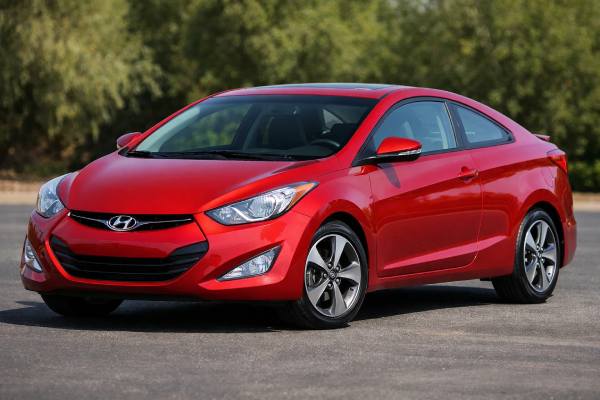
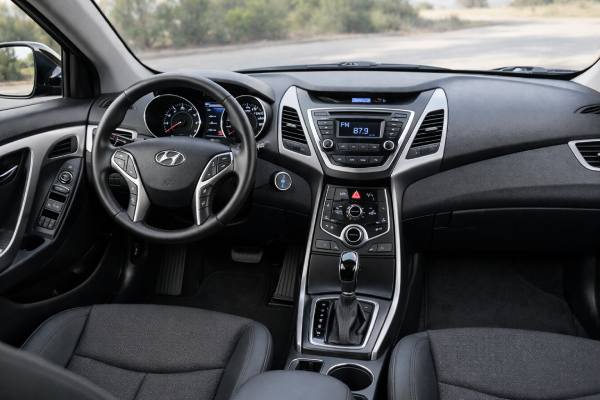
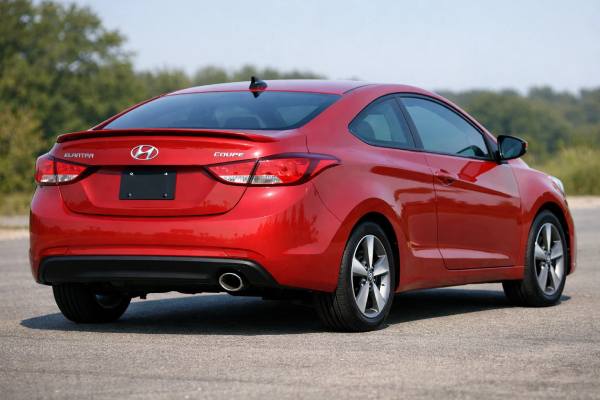
The 2013 Hyundai Elantra Coupe JK is the two-door version of Hyundai’s MD-generation compact, shaped to look sportier without changing the basic formula that made the sedan popular. Under the skin, it stays very familiar: a naturally aspirated 1.8-litre MPI four-cylinder, a 6-speed manual or 6-speed automatic, front-wheel drive, and everyday-friendly packaging. That matters today because the car offers style and decent practicality without moving into turbocharged, high-maintenance territory.
One detail is worth clearing up early. Many listings show this car at 145 hp, while others list it a little higher depending on emissions specification and market documentation. In practical ownership terms, that difference is small. What matters more is that the 1.8 MPI engine is the simpler version of the Elantra Coupe powertrain story, with port injection and a timing chain rather than turbo or direct-injection hardware. Bought carefully, the JK Coupe can still be an attractive, efficient, and low-stress used two-door.
At a Glance
- The Elantra Coupe combines simple MPI engine hardware with a stylish two-door body and a roomy 420 L trunk.
- Six-speed manual and automatic gearboxes are both more modern than the older 4-speed units Hyundai used in earlier compact cars.
- Heated front seats, four-wheel disc brakes, ABS, and stability control made it a well-equipped compact coupe for its class.
- The main ownership caveats are Nu-engine noise concerns, steering-coupler wear, and recall history that should be checked by VIN.
- Treat 12,000 km or 12 months as a sensible oil-service interval, and shorten it for repeated short trips or heavy stop-start use.
Quick navigation
- Hyundai Elantra Coupe JK character
- Hyundai Elantra Coupe JK specs
- Hyundai Elantra Coupe JK trims and safety
- Problem patterns and service campaigns
- Maintenance routine and buyer’s checklist
- Driving impressions and real efficiency
- JK Coupe versus two-door rivals
Hyundai Elantra Coupe JK character
The Elantra Coupe was Hyundai’s answer to buyers who liked the Elantra sedan’s value, space, and efficiency but wanted a car that looked less ordinary. Instead of turning it into a true performance coupe, Hyundai kept the engineering conservative and focused on appearance, packaging, and everyday usability. The result is a car that still makes more sense as a stylish daily driver than as a budget sports car.
That is the key to understanding the JK Coupe today. It shares the sedan’s 1.8-litre naturally aspirated four-cylinder, six-speed transmissions, and front-wheel-drive layout, but adds a lower roofline, coupe-specific rear bodywork, and a slightly more image-focused trim strategy. It looks more dramatic than the sedan, but it is still fundamentally an Elantra underneath. For many used-car buyers, that is actually a good thing. The sedan-based roots help keep parts availability, service knowledge, and general drivability on the sensible side.
The Coupe’s biggest practical surprise is space. Unlike many small coupes that trade away usefulness for styling, the JK keeps a reasonably roomy cabin and a large trunk for the class. Front-seat space is generous, rear access is less convenient than in the sedan, and rear headroom is naturally tighter, but this is not a cramped toy. It can handle normal commuting, weekend luggage, and light family duty better than its shape suggests.
Mechanically, the car is appealing because it avoids several common pain points of later compact cars. The 1.8 MPI engine does not use direct injection, so it avoids the intake-valve carbon concerns seen on some newer engines. There is no turbocharger to age, no dual-clutch gearbox to overheat in traffic, and no complicated hybrid system to maintain. That simplicity is one of the strongest reasons to choose a 2013 Coupe over some flashier rivals.
Still, expectations need to be realistic. This is not an Elantra built for hard driving. The Coupe feels lighter and more stylish than the sedan, and SE versions add wheel-and-tyre hardware that sharpen the look, but the overall tuning is still comfort-first. The steering is easy, the controls are light, and the car is happiest when driven smoothly. It looks more eager than it really is.
The 2013 model year is also unique because it is the only year in this form with the 1.8 MPI engine in the Coupe body before Hyundai changed the formula for later cars. For buyers who prefer the simpler port-injected engine and earlier specification, that gives the 2013 Coupe its own niche. It is a one-year, low-complexity, style-led Elantra that works best when judged as a practical two-door commuter with decent efficiency and low running stress.
Hyundai Elantra Coupe JK specs
The Elantra Coupe JK 1.8 MPI is straightforward on paper. The engine is a 1.8-litre Nu-series inline-four with dual continuously variable valve timing, linked to a six-speed manual or six-speed automatic. Depending on emissions certification, published output may appear as 145 hp or slightly higher, which is why buyer listings often disagree. The important point is that all 2013 1.8 MPI Coupes are close enough in performance and service requirements that ownership decisions should focus more on condition and maintenance than on a small output-number difference.
Powertrain and efficiency
| Item | Hyundai Elantra Coupe (JK) 1.8 MPI |
|---|---|
| Code | Nu 1.8 MPI / D-CVVT |
| Engine layout and cylinders | Inline-4, 4 cylinders, DOHC, 4 valves per cylinder |
| Bore × stroke | 81.0 × 87.1 mm (3.19 × 3.43 in) |
| Displacement | 1.8 L (1,797 cc) |
| Induction | Naturally aspirated |
| Fuel system | MPI / multipoint injection |
| Compression ratio | About 10.3:1 |
| Max power | 145 hp to 148 hp depending on emissions specification, about 108–110 kW @ 6,500 rpm |
| Max torque | About 176–178 Nm (130–131 lb-ft) @ 4,700 rpm |
| Timing drive | Chain |
| Rated efficiency | Manual: 8.4 / 6.2 L/100 km city/highway; Automatic: 8.7 / 6.4 L/100 km city/highway |
| Rated efficiency in mpg | Manual: 28 / 38 mpg US; Automatic: 27 / 37 mpg US |
| Real-world highway @ 120 km/h | Typically about 6.7–7.5 L/100 km, depending on wind, tyres, traffic, and gearbox |
Transmission and driveline
| Item | Hyundai Elantra Coupe (JK) 1.8 MPI |
|---|---|
| Transmission | 6-speed manual or 6-speed automatic |
| Drive type | FWD |
| Differential | Open |
Chassis and dimensions
| Item | Hyundai Elantra Coupe (JK) |
|---|---|
| Suspension (front/rear) | MacPherson strut / coupled torsion beam |
| Steering | Electric power steering |
| Brakes | Four-wheel disc brakes with ABS, EBD, and Brake Assist |
| Wheels and tyres | 195/65 R15, 205/55 R16, or 215/45 R17 depending on trim |
| Length | 4,539 mm (178.7 in) |
| Width | 1,775 mm (69.9 in) |
| Height | 1,435 mm (56.5 in) |
| Wheelbase | 2,700 mm (106.3 in) |
| Kerb weight | About 1,219–1,290 kg (2,687–2,844 lb), depending on trim and gearbox |
| GVWR | About 1,720 kg (3,792 lb) |
| Fuel tank | 48 L (12.68 US gal / 10.56 UK gal) |
| Cargo volume | 420 L (14.8 ft³) |
Performance and capability
| Item | Hyundai Elantra Coupe (JK) 1.8 MPI |
|---|---|
| 0–100 km/h | About 8.4–8.7 s for manual cars; automatic slightly slower |
| 0–62 mph | About 8.4–8.7 s |
| Top speed | About 195 km/h (121 mph) |
| Braking distance | Around 55.5 m (182 ft) from 70–0 mph in published testing of a manual SE |
| Towing capacity | Not a core strength of this model; verify by VIN and local handbook before towing |
| Payload | Check door-jamb label; varies by trim and tyre rating |
Fluids and service capacities
| Item | Hyundai Elantra Coupe (JK) 1.8 MPI |
|---|---|
| Engine oil | 4.0 L (4.23 US qt); SAE 5W-20 preferred, 5W-30 acceptable by climate/spec |
| Coolant | Ethylene-glycol base coolant for aluminum radiator; about 5.9–6.0 L (6.2–6.3 US qt) |
| Manual transmission fluid | About 1.9 L (2.0 US qt); API GL-4 SAE 75W/85 |
| Automatic transmission fluid | About 7.3 L (7.71 US qt) total; SP-IV specification |
| Brake / clutch fluid | DOT 3 or DOT 4; about 0.7–0.8 L (0.74–0.85 US qt) service fill |
| A/C refrigerant | R-134a; verify exact under-hood label |
| Key torque specs | Wheel lug nuts 88–107 Nm (65–79 lb-ft) |
Safety and driver assistance
| Item | Hyundai Elantra Coupe (JK) |
|---|---|
| Crash ratings | Platform-related sedan testing for the 2013 Elantra family was strong in several key categories |
| Headlight rating | Not a standard IIHS headlight-era result for this model |
| ADAS suite | None in the modern sense; no AEB, ACC, blind-spot monitoring, or lane-centering |
The spec sheet makes the Coupe’s identity very clear. It is a light, efficient, front-drive compact with reasonable power, modern-enough six-speed transmissions, and straightforward service demands. The most important ownership numbers are not the horsepower headline but the oil, coolant, transmission-fluid, and wheel-torque figures that keep the car easy to maintain over time.
Hyundai Elantra Coupe JK trims and safety
The 2013 Elantra Coupe came in two trims, GS and SE, and that distinction matters because the SE is the version most likely to attract buyers who expect the car to feel sportier than it really is. Both trims use the same 1.8 MPI engine and the same six-speed manual or automatic options, so the differences are mostly about equipment, wheel packages, and visual character.
The GS was the value-minded version, but it was not bare. Hyundai gave it a strong baseline equipment list that included heated front seats, tilt-and-telescopic steering adjustment, power accessories, keyless entry, air conditioning, a useful audio setup, four-wheel disc brakes, ABS, electronic brake-force distribution, Brake Assist, electronic stability control, traction support functions, and six airbags. For a compact coupe in 2013, that was a generous standard specification.
The SE added the trim pieces and hardware that made the Coupe look more convincing as a style-first model. Typical SE identifiers include 17-inch alloy wheels, a lip spoiler, sportier exterior detailing, aluminum pedals, and cabin accents that better match the coupe image. Hyundai also tuned the SE around its lower-profile tyre package, so steering response and initial turn-in can feel a little tighter than on smaller-wheel cars. The flip side is firmer ride quality and higher tyre replacement cost.
When shopping used examples, visual identifiers are helpful because sellers often mislabel trims. Smaller wheels and a simpler exterior presentation usually point to the GS. Seventeen-inch wheels, spoiler details, and the more assertive look usually indicate an SE. That matters because many buyers assume the SE is automatically the better choice. In reality, the best trim depends on priorities. The GS often rides more comfortably and costs less to maintain. The SE looks better parked and feels slightly sharper in motion.
Safety equipment was a selling point. Six airbags, four-wheel discs, ABS, Brake Assist, stability control, and related traction systems gave the Coupe a good baseline for the class. The car predates the mainstream rollout of advanced driver-assistance systems, so there is no modern forward emergency braking, adaptive cruise, blind-spot monitoring, or lane support. That means fewer electronics to calibrate, but it also means the driver carries more of the active-safety burden.
In crash terms, the Coupe benefits from its close relation to the 2013 Elantra family, which performed well in several major safety categories for the era. Still, buyers should be precise. The public crash data most often associated with this platform is sedan-based, not a dedicated Coupe-only test record. That does not invalidate the Coupe’s structural and passive-safety strengths, but it is worth being careful about how those claims are phrased.
For ownership, the more relevant question is not which trim had the better brochure. It is whether the car has all its original safety systems functioning properly now. Airbag warning lights, ABS faults, poor-quality accident repairs, and missing recall documentation matter much more than whether the car has a spoiler or larger wheels. A basic GS with intact systems and good maintenance is a better used buy than a neglected SE with the right badge.
Problem patterns and service campaigns
The Elantra Coupe’s reliability profile is shaped more by a handful of known patterns than by random complexity. The car itself is not mechanically exotic, but it belongs to a wider Hyundai family that saw specific engine-noise concerns, steering-coupler wear, and recall campaigns involving brake-switch hardware and ABS modules. A careful buyer should know the difference between normal wear and genuinely important service history.
A useful pattern looks like this:
Common and low-to-medium cost
- Front sway-bar links and bushes.
- Engine mounts that increase idle vibration.
- Rear brakes sticking or corroding on lightly used cars.
- Interior rattles, especially in coupe-specific trim areas.
- Weak batteries in cars used mostly for short trips.
Occasional and medium cost
- Steering-column coupler wear causing a click or thud when turning.
- Clock spring faults affecting horn, steering-wheel controls, or warning lamps.
- Automatic shift harshness when fluid service was ignored.
- Air-conditioning leaks caused by aging seals and components.
Higher-risk if ignored
- Cold-start engine slap or persistent upper-engine noise.
- Unresolved recall work.
- Cooling-system neglect leading to overheating.
The biggest non-routine ownership concern is the 1.8-litre Nu engine’s reputation for piston-slap-related noise and, in some cases, internal wear severe enough to justify long-block coverage under Hyundai’s extended warranty program for certain vehicles. This does not mean every Coupe will develop a serious problem, but it does mean a noisy cold start should never be dismissed casually. A healthy Nu engine may sound a little busy when cold, but persistent slapping, metallic knock, or a documented engine replacement history deserves close attention.
The steering coupler issue is better understood and generally less severe. Wear in the flexible coupling inside the electric steering system can create a clicking or knocking feel through the wheel, usually at low speed or during parking maneuvers. It is annoying and common enough to check on every test drive, but it is not usually a crisis repair. Many owners simply budget for it once symptoms appear.
Two recalls matter especially. One involved deterioration of the brake-pedal stopper pad, which can lead to continuously illuminated brake lights, shift-lock issues, ESC warnings, or related brake-override problems. The other is the more serious ABS-module fire-risk campaign, which can allow internal brake-fluid leakage to create an electrical short and increase the risk of an engine-compartment fire. That recall moved this from a routine ownership topic into a must-check item. No 2013 Elantra Coupe should be bought without a VIN-based recall check.
A further ownership detail is the clock spring. If the airbag light stays on, the horn is intermittent, or steering-wheel buttons do not work correctly, this area deserves inspection. It is not always a major repair, but it matters because it touches driver controls and restraint-system warnings.
The encouraging part is that none of this makes the Coupe inherently fragile. Most problem areas are now well known. The real danger is not the model itself but buyers who treat a stylish compact coupe as if it needs no paperwork, no recall verification, and no cold-start mechanical inspection.
Maintenance routine and buyer’s checklist
The Elantra Coupe is one of the easier modern-looking compact cars to maintain because the basic recipe stays simple: naturally aspirated port injection, chain-driven cams, ordinary fluids, and either a manual or a conventional six-speed automatic. The right maintenance strategy is not complicated. It is just disciplined.
A practical real-world schedule looks like this:
| Item | Practical interval |
|---|---|
| Engine oil and filter | Every 12,000 km or 12 months; every 7,500–10,000 km in severe use |
| Engine air filter | Inspect every service; replace around 45,000–50,000 km |
| Cabin air filter | Every 24,000 km or 12 months |
| Spark plugs | Long-life interval, but inspect earlier on rough-running cars |
| Timing chain | No routine replacement interval; inspect only if noise or timing faults appear |
| Accessory drive belt | Inspect at 96,000 km or 72 months, then more frequently |
| Manual transmission fluid | Replace around 120,000 km in severe service |
| Automatic transmission fluid | Replace around 96,000 km in severe service |
| Brake fluid | Every 2 years |
| Coolant | Replace on schedule with the correct type and mix |
| Brake pads and rotors | Inspect every service |
| Tyre rotation | Every 10,000–12,000 km |
| Wheel alignment | Check on pull, steering-angle change, or uneven shoulder wear |
| Battery check | Yearly after year four |
The key fluid numbers are useful when comparing service invoices. Engine oil capacity is about 4.0 L with filter. The manual transaxle takes about 1.9 L of the correct GL-4 fluid. The automatic’s total listed capacity is about 7.3 L, though a drain-and-fill uses less. Brake fluid should meet DOT 3 or DOT 4 requirements, and wheel-lug torque is 88–107 Nm. These are practical numbers that help owners spot sloppy workshop habits before they become problems.
As a used buy, the Coupe rewards a structured inspection. Start with paperwork. Confirm recall completion for the brake-stopper-pad campaign and the ABS-module campaign. Then inspect the car cold, not just after it has been warmed up by the seller. Listen for engine slap or persistent metallic noise. After that, steer lock-to-lock at low speed and listen for the steering-coupler click. Then inspect tyres, because bad tyres on a Coupe often reveal the owner’s overall maintenance standard. Cheap mismatched tyres, especially on an SE, usually mean corners were cut elsewhere too.
Common reconditioning items are predictable: tyres, battery, front links, rear brake service, one or more engine mounts, fluids, and possibly the steering coupler. That is manageable. What hurts value is buying a car that needs all of those items while also carrying unresolved recall work or questionable engine behavior.
The best version to seek is not always the SE. A clean GS with good tyres, full recall history, quiet cold starts, and documented maintenance can be the smarter long-term buy. The SE makes sense if you want the 17-inch-wheel look and slightly more assertive feel, but it also exposes the car to pricier tyres and a somewhat firmer ride.
Long-term durability is decent when the service pattern stays regular. The Elantra Coupe is not a car that rewards neglect. It is a car that rewards ordinary, boring upkeep.
Driving impressions and real efficiency
On the road, the Elantra Coupe is better than many people expect, but not because it behaves like a serious sports coupe. Its strength is that it feels light, predictable, and easy to place while still offering enough composure to make everyday driving pleasant. That matters more in real ownership than a dramatic roofline or a spoiler.
The 1.8 MPI engine behaves exactly like a naturally aspirated compact engine should. Throttle response is linear, power builds progressively, and there is no turbo lag or sudden step in torque. Low-rpm pull is only moderate, so the manual transmission is the better match for drivers who care about response. The engine likes being worked cleanly through the mid-range rather than lugged in a high gear. The automatic is smoother in traffic but duller if you ask for quick overtakes or uphill acceleration.
In manual form, the Coupe is usefully brisk rather than quick. A 0–100 km/h time in the mid-eight-second range is enough to keep the car from feeling slow, but it is not enough to justify calling it sporty in the modern sense. That is consistent with the rest of the chassis. The car turns in neatly, stays composed, and feels secure, but it does not invite aggressive driving the way a true sport-compact coupe would.
Ride and handling are influenced strongly by trim. Smaller-wheel GS cars usually ride more softly and isolate broken roads better. SE cars on 17-inch wheels look better and respond a bit more sharply, but the lower-profile tyres also bring more road noise and sharper impacts. Buyers who drive on rough pavement or want lower running costs often prefer the GS balance. Buyers who want a cleaner, slightly more tied-down feel usually prefer the SE.
Steering is light and quick enough for the class, but it is not especially communicative. That is typical of many electric systems from this era. Braking is a quiet strength. Four-wheel discs, ABS, and stability control give the Coupe a reassuring feel under hard stops, and pedal response is usually easy to manage when the system is healthy.
Noise levels are average for the class. Around town the Coupe feels refined enough, but at highway speeds tyre roar and wind noise become more noticeable than in a newer compact. Much of that depends on tyre choice and overall condition. A car on quality tyres with fresh mounts feels far more polished than one on cheap rubber.
Fuel economy remains a genuine reason to buy one. Manual cars are capable of about 8.4 L/100 km in the city and 6.2 L/100 km on the highway by official rating, while automatics trail only slightly. In real mixed use, many owners should expect roughly 7.8–8.8 L/100 km, with steady highway driving often landing in the mid-6s to low-7s. That is strong for a roomy compact two-door with a naturally aspirated engine and a conventional automatic option.
So the dynamic verdict is simple. The Elantra Coupe is not exciting enough to justify ownership on style alone. But as a comfortable, efficient, attractive commuter with decent trunk space and manageable road manners, it makes a stronger case than its image-first shape suggests.
JK Coupe versus two-door rivals
The Elantra Coupe makes the most sense when judged against the compact two-door cars people actually considered around 2013. Against the Honda Civic Coupe, the Hyundai offered more trunk space, more rear-seat usefulness, and a stronger value-equipment story. The Civic fought back with sharper steering feel, stronger enthusiast credibility, and in sporty variants a much higher performance ceiling. If you wanted the more entertaining car, the Honda usually won. If you wanted the roomier and often cheaper daily driver, the Hyundai had a real advantage.
The Kia Forte Koup is an even closer comparison because it chased many of the same buyers. Both cars combined front-drive compact mechanicals with more expressive two-door styling. The Hyundai usually feels roomier and a little more mature in its interior presentation. The Kia often projects a more openly sporty image. Used today, condition and service history matter more than brochure personality, because both depend heavily on how they were maintained.
Compared with a Scion tC, the Elantra Coupe feels less committed to performance but more balanced as an efficiency-and-comfort play. The tC has the stronger enthusiast identity and a better reputation as a budget tuning platform. The Hyundai answers with better fuel economy, softer edges in daily use, and less temptation for previous owners to modify it badly.
The more interesting comparison, though, is the Elantra sedan. The sedan is easier to buy, easier to sell, and easier to live with if rear-seat access matters. The Coupe exists for buyers who want the Elantra’s value, efficiency, and simplicity in a lower-volume body style. That is both its strength and its weakness. It is more distinctive than the sedan, but the extra style does not come with a major performance upgrade.
Where the Coupe still stands out is simplicity plus packaging. Many sporty-looking compact cars ask buyers to accept higher insurance, worse fuel economy, or more complicated hardware. The 2013 Elantra Coupe does not. It gives you a naturally aspirated engine, proven six-speed transmissions, real luggage space, and a good everyday feature set. Its weak point is that it is not especially memorable when pushed hard.
That is why the right buyer matters so much. If you want a budget sports coupe, there are better choices. If you want a sharp-looking, roomy, efficient two-door daily with manageable ownership risk, the JK Coupe remains a sensible and underrated option.
References
- HYUNDAI ADDS SPORT COUPE VARIANT TO ITS AWARD-WINNING ELANTRA LINE-UP 2012 (Manufacturer Release)
- Gas Mileage of 2013 Hyundai Elantra 2013 (Official Fuel Economy Data)
- 2013 Hyundai Elantra 4-door sedan 2013 (Safety Rating)
- Part 573 Safety Recall Report 23V-651 2023 (Recall Report)
- Part 573 Safety Recall Report 17V-769 2017 (Recall Report)
Disclaimer
This article is for informational purposes only and is not a substitute for professional diagnosis, repair, or factory service information. Specifications, torque values, service intervals, procedures, outputs, and equipment vary by VIN, emissions certification, market, and trim, so always verify details against official service documentation and the labels fitted to the vehicle before carrying out maintenance or repairs.
If this guide helped you, please consider sharing it on Facebook, X, or another platform to support our work.