
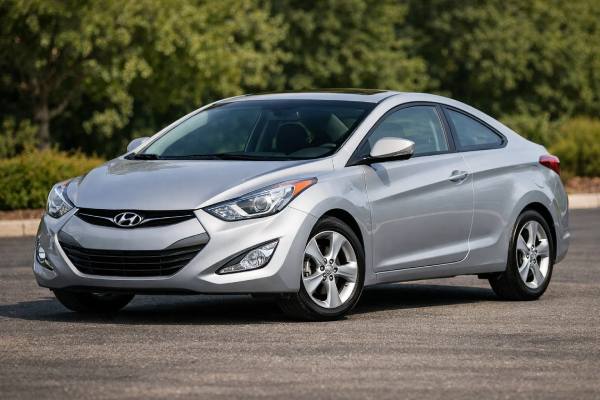
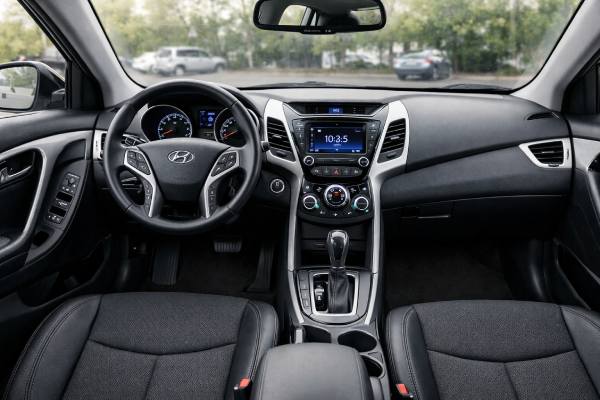

The 2013 Hyundai Elantra Coupe is a niche version of the Elantra family, but it is not just a sedan with two fewer doors. Hyundai gave the JK Coupe its own styling, coupe-specific bodywork, and a slightly sportier personality while keeping the same practical core: a naturally aspirated 1.8-litre MPI engine, standard six-speed transmissions, good cabin room, and low running complexity. That combination still matters today. The Coupe is easy to understand mechanically, relatively efficient for its era, and roomier inside than many buyers expect from a compact two-door. Its strongest ownership traits are simple packaging, broad parts support, and a conventional powertrain without turbocharger or direct-injection complications. Its weak points are also straightforward: some 1.8 Nu engines developed piston-noise and cylinder-wall issues, some steering-column couplings click with age, and deferred maintenance matters more than trim level. Bought carefully, this one-year 148 hp Coupe remains a smart, underrated compact.
What to Know
- The 2013 Coupe combines better style than the sedan with almost the same practical interior space.
- The 1.8 MPI engine is simple and efficient, with no turbo or direct injection to complicate ownership.
- Standard safety equipment is strong for the class, including stability control, traction control, and four-wheel disc brakes.
- The main reliability caveat is the 1.8 Nu engine’s known piston-noise and cylinder-scuffing history on some cars.
- A sensible oil-service interval is every 6,000 to 12,000 km, depending on driving conditions.
Jump to sections
- Hyundai Elantra Coupe JK in Context
- Hyundai Elantra Coupe JK Hard Data
- Hyundai Elantra Coupe JK Grades and Crash Gear
- Known Faults and Campaigns
- Service Routine and Purchase Checks
- Road Manners and Real Economy
- JK Coupe Versus Competitors
Hyundai Elantra Coupe JK in Context
The Elantra Coupe arrived for the 2013 model year as Hyundai’s attempt to broaden the Elantra lineup without making it feel like a budget compromise. It took the familiar MD-generation Elantra platform and wrapped it in coupe-specific bodywork with a more aggressive roofline, revised front and rear styling, and trim choices aimed at younger buyers. The result was a car that looked more special than the sedan while keeping most of the reasons people bought the sedan in the first place.
That matters because the Coupe’s value is still based on balance. This is not a rear-drive sports coupe, and Hyundai never really positioned it as one. It is better understood as a roomy compact two-door with useful equipment, solid fuel economy, and a lighter, more style-driven character than the four-door model. In that role, it still makes sense. The cabin is spacious enough that the car sits near the top of the segment for interior room, and the 14.8 cu ft trunk is more useful than many coupe buyers expect.
The 1.8-litre Nu engine is central to that story. It produces 148 hp and 131 lb-ft, and it does so with a conventional multi-point injection setup rather than direct injection. Hyundai also paired it with six-speed manual and six-speed automatic gearboxes, which helped the Coupe feel more modern than some rivals that were still leaning on older automatics. The engine itself was marketed as lighter and cleaner than the older 2.0-litre Beta-family unit it replaced, and Hyundai highlighted its dual CVVT, aluminum-intensive construction, and silent timing chain. On paper and in daily driving, it is a sensible match for the car.
There is one important year-specific point to keep in mind. The 148 hp 1.8 MPI Coupe is really a 2013-focused story. Hyundai updated the Coupe for 2014 with a more powerful 2.0 GDI engine, so buyers searching this exact 148 hp specification are essentially looking at the launch-year car. That simplifies shopping, because you are not comparing multiple years of the same powertrain. You are looking for the best 2013 example, not the newest one.
Today, the JK Coupe works best for buyers who want compact-car running costs with a bit more personality. It is not rare enough to be collectible, but it is distinct enough to be more interesting than a base sedan. That is why condition matters so much. A clean, well-serviced Coupe still feels like a smart buy. A neglected one just feels like an old compact with extra doors missing.
Hyundai Elantra Coupe JK Hard Data
The 2013 Elantra Coupe was sold in the U.S. with one engine and two transmissions. Trim and option choices change wheel size, equipment, and curb weight, but the core mechanical package stays consistent.
Powertrain and efficiency
| Item | Hyundai Elantra Coupe JK 1.8 MPI |
|---|---|
| Code | Nu-family 1.8 MPI petrol |
| Engine layout and cylinders | Inline-4, DOHC, 4 cylinders, 4 valves per cylinder |
| Bore × stroke | 81.0 × 87.2 mm (3.19 × 3.43 in) |
| Displacement | 1.8 L (1,797 cc) |
| Induction | Naturally aspirated |
| Fuel system | MPI |
| Compression ratio | 10.3:1 |
| Max power | 148 hp (110 kW) @ 6,500 rpm |
| Max torque | 178 Nm (131 lb-ft) @ 4,700 rpm |
| Timing drive | Silent timing chain |
| Rated efficiency | Manual: 7.4 L/100 km combined (32 mpg US / 38.4 mpg UK); Automatic: 7.6 L/100 km combined (31 mpg US / 37.2 mpg UK) |
| Real-world highway @ 120 km/h (75 mph) | typically about 6.8–7.8 L/100 km (34.6–30.2 mpg US / 41.5–36.2 mpg UK) |
Transmission and driveline
| Item | Value |
|---|---|
| Transmission | 6-speed manual or 6-speed automatic with SHIFTRONIC |
| Drive type | FWD |
| Differential | Open |
Chassis and dimensions
| Item | Value |
|---|---|
| Suspension front | MacPherson strut |
| Suspension rear | Coupled torsion beam axle |
| Steering | Rack-and-pinion, motor-driven power steering |
| Steering ratio | Not consistently published in owner-facing Hyundai literature |
| Brakes | 4-wheel disc ABS; diameter figures are not consistently listed in open owner-facing material |
| Wheels and tyres | P195/65 R15, P205/55 R16, or P215/45 R17 depending on trim and package |
| Ground clearance | Not commonly published in open U.S. owner-facing material |
| Length / Width / Height | 4,539 / 1,775 / 1,435 mm (178.7 / 69.9 / 56.5 in) |
| Wheelbase | 2,700 mm (106.3 in) |
| Turning circle | about 10.6 m (34.8 ft) |
| Kerb weight | about 2,687–2,877 lb (1,219–1,305 kg), depending on trim and transmission |
| GVWR | 3,792 lb (1,720 kg) |
| Fuel tank | Hyundai literature varies slightly; roughly 48–50 L (12.7–13.2 US gal / 10.6–11.0 UK gal) |
| Cargo volume | 420 L (14.8 ft³), seats up |
| Cargo volume, seats down | Fold-down rear seat fitted, but no official coupe-specific seats-down volume is usually published |
Performance and service capacities
| Item | Value |
|---|---|
| 0–100 km/h (0–62 mph) | Hyundai did not heavily market an official U.S. figure; real-world performance is generally low-10-second range |
| Top speed | Not a major U.S. brochure figure; typically around 190 km/h (118 mph) |
| Braking distance | Not consistently published in open factory literature |
| Towing capacity | Not generally promoted for the U.S. Coupe; verify locally if towing is intended |
| Payload | Label- and trim-specific |
| Engine oil | API SM / ILSAC GF-4 or above, SAE 5W-20 preferred; 4.0 L (4.23 US qt) |
| Coolant | Ethylene glycol base coolant for aluminum radiator; 5.9–6.0 L (6.23–6.34 US qt) depending on transmission |
| Manual transmission fluid | API GL-4 SAE 75W-85; 1.9 L (2.01 US qt) |
| Automatic transmission fluid | Hyundai / MICHANG / SK ATF SP-IV equivalent; 7.3 L (7.71 US qt) |
| Brake / clutch fluid | FMVSS 116 DOT-3 or DOT-4; 0.7–0.8 L (0.7–0.8 US qt) |
| A/C refrigerant | Verify by VIN or under-hood label |
| A/C compressor oil | Verify by VIN or under-hood label |
| Key torque specs | Wheel nuts 88–107 Nm (65–79 lb-ft) |
Safety and driver assistance
| Item | Value |
|---|---|
| Euro NCAP | No widely cited coupe-specific Euro NCAP rating |
| IIHS | No separate Coupe page is commonly published; the closest public U.S. platform reference is the 2013 Elantra 4-door sedan |
| IIHS closest public platform reference | Small overlap A; moderate overlap G; side G; roof strength G; head restraints G |
| ADAS suite | None in the modern sense; no AEB, ACC, lane support, blind-spot monitoring, or traffic-sign assist |
The hard-data summary is useful because it shows the Coupe’s basic appeal: modern-enough transmissions, strong interior packaging, and a simple naturally aspirated engine. It also shows where the car feels old today. The safety picture is respectable for the time, but there is no modern crash-avoidance technology, and some detailed figures were never a major part of Hyundai’s coupe marketing.
Hyundai Elantra Coupe JK Grades and Crash Gear
The 2013 Elantra Coupe range is fairly easy to understand because Hyundai kept it compact. In the U.S., the big distinction is between GS and SE. That matters more than most buyers expect because the Coupe’s personality changes a little depending on which one you choose.
The GS is the simpler and usually better-value version. It comes with the 148 hp engine, six-speed manual or available automatic, heated front seats, Bluetooth phone and audio streaming, cruise and audio controls on the steering wheel, fog lights, daytime running lights, 16-inch alloy wheels, dual chrome exhaust tips, and the same core safety features as the rest of the line. For a used buyer, the GS makes a lot of sense because it keeps the running costs lower and the ride a little more forgiving on smaller wheels.
The SE is the more interesting trim if you want the Coupe to feel more special. Hyundai added sport-tuned suspension, leather seating surfaces, leather-wrapped wheel and shifter, aluminum pedals, a sunroof, one-touch auto-up driver window, side-mirror turn indicators, integrated rear spoiler treatment, and 17-inch alloy wheels. In other words, the SE is the trim that turns the Elantra Coupe from “practical compact with two doors” into “compact coupe with at least some visual and dynamic attitude.” It does ride a little firmer and can cost more to recondition, especially if the 17-inch wheels are bent or curbed.
There is no big engine or differential change between the trims in 2013. That is important. You are not choosing between a base drivetrain and a hotter powertrain. You are choosing between value and equipment, then between manual and automatic. For most buyers, that means service history matters more than trim. A clean GS is almost always a better purchase than a tired SE with patchy records.
Safety equipment was one of Hyundai’s strongest selling points here. Standard equipment included electronic stability control, traction control, vehicle stability management, brake assist, electronic brake-force distribution, four-wheel disc ABS, a six-airbag system, active front head restraints, and tire-pressure monitoring. That is still a respectable list for a 2013 compact coupe, especially because some rivals of the period spread similar equipment across optional packages.
The crash-rating picture needs context. Hyundai leaned heavily on the Elantra family’s safety reputation, but the cleanest public IIHS page is for the 2013 Elantra sedan on the same 2011–16 platform, not a separate coupe-specific page. That platform reference is strong overall, with Good ratings in moderate overlap, side, roof strength, and head restraints, and Acceptable in driver-side small overlap. That is a credible result for the era, but it should not be overstated. There is still no modern crash-prevention system here, and coupe buyers should remember that body-style-specific published testing is thinner than it is for the four-door.
Known Faults and Campaigns
The Elantra Coupe’s reliability profile is mostly ordinary, but one issue stands above the rest: the 1.8 Nu engine’s piston-noise and cylinder-wall scuffing history on some cars. Hyundai issued service material and warranty-extension documentation covering certain 1.8 Nu vehicles, including the 2013 Elantra Coupe, for upper-end piston slap noise and related short-block damage. That does not mean every Coupe is affected. It does mean any buyer should take cold-start noise seriously and ask whether the car has already been inspected or repaired.
A practical fault map looks like this:
- Common, low cost: brake wear, sway-bar links, aging battery, noisy hatch or door trim, worn cabin filters, tired spark plugs
- Common, medium cost: MDPS steering coupling click or thud, front lower-arm bushings, wheel bearings, valve-cover seepage, tired engine mounts
- Occasional, medium to high cost: 1.8 Nu piston slap or cylinder-wall scuffing, automatic shift-quality decline from old fluid, cooling-system leaks from age
- Rare, high cost: neglected engine damage after chronic oil loss, overheating, or long-term piston-scuffing ignored by prior owners
The engine issue deserves a closer look. Symptoms usually begin as a cold-start knock, slap, or mechanical ticking from the upper engine area. If the noise fades quickly and never returns, it may simply be normal age and oil behavior. If it persists, gets louder warm, or is joined by oil use, roughness, or metal in the oil, the car needs real inspection. Hyundai’s bulletin process involved cylinder-wall inspection and short-engine replacement where scuffing was confirmed. For buyers, that means service documentation is valuable. A repaired car with proper paperwork may be a better bet than an untouched one with a suspiciously quiet seller.
The steering system has its own smaller pattern. The motor-driven power steering coupling can wear and create a click or thud when the steering wheel is turned, especially at low speed or with the car stationary. This is usually more annoying than dangerous, but it tells you the steering column assembly has age on it.
Recalls also matter. One major campaign affecting the Elantra Coupe concerns the ABS module, which can develop an internal short and raise the risk of an engine-compartment fire. Another area buyers should verify is whether any earlier brake-switch or stop-lamp related work was completed, since Hyundai had multiple campaigns across this era for related switch and pad issues in different models. The safest approach is simple: do not guess. Run the VIN through Hyundai and NHTSA recall tools and ask for dealer printouts.
Before purchase, the most useful requests are:
- full service history
- proof of oil-change frequency
- evidence of any engine warranty-extension or inspection work
- VIN-based recall completion
- cold-start test, not just a warm restart
- smooth automatic behavior if fitted
This is a car that rewards documentation. The mechanical layout is simple enough that a good example is usually obvious, and so is a bad one.
Service Routine and Purchase Checks
The Coupe is easiest to own when you treat the factory schedule as a baseline and then tighten it slightly for age and real-world use. Hyundai’s normal oil interval is longer than many older-car owners should actually use, especially now that many of these cars live short-trip lives.
| Item | Practical interval |
|---|---|
| Engine oil and filter | every 6,000–12,000 km or 6–12 months |
| Severe-service oil interval | every 6,000 km or 6 months |
| Engine air filter | inspect regularly; replace around 24,000–48,000 km depending on dust |
| Cabin air filter | roughly every 24,000 km or more often in dusty use |
| Spark plugs | 168,000 km / 105,000 miles for iridium plugs, but inspect earlier on older cars |
| Timing chain | no fixed replacement interval; inspect if there is startup rattle, correlation fault codes, or oil-neglect history |
| Drive belts | first major inspection around 96,000 km / 72 months, then every 24,000 km |
| Coolant | first replacement at 192,000 km / 120 months, then every 48,000 km or 24 months |
| Automatic transmission fluid | inspect condition early; refresh around 80,000–100,000 km for longevity |
| Manual transmission oil | refresh around 80,000–100,000 km when history is unknown |
| Brake fluid | every 2 years |
| Tyre rotation | around every 12,000 km |
| Alignment check | yearly or after pothole damage |
| Battery test | yearly from year 4 onward |
The fluid picture is simple and owner-friendly. Engine oil capacity is 4.0 litres with filter, manual gearbox capacity is 1.9 litres, automatic fluid is 7.3 litres total, coolant is roughly 5.9 to 6.0 litres, and brake fluid capacity is about 0.7 to 0.8 litres. Wheel-nut torque is 88–107 Nm. Those are useful numbers to have when comparing receipts or deciding whether a seller’s “full service” claim sounds real.
For a used-car buyer, the inspection checklist is just as important as the service table:
- Start it fully cold. Listen for piston slap, chain-area noise, or a sharp upper-engine tick that lasts too long.
- Check for recall completion. ABS campaign status is essential.
- Inspect steering feel. Any clicking through the wheel at parking speed points toward MDPS coupling wear.
- Look under the car. Worn lower-arm bushings, uneven tyre wear, and seeping shocks are common on cars that have seen rough roads.
- Drive the automatic until hot. The six-speed automatic should not flare badly or hesitate into gear.
- Inspect brakes closely. The Coupe has four-wheel discs, but neglected rear brakes can drag or corrode.
- Check trunk and rear-seat hardware. Coupes rely on seat folding and trunk access more than sedans, so broken trim and latch parts matter.
The best buys are clean GS manuals or well-kept SE automatics with strong records. The cars to avoid are those with no evidence of frequent oil changes, no recall documentation, and a cold-start noise that the seller wants to explain away.
Road Manners and Real Economy
The Elantra Coupe drives like a slightly sharper Elantra rather than a true sports coupe, and that is not a criticism. Its ride, steering, and overall responses are tuned to be easy to live with first and mildly engaging second. That balance suits the car well.
In normal driving, the Coupe feels light and tidy. The steering is fairly quick for the class, and the front end responds cleanly to small inputs. On-center feel is not especially rich, but the car is easy to place on the road and easy to park. The suspension tune on the SE adds some firmness and a little more discipline in transitions, while GS cars on smaller wheels tend to be the more comfortable everyday choice. Neither version is truly sporty in the way a Civic Si coupe or FR-S is sporty, but both feel competent and balanced.
The 1.8 MPI engine is smoothest in the mid-range. Around town it is perfectly adequate, and once you let it rev a bit it has enough energy to keep the Coupe from feeling slow. The manual transmission suits it best because it lets the driver stay in the useful part of the powerband. The six-speed automatic is not a bad unit, but it emphasizes smoothness over urgency and can feel a little soft on kickdown. That is why manual cars usually feel more alert even though outright power is the same.
Noise, vibration, and harshness are reasonable for a small coupe from this period. The engine is quiet enough at cruise, though it sounds coarse when worked hard. Wind noise is well controlled thanks to the slippery body shape, and tyre choice makes a big difference in road noise. Cars on 17-inch wheels usually look better than they ride.
Real-world fuel economy is one of the Coupe’s strongest ownership points:
- City: about 8.5–9.8 L/100 km
- Highway at 100–120 km/h: about 6.3–7.6 L/100 km
- Mixed use: about 7.2–8.4 L/100 km
That lines up well with the official EPA-era picture. The manual is usually the efficiency winner on open roads, while the automatic gives away a small amount in mixed driving. Cold weather, short trips, worn plugs, and bad alignment will all hurt the result more than many owners expect.
The performance verdict is similar. Hyundai did not make the 2013 Coupe about straight-line numbers, and that shows. It feels adequate rather than quick. The car’s real strength is not speed but consistency. It is easy to drive smoothly, easy to place, and comfortable enough for longer trips without feeling bulky. That combination makes it a better real-world daily car than its compact-coupe styling might suggest.
JK Coupe Versus Competitors
The Elantra Coupe’s most obvious rivals are the Honda Civic Coupe, Kia Forte Koup, Scion tC, and to a lesser extent compact hatchbacks like the Mazda3 when buyers are cross-shopping style against practicality. Each offers something different, which helps clarify where the Hyundai fits.
Against the Honda Civic Coupe, the Hyundai wins on interior room, standard feature value, and often purchase price. The Civic usually counters with stronger resale, a better long-term reputation, and a more polished steering feel. Against the Kia Forte Koup, the comparison is closer because the cars share broad corporate thinking. The Hyundai tends to feel more mature and more spacious, while the Kia often looks more overtly sporty. Against the Scion tC, the Hyundai gives away some driver appeal and aftermarket enthusiasm, but gains fuel economy and a cleaner everyday ride.
Here is the simple comparison:
| Rival | Where the Elantra Coupe wins | Where the rival may win |
|---|---|---|
| Honda Civic Coupe | Value, cabin room, equipment-per-dollar, trunk space | Resale, reputation, sharper polish |
| Kia Forte Koup | Interior packaging, smoother everyday character | More aggressive styling and sportier image |
| Scion tC | Better fuel efficiency, lighter feel, lower routine running costs | Stronger enthusiast following and broader rear-hatch flexibility |
| Mazda3 hatch | Lower purchase price for similar age, simpler coupe identity | Better steering and more engaging road manners |
The Hyundai’s best argument is that it gives you most of what buyers actually use: decent fuel economy, good standard safety equipment, a useful trunk, and a conventional engine that does not demand specialist care. Its worst argument is that it lacks a standout trait. It is not the fastest, not the most fun, not the fanciest, and not the most famous. That can make it easy to overlook, which is exactly why it can also be good value.
For the right buyer, though, the Coupe’s middle-ground nature is the appeal. It has more character than an ordinary compact sedan without becoming awkward to own. It is not as lively as the best sport compacts, but it is usually cheaper to buy and calmer to live with. The best examples are the ones with full oil-service records, no suspicious cold-start noise, and verified recall completion. Buy one like that, and the JK Coupe still feels like a smart, quietly distinctive choice.
References
- HYUNDAI MOTOR AMERICA ANNOUNCES 2013 ELANTRA COUPE PRICING 2012 (Manufacturer Publication)
- OWNER’S MANUAL 2013 (Owner’s Manual)
- 2013 Hyundai Elantra 4-door sedan 2026 (Safety Rating)
- 1.8L NU ENGINE WARRANTY EXTENSION (TXXK) 2021 (TSB)
- Safety Recall 251: Anti-Lock Braking System (ABS) Fuse Replace – Dealer Best Practice 2024 (Recall Database)
Disclaimer
This article is for informational purposes only and is not a substitute for professional diagnosis, repair, or VIN-specific service work. Specifications, torque values, intervals, procedures, campaign coverage, and equipment can vary by VIN, build date, trim, transmission, and market, so always confirm details with the correct official Hyundai service documentation for the exact vehicle.
If this article was useful, please consider sharing it on Facebook, X, or other platforms to support our work.