
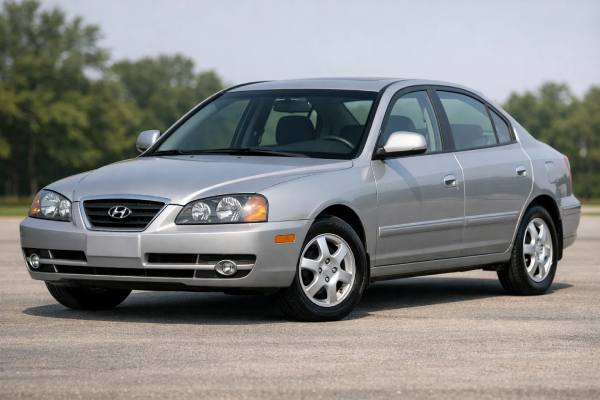
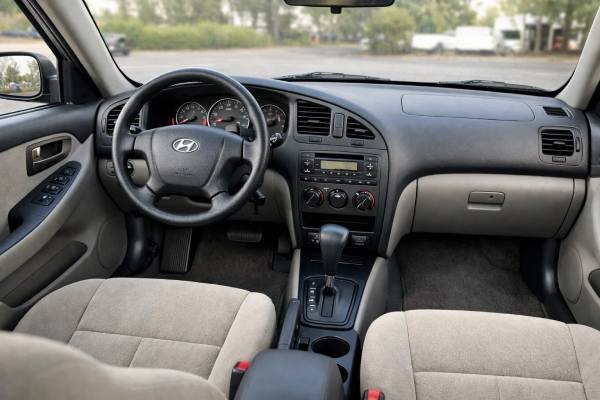
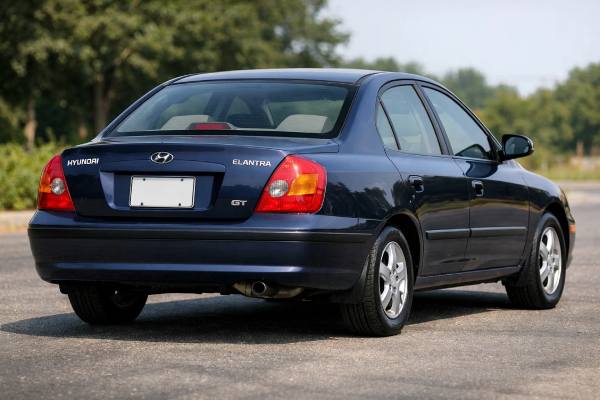
The XD-generation Hyundai Elantra is one of those early-2000s cars that looks simple on paper but makes more sense the closer you study it. In 2.0 CRDi form, it gave buyers a roomy compact body, genuinely useful diesel torque, and a chassis that was more sophisticated than many budget rivals at the time. It was not a premium car, and it never tried to be. Instead, it offered value, decent ride comfort, and low running costs when maintained properly. The biggest ownership story today is age rather than fashion. Rust, timing-belt history, fuel-system health, and suspension condition matter far more than trim badge or paint color. One important detail also needs to be clear from the start: the XD generation spans the early 2000s, but the 2.0 CRDi diesel itself is mainly a 2001-onward European-market proposition, so some “2000–2003” listings describe the generation range more than universal diesel availability.
Essential Insights
- The 2.0 CRDi is the most appealing long-distance Elantra XD for torque, fuel economy, and motorway ease.
- Cabin space is generous for the class, and the XD chassis uses independent rear suspension rather than a cheaper torsion-beam layout.
- Running costs stay reasonable when the timing belt, diesel filter, and cooling system are maintained on time.
- Front suspension-arm corrosion and age-related rust are the main ownership cautions on cars from wet or salted climates.
- A practical timing-belt interval is about 90,000 km or 5–6 years, with many owners treating 60,000–80,000 km as the safer zone on older cars.
What’s inside
- Hyundai Elantra XD Diesel Basics
- Hyundai Elantra XD Technical Data
- Hyundai Elantra XD Trims and Safety
- Fault Patterns and Service Actions
- Maintenance Plan and Buyer Checks
- Road Feel and Real Economy
- Elantra XD Against Diesel Rivals
Hyundai Elantra XD Diesel Basics
The XD-generation Elantra arrived at a time when Hyundai was moving from bargain-basement transport toward genuinely competitive family cars. That shift shows in the engineering. The body was larger and roomier than many buyers expected, the wheelbase grew over the earlier model, and Hyundai gave the XD a more serious chassis layout with independent rear suspension. That last point matters. Many affordable compact cars of the period relied on simpler rear layouts, but the Elantra aimed for better ride control and more composed handling. In day-to-day use, that gave it a more mature feel than some of the cheaper competition.
The 2.0 CRDi diesel is the version that best suits drivers who cover distance. It uses an early common-rail turbo-diesel setup and delivers its strength in the way buyers of that era wanted: low-rev torque rather than top-end excitement. With 111 hp and 235 Nm, it is not fast by modern diesel standards, but it is far more relaxed than the smaller petrol Elantras when climbing, overtaking in fifth gear, or carrying passengers and luggage on longer trips. That is the core reason the diesel still has appeal today. It turns the Elantra from a merely sensible compact into a genuine cheap-mileage cruiser.
There is also a naming wrinkle worth knowing. Depending on market and brochure, you will see this engine described as 2.0 CRDi or 2.0 CRTD. In practice, both labels refer to the same early 2.0-litre common-rail turbo-diesel family used across Hyundai and Kia products of the period. Buyers searching used listings should not dismiss one badge or description purely because the letter sequence differs.
The Elantra XD’s strongest ownership traits are still easy to understand. It is roomy, mechanically straightforward by modern standards, and comfortable enough for everyday use. It also avoids some of the electronic complexity that makes newer diesels expensive when they age badly. There is no particulate-filter drama here in the way later Euro 4 and Euro 5 diesels can bring. At the same time, the car is old enough that condition matters more than original design quality. A good Elantra XD 2.0 CRDi can still be a dependable low-cost commuter or second family car. A neglected one can become an endless list of diesel-fuel, rust, suspension, and cooling-system jobs.
That is why this model rewards a careful buyer. You are not shopping for badge prestige or cutting-edge safety. You are shopping for honest engineering, usable torque, and a platform that can still make financial sense if you choose the right example.
Hyundai Elantra XD Technical Data
The XD diesel was sold in slightly different forms depending on market, body style, and trim. Open factory-era sources are much stronger on shared platform dimensions and general chassis layout than on every trim-specific diesel figure, so some rows below are marked as market-dependent where public documentation varies.
Powertrain and efficiency
| Item | Hyundai Elantra XD 2.0 CRDi / CRTD |
|---|---|
| Code | Commonly identified as D4EA-series 2.0 CRDi; some public market literature omits the full code |
| Engine layout and cylinders | Inline-4, SOHC, 4 valves per cylinder |
| Bore × stroke | 83.0 × 92.0 mm (3.27 × 3.62 in) |
| Displacement | 2.0 L (1,991 cc) |
| Induction | Turbocharged, intercooler |
| Fuel system | Bosch common-rail direct injection |
| Compression ratio | 17.7:1 |
| Max power | 111 hp / 82 kW @ 4,000 rpm |
| Max torque | 235 Nm (173 lb-ft) @ 1,800 rpm |
| Timing drive | Belt |
| Rated efficiency | about 6.4 L/100 km (36.8 mpg US / 44.1 mpg UK) combined NEDC |
| Real-world highway @ 120 km/h | typically about 5.5–6.5 L/100 km (42.8–36.2 mpg US / 51.4–43.5 mpg UK) |
Transmission and driveline
| Item | Value |
|---|---|
| Transmission | 5-speed manual |
| Drive type | FWD |
| Differential | Open |
| Final character | Long-legged diesel gearing, tuned for economy rather than sharp acceleration |
Chassis and dimensions
| Item | Value |
|---|---|
| Suspension front | MacPherson strut with anti-roll bar |
| Suspension rear | Fully independent multi-link with anti-roll bar |
| Steering | Rack-and-pinion power steering; numeric ratio not consistently published in open factory-era sources |
| Brakes | Front ventilated discs; rear discs or drums depending on market, trim, and ABS fitment |
| Wheels and tyres | Most common diesel fitments are 195/60 R15 |
| Ground clearance | Not consistently published in factory-era open sources; many market listings place it near 155–160 mm |
| Length | Sedan about 4,495–4,525 mm; hatch about 4,500–4,520 mm |
| Width | 1,720–1,725 mm (67.7–67.9 in), market-dependent measuring convention |
| Height | about 1,425 mm (56.1 in) |
| Wheelbase | 2,610 mm (102.8 in) |
| Turning circle | about 10.1–10.2 m kerb-to-kerb (33.1–33.5 ft) |
| Kerb weight | roughly 1,288–1,306 kg (2,840–2,879 lb) |
| GVWR | Not consistently published in open factory-era diesel brochures |
| Fuel tank | 55 L (14.5 US gal / 12.1 UK gal) |
| Cargo volume | Sedan about 367 L (13.0 ft³); hatchback values vary by market and seat position |
Performance and capability
| Item | Value |
|---|---|
| 0–100 km/h (0–62 mph) | about 11.6 s |
| Top speed | about 190 km/h (118 mph) |
| Braking distance | Factory-era open public sources do not publish a consistent 100–0 km/h figure |
| Towing capacity | Varies strongly by market approval and towbar certification; verify locally |
| Payload | Usually market-specific and rarely published in open diesel brochures |
Fluids and service capacities
| Item | Value |
|---|---|
| Engine oil | Common D4EA service fill is about 5.9 L (6.23 US qt) with filter; use diesel-grade oil meeting the correct regional specification |
| Engine oil total dry capacity | about 6.5 L (6.87 US qt) |
| Coolant | Public open-source figures vary; verify by VIN and workshop data before refill |
| Manual transmission oil | About 2.15 L (2.27 US qt) on XD manual-transaxle factory literature; verify exact gearbox before filling |
| Transmission fluid spec | 75W-90 API GL-4 manual transmission oil |
| Brake and clutch fluid | DOT 3 or DOT 4 |
| Power steering fluid | PSF-3 or equivalent power-steering fluid to exact spec |
| A/C refrigerant | Factory open-source charge data not consistently published for all XD diesel markets |
| Key torque specs | Wheel nuts 88–108 Nm (65–80 lb-ft); engine-oil drain plug about 39–44 Nm (29–33 lb-ft) |
Safety and driver assistance
| Item | Value |
|---|---|
| Euro NCAP | 3 stars under the older 2001 protocol |
| Euro NCAP breakdown | Pre-percentage era; adult and pedestrian results were presented on the earlier star/point system rather than current percentage scoring |
| IIHS | Poor in original moderate-overlap front, Poor in original side, Poor for head restraints and seats |
| Headlight rating | Not applicable for this era |
| ADAS suite | None in the modern sense; no AEB, ACC, lane support, blind-spot monitoring, or traffic-sign functions |
The main technical story is clear. The XD diesel is appealing because it combines a relatively advanced common-rail engine with a chassis that was not embarrassingly basic. It is not a powerhouse, but it offers a useful blend of torque, reasonable economy, and decent road manners for an early-2000s compact.
Hyundai Elantra XD Trims and Safety
Trim structure depends heavily on country, so buyers should think in terms of equipment groups rather than a single universal grade ladder. In some markets the range centered on value-oriented sedan trims, while in others the better-known diesel versions were hatchback or higher-spec models such as GSi or CDX-type grades. That matters because the diesel was often paired with more attractive equipment than the smaller petrol cars. You may see climate control, alloy wheels, sunroof, upgraded interior trim, and ABS more often on diesel cars than on base petrol versions.
A practical way to identify a better XD diesel is to check for three things. First, look at the rear brakes and ABS fitment, because higher-spec examples were more likely to get four-wheel discs with ABS instead of rear drums. Second, inspect the wheel and tyre package. Fifteen-inch alloys with 195/60 tyres are common on nicer diesel examples. Third, check the cabin for climate control, upgraded audio, and the condition of the seat materials. On cars this old, spec matters less than condition, but a clean upper-trim diesel usually feels worth the extra effort.
Mechanical differences across trim levels are not huge, yet they still matter. The core diesel engine and manual transmission remain the same, but wheel-and-tyre choice changes ride quality, braking hardware can vary, and ABS availability is not universal. That makes VIN-level inspection more important than trusting a seller’s description. On old imports especially, a “full-spec” claim often turns out to mean only that the car has alloy wheels and power windows.
Safety deserves a realistic reading. By the standards of 2001, the Elantra’s equipment list was quite respectable. Hyundai public material highlighted standard front side airbags on some markets, seat-belt pretensioners with load limiters, child-seat anchorage provisions, and optional four-channel ABS. Structurally, the platform was not weak everywhere. Both Euro NCAP and IIHS noted that the safety cage itself had strengths. The problem was how the restraint systems and crash performance worked in real tests. Euro NCAP gave the Elantra 3 stars in 2001 and criticized inadequate driver protection, floorpan deformation, seat movement, and the fact that a door opened in the side impact. IIHS was harsher, rating the 2001–03 sedan Poor in moderate overlap front, and also Poor in side and head-restraint testing under its original protocols.
That sounds grim today, and it should temper expectations. The XD is not a modern safe family car. It is an old compact with a mix of decent passive-safety intentions and clearly dated crash outcomes. There is also no meaningful modern driver assistance here. No autonomous emergency braking, no lane-keeping systems, no blind-spot support, and no radar-based cruise control. The most you are likely to see is ABS, traction-related support in some markets, and basic anti-theft equipment.
So the safety verdict is balanced but firm. For its era, the Elantra offered reasonable equipment value. By modern standards, the crash-test results and absence of driver aids make it something buyers should choose only with realistic expectations.
Fault Patterns and Service Actions
Most Elantra XD reliability questions today come down to age, diesel-system upkeep, and rust. The basic platform can hold up well, but there are several known areas that deserve close attention before purchase.
Common, medium-cost issues
- Timing-belt neglect: If there is no proof of belt, tensioner, and ideally water-pump replacement, assume the job is due.
- Diesel fuel-delivery wear: Hard starting, rough idle, smoke, hesitation, or poor hot restarts usually point toward injector wear, injector-seal leakage, air entering the fuel system, or a tired high-pressure supply path.
- EGR and intake contamination: Early common-rail diesels often collect soot and oil residue in the EGR path and intake, leading to flat response and smoke.
- Glow-plug and relay faults: Cold-start trouble is common on older diesels, especially in colder climates.
Occasional, medium to high-cost issues
- Turbo control faults or boost leaks: Split hoses, sticky control hardware, or oil contamination can cause limp performance or over/under-boost symptoms.
- Clutch and flywheel wear: Not every car has an expensive flywheel issue, but a shuddering take-up, chatter at idle, or vibration under load should not be ignored.
- Cooling-system age: Radiators, hoses, thermostat behavior, and expansion-tank condition matter on any old diesel because overheating damage becomes expensive quickly.
Common age-related chassis issues
- front lower control arm bushes and ball joints
- worn anti-roll-bar links
- wheel bearings
- brake corrosion from lack of use
- power-steering seepage and tired rack boots
- rust around suspension pick-up points, sills, arches, and underbody seams
The biggest documented service-action story is corrosion. European Safety Gate records show a recall covering Hyundai Coupe and Elantra XD vehicles built between 2001 and 2003 because inadequate anti-corrosion coating could allow the front axle A-arms to rust through, with possible loss of control. In the United States, Hyundai also issued a salt-belt corrosion recall affecting 2001–2003 Elantras because front lower control arms could corrode and fracture in regions using road salt. Even though not every diesel market car is covered by the same campaign wording, the lesson is universal: front suspension-arm corrosion is not theoretical on this generation.
Software and calibration concerns are minor compared with newer cars. There are no complicated ADAS modules to recalibrate and no modern emissions aftertreatment to adapt. That is good news. On the other hand, owners lose the easy modern fix of solving everything with a software patch. On an XD diesel, most problems come back to physical inspection: leaks, boost hoses, tired sensors, worn injectors, rust, and overdue service items.
Before buying, ask for:
- complete service history
- timing-belt proof
- evidence of fuel-filter changes
- records for suspension work
- confirmation of recall completion where applicable
- a cold start and a full test drive, not just a warm restart around the block
A good XD diesel usually feels mechanically honest. A bad one shows its problems quickly.
Maintenance Plan and Buyer Checks
The Elantra XD 2.0 CRDi should be maintained more like an old-school working diesel than like a modern extended-interval commuter. The safest approach is a conservative schedule with short fluid intervals and a strong focus on the timing-belt system, diesel filtration, and rust prevention.
| Item | Practical interval |
|---|---|
| Engine oil and filter | every 10,000–15,000 km or 12 months |
| Air filter | every 15,000–20,000 km, sooner in dust |
| Cabin filter | every 15,000–20,000 km or 12 months |
| Fuel filter | about every 30,000 km |
| Timing belt, tensioners, idlers | by about 90,000 km or 5–6 years |
| Water pump | ideally with timing-belt service |
| Coolant | every 2–4 years depending on coolant type and history |
| Manual gearbox oil | inspect for leaks regularly; change around 60,000–90,000 km |
| Brake fluid | every 2 years |
| Brake inspection | every service |
| Auxiliary belts and hoses | inspect every service, replace at first cracking or noise |
| Glow plugs | inspect when cold starting worsens; proactive check by about 100,000–120,000 km |
| Battery | test yearly from year 4 onward |
For fluids, the safest buying advice is to stick to exact specifications rather than generic labels. Use a proper diesel engine oil suited to the climate and regional spec, not just whatever 10W-40 happens to be cheap. Use GL-4 manual-transmission oil, not GL-5 unless a verified source explicitly allows it. Use DOT 3 or DOT 4 brake fluid as specified. On coolant, avoid mixing random chemistries. If the car’s coolant history is unknown, a full flush with the correct type is usually better than topping up with guesswork.
Here are the most useful workshop-style numbers for quick decisions:
- engine oil service fill about 5.9 L
- manual transaxle oil about 2.15 L
- wheel nuts 88–108 Nm
- oil drain plug about 39–44 Nm
As a buyer, inspect the car in this order:
- Start it cold. A healthy diesel should start without dramatic cranking, thick smoke, or rough knocking that continues after the initial fire-up.
- Check timing-belt records. If there is no invoice, budget for immediate replacement.
- Inspect for rust underneath. Pay close attention to front lower arms, subframe points, inner sills, rear arches, brake lines, and floor seams.
- Drive it under load. The engine should pull cleanly from low revs without limp mode, whistle surges, or heavy smoke.
- Check clutch and gearbox feel. The shift should be straightforward, and take-up should be clean.
- Look for cooling-system neglect. Staining, pressure issues, or mixed coolant colors are all warning signs.
The best examples are usually modestly specified but well-maintained diesel cars owned by practical long-distance users. The cars to avoid are low-price imports with shiny paint, vague service history, and no proof of timing-belt or corrosion work. Long-term durability is decent when maintained, but poor maintenance turns this Elantra into a false economy.
Road Feel and Real Economy
On the move, the Elantra XD 2.0 CRDi feels more mature than many people expect from an early-2000s Hyundai. It is not sporty, but it is composed. The steering is light, the ride is generally compliant, and the independent rear suspension helps the car feel calmer over broken surfaces than some cheaper contemporaries. Straight-line stability is decent, especially on 15-inch tyres with sensible sidewall height. In town, the Elantra feels easy rather than agile. On faster roads, the diesel torque is what gives the car its charm.
This engine is not about revving. It is about getting the car moving with less effort than the smaller petrol versions. Peak torque arrives low, so normal overtaking is easier than the power figure suggests. Once on boost, the car feels stronger through the middle of the rev range than the numbers alone imply. Below that torque band, response is merely adequate, and above it the engine gets noisier without adding much reward. That is completely normal for a diesel of this era.
Noise, vibration, and harshness are acceptable for the period. You hear the engine clearly at idle and under acceleration, and there is more diesel clatter than in later common-rail units. At a steady cruise, though, the Elantra settles down well enough, especially compared with smaller, lighter hatchbacks of the same era. Wind noise is reasonable, road noise depends heavily on tyres, and worn engine mounts can make any neglected example feel much rougher than it should.
Real-world fuel economy is one of the Elantra diesel’s strongest cards:
- city: around 7.0–8.2 L/100 km
- highway at 100–120 km/h: around 5.3–6.5 L/100 km
- mixed use: around 6.1–7.0 L/100 km
That translates to roughly 33–39 mpg US or 40–47 mpg UK in mixed everyday driving. The official-era combined figure around 6.4 L/100 km is believable if the car is healthy, tyres are correct, and the driver does a fair amount of open-road work. Short winter trips, sticky brakes, tired thermostats, and underinflated tyres can all worsen fuel use noticeably.
Performance numbers do not tell the whole story, but they still matter. Around 11.6 seconds to 100 km/h and a top speed near 190 km/h place the car in the respectable rather than fast category. What matters more is that the diesel does not feel strained in the way a smaller naturally aspirated petrol often does. It has the kind of effortless second-gear and third-gear shove that makes old diesels satisfying for ordinary use.
So the driving verdict is simple. The XD diesel is not exciting, yet it is more comfortable, more relaxed, and more efficient than many buyers would expect. That is exactly why it still makes sense for budget-minded drivers who care more about usable performance than headline speed.
Elantra XD Against Diesel Rivals
The Elantra XD 2.0 CRDi sits in an interesting place among early-2000s diesel compacts. It was never the class prestige choice, and it was not the dynamic benchmark either. But it often undercut rivals on price while offering more space and equipment than buyers expected.
Against a Volkswagen Bora or Golf 1.9 TDI, the Hyundai usually loses on badge image, resale confidence, and the sheer reputation of the VW diesel drivetrain. It wins on value, simpler purchase pricing, and often a less overhyped used market. Against a Ford Focus TDCi, the Hyundai loses on steering feel and driver appeal but competes well on comfort and equipment. Against an Opel Astra 2.0 DTI or Peugeot 307 HDi, the Elantra’s biggest strength is usually straightforward ownership value rather than a clear win in any one dynamic metric.
Here is where the Hyundai makes the strongest case:
- Cabin and packaging: roomy for the class, especially for rear passengers
- Diesel character: enough torque to make it feel effortless in normal use
- Equipment value: side airbags, decent trim, and comfort features were often generous for the money
- Chassis design: more sophisticated than some buyers assume
Here is where rivals can beat it:
- Crash reputation: safety results from Euro NCAP and IIHS are not flattering
- Prestige and resale: many buyers still trust German or French diesel badges more
- Parts familiarity: some markets have deeper aftermarket and specialist knowledge for mainstream European rivals
- Refinement: later or better-developed competitor diesels can feel smoother
The strongest modern reason to choose the Elantra XD diesel is financial logic. If you find a rust-free, well-serviced example with proof of timing-belt work and clean suspension condition, it can still deliver cheap, usable, honest motoring. The weakest reason to buy one is romance. There is no badge magic here, and there is no special collector story. It is simply a practical early common-rail family car that makes sense when bought on condition and maintained with discipline.
That is the final verdict. The Elantra XD 2.0 CRDi is not the obvious class hero, but it is one of the more underrated budget diesels of its period. Bought carefully, it can still be a smart and useful car.
References
- HYUNDAI ELANTRA GLS SEDAN PROVIDES VALUE AND REFINEMENT FOR 2002 2002 (Manufacturer Publication)
- 2001 Hyundai Elantra 2026 (Safety Rating)
- Adult occupant protection Child restraints Pedestrian … 2001 (Safety Rating)
- Safety Gate Alerts 2012 (Recall Database)
- Dear 2001-2003 Elantra or 2003 Tiburon Owner 2009 (Recall Notice)
Disclaimer
This article is for informational purposes only and is not a substitute for professional diagnosis, repair, or vehicle-specific inspection. Specifications, torque values, intervals, fluids, parts fitment, and procedures can vary by VIN, market, body style, and equipment, so always verify against the correct official service documentation for the exact car.
If this guide was useful, please consider sharing it on Facebook, X, or another platform to support our work.