

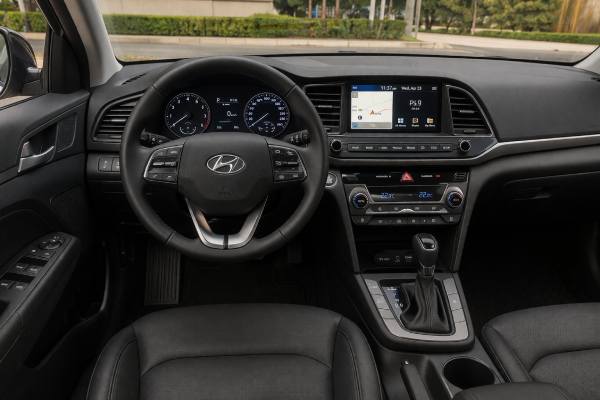

The facelifted 2019–2020 Hyundai Elantra AD 2.0 MPI Atkinson is the practical heart of the late AD range. It does not chase the Eco model’s best fuel numbers or the Sport model’s performance image. Instead, it gives buyers the version that makes the most sense for daily use: a 147 hp naturally aspirated 2.0-litre engine, a roomy compact-sedan body, and a calmer, more mature driving experience than many people expect from an affordable four-door.
That balance is what makes it attractive as a used buy. The Atkinson-cycle 2.0 is simpler than the turbocharged Elantras, the cabin is quiet for the class, and the trunk and rear-seat room remain strong selling points. The main caution is that simplicity does not mean zero risk. The late AD 2.0 still has model-specific recall history to verify, and the IVT transmission rewards sensible service habits even if factory schedules sound relaxed. Chosen carefully, though, this is one of the most rational Elantras Hyundai built in the late 2010s.
Key Takeaways
- The 2.0 MPI Atkinson version is the straightforward, comfort-focused facelift Elantra, with simpler hardware than the turbo models.
- Rear-seat room, trunk space, and highway refinement are genuine strengths for a compact sedan.
- Fuel economy is strong for a 147 hp non-hybrid four-door, especially in mixed commuting.
- Check engine-recall completion and oil-change history before buying, because this 2.0-litre Nu-family engine has specific campaign history.
- For severe use, keep oil changes to about 5,000 km or 6 months rather than stretching them.
Contents and shortcuts
- Hyundai Elantra AD facelift identity
- Hyundai Elantra AD spec tables
- Hyundai Elantra AD trim and safety
- Fault patterns and recall watch
- Service plan and smart buying
- Road behavior and efficiency
- AD facelift versus rivals
Hyundai Elantra AD facelift identity
The facelifted AD Elantra is easy to underestimate because it looks like a routine mid-cycle update. In reality, Hyundai used the 2019 refresh to sharpen the styling, widen the safety story, and make the mainstream 2.0-litre version feel more defined. This is the Elantra for buyers who want a conventional compact sedan done well. It is not built to be sporty, and it does not try to disguise that. It is built to be light on fuel, comfortable enough for real commuting, and roomy enough to function as a family car without stepping into the midsize class.
The 2.0 MPI Atkinson engine is the key to that character. Hyundai tuned it for efficiency first, using an Atkinson-cycle approach to improve fuel economy rather than chase torque-rich punch. On paper, 147 hp and 132 lb-ft do not look especially exciting. In practice, the powertrain works well because the car is not very heavy and the facelift models pair this engine with Hyundai’s Intelligent Variable Transmission in most mainstream trims. That combination gives the Elantra a smoother, lower-revving highway feel than older compact sedans with basic automatic gearboxes.
One of the biggest strengths of this version is that it avoids the extra complexity of the turbocharged Eco and Sport models. There is no turbocharger, no direct injection on the mainstream U.S.-spec 2.0 Atkinson setup, and no dry-clutch dual-clutch transmission. That does not make it maintenance-free, but it does make it easier to understand and usually cheaper to run long term. For many used buyers, that matters more than a faster 0–100 km/h time.
The body also helps the Elantra’s case. Even after the facelift’s sharper nose and more angular rear design, it remains a conventional sedan with a practical 14.4 ft³ trunk, usable rear seat, and low loading lip. Hyundai did a good job with packaging in this generation. The cabin does not feel oversized, but it gives rear passengers enough room that the car works for regular family duty instead of feeling like a compromise.
Another part of the facelift story is refinement. This generation already leaned toward comfort, and the late AD keeps that bias. Road noise is reasonably well controlled, the suspension is tuned to absorb rough pavement without constant fuss, and the steering is light but predictable. That makes the 2.0 Atkinson version a better daily companion than many “sporty” compact sedans that spend their lives in traffic rather than on empty roads.
The main warning is that sensible cars still need careful shopping. The 2019–2020 2.0-litre Elantra belongs to a group of Hyundai vehicles that later saw an official engine-related recall involving piston oil rings. That does not cancel out the model’s strengths, but it changes the buying process. Service history, recall completion, and a quiet engine matter more than trim badges. Buy one on condition rather than on appearance, and the late AD Elantra becomes a very smart used compact.
Hyundai Elantra AD spec tables
For the facelift 2019–2020 Hyundai Elantra AD with the 2.0 MPI Atkinson engine, the official U.S.-market specification sheets provide a clear baseline. This version uses Hyundai’s Nu 2.0-litre four-cylinder with dual CVVT, tuned in Atkinson-cycle form for efficiency. It sits below the Eco and Sport models in performance, but it is the mainstream late-AD powertrain and, for many buyers, the most important one.
Powertrain and efficiency
| Item | Hyundai Elantra (AD facelift) 2.0 MPI Atkinson |
|---|---|
| Code | Nu 2.0 MPI Atkinson |
| Engine layout and cylinders | Inline-4, 4 cylinders, DOHC, 4 valves per cylinder |
| Bore × stroke | 81.0 × 97.0 mm (3.19 × 3.82 in) |
| Displacement | 2.0 L (1,999 cc) |
| Induction | Naturally aspirated |
| Fuel system | MPI / multi-point injection |
| Compression ratio | 12.5:1 |
| Max power | 147 hp (110 kW) @ 6,200 rpm |
| Max torque | 179 Nm (132 lb-ft) @ 4,500 rpm |
| Timing drive | Chain |
| Rated efficiency | 7.6 / 5.7 / 6.7 L/100 km city / highway / combined for SE; 7.8 / 5.9 / 6.9 L/100 km for SEL, Value, and Limited |
| Rated efficiency in mpg | 31 / 41 / 35 mpg US for SE; 30 / 40 / 34 mpg US for SEL, Value, and Limited |
| Real-world highway @ 120 km/h | Usually about 6.3–7.2 L/100 km, depending on tyres, terrain, and load |
Transmission and driveline
| Item | Hyundai Elantra (AD facelift) 2.0 MPI Atkinson |
|---|---|
| Transmission | Smartstream Intelligent Variable Transmission (IVT) |
| Drive type | FWD |
| Differential | Open |
Chassis and dimensions
| Item | Hyundai Elantra (AD facelift) 2.0 MPI Atkinson |
|---|---|
| Suspension (front/rear) | MacPherson strut with coil springs / coupled torsion beam axle |
| Steering | Motor Driven Power Steering (MDPS), rack and pinion |
| Steering ratio | 12.7:1 |
| Turns lock-to-lock | 2.44 |
| Brakes | Front ventilated discs 280 mm (11.0 in); rear drums 203 mm (8.0 in) on SE, rear solid discs 262 mm (10.3 in) on better-equipped trims |
| Wheels and tyres | 195/65 R15, 205/55 R16, or 225/45 R17 depending on trim |
| Ground clearance | 135 mm (5.3 in) on most 2.0 trims |
| Length | 4,620 mm (181.9 in) |
| Width | 1,800 mm (70.9 in) |
| Height | 1,435 mm (56.5 in) |
| Wheelbase | 2,700 mm (106.3 in) |
| Turning circle (curb-to-curb) | 10.6 m (34.78 ft) |
| Kerb weight | About 1,290 kg (2,844 lb) on common IVT 2.0 trims |
| GVWR | About 1,780 kg (3,924 lb) |
| Fuel tank | 53 L (14.0 US gal / 11.7 UK gal) |
| Cargo volume | 407 L (14.4 ft³) SAE |
Performance and capability
| Item | Hyundai Elantra (AD facelift) 2.0 MPI Atkinson |
|---|---|
| 0–100 km/h | About 9.5–10.2 s |
| 0–62 mph | About 9.5–10.2 s |
| Top speed | About 200 km/h (124 mph), market and limiter dependent |
| Braking distance | Tyre- and trim-dependent; no single official public stop figure confirmed for this exact 2.0 IVT variant |
| Towing capacity | Verify by VIN plate and market handbook before towing |
| Payload | Check door-jamb label; varies slightly by trim |
Fluids and service capacities
| Item | Hyundai Elantra (AD facelift) 2.0 MPI Atkinson |
|---|---|
| Engine oil | 4.0 L (4.23 US qt.) drain and refill; SAE 5W-20 recommended in the official 2.0 MPI manual data |
| Coolant | About 6.0 L (6.3 US qt.), phosphate-based ethylene glycol coolant, 50:50 mix |
| Transmission / ATF | IVT fluid about 6.5 L (6.86 US qt.) total capacity; specific IVTF SP-CVTI type in the official manual data |
| Differential / transfer case | Not applicable |
| A/C refrigerant | R-134a; about 500 ± 25 g (17.6 ± 0.88 oz) in the official 2020 manual data |
| A/C compressor oil | PAG (FD46XG); about 110 ± 10 cc (3.88 ± 0.35 oz) |
| Key torque specs | Wheel lug nuts 88–107 Nm (65–79 lb-ft) |
Safety and driver assistance
| Item | Hyundai Elantra (AD facelift) 2.0 MPI Atkinson |
|---|---|
| Crash ratings | 2019 IIHS Top Safety Pick+ applies only to vehicles with optional front crash prevention and specific headlights built after September 2018 |
| IIHS crashworthiness | Good in driver-side small overlap, passenger-side small overlap, moderate overlap, side, roof strength, and head restraints |
| Headlight rating (IIHS) | Good or Poor depending on trim and headlight specification |
| ADAS suite | Forward Collision-Avoidance Assist and Lane Keeping Assist were widely available; blind-spot warning, rear cross-traffic alert, smart cruise, and stronger lighting depended on trim |
The numbers show why this Elantra makes sense. It is not quick enough to be sold on performance, but it offers compact dimensions, good fuel economy, practical interior packaging, and a mainstream powertrain that stays simpler than the turbo alternatives.
Hyundai Elantra AD trim and safety
Trim structure is especially important on the 2019–2020 Elantra because the facelift spread meaningful comfort and safety differences across the range. In the U.S. specification used as the clearest official baseline for the 2.0 MPI Atkinson engine, the main trims were SE, SEL, Value Edition, and Limited. The Eco and Sport used different powertrains, so they are relevant only as reference points, not as direct equivalents to the 2.0 Atkinson car.
The SE was the entry point, but Hyundai did not leave it stripped. Even the base facelift Elantra included Forward Collision-Avoidance Assist, Driver Attention Warning, Lane Keeping Assist, rearview camera, stability control, ABS, and a useful touchscreen audio setup. That is a respectable base package for a compact sedan, and it is one reason the late AD still feels modern enough in regular use. The SE also kept 15-inch steel wheels and rear drum brakes, which helps explain why it rides softly and can be cheaper to maintain.
The SEL is where the range becomes more attractive for many used buyers. It moved to 16-inch alloys, added blind-spot detection, rear cross-traffic warning, automatic headlights, and more of the convenience features that make a compact sedan feel complete instead of bare. The Value Edition then added a stronger feature bundle with items such as sunroof and trim upgrades, while the Limited focused on leather, LED lighting, more upscale cabin materials, and the best factory look of the mainstream 2.0 models.
Quick identifiers are useful when sellers mislabel trims. Fifteen-inch steel wheels and a simpler cabin usually indicate SE. Sixteen-inch alloys and more driver-assistance buttons often point to SEL or Value Edition. Seventeen-inch wheels, chrome-heavy trim, leather seating, and LED lighting cues usually indicate Limited. Because equipment varied so much, buying by actual features is smarter than buying by badge alone.
Safety is one of the late AD’s better stories, but it comes with an important qualifier. IIHS gave the 2019 Elantra Top Safety Pick+ only for vehicles with optional front crash prevention and specific headlights built after September 2018. That means not every 2019–2020 Elantra earns the same safety headline. Crash structure is consistently strong across the facelift range, with Good ratings in the major crashworthiness categories, but headlight performance and certain active-safety features depend on trim.
That makes the Limited and better-equipped trims more attractive than a simple specification sheet might suggest. A higher trim is not only about leather or chrome. On this generation, it can also mean materially better safety hardware in real use. Even so, the base car’s fundamentals remain solid: multiple airbags, ESC, traction control, LATCH child-seat anchors, rear camera, and a stable body shell.
For used buyers, the sweet spot is usually not the cheapest SE or the most expensive Limited. It is often a clean SEL or Value Edition with good service history, the right safety features, and no evidence of hard use or poor tyres. Those cars capture most of the facelift’s strengths without asking you to pay for appearance extras you may not care about.
Fault patterns and recall watch
The 2019–2020 Elantra 2.0 MPI Atkinson is one of the more sensible late-AD variants, but it is not a car you should buy blindly. Its reliability picture is mostly good in day-to-day use, yet the official campaign history matters because this 2.0-litre Nu-family engine was included in a major Hyundai recall. That single fact changes the used-car buying process more than any individual complaint about cabin trim or suspension noise.
A practical reliability map looks like this:
Common and usually low to medium cost
- Rear-brake corrosion or uneven wear on lightly used cars.
- Front anti-roll-bar links and small suspension noises.
- 12 V battery weakness on urban or short-trip cars.
- Cabin rattles around the dash or parcel shelf.
- Tyre noise or alignment sensitivity when cheap replacement tyres are fitted.
Occasional and medium cost
- Ignition-coil or spark-plug related misfire complaints.
- Thermostat housing or hose-joint seepage in older examples.
- IVT behavior complaints such as lazy response or unusual feel when fluid age and driving style work against it.
- Steering coupler or steering-column noises, more annoying than dangerous.
Rare, but far more important
- Recall-related engine damage tied to improperly heat-treated piston oil rings in certain 2019–2020 2.0 MPI vehicles.
- Severe oil consumption or abnormal knocking if that recall condition is ignored.
- Fire risk in worst-case scenarios when damaged components and oil leakage combine.
That recall is the big one. Hyundai’s official Part 573 report states that certain 2019–2020 Elantra vehicles equipped with the 2.0-litre Nu MPI engine may have been assembled with piston oil rings produced with inconsistent nitride heat treatment. The risk is abnormal cylinder-bore scuffing, excessive oil consumption, abnormal knocking noise, reduced motive power, and in limited cases engine failure or fire risk. The official remedy included inspection, engine replacement if necessary, and deployment of the Piston Ring Noise Sensing System software. That is not an obscure footnote. It is a central buying check.
Outside that recall, the 2.0 Atkinson Elantra is not known for a flood of catastrophic failures. In fact, it is easier to own than the turbo Elantras in several ways. The engine uses multi-point injection rather than direct injection, so intake-valve carbon build-up is less of a concern than on some rivals. There is no turbocharger to age, and the IVT, while sometimes less satisfying than a conventional automatic, avoids some of the more severe reputation issues associated with dual-clutch gearboxes in city use.
Still, this is a modern compact sedan, not an old mechanical appliance. Software updates and dealer scans can matter when drivability feels off. A car with hesitant throttle response, a history of warning lights, or a strange knock should not be judged by a five-minute test drive alone. A proper scan and recall verification are worth far more than a polished exterior.
As a rule, the late AD 2.0 is dependable when maintained and verified. The trouble comes when a buyer assumes that naturally aspirated also means worry-free. On this exact engine family, that assumption can be expensive.
Service plan and smart buying
The facelift AD 2.0 Atkinson does not need exotic care, but it does benefit from deliberate care. Its mainstream image can tempt owners to follow the longest possible intervals and ignore gradual changes in engine or transmission behavior. That is not the best strategy. This version responds better to steady maintenance and early diagnosis than to “wait until it gets loud” ownership.
A sensible practical schedule looks like this:
| Item | Practical interval |
|---|---|
| Engine oil and filter | Every 10,000–12,000 km or 12 months; 5,000 km or 6 months in severe use |
| Engine air filter | Inspect every service; replace around 30,000–40,000 km sooner in dust |
| Cabin air filter | About every 20,000–24,000 km or yearly |
| Spark plugs | Around 60,000–90,000 km depending on condition and driving pattern |
| Coolant | Follow factory interval, but inspect level and condition regularly |
| Timing chain | No scheduled replacement; inspect only for noise, stretch symptoms, or timing-correlation faults |
| Accessory belt | Inspect at major services and replace on condition |
| IVT fluid | Official maintenance guidance in some markets treats IVT fluid as no routine service under normal conditions, but leaks, harsh behavior, or severe use justify closer attention |
| Brake fluid | Every 2 years |
| Brake pads and rotors / drums | Inspect every service |
| Tyre rotation | Every 10,000–12,000 km |
| Wheel alignment | On pull, uneven shoulder wear, or after pothole impact |
| 12 V battery test | Yearly after year four |
The main point is that “no routine service” language for some transmission fluids should not be interpreted as “ignore forever.” Used-car ownership is different from new-car brochure logic. Inspect fluid condition, check for leaks, monitor shift behavior, and do not assume the gearbox is immortal because the maintenance sheet looks light.
Fluid choices are straightforward. The official 2.0 MPI data recommends SAE 5W-20 engine oil in normal conditions, with about 4.0 litres required on a drain and refill. That is useful because it keeps service costs modest and makes DIY oil changes easy. Coolant chemistry also matters, so use the proper phosphate-based formula rather than generic top-offs. Brake fluid, IVT fluid, and refrigerant specifications should all be matched carefully rather than approximated.
As a used buy, this Elantra should be inspected in a strict order:
- Run a VIN-based recall check and confirm recall completion in writing.
- Listen for engine knock or abnormal noise from cold.
- Inspect oil condition and ask for oil-change proof, not just verbal assurances.
- Drive the car long enough to feel IVT response in traffic and at cruising speed.
- Check tyres for matched quality and even wear.
- Look for brake neglect, especially on lightly used cars.
- Scan the car for stored or pending powertrain codes.
The best examples are usually late-build cars with clean service records, decent tyres, no warning lights, and proof that campaign work has already been completed. The worst ones are polished but vague: fresh-detail cars with bargain tyres, no paperwork, and a seller who says the noise is “normal for all Hyundais.” Long term, the 2.0 Atkinson Elantra can be durable and inexpensive to run. It just needs buying discipline.
Road behavior and efficiency
The facelift AD Elantra 2.0 Atkinson is not a driver’s compact in the classic sense, but it is a very easy car to appreciate in daily use. Hyundai tuned this generation toward refinement rather than excitement, and the facelift 2.0 version leans into that character fully. The result is a compact sedan that feels calm, predictable, and competent instead of eager or playful.
The engine’s behavior tells the story. Off the line, the 2.0 Atkinson feels adequate rather than urgent. There is enough power for normal commuting, merging, and overtaking, but you do not get the instant shove of a small turbo engine. What you do get is smoothness and good fuel economy. Once up to speed, the powertrain settles into a relaxed rhythm that suits the Elantra’s quiet cabin and stable body well. That makes it a better long-distance car than some quicker but noisier rivals.
The IVT transmission is central to the experience. Some drivers dislike the artificial, rubber-band feel common to CVT-type gearboxes, and the Elantra’s IVT does not completely escape that impression under hard throttle. But in gentle everyday driving, it works well. It keeps revs low, helps the car cruise efficiently, and fits the engine’s economy-first tuning. If you drive smoothly, the transmission feels natural enough. If you drive it like a sport sedan, it reminds you quickly that this is not its intended role.
Ride quality is one of the AD’s most consistent strengths. The facelift did not turn the car stiff or busy. On 15- or 16-inch wheels, the Elantra absorbs rough pavement well and stays settled over motorway undulations. Seventeen-inch Limited cars can feel slightly firmer and noisier, but even those stay reasonable by compact-sedan standards. Straight-line stability is good, and wind noise is better controlled than many buyers expect in this class.
Handling is secure rather than entertaining. The steering is light and accurate enough, but feedback is limited. The front end turns in cleanly, body roll is controlled, and the rear torsion beam keeps the car predictable. There is no real sense of rear-end play or lift-off rotation. That is not a criticism here. This Elantra is built to make ordinary drivers feel comfortable, not to entertain enthusiasts.
Real-world fuel economy is a major reason to buy the 2.0 Atkinson version. In healthy cars, expect roughly:
- city: about 7.6–8.8 L/100 km
- highway at 100–120 km/h: about 5.7–6.8 L/100 km
- mixed use: about 6.5–7.5 L/100 km
That is strong for a naturally aspirated non-hybrid sedan with real passenger room. Cold weather, cheap tyres, underinflation, and neglected ignition parts will worsen those numbers, but the platform’s basic efficiency is genuine. For many owners, the dynamic conclusion is simple: it is not exciting, yet it is exactly the kind of car you stop thinking about and simply use. That is often the highest compliment an everyday sedan can earn.
AD facelift versus rivals
The 2019–2020 Elantra 2.0 Atkinson makes the most sense when compared with other mainstream compact sedans rather than sport models or hybrids. Against the Toyota Corolla 2.0, the Hyundai usually gives you better feature value for the money and a quieter, slightly softer highway character. The Toyota fights back with a stronger reputation for conservative long-term durability and a more cohesive resale story. If you want the safest reputation play, the Corolla still has the edge. If you want more equipment per dollar and a more relaxed feel, the Elantra becomes attractive.
Compared with the Honda Civic 2.0, the Elantra is less engaging to drive. The Civic feels sharper, more responsive, and more polished dynamically. Hyundai responds with a roomier-feeling rear seat, a simpler cabin layout, and a calmer ride. For drivers who care about steering feel and chassis poise, the Honda usually wins. For buyers who care more about comfort, quietness, and price, the Elantra holds up very well.
The Mazda3 is the enthusiast’s alternative. It looks and feels more premium in many trims, and it is the better driver’s car. But it can also ride more firmly, cost more on the used market, and offer less rear-seat ease. The Elantra is the more rational family compact, even if it is less memorable from behind the wheel.
The Nissan Sentra of the same general era is a more mixed comparison. Hyundai usually comes out ahead in perceived build quality, safety story, and general confidence, while Nissan’s older CVT reputation weighs on used buyers more than Hyundai’s IVT does. That gives the Elantra a meaningful advantage for owners who want a mainstream compact without feeling like they are gambling on the transmission.
Inside Hyundai’s own lineup, the 2.0 Atkinson is arguably the smartest facelift AD for most owners. The 1.4 turbo Eco can be thriftier, but it adds powertrain complexity. The Sport is quicker and more interesting, but costs more to buy and run. The 2.0 Atkinson version gives you the clean middle ground: strong economy, enough power, and fewer mechanical layers to worry about.
That is why this Elantra still deserves attention. It is not the segment star in any single category. It is the model that stays consistently good across the things that matter most in real ownership: space, comfort, efficiency, equipment, and usability. The caveat is recall history. Get that part right, and it becomes one of the more sensible used compact sedans of its era.
References
- Safety Comes First in the Redesigned 2019 Elantra 2018 (Manufacturer Release)
- 2020 Elantra Specifications 2019 (Specifications)
- AD(FL) CAN-E 8.qxp 2020 (Owner’s Manual)
- 2019 Hyundai Elantra 2019 (Safety Rating)
- Part 573 Safety Recall Report 21V-301 2021 (Recall Report)
Disclaimer
This article is for informational purposes only and is not a substitute for professional diagnosis, repair, or factory service information. Specifications, torque values, service intervals, procedures, outputs, and equipment vary by VIN, market, trim, and production date, so always verify details against official service documentation and the labels fitted to the vehicle before carrying out maintenance or repairs.
If this guide was useful, please consider sharing it on Facebook, X, or another platform to support our work.