

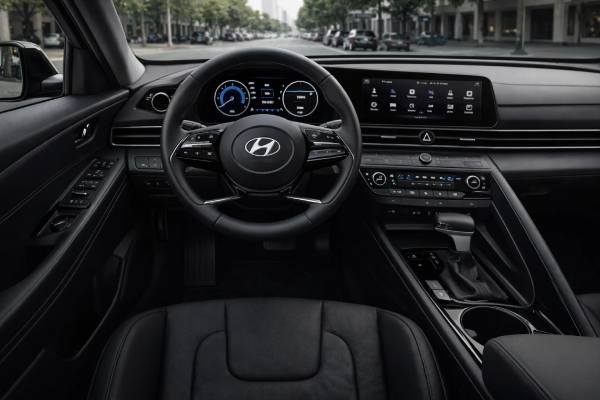

The facelifted Hyundai Elantra CN7 with the 2.0 MPI Atkinson engine is a compact sedan built around efficiency, comfort, and low-stress ownership rather than speed. That matters, because many buyers looking at this version are not cross-shopping hot sedans. They want a roomy four-door with honest running costs, a smooth daily character, and enough modern safety tech to feel current. In 2024 facelift form, Hyundai sharpened the styling, kept the 147 hp 2.0-litre engine for mainstream trims, and paired it with the Smartstream IVT. The result is a car that feels more refined than its price point suggests. Its best engineering traits are the simple naturally aspirated port-injected layout, good cabin and trunk space, and strong safety equipment. The main caution is that even a sensible compact needs close attention to recall history, transmission behaviour, and maintenance discipline if you want the ownership experience to stay as straightforward as the specification sheet suggests.
Core Points
- The 2.0 MPI Atkinson engine is simpler than Hyundai’s turbo or hybrid alternatives and avoids direct-injection intake-valve deposit concerns.
- Cabin room, trunk space, and overall comfort are standout strengths for a compact sedan.
- The facelift keeps the Elantra current with strong standard safety equipment and useful available driver aids.
- Early 2024 cars need a careful recall check because certain 2.0 models were affected by an EGR valve campaign.
- A sensible ownership pattern is annual servicing with oil and filter changes every 8,000–10,000 km or 12 months.
On this page
- Hyundai Elantra CN7 facelift profile
- Hyundai Elantra CN7 2.0 data
- Hyundai Elantra CN7 grades and safety
- Known issues and factory actions
- Service plan and purchase advice
- Road behavior and fuel use
- CN7 Elantra versus competitors
Hyundai Elantra CN7 facelift profile
The facelifted CN7 Elantra is best understood as Hyundai refining a formula that was already working. The original CN7 already offered bold styling, generous interior packaging, and strong value. For 2024, Hyundai updated the nose, lighting, wheels, and equipment structure, but the bigger story for this 2.0-litre model is continuity. Hyundai kept the mainstream 2.0 MPI Atkinson engine in SE, SEL, and Limited trims for the facelift launch, and current 2025 and 2026 Elantra trim materials continue to show the same basic 2.0-litre non-hybrid powertrain as the volume choice. That makes this version the long-running core of the facelift range, not a side variant.
That continuity is useful for owners because the 2.0 MPI Atkinson version is mechanically conservative by modern standards. It is naturally aspirated, uses multi-point injection rather than direct injection, and avoids the added complexity of a turbocharger or hybrid system. In practical terms, that means fewer heat-related components, fewer deposit concerns on the intake valves, and a powertrain that is tuned more for efficiency and smoothness than for drama. The downside is obvious as well: the Elantra 2.0 is responsive enough, but it is not quick in the way a turbocharged Civic or a Jetta GLI-type alternative can be. The Atkinson-cycle calibration favors fuel use and low operating stress over aggressive throttle response.
The chassis and packaging matter just as much. Hyundai’s official dimensions show a long 107.1-inch wheelbase, a wide body for the class, and a 14.2-cubic-foot trunk. Those are not glamorous numbers, but they explain why the Elantra works so well as a daily sedan. You get real rear-seat room, a usable cargo area, and a planted road stance without moving into a midsize footprint. The car is also light enough that the 147 hp engine does not feel overwhelmed in normal driving. On the most common 2.0 trims, curb weight sits in a range of roughly 2,725 to 2,868 pounds, which keeps the overall package efficient and easygoing.
Another strength is that Hyundai spread the safety basics widely. The official 2024 spec sheet shows the core passive-safety structure, six airbags, ESC, brake assist, TPMS, blind-spot collision warning, rear cross-traffic warning, lane keeping assist, lane following assist, driver attention warning, and high beam assist all present in the mainstream lineup, with higher trims adding more advanced front-crash and parking features. That gives the 2.0-litre Elantra a stronger everyday-safety case than many budget-minded compacts once did.
The ownership catch is that “simple” does not mean “ignore it.” Even a sensible naturally aspirated sedan still depends on good recall follow-up, clean fluid history, and proper transmission behavior. The facelift Elantra has a strong foundation, but the best one to own is still the one with the cleanest paperwork and the fewest excuses.
Hyundai Elantra CN7 2.0 data
For the facelifted CN7 2.0, Hyundai’s official 2024 specification sheet is the clearest primary source for the engine, dimensions, capacities, steering, brakes, and standard configuration. Current 2025 and 2026 materials show that the same 2.0/IVT layout continues as the core non-hybrid Elantra powertrain. Where Hyundai’s open-access documents do not publish a value clearly, it is marked for VIN verification rather than guessed.
Powertrain and efficiency
| Item | Hyundai Elantra CN7 2.0 MPI Atkinson |
|---|---|
| Code | Verify by VIN; official materials identify it as Smartstream 2.0L MPI Atkinson |
| Engine layout and cylinders | Inline-4, 4 cylinders |
| Valvetrain | DOHC, 16 valves, D-CVVT |
| Bore × stroke mm (in) | 81 × 97 mm (3.19 × 3.82 in) |
| Displacement | 2.0 L (1,999 cc) |
| Induction | Naturally aspirated |
| Fuel system | MPI / multi-point injection |
| Compression ratio | 12.5:1 |
| Max power | 147 hp (110 kW) @ 6,200 rpm |
| Max torque | 179 Nm (132 lb-ft) @ 4,500 rpm |
| Timing drive | Verify by VIN-specific service data |
| Rated efficiency | 31/40/34 mpg US for 2024 SEL and Limited IVT, about 7.6 / 5.9 / 6.9 L/100 km |
| Real-world highway @ 120 km/h (75 mph) | Roughly 6.2–7.2 L/100 km in good conditions |
Transmission and driveline
| Item | Data |
|---|---|
| Transmission | Smartstream Intelligent Variable Transmission (IVT) |
| Drive type | FWD |
| Differential | Open |
Chassis and dimensions
| Item | Data |
|---|---|
| Suspension front / rear | MacPherson strut front / torsion beam rear |
| Steering | Column-mounted motor driven power steering |
| Steering ratio | 12.9:1 |
| Brakes | Front ventilated discs 11.0 in; rear solid discs 10.3 in |
| Wheels and tyres (common 2.0 trims) | 15-inch or 17-inch setups depending on trim |
| Ground clearance | 5.3 in (134.6 mm) on SE/SEL/Limited |
| Length / Width / Height | 185.4 / 71.9 / 55.7 in (4,709 / 1,826 / 1,415 mm) |
| Wheelbase | 107.1 in (2,720 mm) |
| Turning circle (kerb-to-kerb) | Minimum turning radius 17.7 ft |
| Kerb weight | 2,725–2,868 lb (1,236–1,301 kg), trim-dependent |
| GVWR | 3,858 lb (1,750 kg) |
| Fuel tank | 12.4 US gal (46.9 L) |
| Cargo volume | 14.2 ft³ (402 L) trunk |
Performance and capability
| Item | Data |
|---|---|
| 0–100 km/h (0–62 mph) | Roughly 9.5–10.5 s depending on trim and conditions |
| Top speed | Typically around 195–200 km/h (121–124 mph), market-dependent |
| Braking distance | No Hyundai open-access factory figure located |
| Towing capacity | Not a towing-focused model; verify by market |
| Payload | Verify by door sticker or VIN plate |
Fluids and service capacities
| Item | Data |
|---|---|
| Engine oil specification | Use Hyundai-approved grade for market and climate |
| Engine oil viscosity | Typically 0W-20 or 5W-20/5W-30 depending on market documentation |
| Engine oil capacity | 4.3 L (with filter) |
| Coolant specification | Hyundai long-life coolant to exact spec |
| Coolant capacity | Verify by VIN-specific manual |
| Transmission / ATF | Verify by exact IVT service data |
| Differential / transfer case | Not separately serviced on this FWD layout |
| A/C refrigerant | Verify by under-bonnet label |
| A/C compressor oil | Verify by compressor type |
| Key torque specs | Use VIN-specific workshop documentation |
Safety and driver assistance
| Item | Data |
|---|---|
| Crash ratings | IIHS: strong small-overlap and side results; 2025-26 cars built after October 2024 are Top Safety Pick+ |
| Headlight rating | Varies by exact lamp setup and build timing |
| ADAS suite | Lane keeping, lane following, blind-spot warning, rear cross-traffic warning, driver attention warning, high beam assist standard; higher trims add enhanced FCA, Smart Cruise Control, parking features, and HDA |
The core engine, chassis, capacity, brake, steering, and safety-equipment figures above come from Hyundai’s official 2024 specification materials and current IIHS ratings pages for the facelift-era sedan.
Hyundai Elantra CN7 grades and safety
Trim structure is one of the more useful ownership details on the facelifted Elantra because Hyundai has adjusted naming and packaging while keeping the 2.0 powertrain in place. For 2024, the 147 hp 2.0 MPI Atkinson engine served SE, SEL, and Limited trims. By 2025, Hyundai had shifted to SE, SEL Sport, SEL Convenience, and Limited, and the 2026 pricing structure continues the 2.0-litre engine in SE, SEL Sport, SEL Sport Premium, and Limited trims. That means the same engine can appear in both value-focused and better-equipped versions, so buyers need to shop the equipment list, not just the engine badge.
That trim spread changes the ownership feel more than many people expect. Lower trims usually make the most sense for buyers who want the simplest, cheapest-to-run Elantra with smaller wheels and softer ride tuning. Higher trims add useful features like improved front-crash systems, Smart Cruise Control with Stop and Go, parking-distance warning, reverse parking-collision assist, Highway Drive Assist, and richer infotainment or upholstery. Hyundai’s 2024 specs page also shows that blind-spot warning, rear cross-traffic warning, lane keeping assist, lane following assist, driver attention warning, high beam assist, Safe Exit Warning, and Rear Occupant Alert are broadly available or standard across the lineup, which is a major strength for a mainstream compact sedan.
Safety is where the CN7 facelift story needs some care, because the current IIHS position is more nuanced than a simple “safe” label. The 2024 Elantra’s IIHS page shows strong small-overlap scores and good updated side-test results, but it also shows a Marginal overall rating in the updated moderate overlap front test for 2024-25 cars built before November 2024 because of rear-passenger restraint performance. IIHS says Hyundai changed the rear seatbelt hardware beginning with 2025 models built after October 2024, and those later 2025-26 cars now carry a Top Safety Pick+ award with a Good rating in the updated moderate-overlap test. That means build date matters, especially if safety is high on your priority list.
That does not undermine the Elantra’s broader safety case. The structure remains strong, the small-overlap performance is good, and Hyundai loaded the car with active-safety hardware. It just means a buyer who wants the strongest current IIHS configuration should favor 2025-26 production built after October 2024, while 2024 buyers should pay closer attention to the exact car’s build date, headlamp specification, and feature content.
For used shoppers, the practical takeaway is straightforward. A clean mid-trim or upper-trim 2.0 Elantra with documented service history and the right safety equipment can feel far more complete than its price suggests. The main mistake is assuming every 2.0 trim is mechanically and electronically identical. It is not. Small trim differences can change the ownership experience more than the engine itself does.
Known issues and factory actions
Because the facelifted 2024-present Elantra 2.0 is still relatively new, the reliability picture is not yet defined by a long list of age-related failures. That is actually good news. There is no strong official evidence of a widespread engine design crisis for this specific 2.0 MPI Atkinson CN7 facelift. The most important documented issue so far is a narrow but meaningful early-2024 recall involving the EGR valve assembly on certain 2024 CN7 Elantras equipped with the Nu 2.0L MPI engine. Hyundai’s recall documentation says solder-flux contamination inside the EGR valve sensor could cause an electrical short, illuminate the MIL, and in some cases lead to a sudden loss of motive power. Affected cars were produced in a limited early-2024 window, and the remedy was EGR valve assembly replacement.
That recall matters for buyers because it is a perfect example of why even a simple naturally aspirated sedan still needs a VIN-level campaign check. A car can feel fine on a short drive and still have open recall work pending. On this Elantra, verifying recall completion through Hyundai’s official recall and campaign system is not optional. It is part of basic due diligence.
Outside that recall, the 2.0 MPI Atkinson version actually looks mechanically conservative in a positive way. Compared with direct-injection or turbocharged rivals, it avoids two common stress points: intake-valve deposit buildup from GDI fuel delivery and turbocharger heat-related wear. That does not mean it is immune to faults. It still relies on correct oil, good coolant condition, clean air filtration, and healthy sensors. But its core design is more forgiving than many modern small turbo engines. That is one reason the 2.0 remains the safest mainstream Elantra powertrain choice for long-term ownership.
The transmission deserves separate attention. Hyundai’s IVT is tuned for smoothness and economy rather than sporty response. In normal use, that is fine. In used ownership, what matters is behavior. A healthy car should not shudder persistently, flare oddly, or feel confused under light throttle. Some CVT-style response is normal, but repeatable vibration, warning lights, or harsh engagement from park or reverse are not. Since there is no broad official recall pattern here in the sources reviewed, transmission evaluation is mainly about the exact vehicle’s condition and service history rather than a known campaign.
There is also one useful current service-action note beyond the facelift launch window. Hyundai issued a U.S. warranty extension for horn assembly replacement on certain 2021–2025 CN7 Elantras, extending coverage to 10 years or 120,000 miles for that condition. It is not a major reliability threat, but it is the kind of quiet ownership detail that matters on a modern car full of small electrical components.
So the reliability verdict today is measured rather than dramatic. The 2.0 facelift Elantra looks promising because the hardware is conservative and the official campaign list is short, but it is still new enough that a careful buyer should prioritize service records, recall completion, smooth IVT behavior, and clean warning-light status over internet mythology.
Service plan and purchase advice
The CN7 2.0 is the kind of modern sedan that benefits from simple, disciplined ownership. Hyundai’s owner resources stress that the exact maintenance schedule in the Owner’s Manual governs warranty and long-term care, and that is the right place to verify official intervals. Still, for real-world decision-making, a practical maintenance plan is more useful than vague “follow the book” advice.
A sensible service routine for the 2.0 MPI Atkinson looks like this:
| Item | Practical planning interval |
|---|---|
| Engine oil and filter | Every 8,000–10,000 km or 12 months |
| Engine air filter | Inspect every service; replace around 20,000–30,000 km |
| Cabin air filter | Every 12 months |
| Coolant | Inspect yearly; replace by the official time schedule |
| Spark plugs | Follow the exact owner-manual interval for the engine and market |
| Fuel system | No routine external fuel-filter strategy unless specified by VIN documentation |
| Timing components | Inspect on condition and by diagnostic symptoms; verify exact service guidance by VIN |
| Auxiliary belt and hoses | Inspect every service |
| IVT fluid | Verify Hyundai’s exact service requirements; do not improvise |
| Brake fluid | Every 2 years |
| Brake pads and rotors | Inspect every service |
| Tyre rotation and alignment | Rotate every 10,000–12,000 km; align if wear becomes uneven |
| 12 V battery | Test from year 4 onward |
| Recall and software check | Confirm at every dealer visit |
For fluids and capacities, the official 2024 specification sheet gives one especially useful number: oil capacity including filter is 4.3 liters for the mainstream 2.0 trims. Fuel tank capacity is 12.4 gallons, and trunk volume is 14.2 cubic feet. Hyundai’s public spec sheet does not clearly publish the non-hybrid cooling capacity, so that should be verified through the VIN-specific manual or dealer information before service. That is the right example of how to approach this car in general: use public data for planning, but use VIN-specific documentation before buying parts or quoting capacities.
The buyer’s checklist is fairly straightforward:
- Confirm EGR recall completion on any early 2024 car.
- Check for smooth IVT take-up and no warning lights.
- Inspect tyre wear for suspension or alignment clues.
- Verify annual or mileage-based servicing with receipts.
- Check every driver-assistance feature that is fitted.
- Inspect the front bumper, grille, and lamps carefully, because facelift parts are not cheap.
The long-term durability outlook is positive, mainly because this version is simpler than Hyundai’s turbo or hybrid alternatives. If you want the least risky current CN7, the 2.0 MPI Atkinson is the one to choose. The trade-off is that it is also the least exciting powertrain in the range. For many owners, that is exactly the point.
Road behavior and fuel use
On the road, the facelifted Elantra 2.0 feels like a compact sedan designed by people who cared more about ease than spectacle. That is not an insult. It is part of the reason the car works so well as everyday transport. The steering is light, the visibility is decent, and the control weights are low enough that commuting never feels like hard work. The car is happiest when driven smoothly rather than aggressively.
The engine’s Atkinson-cycle character defines the experience. You do not get the punch of the 1.6 turbo N Line, but you do get a clean, predictable power delivery and a drivetrain that feels calmer than many small turbo competitors under light throttle. Around town, the Elantra responds well enough and stays quiet. On open roads, it builds speed progressively rather than urgently. That means overtakes require a little more planning than in a stronger turbo sedan, but the trade-off is a low-stress, fuel-efficient feel that suits the car’s mission.
The IVT is a big part of that character. It is tuned to keep the engine in its efficiency zone, not to simulate fast gearshifts. When you drive gently, the system works well and feels unobtrusive. When you ask for maximum acceleration, it can sound and feel more elastic than a stepped automatic, which is typical for this type of transmission. For most owners, that only matters on short bursts of hard acceleration. In normal use, the IVT helps the Elantra feel smoother and more refined than a traditional economy-car automatic.
Ride quality is another quiet strength. Even without a multi-link rear suspension on the mainstream 2.0 trims, the Elantra remains composed over ordinary broken surfaces and settles down nicely on the highway. Smaller-wheel trims are usually the sweet spot because they combine lower tyre cost, better impact absorption, and slightly better cabin quietness. That is one reason a mid-grade 2.0 can actually be a nicer long-term daily than a more expensive, firmer-trimmed alternative.
Fuel economy is solid enough to be a real selling point. Hyundai’s 2024 official sheet lists 31/40/34 mpg for SEL and Limited 2.0 IVT trims, and current 2025 consumer material continues to advertise the Elantra family at up to 41 mpg depending on trim. In real ownership, that usually translates to roughly 6.5–7.5 L/100 km in mixed use, with steady highway driving often lower if the weather, tyres, and traffic cooperate. That is not hybrid-level economy, but for a non-hybrid naturally aspirated sedan of this size, it is a very credible result.
CN7 Elantra versus competitors
The facelifted CN7 2.0 competes best when judged against other practical compact sedans rather than against sporty turbo compacts. Its natural rivals are cars like the Toyota Corolla 2.0, Honda Civic 2.0, Nissan Sentra, Volkswagen Jetta 1.5T, and Kia Forte/K4 equivalents. Against that group, the Hyundai’s biggest strengths are packaging, equipment value, and mainstream drivability.
Where the Elantra usually wins is on the overall balance of space and features for the money. The cabin feels wide enough for real adult use, the trunk is properly useful, and even non-luxury trims can have a surprisingly strong safety-tech list. That matters because many buyers in this segment are not shopping for badge image. They are shopping for a car that feels complete and easy to live with for five or ten years. The Elantra understands that brief very well.
Where rivals may do better depends on priorities. A Civic often feels more polished dynamically. A Corolla may inspire more confidence among conservative buyers because of Toyota’s long reputation. A Jetta 1.5T usually feels stronger under full throttle because of its turbo torque. The Elantra answers those cars differently. It offers a more expressive design than some, more equipment than others, and a mechanically simpler base engine than most small-turbo alternatives. That last point matters more in used ownership than it does on a brochure.
The Elantra’s weaknesses are also clear. The 2.0 Atkinson powertrain is smooth and efficient, but it is not exciting. The IVT is effective, but drivers who dislike CVT-style behavior will never fully warm to it. And while the current safety picture is still good overall, buyers who care deeply about the latest IIHS nuance should prefer cars built after Hyundai’s late-2024 rear-seatbelt update.
Overall, the facelifted CN7 2.0 MPI Atkinson is one of the smarter “rational buy” compact sedans on the market. It is roomy, efficient, well equipped, and mechanically conservative in the right places. It becomes an even better used buy when you choose the right build date, confirm recall completion, and prioritize service history over trim vanity. That is why it compares so well to its rivals: not because it dominates every category, but because it avoids expensive mistakes.
References
- Hyundai Unveils Refreshed 2024 Elantra Lineup for North American Market in Digital News Conference 2023
- 2024 Elantra Specifications 2023 (Manufacturer Specifications)
- 2024 Hyundai Elantra 2026 (Safety Rating)
- Part 573 Safety Recall Report 24V-308 2024 (Recall Report)
- Manuals & Warranties | Hyundai Resources 2026 (Owner Resources)
Disclaimer
This article is for informational purposes only and is not a substitute for professional diagnosis or repair. Specifications, torque values, service intervals, procedures, and equipment can vary by VIN, market, trim, build date, and transmission, so always verify every critical detail against the official service documentation for the exact vehicle.
If this guide helped you, please consider sharing it on Facebook, X/Twitter, or other social platforms to support our work.