
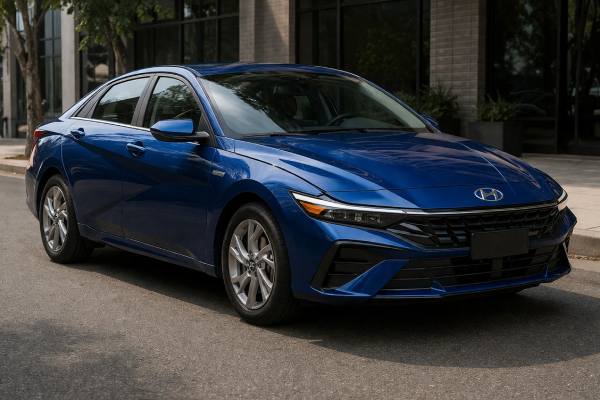
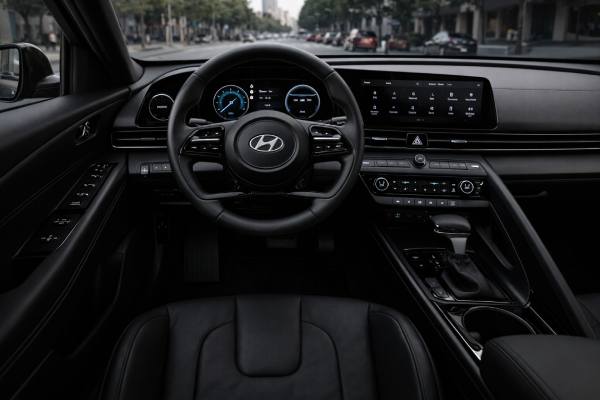
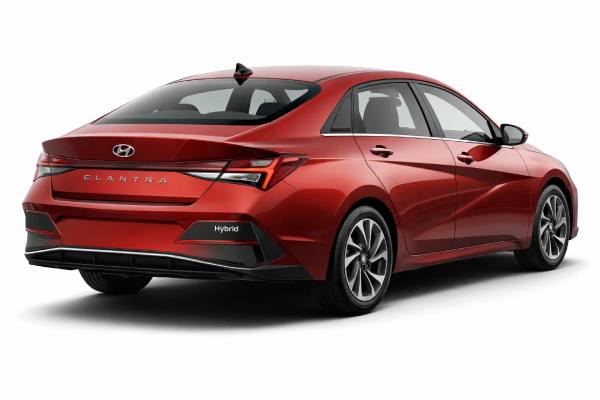
The facelifted Hyundai Elantra Hybrid CN7 is one of the more convincing compact hybrids on sale because it does not rely on one party trick. Instead, it blends several useful traits into one package: a roomy cabin, a large trunk, strong fuel economy, and a hybrid system that still feels familiar to drivers moving out of ordinary gasoline sedans. Under the body, Hyundai pairs a 1.6-liter Atkinson-cycle four-cylinder with a 32 kW electric motor and a six-speed dual-clutch transmission, for a combined 139 hp and 195 lb-ft of system torque. That matters because the Elantra Hybrid does not drive like a droning CVT-only commuter. It feels more direct and more natural in light acceleration than many rivals. The facelifted 2024-onward car also gained meaningful safety updates and sharper styling. The main ownership question is not whether the concept works. It does. The real question is whether the specific car has been serviced carefully and had all campaign work completed.
What to Know
- The hybrid system delivers excellent real-world economy without making the car feel slow or disconnected.
- Rear-seat room and trunk space are unusually strong for a compact hybrid sedan.
- Standard safety equipment is generous, and upper trims add genuinely useful highway-assist features.
- The six-speed dual-clutch transmission needs smooth calibration and proper service history, especially in heavy urban use.
- A conservative oil-and-filter interval of 10,000 to 12,000 km or 12 months is a smart ownership baseline.
Quick navigation
- Hyundai Elantra Hybrid CN7 roadmap
- Hyundai Elantra Hybrid CN7 spec sheet
- Hyundai Elantra Hybrid CN7 trims and safety
- Known issues and service campaigns
- Maintenance plan and buyer guidance
- Driving feel and efficiency
- How it compares to rivals
Hyundai Elantra Hybrid CN7 roadmap
The facelifted Elantra Hybrid sits in an interesting place in the compact-car market. It is more style-conscious than a Toyota Corolla Hybrid, more conventional than a Prius, and more efficiency-focused than the Elantra N Line or Elantra N. That makes it a quietly smart buy for people who want one car to do everything well. It commutes cheaply, carries four adults without complaint, and still feels like a normal sedan rather than a science project. That is a bigger advantage than it sounds, because many hybrid buyers want lower fuel costs without relearning how a car should drive.
The hybrid hardware is central to that appeal. Hyundai uses a 1.6-liter Smartstream GDI Atkinson-cycle four-cylinder producing 104 hp and 109 lb-ft on its own, paired with a 32 kW interior permanent-magnet synchronous motor that adds 43 hp and 125 lb-ft. Combined output is 139 hp and 195 lb-ft. The battery is a 240-volt lithium-ion pack rated at 1.32 kWh. Unlike many rivals, Hyundai routes that power through a six-speed EcoShift dual-clutch transmission instead of an eCVT. In normal use, that gives the Elantra Hybrid a more familiar and more mechanical feel, especially at moderate throttle openings and higher road speeds.
The 2024 facelift improved the package in ways that matter. The styling became cleaner and sharper, but the more meaningful changes were in equipment and safety. Hyundai strengthened the safety structure for updated IIHS side-impact criteria, revised the feature lineup, and kept the hybrid powertrain unchanged. Through the current run, the basic mechanical package remains familiar, which is usually good news for owners because it means fewer rolling hardware changes and a better chance for a consistent service and parts story.
The Elantra Hybrid is also unusually practical. The sedan body still gives you a proper trunk, and Hyundai manages to keep the cabin spacious even with hybrid hardware onboard. Front and rear legroom are strong for the class, and the seating position is more natural than in many style-led compact sedans. That makes the car easy to recommend to buyers who might otherwise look at a small crossover.
Its main limitations are not hard to understand. It is front-wheel drive only, it is not especially quick, and the dual-clutch transmission will always feel a little more mechanical at parking-lot speed than a planetary eCVT rival. But those are trade-offs rather than flaws. What matters is that the car remains coherent. The facelifted CN7 Hybrid still feels like one of Hyundai’s most sensible mainstream models: efficient, roomy, easy to live with, and mature enough to satisfy people who want more than just a high mpg number.
Hyundai Elantra Hybrid CN7 spec sheet
The figures below focus on the facelifted 2024-present Elantra Hybrid sold in North American form. Some trim-specific values vary, especially curb weight, wheel size, and feature content, but the core hybrid system stays the same.
| Powertrain and efficiency | Data |
|---|---|
| Code | Smartstream G1.6 Hybrid |
| Engine layout and cylinders | Inline-4, DOHC, 4 valves per cylinder, 72 × 97 mm (2.83 × 3.82 in) |
| Displacement | 1.6 L (1,580 cc) |
| Motor | Interior permanent-magnet synchronous motor, single motor on the front axle |
| System voltage | 240 V |
| Battery chemistry | Lithium-ion |
| Battery capacity | 1.32 kWh |
| Induction | Naturally aspirated |
| Fuel system | GDI |
| Compression ratio | 13.0:1 |
| Max engine power | 104 hp (78 kW) @ 5,700 rpm |
| Max engine torque | 148 Nm (109 lb-ft) @ 4,000 rpm |
| Motor output | 32 kW (43 hp) |
| Motor torque | 169 Nm (125 lb-ft) |
| Combined system power | 139 hp |
| Combined system torque | 264 Nm (195 lb-ft) |
| Timing drive | Chain |
| Rated efficiency | Blue: 53/56/54 mpg city/highway/combined; Limited: 49/52/50 mpg |
| Real-world highway @ 120 km/h | About 4.8–5.8 L/100 km in warm conditions; usually higher in winter |
| Transmission and driveline | Data |
|---|---|
| Transmission | 6-speed EcoShift dual-clutch transmission |
| Transmission code | Not publicly specified in the reviewed official sources |
| Drive type | FWD |
| Differential | Open |
| Chassis and dimensions | Data |
|---|---|
| Suspension (front/rear) | MacPherson strut front / multi-link independent rear |
| Steering | Rack and pinion, motor-driven power steering |
| Steering ratio | Public hybrid-specific ratio not clearly published; standard Elantra data sits around 12.9:1 |
| Brakes | Front 11.0-inch ventilated discs, rear 10.3-inch solid discs |
| Brake booster | Electric booster with regenerative brake integration |
| Wheels and tyres | Blue commonly uses 16-inch wheels; Limited commonly uses 17-inch wheels |
| Ground clearance | 5.5 in (140 mm) |
| Length / Width / Height | 185.4 / 71.9 / 55.7 in (4,709 / 1,826 / 1,415 mm) |
| Wheelbase | 107.1 in (2,720 mm) |
| Turning circle (kerb-to-kerb) | Official hybrid-specific figure not clearly published in the reviewed U.S. material |
| Kerb weight | Blue HEV about 2,965 lb (1,345 kg); Limited HEV about 3,069 lb (1,392 kg) |
| GVWR | About 4,079 lb (1,850 kg) |
| Fuel tank | 11.0 US gal (41.6 L / 9.2 UK gal) |
| Cargo volume | 14.2 ft³ trunk (about 402 L), with total interior volume of 113.6 ft³ |
| Performance and capability | Data |
|---|---|
| Acceleration | 0–100 km/h in about 9.7–10.5 s in typical independent testing conditions |
| Top speed | Not officially published in the reviewed sources |
| Braking distance | No official factory figure published in the reviewed sources |
| Towing capacity | Not officially recommended in the reviewed U.S. hybrid material |
| Payload | Verify from certification label; trim and market dependent |
| Fluids and service capacities | Data |
|---|---|
| Engine oil | 5W-30 is a sensible all-round grade in many markets; official public capacity incl. filter: 4.1 L (4.33 US qt) |
| Coolant | Official public U.S. spec sheet lists 2.65 L; verify by VIN and service literature because hybrid thermal-system service procedures vary |
| Transmission / ATF | Refer to Hyundai service literature for exact DCT fluid specification and service-fill method |
| Differential / transfer case | Not applicable |
| A/C refrigerant | Refer to the under-bonnet label and model-year service data |
| A/C compressor oil | Refer to the under-bonnet label and model-year service data |
| Key torque specs | Wheel nuts 79–94 lb-ft (107–127 Nm) |
| Safety and driver assistance | Data |
|---|---|
| Crash ratings | No dedicated Euro NCAP rating published for the Elantra Hybrid CN7; IIHS lists the 2024-25 Elantra sedan as Top Safety Pick |
| IIHS crash details | Good in driver-side and passenger-side small overlap; Good in side 2.0; updated moderate overlap front is Moderate on 2024-25 models built before November 2024 |
| Headlight rating | Good for all trims tested by IIHS |
| ADAS suite | FCA, BCW, RCW, LKA, LFA, DAW, HBA, SEW standard; sensor-fusion FCA, SCC with Stop & Go, HDA, and reverse parking-collision aids on higher trims |
The specifications tell the story clearly. This is not a performance hybrid, but it is a very complete one. The multi-link rear suspension, real trunk, and six-speed hybrid DCT make it feel more like a normal compact sedan than many hybrids, while the fuel economy remains the headline strength.
Hyundai Elantra Hybrid CN7 trims and safety
For the facelifted CN7 Hybrid, the most useful way to think about the lineup is simple: Blue for maximum economy, Limited for the fuller comfort and technology package. Hyundai has kept the trim structure straightforward, which is helpful for buyers because it reduces guesswork in the used market. The Blue is the efficiency-focused version, and the Limited is the more complete daily driver if the extra equipment matters to you.
The Blue’s strongest selling point is not only its 54 mpg combined EPA figure. It is the way Hyundai managed to keep that efficiency without making the car feel stripped. Even the lower hybrid trim includes a strong baseline of safety gear, useful infotainment, and a practical wheel-and-tyre package that supports both fuel economy and ride quality. The Limited adds the features many buyers expect in a modern upper-trim compact sedan: more premium cabin materials, a larger equipment count, and the better highway-assist and convenience features that make long-distance driving easier.
Mechanically, the differences matter. Both trims share the same 139 hp hybrid system, multi-link rear suspension, and 6-speed hybrid DCT, but wheel size and equipment alter the experience. The Blue’s smaller, lower-drag wheels are better for economy and usually a little better for ride comfort. The Limited’s larger wheels and heavier equipment shave some fuel economy, but the trade-off is richer cabin trim and a broader set of driver-assistance features.
Safety equipment is one of the facelifted CN7’s strongest areas. Hyundai’s public specifications show camera-based forward collision avoidance with pedestrian detection, blind-spot collision warning, rear cross-traffic collision-avoidance warning, lane keeping assist, lane following assist, driver attention warning, high beam assist, safe exit warning, and rear occupant alert all available as core equipment. The Limited adds the more advanced sensor-fusion forward collision system with cyclist and junction-turning detection, smart cruise control with stop-and-go, highway drive assist, and reverse parking-collision aids.
Crash performance is good overall, but it deserves clear explanation rather than marketing language. IIHS lists the 2024-25 Elantra sedan as a Top Safety Pick. The car scores Good in driver-side small overlap, passenger-side small overlap, side impact, roof strength, and head restraints. Headlights are rated Good across tested trims. The one caution is the updated moderate overlap front result for 2024-25 cars built before November 2024, which is Moderate because rear-passenger restraint performance drags the overall score down. That does not make the Elantra Hybrid unsafe. It simply means the safety verdict is strong rather than flawless.
Euro NCAP is harder to use here because Hyundai does not publish a dedicated Euro NCAP result for the Elantra Hybrid CN7. In practice, the most useful official crash evidence for buyers is IIHS, plus the car’s strong standard active-safety equipment. If you are shopping used, the most important questions are still practical ones: Does every warning light behave correctly? Has the windscreen ever been replaced? Were the sensors calibrated properly afterward? On modern Hyundais, equipment condition is part of the safety specification.
Known issues and service campaigns
The facelifted Elantra Hybrid is still a relatively young car, so the reliability picture is not defined by heavy age-related failures yet. That is good news, but it also means buyers need to be careful not to overstate how “proven” the facelift car is. The best way to describe it is promising but still maturing. The basic hybrid system has looked solid in public materials so far, and Hyundai backs the hybrid battery and system with a 10-year/100,000-mile warranty in the U.S. Still, there are a few realistic ownership watchpoints.
The first is the hybrid DCT. Hyundai’s hybrid system is interesting because it uses a six-speed dual-clutch transmission instead of an eCVT. That gives the Elantra Hybrid more natural road feel, but it also means low-speed behavior deserves attention. Light hesitation or a slightly mechanical feel in stop-and-go driving can be normal. Harsh engagement, shudder, or repeated awkward take-up is not something to ignore. On a used car, the right approach is to distinguish normal calibration feel from a transmission that has been driven badly or adapted poorly.
The second is engine service discipline. The 1.6-liter engine is an Atkinson-cycle GDI four-cylinder, which means it combines chain-driven cams with direct injection. In plain ownership terms, that means regular oil changes matter, cold-start neglect matters, and intake-valve carbon accumulation remains a possible long-term issue. None of this is a reason to fear the car. It is simply the normal checklist for a direct-injected hybrid petrol engine that may spend long periods cycling between load states and short-trip operation.
Brake condition is another easy place to miss problems. Because regenerative braking carries part of the work, conventional friction brakes can sometimes see lighter use than expected, which makes rotor surface corrosion or sticky slide hardware more likely on lightly driven cars. This is not unique to Hyundai. It is a general hybrid ownership reality. A car with uneven rear-brake wear, grumbling pedal feel, or obvious rotor corrosion deserves proper inspection rather than a quick drive around the block.
For public service actions on facelift-era cars, the record reviewed for 2024-present models is still short, but there are a few concrete items worth knowing. Hyundai issued a 2024 service campaign for certain 2023-2024 Elantra Hybrid vehicles built from late October to mid-December 2023 because the tire mobility kit sealant could leak and contaminate the kit contents. That is not a drivetrain defect, but it is still the kind of detail a careful buyer should verify. More broadly, Hyundai’s wider CN7 Hybrid record also shows how software history matters on electrified models. Earlier CN7 Hybrids saw HCU and BMS software-related campaigns, which is a useful reminder that on any hybrid, dealer campaign status can matter just as much as oil-change history.
The most practical reliability advice is simple. Ask for a complete service history, verify open campaigns by VIN, test drive the car long enough to feel the DCT at parking speed and motorway speed, and check the brake hardware carefully. The facelifted car does not currently show a single public “avoid at all costs” pattern in the reviewed official material. But it is still complex enough that neglect shows up quickly.
Maintenance plan and buyer guidance
The Elantra Hybrid is easiest to own when you treat it like two cars at once: a modern direct-injected petrol engine and a modern hybrid system. The goal is not to over-service it. The goal is to stay ahead of the items that matter most: oil quality, cooling health, clean brake hardware, battery health at both the 12-volt and high-voltage levels, and proper campaign completion.
| Item | Practical interval | Notes |
|---|---|---|
| Engine oil and filter | Every 10,000–12,000 km or 12 months | Shorter intervals help timing-chain and GDI cleanliness |
| Engine air filter | Inspect every service, replace around 20,000–30,000 km | Earlier in dusty conditions |
| Cabin air filter | Every 15,000–20,000 km or 12 months | Helps HVAC performance |
| Spark plugs | Around 60,000–90,000 km depending on plug type and driving use | Misfires are more noticeable in hybrids |
| Coolant | Inspect yearly, replace by official schedule | Verify exact hybrid cooling procedure by VIN |
| Brake fluid | Every 2 years | Important for ABS and brake feel, even on a hybrid |
| DCT fluid / service | Follow Hyundai service documentation | Hybrid DCT care is more important than many owners assume |
| Timing chain | No fixed interval; inspect on rattle, timing faults, or oil-neglect history | Clean oil is the real prevention |
| Auxiliary belt and hoses | Inspect every service | Replace on cracks, swelling, or glazing |
| Tyres | Rotate every 10,000–12,000 km | Low-rolling-resistance tyres can hide alignment problems until wear is advanced |
| Brake inspection | Every service | Check rotor corrosion, pad movement, and rear hardware carefully |
| 12 V battery test | Yearly from year 3 onward | Weak 12 V batteries can cause misleading hybrid warnings |
| Hybrid battery check | Review state-of-health and system codes at dealer or specialist inspections | Especially important before used purchase |
A few service notes matter more on this car than on a normal compact sedan. First, use the right oil. The hybrid’s petrol engine may not seem stressed in the usual performance-car way, but oil quality still affects chain health, variable-valve operation, and general refinement. Second, do not ignore brake fluid just because the car regenerates. Hybrids still need clean hydraulic systems. Third, keep the 12-volt system healthy. Many odd hybrid complaints begin with a weak auxiliary battery rather than with the high-voltage pack.
As a used buy, the Blue is the smartest value choice if fuel economy is the priority and you do not need every convenience feature. The Limited is the nicer all-round car if you spend more time on the motorway and want the additional active-safety and comfort equipment. I would choose the better-documented car over the “better trim” car almost every time. On a used hybrid, proof beats badges.
The inspection order should be straightforward:
- VIN campaign and recall check.
- Cold start and warm restart behavior.
- DCT smoothness at crawling speed and normal acceleration.
- Brake condition, especially rear rotors and slide movement.
- 12 V battery health and warning lights.
- Tyre wear and alignment pattern.
- Full service documentation.
The long-term durability outlook is encouraging, but still early. The facelifted Elantra Hybrid looks like a smart and durable compact hybrid when serviced correctly. It just is not the kind of car that rewards vague maintenance or shortcut diagnostics.
Driving feel and efficiency
The Elantra Hybrid’s biggest trick is that it does not feel like it is trying to impress you with efficiency every second you drive it. It just feels easy. That is a compliment. Around town, electric assist makes the car respond cleanly off the line, and the hybrid system fades into the background quickly. Unlike some eCVT hybrids, the Elantra does not immediately rush into a high-rev drone under moderate throttle. The six-speed DCT helps it feel more like a familiar compact sedan that happens to be efficient.
That transmission choice defines the car’s road feel. At steady speed and light acceleration, the Elantra Hybrid feels more direct than many rivals. Gear changes are subtle, motorway cruising is relaxed, and the engine usually sounds less strained than the numbers suggest. In stop-and-go traffic, you can still feel a slightly more mechanical nature at very low speed than in a planetary hybrid, but the trade-off is a more natural feel once the car is moving.
Ride comfort is another strength. The facelifted CN7 still rides like a normal sedan first and a hyper-efficient special-case hybrid second. The multi-link rear suspension helps the car stay composed over broken surfaces, and the chassis feels more mature than many compact sedans that rely on simpler rear setups. The Blue’s smaller, efficiency-focused wheel package is the better choice for ride comfort and low running costs. The Limited looks better and feels a little more upscale inside, but the Blue is the more rational choice if maximum efficiency matters most.
The 139 hp system output will not make the Elantra Hybrid feel quick, but it is more than enough for normal traffic. Highway merging is easy, overtakes are competent rather than exciting, and the powertrain feels especially strong in rolling urban and suburban driving where the electric motor can help most. The hybrid is not an N Line in disguise, and it does not need to be.
Real-world economy is where the car earns its reputation. The Blue’s official 53/56/54 mpg EPA rating is excellent, and the Limited’s 49/52/50 mpg is still very strong. In practical terms, owners driving mixed suburban routes can often stay around 4.5–5.2 L/100 km without much effort. Steady 120 km/h motorway use usually pushes the car higher, often into the 4.8–5.8 L/100 km range in warm conditions, with winter weather, short trips, and aggressive HVAC use increasing consumption further. In city traffic, the Elantra Hybrid can be impressively economical as long as the trip is long enough for the system to settle into normal operation.
That is really the car’s secret. It is not a flashy hybrid. It is a comfortable, practical compact sedan that just happens to use very little fuel. For many buyers, that is exactly what makes it good.
How it compares to rivals
The facelifted Elantra Hybrid competes in a crowded field, but it has a clearer identity than many rivals. Its most direct alternatives are the Toyota Corolla Hybrid, Toyota Prius, Honda Civic Hybrid, and in some markets hybrid versions of the Kia K4 or Niro family. The Hyundai’s biggest advantage is that it sits between the extremes. It is neither as conservative as the Corolla Hybrid nor as identity-driven as the Prius.
Against the Toyota Corolla Hybrid, the Hyundai usually wins on cabin space, trunk usability, and a more natural-feeling powertrain at higher speed. The Toyota counters with its long-established hybrid reputation and often stronger resale confidence. Against the Toyota Prius, the Hyundai is less visually dramatic and not as dedicated to hypermiling, but it feels more conventional and often easier to recommend to buyers who simply want a normal sedan shape. Against the Honda Civic Hybrid, the Hyundai is generally a value play: more equipment for the money in many markets, but usually less polish in the final layer of steering feel and interior sophistication.
What makes the Elantra Hybrid especially attractive is that it does not demand much compromise. Many hybrids become noticeably duller or less practical than their gasoline siblings. This one does not. It keeps a real trunk, real rear-seat room, useful road manners, and a powertrain that feels more normal than many rival hybrids. The main sacrifice is that it is not the absolute leader in every metric. Some rivals are more refined, some are more established, and some have cleaner low-speed transmission behavior.
But used-car buying is rarely about winning one isolated category. It is about total ownership value. That is where the Elantra Hybrid makes a strong case. It offers excellent fuel economy, a generous feature set, strong safety credentials, and a hybrid battery warranty that removes a lot of anxiety for early owners. When bought carefully, it is one of the easiest hybrid sedans to recommend.
The verdict is simple. The facelifted 2024-present Hyundai Elantra Hybrid CN7 is not the most famous hybrid sedan on the market, but it is one of the most rounded. It combines efficiency, space, and everyday normality better than many alternatives. For buyers who want a compact hybrid that still feels like a real car rather than an engineering experiment, it deserves serious attention.
References
- 2024 Elantra Specifications 2023 (Technical Specifications)
- 2025 Hyundai Elantra Hybrid | Compact Sedan 2025
- 2024 Hyundai Elantra 2024 (Safety Rating)
- Hyundai Warranty Vehicle – Hyundai USA Service & Maintenance 2025 (Warranty)
- TMK SEALANT LEAKAGE INSPECTION/PARTS REPLACEMENT (SERVICE CAMPAIGN TBR) 2024 (TSB)
Disclaimer
This article is for informational purposes only and is not a substitute for professional diagnosis or repair. Specifications, torque values, service intervals, procedures, and equipment vary by VIN, market, trim, and build date, so always verify the exact vehicle against official service documentation before buying parts or carrying out repairs.
If this guide helped you, please consider sharing it on Facebook, X, or another social platform to support our work.