
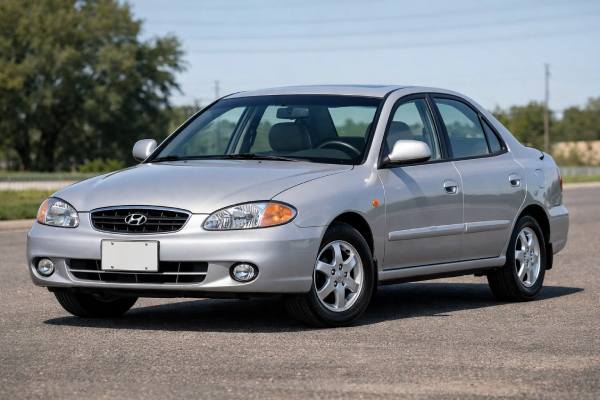
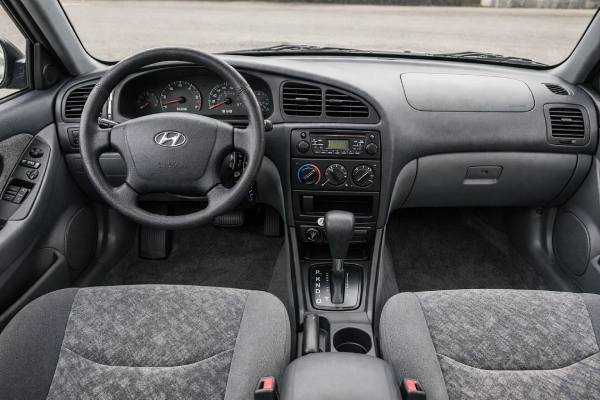

The facelifted Hyundai Elantra J2 1.6 sits in an interesting place today. It is old enough to be simple, light, and easy to understand, yet modern enough to feel usable as everyday transport if it has been cared for properly. In many export markets this facelift was sold as the Lantra rather than Elantra, but the engineering story is the same: a compact front-wheel-drive family car with a naturally aspirated 1.6-litre DOHC petrol engine, multi-point injection, a manual gearbox, and none of the complexity that defines newer cars. That simplicity is its biggest strength. Parts supply is still manageable, the drivetrain is straightforward, and routine servicing is not difficult. The trade-off is that age now matters more than brochure quality ever did. Rust, deferred timing-belt service, tired suspension, and neglected cooling systems usually matter more than mileage alone. Buy a clean one, though, and the J2 facelift still offers honest value, good space, and low-stress ownership.
Essential Insights
- Simple naturally aspirated 1.6 engine and manual transmission make it easier to maintain than many newer compact cars.
- Cabin space is still useful, and the 376 L boot is respectable for a late-1990s family hatch or sedan.
- Light weight and modest running costs remain genuine advantages for daily use.
- Timing-belt history and corrosion checks matter more than odometer reading on this generation.
- Treat 12 months or 10,000–15,000 km as the sensible oil-service window, and replace the timing belt around 60,000 km or 4–5 years unless verified otherwise by official documentation.
What’s inside
- Elantra J2 Facelift Essentials
- Elantra J2 1.6 Numbers
- Elantra J2 Grades and Safety
- Failure Points and Aging Risks
- Care Plan and Smart Buying
- On-Road Feel and Economy
- How the J2 Stacks Up
Elantra J2 Facelift Essentials
The 1998–2000 facelifted J2 is the version of the second-generation Elantra that feels most mature. Hyundai cleaned up the styling, revised the front and rear lighting, updated trim and equipment by market, and gave the car a more finished appearance than the earlier J2. In Europe and Australia, many of these cars were sold as Hyundai Lantra, which explains why parts databases, brochures, and workshop references often use both names. Mechanically, though, the important point is simple: the 1.6-litre 114 hp version is one of the most straightforward cars Hyundai sold in this period.
Its character is defined by lightness and mechanical honesty. The G4GR 1.6-litre inline-four is a naturally aspirated, multi-point-injected petrol engine with a twin-cam 16-valve head. It does not deliver modern low-rpm punch, but it is predictable, reasonably eager once revs rise, and free from the turbocharging, direct-injection, and hybrid-system complexity that make newer used cars more expensive to diagnose. Paired with a 5-speed manual and front-wheel drive, the J2 1.6 is built around a layout that most independent garages still understand well.
That simplicity also shapes ownership. The Elantra J2 does not need software updates, battery health checks, or advanced sensor calibration in the way a newer car does. It responds instead to old-fashioned maintenance basics: clean oil, a fresh timing belt, healthy cooling components, good ignition parts, and rust prevention. When those needs are met, it can feel dependable in a very traditional way. When they are ignored, it can become a typical late-1990s bargain car with multiple small faults that add up quickly.
Another strength is usability. The car is not large, but the wheelbase and tall roofline give it a practical cabin, reasonable rear space, and a useful luggage area. It is also easier to place in traffic than many modern compact cars because visibility is good, the body corners are easy to judge, and the controls are light. That makes it well suited to owners who want uncomplicated transport rather than a nostalgic weekend project that constantly asks for attention.
The most important ownership reality, however, is age. A facelift J2 is now a rust-and-history purchase more than a brand purchase. Two cars with the same engine and trim can feel completely different depending on how they were stored, whether the timing-belt interval was respected, and whether previous owners fixed small problems before they became expensive ones. That is why this Elantra rewards careful buying more than casual bargain hunting. The best examples are simple, useful, and refreshingly direct. The worst are cheap for a reason.
Elantra J2 1.6 Numbers
For the facelifted 1998–2000 J2 1.6 with 114 hp, the most consistent open-source figures point to the European-spec 1.6 16V version sold in Lantra or Elantra form. Exact dimensions and some service-fill values can vary a little by body style, market, and trim, so the table below focuses on the most repeatable figures for the 1.6 manual front-wheel-drive car. Where open public sources are inconsistent or incomplete, that is stated clearly rather than guessed.
| Powertrain and efficiency | Figure |
|---|---|
| Code | G4GR |
| Engine layout and cylinders | Inline-4, DOHC, 4 cylinders |
| Valves per cylinder | 4 |
| Bore × stroke | 77.4 × 85.0 mm (3.05 × 3.35 in) |
| Displacement | 1.6 L (1,599 cc) |
| Induction | Naturally aspirated |
| Fuel system | MPI |
| Compression ratio | 9.85:1 |
| Max power | 114 hp (84 kW) @ 6,100 rpm |
| Max torque | 143 Nm (105 lb-ft) @ 3,000 rpm |
| Timing drive | Timing belt |
| Rated efficiency | 7.7 L/100 km (30.5 mpg US / 36.7 mpg UK) combined |
| Real-world highway @ 120 km/h | Usually around 6.8–7.6 L/100 km, depending on condition and load |
| Transmission and driveline | Figure |
|---|---|
| Transmission | 5-speed manual |
| Drive type | FWD |
| Differential | Open |
| Chassis and dimensions | Figure |
|---|---|
| Suspension, front | MacPherson strut, coil springs, anti-roll bar |
| Suspension, rear | Independent multi-link / trailing-link layout with coil springs |
| Steering | Hydraulic power steering |
| Steering ratio | Not reliably published in open sources for this exact trim |
| Brakes | Front ventilated discs; rear drums on the commonly cited 1.6 specification |
| Wheels and tyres | 175/65 R14 common period fitment |
| Ground clearance | Not consistently published by period open sources |
| Length | 4,450 mm (175.2 in) |
| Width | 1,700 mm (66.9 in) |
| Height | 1,400 mm (55.1 in) |
| Wheelbase | 2,550 mm (100.4 in) |
| Turning circle, kerb-to-kerb | Not reliably confirmed in open public data for this exact version |
| Kerb weight | 1,085 kg (2,392 lb) |
| GVWR | Market-dependent and not consistently published in open sources |
| Fuel tank | 55 L (14.5 US gal / 12.1 UK gal) |
| Cargo volume | 376 L (13.3 ft³), body-style dependent |
| Performance and capability | Figure |
|---|---|
| 0–100 km/h (0–62 mph) | 10.5 s |
| Top speed | 193 km/h (120 mph) |
| Braking distance 100–0 km/h | No dependable period open-source figure for this exact trim |
| Towing capacity | Market-dependent; verify from VIN and local handbook |
| Payload | Not reliably published in open public data for this exact version |
| Fluids and service capacities | Figure |
|---|---|
| Engine oil | 5W-40 or 10W-40 is commonly used on well-kept examples; open-source catalogues often cite about 4.0 L total, but fill by dipstick |
| Coolant | Ethylene glycol coolant, typically 50:50 mix; open-source catalogues often cite about 6.0 L |
| Transmission oil | Verify by gearbox code; use only the correct manual transaxle fluid specification |
| Differential / transfer case | Not applicable |
| A/C refrigerant | R134a on most period examples; confirm from under-bonnet sticker |
| A/C compressor oil | Verify from system label or workshop data |
| Key torque specs | Use VIN-specific workshop documentation rather than generic internet values |
| Safety and driver assistance | Figure |
|---|---|
| Euro NCAP | No verified period Euro NCAP rating confidently attributable to this exact facelift J2 in open public sources |
| IIHS | Moderate overlap front: original test, overall rating A for 1996–2000 4-door sedan |
| Headlight rating | Not available for this generation |
| ADAS suite | None; no AEB, ACC, lane support, BSD, or traffic-sign assist |
The key technical takeaway is that the J2 1.6 wins by being conventional. It is not fast, but it is light. It is not advanced, but it is easy to understand. For an owner or buyer, that often matters more than one more decimal point in a specification table.
Elantra J2 Grades and Safety
Trim naming on the J2 facelift depends heavily on market, which is one reason these cars can be confusing to research. In Europe and the UK, the 1.6 version was commonly sold under badges such as GL, GLS, or GSi, while other markets used different naming or bundled equipment in different ways. The important thing for buyers today is not the badge alone, but what the car actually has. On a late-1990s Hyundai, equipment matters because two outwardly similar cars can differ in airbags, ABS, air conditioning, seat trim, wheel size, rear brake setup, and power features.
The 1.6 114 hp car usually sat in the middle of the range. That made it appealing when new because it gave buyers enough power to avoid feeling under-engined without stepping up to the larger 1.8 or 2.0 engines. In practical terms, a better-equipped 1.6 can still be the sweet spot today. Cars with power windows, central locking, air conditioning, a passenger airbag, and ABS are easier to live with and easier to justify keeping in service. Some higher-grade facelift cars also got alloy wheels, fog lamps, a sunroof, upgraded cloth trim, and additional convenience features that now make the cabin feel less bare.
Quick identifiers are useful because marketing names are not always reliable after decades of ownership changes. Look for wheel size, rear brake hardware, badge details, seat fabric, air-conditioning controls, and airbag labeling on the dashboard or steering wheel. Factory brochures and original handbooks are valuable because they clarify what the car should have had when new. This matters for restoration-grade buyers and for anyone ordering parts, especially when mixing Lantra and Elantra badging across countries.
Safety needs to be understood in period context. This is a pre-ADAS compact family car, so even well-equipped examples do not offer modern active safety systems. There is no autonomous emergency braking, blind-spot monitoring, lane-centering, radar cruise control, or post-repair sensor calibration issue to worry about. Passive safety equipment, however, improved over time. Side-impact protection, dual front airbags, and on some trims side airbags and ABS were part of the J2’s effort to look more competitive against Japanese and European rivals.
Crash-test coverage is limited compared with modern cars. The most useful official benchmark in open sources is the IIHS moderate-overlap frontal result that applies to 1996–2000 U.S.-spec 4-door sedans, where the Elantra scored well for its era. That is encouraging, but it should not be mistaken for modern crash performance. A J2 facelift can be considered acceptable by late-1990s standards, yet it still lacks the structural sophistication, restraint technology, and active safety systems that buyers now take for granted.
For family use, the smart view is balanced. A good facelift J2 with ABS, multiple airbags, sound tyres, and healthy brakes can still be a reasonable low-cost commuter or second car. But if the goal is maximum crash protection for heavy motorway family use, a newer generation remains the better answer. The J2’s safety story is about honest period competence, not modern leadership.
Failure Points and Aging Risks
The facelifted J2 Elantra 1.6 does not have one dominant catastrophic design flaw that defines the ownership story. Its problems are more typical of an older naturally aspirated compact car: age, neglected maintenance, corrosion, and small mechanical wear points. That is good news if you buy carefully, because most faults are understandable. It is bad news if you buy a cheap car blindly, because a dozen small problems can still turn a simple Hyundai into an expensive nuisance.
The most important issue is timing-belt history. This is a belt-driven cam engine, and that means a missing service record is not a small concern. If the seller cannot prove when the belt, tensioners, and ideally the water pump were last replaced, assume the job is due. Symptoms of trouble can include belt noise, visible cracking, or uncertain engine timing, but many belts fail without much warning. This is a high-priority, medium-to-high-cost issue because postponing it risks serious engine damage.
Cooling system neglect is next on the list. Old radiators, brittle hoses, tired thermostats, and weak expansion-tank caps are common on cars of this age. Symptoms include temperature creep in traffic, heater inconsistency, coolant smell, or staining around the radiator and hose connections. The root cause is usually old plastic and rubber rather than a mysterious design defect. Remedy means a proper pressure test, fresh hoses where needed, and replacing worn cooling parts before overheating damages the head gasket.
Oil leaks are common but usually manageable. The rocker-cover gasket, cam seals, crank seals, and sump sealing areas are all worth checking. Small leaks are usually a low-cost annoyance; ignored leaks that contaminate belts, mounts, or the clutch become more serious. Idle issues and misfires can also show up from aged ignition components, vacuum leaks, tired sensors, or moisture around plug wells. These are usually low-to-medium severity faults, but they can make a healthy engine feel far worse than it is.
On the chassis side, expect worn front lower-arm bushes, drop links, dampers, top mounts, wheel bearings, and CV-boot deterioration. Symptoms are clunks over bumps, vague steering, vibration, or split boots throwing grease. Manual gearboxes are generally durable, but worn clutches, tired linkages, and synchro wear on abused cars do appear. Rust is the real high-severity risk. Check sills, rear arches, suspension pickup points, brake and fuel lines, floor edges, and the underside around subframe mounting areas. Cosmetic rust is one thing. Structural rust is the point where a cheap J2 stops making economic sense.
Because this is an older car, software and calibration issues are almost irrelevant by modern standards. There is no serious ADAS or infotainment update story here. Open official recall coverage for the facelift J2 1998–2000 is far thinner than for the 2001 redesign that followed, so the wise approach is to treat condition and documented maintenance as the main reliability filters. Always run an official VIN check where available, but assume your biggest enemy is neglect, not hidden electronics.
Care Plan and Smart Buying
Owning a J2 Elantra well is mostly about discipline. This is not a car that asks for expensive specialist work every few months, but it does reward routine service and punishes delay. Because many surviving cars are now maintained on mixed paperwork and incomplete histories, the safest plan is to reset the maintenance baseline soon after purchase unless the records are unusually strong.
A practical maintenance schedule for the 1.6 114 hp looks like this:
| Item | Practical interval | Notes |
|---|---|---|
| Engine oil and filter | Every 10,000–15,000 km or 12 months | Use a quality oil of the correct viscosity for climate and engine condition |
| Engine air filter | Inspect every 15,000 km; replace as needed | Sooner in dusty use |
| Cabin air filter | If fitted, every 12 months | Some market versions differ |
| Spark plugs | 30,000–40,000 km | Replace earlier if idle quality worsens |
| Fuel filter | Around 60,000 km | Earlier if fuel quality is uncertain |
| Timing belt, tensioners, and ideally water pump | Around 60,000 km or 4–5 years | High priority on a newly purchased car with unclear history |
| Auxiliary belts and hoses | Inspect every service | Replace at first signs of cracking or glazing |
| Coolant | Every 2–3 years | Use proper antifreeze mix, not plain water |
| Brake fluid | Every 2 years | Moisture contamination matters on old systems |
| Brake pads and discs or drums | Inspect every service | Check for seized sliders, pipe corrosion, and handbrake balance |
| Manual gearbox oil | Refresh on age or unknown history | Use correct spec only |
| Tyre rotation and alignment | Check every 10,000–15,000 km | Uneven wear often reveals suspension issues |
| 12 V battery | Test yearly after year 4 of battery age | Charging issues often masquerade as sensor faults |
For fluids, open-source catalogues commonly point to about 4.0 L of engine oil and about 6.0 L of coolant for the G4GR 1.6, but the right habit is still to verify by dipstick, bleed the cooling system properly, and confirm any gearbox fill by code rather than assumption. On a car this old, “approximately right” is not good enough where fluids are concerned.
As a buyer, prioritize structure and service history over trim. The best J2 is usually not the newest-looking one but the one with proof of belt service, clean coolant, dry floorpans, even panel fit, healthy brake lines, and minimal corrosion underneath. Check for bubbling at arches and sills, water leaks in the boot or footwells, tired door seals, sloppy gearshift action, and exhaust corrosion. Ask when the clutch, timing belt, radiator, shocks, and battery were last changed.
Recommended versions are late facelift 1.6 manual cars with ABS, air conditioning, and honest history. Cars to avoid are neglected examples with fresh underseal over rust, no belt evidence, overheating history, or a seller who dismisses warning lights as “just old-car stuff.” The long-term durability outlook is still decent if rust is controlled and maintenance is caught up. The engine is simple enough to survive, but the body decides whether the car is worth saving.
On-Road Feel and Economy
The J2 Elantra 1.6 drives exactly as a late-1990s naturally aspirated compact should: light on its feet, easy to read, and more pleasant than its modest paper output suggests. It is not quick by modern standards, but it does not feel painfully slow if it is healthy. The engine needs revs more than a modern turbo petrol, so low-rpm response is only average. Once past roughly 3,000 rpm, it pulls more willingly and feels happier. That makes the manual gearbox an important part of the experience, because keeping the engine in the right part of the rev range transforms the car.
Around town, the J2 is easy to place. The controls are light, visibility is better than in most newer cars, and the car’s compact footprint makes parking simple. The steering is not especially rich in feedback, but it is predictable and friendly. On secondary roads, the chassis feels tidy rather than exciting. Grip is adequate, body roll is modest for the era, and the car remains composed if the suspension is still in good shape. Old dampers or tired bushes, however, quickly make the handling feel looser and noisier than it should.
Ride quality depends almost entirely on condition. A fresh, healthy J2 still rides with decent fluency over ordinary surfaces. A neglected one can feel crashy, floaty, or noisy because of worn dampers, cheap tyres, tired mounts, or perished bushings. Noise, vibration, and harshness are period-correct rather than polished. At motorway speed, wind and tyre noise are more obvious than in a newer compact, but the car settles into a steady cruise reasonably well if alignment and wheel balance are right.
Real-world fuel use remains respectable. The official combined figure of 7.7 L/100 km translates well enough to real ownership expectations today. In mixed driving, a sound car often returns around 7.5–8.5 L/100 km. City use with short trips can push it to 9.5–11.0 L/100 km, while gentle extra-urban driving may bring it down near 6.5–7.0. At a steady 120 km/h, expect roughly high-6s to mid-7s L/100 km if the engine is well tuned and the tyres are correct. A tired ignition system, dragging brakes, bad wheel alignment, or old oxygen sensors can move those numbers in the wrong direction quickly.
Braking feel is honest and easy to modulate, though results vary with trim, tyre quality, and whether the car has ABS. Load carrying is reasonable for family errands, luggage, and light trips, but this is not a tow-focused car. It works best as a light, simple commuter and everyday hatch or sedan. The verdict on the road is clear: the J2 1.6 is not special in one dramatic way, but it is agreeable in many small ways, and that counts for a lot in an older daily driver.
How the J2 Stacks Up
Against its period rivals, the facelifted J2 Elantra 1.6 makes its best case on value, simplicity, and equipment-for-money. Cars such as the Toyota Corolla E110, Honda Civic EK, Nissan Almera, Opel Astra G, and early Ford Focus generally offered either better brand prestige, sharper dynamics, or stronger resale appeal. Hyundai’s answer was to give buyers a roomy, well-equipped compact car with simple petrol engines and a lower purchase price. That logic still explains the J2’s place in the used market now.
Compared with a same-era Corolla, the Hyundai usually feels less polished but often better equipped for the money. Compared with a Civic, it gives away some engine sparkle and steering precision but can be cheaper to buy into. Against an Astra or Almera, it stands up fairly well on straightforward mechanical design and practical cabin use. In other words, the J2 was rarely the absolute class leader, but it was often the rational outsider.
Today, the J2’s strongest rival is not another 1990s compact in theory, but the question of whether an old compact car is worth the effort at all. That depends on what you want. If you need the best crash safety, best refinement, and least corrosion risk, a newer generation makes more sense. If you want a simple manual petrol car with modest costs, decent space, and a mechanical layout you can still understand without a laptop, the J2 has a stronger case than many people remember.
The facelift 1.6 114 hp version is also a good middle ground within the range. It offers enough performance to feel normal in modern traffic while staying simpler and lighter than higher-output variants. It is the version to choose if you care most about balanced ownership rather than maximum pace. The ideal spec is a rust-free late facelift manual with air conditioning, ABS, complete belt history, and no cooling or bodywork drama.
So how does it compare to rivals in one line? It is not the one to buy for image or for class-leading polish. It is the one to buy if you value straightforward engineering, honest space, manageable running costs, and a used-car purchase price that still leaves room in the budget to put the car right. For the right owner, that remains a very attractive formula.
References
- Hyundai Lantra (J2 1998) 1.6i Specs, Performance, Comparisons 1998 (Technical Data)
- 2000 Hyundai Elantra 2000 (Safety Rating)
- Vehicle Detail Search – 2000 Hyundai Elantra | NHTSA 2000 (Recall Database)
- 1998 lantra elantra owners manual.pdf (4.97 MB) – User’s manuals – English (EN) 1998 (Owner’s Manual)
- 1998 hyundai lantra uk.pdf (9.4 MB) – Data sheets and catalogues – English (EN) 1998 (Brochure)
Disclaimer
This article is for informational purposes only and is not a substitute for professional diagnosis, inspection, or repair. Specifications, torque values, service intervals, procedures, and equipment can vary by VIN, market, body style, and trim, so always verify against the vehicle’s official service documentation before performing maintenance or making a buying decision.
If this guide was useful, please consider sharing it on Facebook, X, or another platform to support our work.