
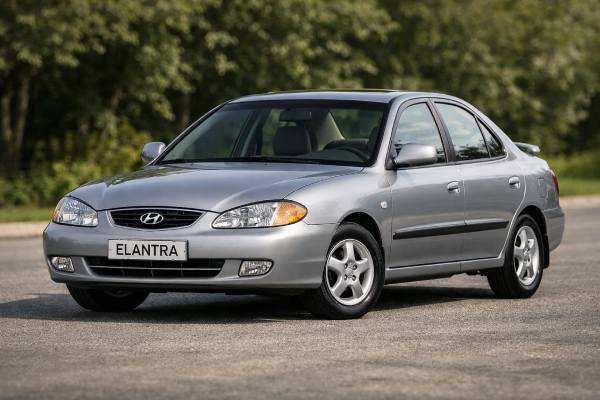
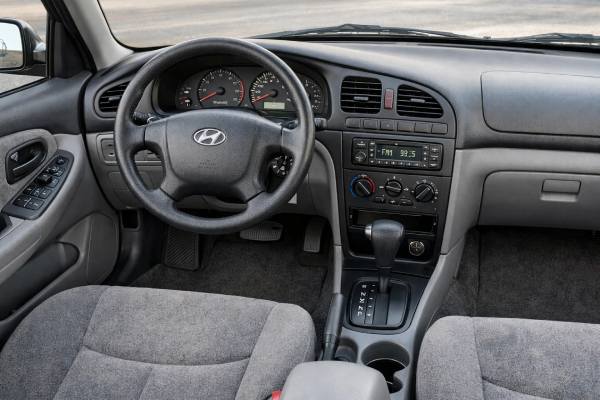
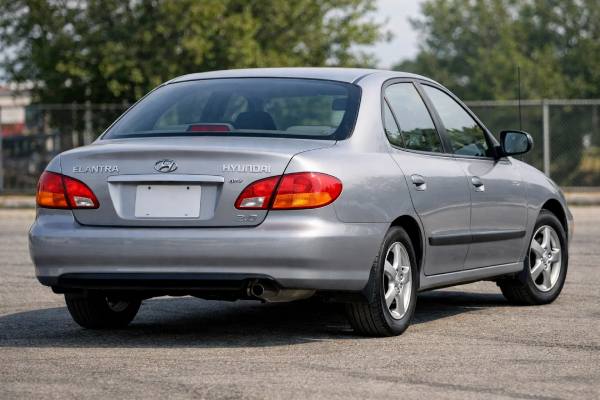
The facelifted Hyundai Elantra J2 2.0 is one of those late-1990s compact sedans that rewards buyers who care more about solid fundamentals than badge status. Its appeal starts with the naturally aspirated 2.0-liter Beta-series four-cylinder: simple, eager enough for daily use, and easier to live with long term than many later small turbo engines. Hyundai also gave the J2 a roomy cabin for its footprint, honest ergonomics, and a chassis that feels straightforward rather than fussy. This was still the era before complex driver-assistance systems, so ownership is mostly about mechanical condition, maintenance history, and corrosion control rather than software surprises. The facelift years from 1998 to 2000 are the sweet spot of the second-generation car, with the 140 hp engine bringing the most complete mix of performance and usability. Today, the Elantra J2 2.0 makes the most sense for buyers who want an affordable, easy-to-understand classic daily with parts availability and modest running costs.
What to Know
- The 2.0-liter G4GF engine gives the J2 better real-world pace than the smaller engines.
- Simple front-wheel-drive mechanicals make home maintenance and parts sourcing easier.
- A clean shell matters more than mileage, because age-related rust can outweigh engine wear.
- Timing belt history is essential on any car without documented service records.
- Plan on engine oil and filter changes every 12,000 km or 6 months in the factory schedule, with shorter intervals in severe use.
Section overview
- Hyundai Elantra J2 facelift profile
- Hyundai Elantra J2 2.0 specs
- Hyundai Elantra J2 trims and safety
- Known faults and service actions
- Maintenance and buying advice
- Road manners and economy
- How it stacks up to rivals
Hyundai Elantra J2 facelift profile
The second-generation Elantra, known in some export markets as the Lantra, arrived in the mid-1990s and stayed on sale through 2000 in facelifted form. For this article, the focus is the facelifted 2.0-liter 140 hp sedan, because it best captures what the J2 does well. It sits in the old compact-sedan tradition: front-wheel drive, a naturally aspirated inline-four, sensible exterior dimensions, and a layout designed around daily durability rather than fashion. Hyundai had not yet fully reached the refinement level of the Japanese class leaders, but by the end of the J2 run it had built a car that was more mature, better assembled, and mechanically stronger than many buyers remember.
The key mechanical feature is the 2.0-liter Beta-series G4GF engine. It is a 1,975 cc DOHC inline-four with multi-point injection, a 10.3:1 compression ratio, and output right around 139 to 140 hp with 182 Nm of torque. That does not sound dramatic today, but in a compact sedan from the late 1990s it gave the Elantra a useful advantage over lower-powered rivals and over its own smaller-engined trims. The engine is not especially exotic, and that is a compliment. It delivers its performance in a linear way, it does not rely on direct injection or turbocharging, and it is supported by a straightforward cooling, ignition, and intake layout that good independent shops still understand.
The facelift years also matter because they sharpened the Elantra’s value proposition. Hyundai was still a budget-focused brand, so even the better-equipped cars were usually simpler than premium rivals. For a used buyer today, that helps. There are fewer luxury systems to fail, and the core ownership concerns are refreshingly old-school: timing-belt service, oil leaks, power-steering seepage, brake wear, suspension bushings, and body corrosion. If the shell is solid and the maintenance history is real, the J2 can still be a usable and surprisingly pleasant daily classic.
Where the Elantra J2 shows its age is safety technology and crash philosophy. This is a pre-ESC, pre-AEB, pre-lane-keeping car. It belongs to an era when good visibility, predictable steering, and mechanical condition mattered more than electronic intervention. That does not make it unsafe by default, but it does mean buyers need realistic expectations. The best reason to own one now is not nostalgia alone. It is that the J2 2.0 remains a simple, honest compact sedan with enough performance to feel useful, enough cabin and trunk space to stay practical, and enough mechanical simplicity to be maintainable without modern-car diagnostic drama.
Hyundai Elantra J2 2.0 specs
Published figures for the facelifted J2 2.0 vary a little by market, body style, and transmission, so the table below centers on the sedan with the 2.0-liter G4GF engine and cross-checks North American trim data against widely shared J2 2.0 mechanical specifications. Where exact brake diameters, A/C oil charge, or market-specific trim details are not consistently published in the open sources, the safest answer is to verify by VIN and service manual before ordering parts.
| Powertrain and efficiency | Data |
|---|---|
| Code | G4GF |
| Engine layout and cylinders | Inline-4, DOHC, 4 valves per cylinder, 82.0 × 93.5 mm (3.23 × 3.68 in) |
| Displacement | 2.0 L (1,975 cc) |
| Motor | Not applicable |
| Induction | Naturally aspirated |
| Fuel system | MPFI |
| Compression ratio | 10.3:1 |
| Max power | 140 hp (about 102 kW) @ 6,000 rpm |
| Max torque | 182 Nm (134 lb-ft) @ 4,900 rpm |
| Timing drive | Belt |
| Rated efficiency | About 9.9 L/100 km city and 6.5 L/100 km highway for a manual; about 10.8 / 7.1 L/100 km for an automatic |
| Real-world highway at 120 km/h | Roughly 7.5–8.5 L/100 km in a healthy manual sedan |
| Transmission and driveline | Data |
|---|---|
| Transmission | 5-speed manual or 4-speed automatic |
| Drive type | FWD |
| Differential | Open |
| Chassis and dimensions | Data |
|---|---|
| Suspension (front/rear) | Independent front / independent rear; front strut-type and rear multi-link or coil-spring arrangement depending on source wording |
| Steering | Hydraulic power rack and pinion; about 15:1 overall ratio |
| Brakes | Front disc; rear drum on some North American trims, rear disc in some other markets |
| Wheels and tyres | Common size P195/60R14 on North American GLS; 195/65 R14 also appears in broader J2 2.0 listings |
| Ground clearance | About 158–160 mm (6.2–6.3 in) |
| Length / Width / Height | About 4,420–4,450 mm / 1,700 mm / 1,393–1,395 mm |
| Wheelbase | 2,550 mm (100.4 in) |
| Turning circle (kerb-to-kerb) | About 10.1 m (33.0 ft) |
| Kerb weight | About 1,158–1,280 kg (2,553–2,822 lb), depending on market and gearbox |
| GVWR | About 1,685 kg (3,715 lb) where published |
| Fuel tank | 52–55 L (13.7–14.5 US gal / 11.4–12.1 UK gal) |
| Cargo volume | About 324–390 L (11.4–13.8 ft³), depending on market measuring method |
| Performance and capability | Data |
|---|---|
| Acceleration | 0–100 km/h in about 8.6 s for the manual |
| Top speed | About 202 km/h (126 mph) for the manual |
| Braking distance | No reliable open-source tested figure confirmed for the exact facelift 2.0 sedan |
| Towing capacity | Up to about 680 kg (1,500 lb) in lighter-duty North American data; verify locally before towing |
| Payload | About 405 kg (893 lb) where published |
| Fluids and service capacities | Data |
|---|---|
| Engine oil | API SG or SG/CD; 5W-30, 5W-40, 10W-30, 10W-40, 10W-50, 20W-40, or 20W-50 by temperature band; total 4.0 L (4.23 US qt) |
| Coolant | Ethylene glycol-based coolant, 40–50% concentration; about 6.0–6.3 L (6.3 US qt) |
| Transmission / ATF | Hyundai ATF SP-II M or Genuine Diamond ATF SP-II M; automatic capacity about 6.6 qt |
| Differential / transfer case | Not applicable as a separate service item |
| A/C refrigerant | R-134a; 675–725 g (23.8–25.6 oz) |
| A/C compressor oil | Not clearly published in the open source reviewed |
| Key torque specs | Wheel nuts 90–110 Nm (66–81 lb-ft); spark plugs 20–30 Nm (15–21 lb-ft) |
| Safety and driver assistance | Data |
|---|---|
| Crash ratings | IIHS moderate overlap front overall rating A, applying to 1996–2000 U.S.-market sedan; no confirmed Euro NCAP result for this exact facelift 2.0 sedan found in the reviewed sources |
| Headlight rating | Not applicable for this era of IIHS testing |
| ADAS suite | None in the modern sense; ABS depended on market and trim |
These numbers explain why the 2.0-liter car is the one enthusiasts and careful used buyers usually want. It has enough power to feel genuinely brisk by late-1990s compact standards, and its mechanical simplicity remains one of its best ownership advantages today.
Hyundai Elantra J2 trims and safety
Trim structure on the facelifted J2 varied a lot by country, which matters more here than it does on newer cars. In North America you will most often see GL and GLS badges, while Europe and Australia also used Lantra naming and trim labels such as GL, GLS, and CDX. The practical takeaway is simple: do not buy solely on badge. Two cars with the same engine can differ meaningfully in brakes, wheel size, rear brake type, upholstery, air-conditioning fitment, and safety equipment. On late J2 cars, the better-equipped versions generally add the items that make the car easier to live with now: power accessories, air conditioning, better seat trim, and in some markets ABS.
Visual identifiers are basic but useful. A genuine higher-trim car usually has more complete interior trim, factory wheel covers or alloys depending on market, and cleaner switchgear around the center stack and doors. Because these cars are now old enough to have passed through many owners, you should treat badges and seller descriptions with caution. Interior condition often tells the truth faster than the badge does. If the trim is supposed to be a better-equipped 2.0 GLS but the car has a patchwork interior, missing A/C components, or non-matching door cards, budget extra inspection time. This generation is easy to keep alive mechanically, but it is just as easy for neglected examples to hide years of low-cost repairs.
Safety is where age shows most clearly. The J2 predates the era of modern active safety, so there is no AEB, no lane keeping, no blind-spot monitoring, and no electronic stability control in the way most buyers now understand it. The best verified crash-test reference in the reviewed sources is IIHS, which gave the 1996–2000 Elantra sedan an overall A rating in its original moderate-overlap front test, with strong structure and mostly good injury measures for that era. That is a positive result, but it should be read in historical context. A good late-1990s crash test is not the same thing as modern small-car crash performance.
Safety equipment also changed by market. ABS was available or standard in some trims, but not universally. Airbag fitment varied too, and open-source trim pages for some markets are inconsistent enough that the safest statement is this: verify the exact car rather than assuming universal dual-airbag or ABS fitment. Child-seat anchorage standards were also less uniform than on newer cars. If safety is a top priority, buy the cleanest, latest, best-equipped 2.0 you can find and inspect the seat belts, warning lamps, and front crash structure carefully. On a car this old, condition is part of the safety specification.
Known faults and service actions
The Elantra J2 2.0 has a better reputation for mechanical honesty than for perfection. Most of its common issues are old-car problems rather than design disasters, which is good news if you buy carefully. The engine itself is usually durable when serviced on time, but neglect changes the picture quickly. The most important age band now is not mileage alone. It is time. Any facelift J2 is old enough that dried seals, corroded lines, brittle plastic fittings, and deferred timing-belt service can matter more than whether the odometer shows 140,000 km or 240,000 km.
The highest-priority mechanical watchpoint is the timing-belt system. Factory interval material in the service manual shows inspection at 48,000 km and replacement at 96,000 km or 48 months in normal service. On a car this old, that means history is everything. If the seller cannot prove belt service, you should assume it needs a belt, tensioner, idler inspection, and usually a water-pump conversation at minimum. Closely behind that come routine leak points and wear items: valve-cover-area seepage, aging coolant hoses, tired accessory belts, and power-steering pump or hose leaks. Power-steering pump and hose leaks are among the more typical age-related complaints on late J2 cars, which fits the profile of these sedans well.
Driveability problems are the next major area. Open recall reporting for the 2000 U.S.-market Elantra shows recall 00V259 for intermittent low-speed engine stalling related to the MAF sensor connector wiring harness, with the official fix being harness rerouting. Even if your car is not a U.S.-market example, stalling, rough idle, or unstable low-speed running should make you check the intake and ignition basics before guessing at bigger failures. On older J2s, bad sensors, poor grounds, cracked intake hoses, dirty throttle bodies, and tired ignition parts are all more likely than some exotic internal engine problem.
Chassis and body issues are mostly age and climate related. Corrosion is the real budget killer. Check front lower control-arm mounting areas, subframe surfaces, rear arches, sills, floor seams, spring perches, brake lines, and the lower edges of doors and trunk openings. A tidy engine and fresh oil do not compensate for structural rust. Suspension bushings, ball joints, and brake hardware are normal wear items now, not surprises. The J2 is still easy to buy well, but only if you view it as an old mechanical car first and a bargain commuter second. There was one verified U.S.-market recall for the 2000 model in the reviewed sources, but regardless of market, buyers should still ask a Hyundai dealer or national VIN system to confirm any historic campaign status that applies locally.
Maintenance and buying advice
The best way to own a facelifted Elantra J2 2.0 is to treat it like a well-engineered old car, not a disposable cheap car. The service manual gives a solid baseline, and it is still useful because the car is mechanically simple. Factory guidance shows routine oil and filter changes by schedule, more frequent service in severe use, brake-fluid renewal every 24 months, timing-belt inspection at 48,000 km and replacement at 96,000 km or 48 months, plus regular checks of coolant, drive belts, hoses, brakes, transaxle fluid condition, and steering components. On a survivor now, conservative intervals are smarter than stretching anything.
| Item | Practical interval | Notes |
|---|---|---|
| Engine oil and filter | Every 6 months or 12,000 km in the factory schedule | Shorten for hard use, short trips, or unknown engine condition |
| Air filter | Inspect regularly; replace around 72,000 km in normal use | Replace earlier in dust or if airflow is poor |
| Fuel filter | Inspect or replace as needed; many owners replace preventively by 48,000–60,000 km | Useful on cars with hesitation or uncertain history |
| Spark plugs | About 96,000 km in normal schedule, sooner in hard use | Correct heat range matters |
| Brake fluid | Every 24 months | Use DOT 3 |
| Coolant | Every 24 months at the 96,000 km service point in the reviewed manual | Keep the concentration around 40–50% |
| Timing belt | Inspect by 48,000 km / 24 months; replace by 96,000 km / 48 months | History is critical |
| Drive belts | Inspect every service | Replace if cracked, glazed, or oil-soaked |
| Manual transaxle oil | Inspect condition and level regularly | Change early if the shift feel is poor |
| Automatic fluid | Check hot level and condition regularly | Use Hyundai ATF SP-II type fluid |
| Tires | Rotate and inspect every 10,000–12,000 km | Alignment matters on older suspension bushings |
| SRS inspection | Every 10 years in the service-manual guidance | Mostly relevant now as a condition check |
Useful fluid and torque figures from the reviewed service-manual data include 4.0 L total engine oil capacity, ethylene-glycol coolant at roughly 6.3 US qt, automatic transmission fluid capacity of 6.6 qt, wheel-nut torque of 90–110 Nm, and spark-plug torque of 20–30 Nm. For oil viscosity, the open service data allows several grades by climate band, including 5W-30 and 5W-40. That flexibility is helpful for older cars used in mixed climates.
As a used buy, prioritize condition in this order: body shell, timing-belt proof, cooling-system health, steering and suspension play, gearbox behavior, then cosmetics. The best cars are usually unmodified, rust-light, and owned by someone who kept receipts. A manual 2.0 is the most appealing long-term choice because it keeps the car simple and lets the engine feel more alive. An automatic can still be a good buy, but only if the shifts are clean and the fluid history is believable. Expect common reconditioning items such as tires, brakes, engine mounts, accessory belts, shocks, and small gasket leaks. Long-term durability is still respectable, but only if you buy a car that was maintained as transport rather than merely tolerated as transport.
Road manners and economy
By modern standards, the Elantra J2 2.0 feels light, direct, and pleasantly uncomplicated. That is its charm. The steering is hydraulic, so it has a more natural on-center feel than many newer low-cost electric systems, even if it is not especially chatty. Ride quality is typical of late-1990s compact sedans: compliant enough in town, sometimes a little busy over broken surfaces, but rarely harsh if the dampers and bushings are still healthy. Straight-line stability is good enough for motorway use, though worn suspension parts and bargain tires can quickly make an old J2 feel less secure than the platform really is.
The 2.0-liter engine is the reason this version stands apart from the smaller J2 trims. Output of roughly 140 hp and 182 Nm gives the car a respectable power-to-weight ratio for the era, especially with the manual gearbox. The best published manual figure in the reviewed data is about 8.6 seconds from 0 to 100 km/h with a top speed around 202 km/h. Those are strong numbers for an affordable compact sedan from this period. More important than the raw number is the way the car delivers it. There is no turbo lag, no complicated hybrid blending, and no dual-clutch hesitation. Throttle response is clean, and the engine feels happiest when allowed to rev rather than lug.
Fuel economy is acceptable rather than exceptional today. The best period figures in the reviewed sources put the manual sedan around 9.9 L/100 km in city driving and 6.5 L/100 km on the highway, with the automatic slightly thirstier at 10.8 and 7.1 L/100 km. Real-world highway consumption at 100 to 120 km/h usually lands a bit above the period brochure-style best case, especially on tired oxygen sensors, old tires, or poor alignment. That still leaves the J2 2.0 as a manageable car to run, because it combines modest fuel use with cheap, basic maintenance.
Noise, vibration, and harshness are about what you would expect from a late-1990s Korean compact. At idle, a healthy engine is smooth enough. At motorway speed, there is more wind and tire noise than in a newer Elantra, but not enough to make the car tiring if the door seals and wheel bearings are good. Braking feel is simple and easy to judge. If you test-drive one and it feels vague, noisy, or nervous, assume it needs mechanical attention rather than blaming the base design. A sorted J2 is not sporty, but it is tidy, predictable, and more enjoyable than many buyers expect.
How it stacks up to rivals
In period, the Elantra J2 2.0 competed with cars like the Toyota Corolla, Honda Civic sedan, Nissan Sentra, Mazda 323/Protegé, and Ford Focus at the very end of its run. It did not lead the class for prestige or polish, but it did offer one thing that still matters in the used market: strong value. The Hyundai usually cost less to buy, often came decently equipped, and with the 2.0-liter engine it had enough performance to avoid feeling like the bargain option dynamically. That remains true today. If you are choosing among old compact sedans as a hobby daily or low-cost classic commuter, the J2’s price-to-performance ratio is still one of its strongest cards.
Against a same-era Corolla, the Hyundai usually loses on long-term reputation and trim quality, but often wins on purchase price and engine punch in 2.0 form. Against a Civic sedan of the era, it is less sharp and less prestige-backed, yet it can feel roomier and often costs much less to put on the road. Against the Protegé, it is usually softer and less playful, but easier to justify if your priority is simple transport with straightforward parts sourcing. Against an early Focus, the Elantra gives up some handling sparkle but can return the favor with simpler ownership and less electronic fuss.
The biggest limitation is that the rivals often age better in the body and trim details, especially if the Hyundai lived in a wet or salty climate. A rusty J2 is rarely worth rescuing unless it has sentimental value or unusual originality. But a clean J2 2.0 with proper maintenance can be a very smart buy. It has enough engine, enough space, enough simplicity, and enough parts support to remain practical. That combination makes it more interesting than the brand image alone suggests.
So the verdict is straightforward. The facelifted 1998–2000 Hyundai Elantra J2 2.0 is not the collector’s choice of its era, and it is not the safest old compact by modern standards. What it is, when bought well, is a durable and genuinely useful old sedan with honest engineering, decent performance, and low entry cost. For buyers who value mechanical simplicity, the 140 hp version is the one that makes the strongest case.
References
- 1999 Hyundai Elantra | Specifications – Car Specs | Auto123 1999
- Hyundai Elantra II 2.0 16V (139 Hp) | Technical specs, data, fuel consumption, Dimensions 1996
- 2000 Hyundai Elantra 2000 (Safety Rating)
- Free Service Manual for the 2000 Hyundai Elantra GLS Sedan L4-2.0L | Operation CHARM 2000 (Service Manual)
- 2000 Hyundai ELANTRA Recalls | Cars.com 2000 (Recall Database)
Disclaimer
This article is for informational purposes only and is not a substitute for professional diagnosis or repair. Specifications, torque values, intervals, procedures, and even safety equipment can vary by VIN, market, body style, and trim, so always verify the exact vehicle against official service documentation and local Hyundai records before servicing or buying.
If this guide was useful, please share it on Facebook, X, or another platform to support our work.