
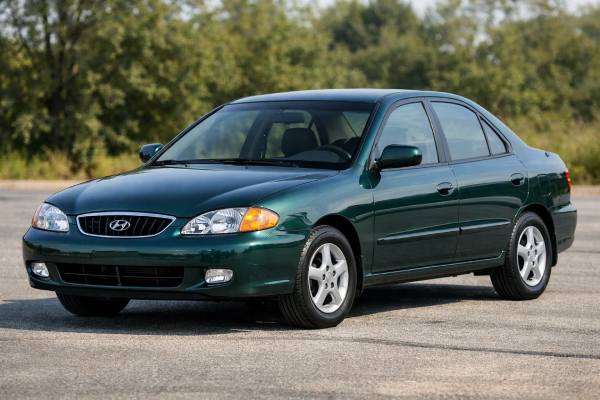
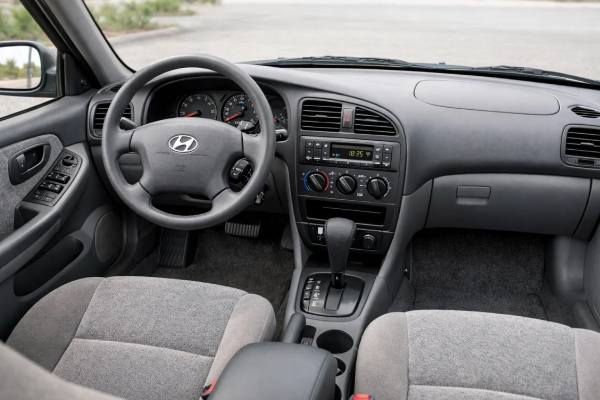

The facelifted Hyundai Elantra J2 with the 1.5-litre 88 hp petrol engine sits in an interesting place today. It is not the fastest or most sophisticated compact sedan of its era, but it offers something many modern budget cars still struggle to match: honest simplicity. This Elantra uses a naturally aspirated four-cylinder engine, a manual gearbox in most 1.5-litre versions, and straightforward front-wheel-drive packaging. That makes it easy to understand, usually affordable to repair, and realistic to keep on the road if rust and overdue maintenance have not already caught up with it. For buyers, the real appeal is value. You get a roomy cabin, decent ride comfort, predictable controls, and relatively simple mechanical systems. The main caution is age. By now, the condition of the timing belt, cooling system, seals, suspension joints, and body shell matters far more than the badge or brochure spec sheet.
Fast Facts
- Simple naturally aspirated 1.5-litre engine makes the J2 Elantra easier to maintain than many newer compact cars.
- Cabin space and everyday comfort are better than many people expect from a late-1990s budget sedan.
- Basic mechanical layout means parts and repairs are usually manageable if the car has not been neglected.
- Rust, overdue timing-belt service, and cooling-system wear are the biggest ownership risks today.
- Treat any undocumented timing belt as overdue if it is older than 4–5 years or around 60,000–90,000 km.
What’s inside
- Hyundai Elantra J2 facelift essentials
- Hyundai Elantra J2 1.5 data
- Hyundai Elantra J2 trims and safety
- Reliability and aging weak spots
- Maintenance and smart buying
- On-road manners and economy
- Elantra J2 against rivals
Hyundai Elantra J2 facelift essentials
The Hyundai Elantra J2 facelift is best understood as a value-focused compact sedan from a period when Hyundai was improving quickly but had not yet reached the polish of Japanese class leaders. In facelifted 1998–2000 form, the J2 looked a little cleaner and more mature than the early version, and equipment often improved depending on region. The exact nose design, trim naming, bumpers, and standard features varied by market, but the formula stayed the same: roomy body, straightforward controls, and more equipment for the money than many rivals.
For the specific 1.5-litre 88 hp version, performance is modest but honest. This is not the twin-cam or 2.0-litre J2 that tries to feel brisk. It is the basic naturally aspirated Alpha-series setup, chosen more for affordability and acceptable fuel economy than for speed. In daily use, that means easy servicing, uncomplicated cold starts when healthy, and predictable behaviour. It also means you need to manage expectations. The 1.5 works fine in town and on secondary roads, but it feels strained when fully loaded or when asked to make quick motorway passes.
Where the J2 still deserves credit is packaging. Even in period, Hyundai pushed the Elantra as a compact that did not feel cramped, and that remains true. The cabin is roomy enough for adults, visibility is good by modern standards, and the sedan boot is useful. It also rides with more softness than some rivals from the same era, which makes it a decent cheap commuter or second car if the suspension is still in good shape.
The stronger ownership argument today is mechanical transparency. There is no modern driver-assistance hardware, no dual-clutch gearbox, no direct injection, and no turbocharger. For many buyers, especially those looking for a low-cost classic daily or a first project car, that simplicity is the biggest advantage. You can inspect most of the known trouble spots without specialist equipment. A tired Elantra J2 usually tells you what it needs through noise, leaks, heat, vibration, or poor idle quality rather than through cryptic warning messages.
That said, age changes the verdict. A neglected example can quickly become poor value because corrosion, overdue belt service, old coolant, tired rubber parts, and brittle electrics stack up fast. On this model, condition matters more than specification. A clean, rust-free 1.5 with documented servicing is worth more than a shinier but neglected higher-spec car. That is the right mindset for this generation of Elantra.
In short, the facelifted J2 1.5 is a sensible old-school compact sedan. Its advantages are simplicity, space, comfort, and low entry cost. Its weaknesses are modest power, dated safety, and the fact that every surviving car is now old enough to be judged mainly on upkeep rather than design.
Hyundai Elantra J2 1.5 data
Publicly available period-correct data for this exact facelifted 1.5-litre 88 hp version is thinner than it is for later Elantras, and some figures vary by country, trim, tyre package, and test standard. The table below focuses on the values most consistently associated with the J2 1.5 12V sedan. Where market variation is common, that is stated clearly rather than hidden.
Powertrain and efficiency
| Item | Hyundai Elantra J2 1.5 12V 88 hp |
|---|---|
| Code | G4EK |
| Engine layout and cylinders | Inline-4 |
| Valvetrain | SOHC, 3 valves per cylinder |
| Bore × stroke | 75.5 × 83.5 mm (2.97 × 3.29 in) |
| Displacement | 1.5 L (1,495 cc) |
| Induction | Naturally aspirated |
| Fuel system | MPFI / multi-point injection |
| Compression ratio | 10.0:1 |
| Max power | 88 hp (65 kW) @ 5,600 rpm |
| Max torque | 130 Nm (95.9 lb-ft) @ 3,050 rpm |
| Timing drive | Belt |
| Rated efficiency | About 7.3–7.8 L/100 km combined, depending on market test method |
| Real-world highway @ 120 km/h (75 mph) | Usually about 7.5–8.5 L/100 km in good condition |
Transmission and driveline
| Item | Data |
|---|---|
| Transmission | 5-speed manual transaxle |
| Drive type | FWD |
| Differential | Open |
Chassis and dimensions
| Item | Data |
|---|---|
| Suspension front / rear | MacPherson strut front / independent multi-link rear |
| Steering | Power-assisted rack-and-pinion |
| Brakes | Front ventilated discs / rear drums; ABS optional by market and trim |
| Wheels and tyres | 185/65 R14 or 195/60 R14 were common late-period sizes |
| Ground clearance | Usually around 150–160 mm, market-dependent |
| Length | 4,420 mm (174.0 in) |
| Width | 1,700 mm (66.9 in) |
| Height | 1,393 mm (54.8 in) |
| Wheelbase | 2,550 mm (100.4 in) |
| Turning circle (kerb-to-kerb) | Typically around 10.2–10.5 m (33.5–34.4 ft) |
| Kerb weight | Roughly 1,160–1,240 kg (2,557–2,734 lb), depending on market and equipment |
| GVWR | Around 1,685 kg (3,715 lb), market-dependent |
| Fuel tank | About 52–55 L (13.7–14.5 US gal / 11.4–12.1 UK gal) |
| Cargo volume | About 393 L (13.9 ft³) seats up |
Performance and capability
| Item | Data |
|---|---|
| 0–100 km/h (0–62 mph) | About 11.2–12.5 s, depending on source and market |
| Top speed | About 185–190 km/h (115–118 mph) |
| Braking distance | No reliable factory figure widely published |
| Towing capacity | Market-dependent; verify by VIN and registration data |
| Payload | Typically around 430–500 kg depending on exact curb mass |
Fluids and service capacities
| Item | Data |
|---|---|
| Engine oil | 10W-30 or 10W-40, API SH-class period spec or suitable modern equivalent; 3.3 L (3.49 US qt) |
| Coolant | Ethylene glycol type suitable for Hyundai alloy head engines; 50:50 mix typical; 6.0 L (6.34 US qt) |
| Transmission / gear oil | Verify by gearbox code and market manual before filling |
| Differential / transfer case | Not separately serviced on this FWD layout |
| A/C refrigerant | Varies by market and compressor setup; verify under-bonnet label |
| A/C compressor oil | Verify by compressor type |
| Key torque specs | Always verify in service data for the exact car; do not rely on generic internet values |
Safety and driver assistance
| Item | Data |
|---|---|
| Crash ratings | Euro NCAP result for this exact facelift/engine version is not commonly published; IIHS moderate overlap front rating for 1996–2000 U.S. sedan: Acceptable overall |
| Headlight rating (IIHS) | Not published for this generation |
| ADAS suite | None; no AEB, ACC, lane assist, blind-spot monitoring, or rear cross-traffic systems |
These figures explain the Elantra J2 1.5 clearly. It is a conventional late-1990s compact sedan with modest output, practical dimensions, and easy-to-understand mechanicals. That simplicity is still one of its strongest advantages.
Hyundai Elantra J2 trims and safety
The J2 Elantra was sold in many regions, so trim structure is less tidy than on newer Hyundai models. Some markets used simple badge levels, others used engine-linked equipment grades, and late-facelift stock often mixed features depending on what importers ordered. That means the smartest way to evaluate a car is not by trim name alone. It is by actual equipment on the car in front of you.
On the 1.5-litre 88 hp facelifted sedan, the baseline setup was usually quite simple. Expect cloth seats, manual air conditioning or no air conditioning on poorer-market cars, manual or basic power windows, steel wheels on low trims, and a cassette-era audio unit if the car still has its original equipment. Better-equipped examples could add alloy wheels, ABS, power mirrors, power windows, central locking, rear headrests, a tachometer, and in some markets a sunroof or upgraded audio. By the late J2 years, Hyundai had become much better at offering a generous value package, so some cars feel better equipped than their reputation suggests.
There were also meaningful year-to-year differences. In some markets, late-1999 and 2000 cars bundled more convenience equipment into fewer trim levels. Hyundai did this in several export markets as it tried to strengthen value perception. That matters today because a late-facelift car can feel noticeably better specified even when the mechanical package is unchanged. When inspecting one, look for practical identifiers: tachometer or no tachometer, wheel type, presence of ABS warning lamp, power rear windows, mirror controls, and airbag markings on the steering wheel and dashboard.
Safety is where you need to judge the J2 fairly but honestly. For its era, it was not embarrassingly bare. Dual front airbags were available or standard in many markets by the late 1990s, front seat-belt pretensioners appeared on better-equipped versions, and ABS was available in some regions. The body shell also used front and rear crumple-zone thinking typical of the period. However, it remains a late-1990s compact car. You do not get electronic stability control, side-curtain airbags, modern seat design, or any driver-assistance systems.
For U.S.-market 1996–2000 Elantra sedans, IIHS gave the moderate-overlap frontal test an overall Acceptable rating, and the rating applies to 1996–2000 models. IIHS also noted that bumpers were improved from 1999. That does not make the J2 a modern safe car, but it does show Hyundai was improving structure and restraint performance during this generation.
Child-seat support is similarly period-correct rather than modern. Some cars had child-seat anchor provisions, but ISOFIX/LATCH convenience was not a consistent strength. Any owner planning family duty should inspect rear belt condition, buckle operation, and anchor-point integrity rather than assuming modern compatibility.
The key takeaway is simple. In trim and safety terms, the facelifted J2 is best when found as a late car with airbags, ABS, power conveniences, and a clear equipment list. It is still a budget-era Hyundai, but a well-kept higher-spec example can feel far less bare than expected.
Reliability and aging weak spots
Reliability on the facelifted Elantra J2 is no longer mainly about design. It is about age, maintenance history, and whether rust has overtaken the car. The underlying mechanical package is simple and generally durable when serviced on time, but three decades of heat cycles, cheap repairs, and deferred maintenance now define the ownership experience far more than the original factory engineering.
The most important issue is the timing belt. This is a belt-driven engine, not a chain-driven one, and any car with unknown timing-belt history should be treated as overdue immediately. On cars like this, the belt itself is only part of the risk. The tensioner, idlers, and water pump matter too. Symptoms of neglect include belt noise, coolant seepage around the pump, unstable ignition timing feel, or a seller who says the belt was “probably done once.” The remedy is simple: replace the full belt service set and do not gamble.
Oil leaks are common and usually low to medium cost. Expect valve-cover gasket seepage, camshaft and crankshaft seal sweating, and occasional oil around the sump or distributor area depending on exact setup. These are not usually catastrophic, but they matter because neglected leaks shorten belt life, soften rubber mounts, and coat the front of the engine bay in grime. A dry engine is a strong sign on any old J2.
Cooling-system wear is another major age-related problem. Radiator plastic end tanks, upper and lower hoses, thermostat housings, and heater hoses all deserve inspection. The J2 does not tolerate repeated overheating well. If a car shows brown coolant, a weak heater, rising temperature in traffic, or signs of past coolant loss, assume you will need a proper cooling-system refresh. Head-gasket failure is not the car’s main weakness, but overheating can push it there.
Idle and running issues are usually caused by straightforward petrol-engine faults: dirty throttle body, tired ignition leads, worn plugs, vacuum leaks, weak battery, or a sticky idle control system. That is good news because most of these faults are diagnosable without advanced scan tools. Fuel pumps and injectors can also age out, but they are less common than simple ignition and air-leak problems.
On the driveline side, a healthy manual gearbox is usually durable, but old cars can develop weak synchromesh, tired clutch hydraulics, worn clutch kits, or leaking driveshaft seals. Listen for bearing whine and test second- and third-gear engagement carefully when cold and warm. Suspension wear is common rather than alarming: front lower-arm bushes, ball joints, drop links, top mounts, rear bushes, and wheel bearings are all normal age-related jobs.
The real high-cost threat is corrosion. Check sills, rear wheel arches, floor edges, subframe mounting points, front chassis legs, strut towers, brake lines, fuel lines, and spare-wheel wells. Cosmetic rust is one thing. Structural rust is the point where a cheap J2 stops being good value.
There are no meaningful modern software campaigns to worry about here. This is a largely mechanical ownership proposition. Buy the cleanest body, coolest-running engine, and best-documented belt history you can find.
Maintenance and smart buying
Owning a Hyundai Elantra J2 1.5 well means being proactive instead of reactive. The good news is that the car responds well to basic maintenance. The bad news is that a neglected one can consume time and money through a long list of small jobs. The best strategy is to treat the car like an old mechanical sedan, not a disposable cheap runabout.
A practical maintenance plan looks like this:
| Item | Practical interval |
|---|---|
| Engine oil and filter | Every 10,000 km or 12 months |
| Engine air filter | Inspect every 10,000 km; replace around 20,000–30,000 km or sooner in dusty use |
| Cabin air filter | Not fitted to every market version; inspect if equipped |
| Coolant | Inspect yearly; full renewal usually every 2–3 years with the correct mix |
| Spark plugs | Around 30,000 km for standard copper plugs; longer if a compatible upgraded plug type is fitted |
| Fuel filter | Replace to market schedule or when fuel-delivery condition is poor |
| Timing belt | Replace at the factory interval; if history is unknown, treat as overdue now |
| Water pump | Replace with timing-belt service if there is no proof it was done |
| Auxiliary belts and hoses | Inspect at every service |
| Manual gearbox oil | Check leaks and shift quality; refresh at sensible intervals on older cars |
| Brake fluid | Every 2 years |
| Brake pads, shoes, discs, and drums | Inspect every service |
| Tyre rotation and alignment | Rotate about every 10,000 km; align if wear is uneven |
| Valve clearances | Usually not a frequent issue on this engine, but investigate tapping properly |
| 12 V battery | Test from year 4 onward; replace on condition, not just on failure |
For fluids, the most useful public figures are the engine oil and coolant capacities. Engine oil capacity is about 3.3 L with filter. Coolant capacity is about 6.0 L. Use the correct oil grade for climate and condition, usually 10W-30 or 10W-40 in a period-correct spec or a suitable modern equivalent. Gearbox oil type and fill quantity should be confirmed by gearbox code before service because old Hyundai transaxles are not a place for guesswork.
A smart buyer’s checklist is simple:
- Verify timing-belt history with receipts, not promises.
- Inspect radiator, coolant colour, and signs of past overheating.
- Check for oil leaks at the top and front of the engine.
- Drive the car long enough to test hot idle, clutch take-up, and second-gear engagement.
- Inspect arches, sills, jacking points, floor edges, and brake lines for corrosion.
- Look for uneven tyre wear that suggests tired bushes or poor alignment.
- Test every electrical switch, blower speed, light, and locking function.
For recommended versions, condition matters more than trim. A rust-free manual 1.5 with working cooling system and documented belt service is the right type of car. Avoid neglected cars with fresh paint over old corrosion, overheating history, or vague service stories. On long-term durability, the J2 can still be a dependable low-cost sedan, but only when bought on body condition and maintenance quality, not price alone.
On-road manners and economy
The Elantra J2 1.5 drives exactly like the kind of car it is: a comfort-oriented compact sedan from the late 1990s, tuned to feel easy rather than exciting. That is not a criticism. In fact, it is one of the reasons the car can still work well as a cheap commuter. The steering is light, visibility is good, and the controls are simple. Around town, it feels smaller than many modern compact sedans, which helps in traffic and parking.
The ride is generally softer than many buyers expect. A healthy J2 absorbs ordinary bumps well and does not crash harshly over imperfect urban roads. The independent rear suspension helps the car feel more settled than some budget rivals that used simpler rear layouts. It is not sporty, but it is more composed than its bargain reputation suggests. Body roll exists, of course, and the car does not encourage hard cornering, but the basic balance is predictable and friendly.
The 1.5-litre engine is adequate rather than strong. In city driving, it feels acceptable because the gearing and light controls suit stop-start work. Once speeds rise, the modest 88 hp output becomes obvious. Overtakes need planning, hills require downshifts, and a fully loaded car feels much slower than the brochure suggests. On the positive side, the engine’s naturally aspirated character makes throttle response fairly linear. There is no turbo lag, and the mechanical layout is easy to live with when maintained properly.
Highway refinement is period-correct. At 100 km/h, the car is still calm enough for daily use. At 120 km/h, road and wind noise become more noticeable, and the engine feels busier. That does not make it unusable, but it does mean the Elantra J2 is happier on ordinary roads than on long, fast motorway runs. Braking feel is usually decent if the system is fresh, though rear drums and old hoses can make neglected cars feel duller than they should.
Real-world fuel use depends heavily on condition. A healthy manual car can still return reasonable numbers for its age. In mixed use, expect roughly 7.5–8.5 L/100 km. City use often lands around 9.0–11.0 L/100 km depending on traffic and engine condition. Fast motorway running usually pushes the car into the high-7s or low-8s. A tired ignition system, sticky brakes, worn alignment settings, or low compression can worsen economy quickly, so fuel consumption is also a good clue about condition.
There is no traction system or electronic chassis help to discuss because this is a simple front-wheel-drive car from an earlier era. Tyre quality matters more than on many modern cars. Good tyres make the steering cleaner, the wet-weather braking more secure, and the whole car feel better tied down.
In short, the J2 1.5 is easygoing, comfortable enough, and honest. It feels most at home as a low-stress daily car, not as a fast long-distance machine.
Elantra J2 against rivals
In its own era, the Elantra J2 fought cars such as the Toyota Corolla E110, Honda Civic EK/EJ sedan, Nissan Almera N15, Mazda 323 BJ, Mitsubishi Lancer, and Daewoo Nubira. Today, that comparison matters mainly to used-car buyers and enthusiasts choosing an affordable old compact. Against those rivals, the Hyundai’s biggest strengths are value, space, and simplicity.
Compared with a Corolla of the same age, the Elantra usually offers more equipment for the money and a softer, more comfort-oriented feel. The Toyota often wins on long-term durability reputation and parts-network confidence, but the Hyundai can feel like the better bargain if you find a clean one. Against the Civic, the Elantra is less engaging to drive and less crisp in cabin design, but often roomier and cheaper to buy. Against the Almera, it is competitive on practicality and comfort, though Nissan generally held a stronger quality image at the time.
The Elantra’s best real-world advantage is that it feels like a slightly bigger car than some rivals while still remaining mechanically straightforward. The cabin and boot are useful, and late-facelift equipment can be generous enough to make the car feel less basic than expected. That is why good surviving examples still attract sensible buyers.
Its disadvantages are just as clear. Rust protection is not class-leading. The 1.5-litre engine is one of the weaker petrol options in the segment. Safety is dated even by early-2000s standards, and parts quality on neglected examples can feel inconsistent because many cars have already been repaired with mixed aftermarket components. It is also a car where bad ownership hurts more than on a sturdier rival. A neglected Corolla may still limp along. A neglected Elantra J2 often feels tired everywhere at once.
As a used buy today, the Elantra J2 1.5 makes the most sense when compared on condition rather than brand prestige. If you find one with a solid shell, proper cooling-system care, recent timing-belt service, and a tight manual gearbox, it can be a very smart low-cost choice. If you are comparing rough, rusty examples, a cleaner rival is almost always the better answer.
So how does it compare overall? The Elantra J2 is not the segment icon, but it remains one of the more sensible under-the-radar options. Its main strengths are practical space, uncomplicated engineering, and value. Its main weaknesses are rust, modest performance, and old-car age risk. Choose on maintenance history, not nostalgia, and it can still be a rewarding budget sedan.
References
- HYUNDAI ELANTRA SEDAN ADDS EVEN MORE FEATURES FOR 2000 MODEL YEAR 1999
- 2000 Hyundai Elantra 2026 (Safety Rating)
- Vehicle Detail Search – 2000 Hyundai Elantra 2026 (Recall Database)
- Manuals & Warranties | Hyundai Resources | MyHyundai 2026 (Owner Resources)
Disclaimer
This article is for informational purposes only and is not a substitute for professional diagnosis or repair. Specifications, torque values, intervals, procedures, and equipment can vary by VIN, market, trim, and prior repair history, so always verify details against the official service documentation for the exact vehicle.
If this guide helped you, please consider sharing it on Facebook, X/Twitter, or other social platforms to support our work.