
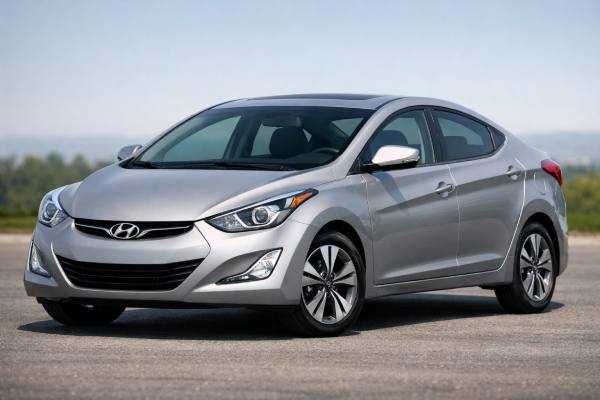
The facelifted Hyundai Elantra UD 1.8 MPI is a compact sedan that makes its case through balance rather than drama. It gives you a roomy cabin, a large trunk, tidy road manners, and a naturally aspirated 1.8-liter four-cylinder that stays simpler than many later turbocharged rivals. For the 2014 to 2016 facelift years, Hyundai also sharpened the styling, revised trim structure, and improved the overall sense of polish without changing the car’s basic strengths. In this version, the 1.8-liter Nu engine is rated at 145 hp and 130 lb-ft in the U.S.-market facelift documentation, paired with a six-speed manual or six-speed automatic. That is enough to make the Elantra feel useful rather than quick, and that is exactly the point. It is a practical daily driver first. A good one can still be an excellent used buy, but recall history, chain health, suspension wear, and overall maintenance discipline matter far more than the price tag alone.
At a Glance
- The 1.8 MPI engine is smooth, simple, and easier to live with than many later small turbo engines.
- Rear-seat room and a large trunk make the facelifted UD more practical than many compact rivals.
- Six-speed manual and automatic choices keep the drivetrain conventional and widely serviceable.
- Poor oil service can accelerate timing-chain wear and create startup noise or fault codes.
- A smart oil and filter interval is every 10,000 to 12,000 km or 12 months.
On this page
- Hyundai Elantra UD facelift overview
- Hyundai Elantra UD facelift specs
- Hyundai Elantra UD facelift trims and safety
- Reliability issues and recall history
- Maintenance schedule and buyer advice
- Driving impressions and real-world economy
- How the facelift Elantra compares
Hyundai Elantra UD facelift overview
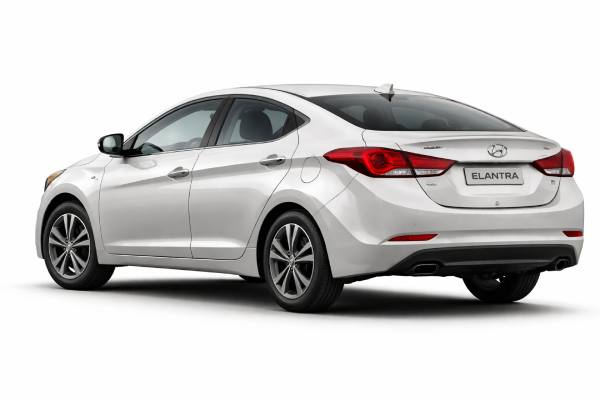
The 2014 to 2016 facelifted Elantra UD is a useful example of how a mid-cycle update can improve a car without rewriting its character. Hyundai did not turn the Elantra into something sportier or more luxurious than it really was. Instead, it refined the package buyers already liked. The facelift brought a revised front and rear design, cleaner detailing, and a slightly more polished look overall. More importantly, it kept the things that made the original UD strong in the first place: generous cabin room, a large trunk, low running costs, and a naturally aspirated engine that avoided the extra complexity of the turbocharged trend that came later.
That 1.8-liter Nu MPI engine is the center of the ownership case here. In facelift-era U.S. documentation, Hyundai lists it at 145 horsepower and 130 lb-ft of torque, standard on SE, Value Edition, and Limited trims. It is not an engine that sells the car on excitement, but it fits the Elantra’s purpose very well. Power delivery is linear, cold-start behavior is usually smooth when the car is healthy, and the absence of direct injection means the intake system avoids one of the more annoying long-term issues seen in later mainstream engines. The six-speed manual and six-speed automatic are also conventional enough that independent repair shops usually understand them well.
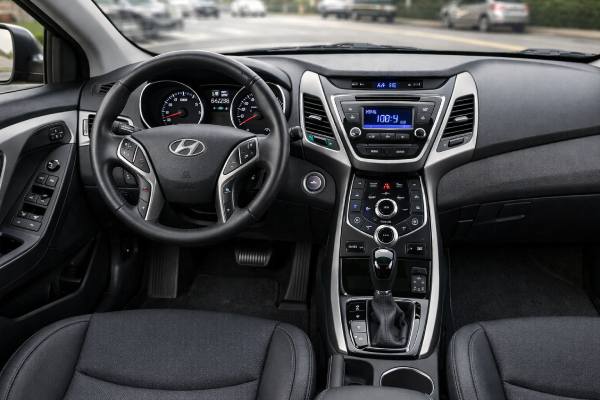
The rest of the car follows that same logic. This Elantra is not about one standout feature. It is about being consistently useful. Rear-seat room is generous for the class, the sedan trunk is genuinely practical, and the dashboard layout remains easy to live with even now. Visibility is better than in many newer compact sedans, and the overall footprint is easy to manage in town. Hyundai was clearly aiming for a compact family car that felt larger and more comfortable than its price might suggest, and the UD still delivers on that.
The flip side is that this generation now lives in the tricky zone where used examples can look clean while hiding years of average maintenance. A shiny 2015 or 2016 Elantra is not automatically a good Elantra. Cold-start chain noise, overdue fluid changes, tired suspension hardware, brake drag, cheap tyres, and unresolved recall work can all lurk beneath decent cosmetics. That is why the facelifted UD 1.8 is best understood as a smart, well-balanced used sedan that rewards careful buying. Buy a documented, honest example and it feels calm, roomy, and inexpensive to own. Buy the cheapest one you find, and the same car can feel older and rougher than it should.
Hyundai Elantra UD facelift specs
The table below focuses on the facelifted 2014 to 2016 Elantra sedan with the 1.8 MPI engine in 145 hp form. Because this generation was sold in multiple markets and trims, some weights, tyre sizes, and brake arrangements vary slightly. The core mechanical layout remains consistent.
| Powertrain and efficiency | Data |
|---|---|
| Code | Nu 1.8 MPI family engine |
| Engine layout and cylinders | Inline-4, DOHC, 4 valves per cylinder, about 81.0 × 87.1 mm (3.19 × 3.43 in) |
| Displacement | 1.8 L (1,797 cc) |
| Motor | Not applicable |
| Induction | Naturally aspirated |
| Fuel system | MPI |
| Compression ratio | About 10.3:1 |
| Max power | 145 hp (108 kW) @ 6,500 rpm |
| Max torque | 176 Nm (130 lb-ft) @ 4,700 rpm |
| Timing drive | Chain |
| Rated efficiency | About 7.4–7.6 L/100 km combined for the automatic on 15–16 inch wheels, a little better with the manual in equivalent use |
| Real-world highway @ 120 km/h | About 6.3–7.2 L/100 km in a healthy car |
| Transmission and driveline | Data |
|---|---|
| Transmission | 6-speed manual or 6-speed automatic |
| Drive type | FWD |
| Differential | Open |
| Chassis and dimensions | Data |
|---|---|
| Suspension (front/rear) | MacPherson strut front / torsion-beam rear |
| Steering | Motor-driven electric power steering rack |
| Brakes | Front ventilated discs; rear discs on many trims, though some lower-spec market versions can differ |
| Wheels and tyres | 195/65 R15, 205/55 R16, and 215/45 R17 were common depending on trim |
| Ground clearance | About 140 mm (5.5 in) |
| Length / Width / Height | 4,550 mm / 1,775 mm / 1,445 mm (179.1 / 69.9 / 56.9 in) |
| Wheelbase | 2,700 mm (106.3 in) |
| Turning circle (kerb-to-kerb) | About 10.6 m (34.8 ft) |
| Kerb weight | Roughly 1,230–1,285 kg (2,712–2,833 lb), depending on trim and transmission |
| GVWR | About 1,760 kg (3,880 lb), depending on market |
| Fuel tank | About 48.5 L (12.8 US gal / 10.7 UK gal) |
| Cargo volume | 420–460 L (14.8–16.2 ft³), depending on market method; 460 L is the commonly cited sedan figure |
| Performance and capability | Data |
|---|---|
| Acceleration | 0–100 km/h in about 10.0–10.6 s, depending on gearbox |
| Top speed | About 195–202 km/h (121–126 mph), depending on specification |
| Braking distance | No single validated manufacturer figure for the exact facelift 1.8 MPI sedan |
| Towing capacity | Market dependent; check the VIN plate and local approval data |
| Payload | Roughly 430–500 kg (948–1,102 lb), depending on trim |
| Fluids and service capacities | Data |
|---|---|
| Engine oil | SAE 5W-20 is the common U.S. recommendation, with 5W-30 acceptable in some climates and markets; about 4.0 L (4.2 US qt) with filter |
| Coolant | Ethylene glycol-based coolant; about 5.9–6.0 L (6.2–6.3 US qt) |
| Transmission / ATF | Manual: GL-4 class gear oil, about 1.9–2.0 L; automatic: Hyundai SP-IV-family fluid, verify by service method |
| Differential / transfer case | Not applicable |
| A/C refrigerant | R-134a; exact charge varies by label and market |
| A/C compressor oil | Verify from system label or workshop literature |
| Key torque specs | Wheel nuts 88–107 Nm (65–79 lb-ft) |
| Safety and driver assistance | Data |
|---|---|
| Crash ratings | IIHS: Good in moderate overlap front, side, roof strength, and head restraints; Acceptable in driver-side small overlap |
| Headlight rating | Not applicable for this test period |
| ADAS suite | None in the modern sense |
These figures explain why the facelifted 1.8 still works as a used family car. It is not especially fast and it is not built around a sophisticated rear suspension or a premium drivetrain. What it gives you instead is a clean mechanical layout, sensible efficiency, good space, and straightforward usability.
Hyundai Elantra UD facelift trims and safety
The facelift-era Elantra 1.8 was offered in a trim structure that made a lot of practical sense. In U.S. market material, the 1.8-liter engine remained standard on SE, Value Edition, and Limited trims, while the Sport moved up to the 2.0-liter GDI engine. That matters because it means most 1.8 cars were bought for everyday driving, not for image or performance. As a used buyer, that is often a good thing. The 1.8 cars tend to have a calmer ownership history and a lower chance of performance-oriented neglect.
The trim spread itself is worth paying attention to. SE cars cover the basics well and can be excellent used buys if the maintenance history is strong. Value Edition trims add features that many owners actually want, such as sunroof and additional convenience equipment, without making the car much more complex. Limited models add leather, richer trim, and more comfort equipment. In practice, the best ownership balance is often found in a mid- or upper-mid trim with the 1.8 engine, especially if it also has the more desirable wheel and brake package without pushing tyre costs too high.
Quick identifiers are easy enough. SE cars often sit on simpler wheel designs and cloth trim. Value Edition and Limited cars tend to show more complete climate controls, upgraded seat materials, additional steering-wheel functions, and more distinctive alloys. Facelift details also help you identify the later car at a glance: the front and rear styling are sharper, and the overall look is slightly more mature than the original 2011–2013 version. Because these cars are now old enough to have passed through multiple owners, it is still important to judge consistency rather than badges alone. A “Limited” with missing equipment, aftermarket switches, or a patchwork interior deserves caution.
Safety is one of the facelifted UD’s more convincing strengths, though it should not be overstated. The IIHS record is strong in most of the traditional categories. The Elantra sedan earns Good ratings for moderate-overlap front, side, roof strength, and head restraints and seats. That is real evidence that Hyundai built a competent structure for the class. The weak point is the driver-side small-overlap test, where the rating is Acceptable rather than Good. That still places the car in a respectable position for its era, but it keeps the verdict balanced rather than glowing.
In everyday ownership terms, the Elantra’s safety equipment is solid for the period. Many examples have six airbags, ABS, electronic stability control, traction control, and child-seat anchors. But this is still a pre-ADAS mainstream sedan. There is no automatic emergency braking, no lane centering, and no blind-spot system in the way later cars offer. That means your used-buy checklist matters just as much as the brochure did: verify warning lights, inspect crash repairs carefully, confirm good tyres, and make sure recalls have actually been completed.
Reliability issues and recall history
The facelifted Elantra UD 1.8 is usually a dependable car when maintained well, but its reliability story is shaped heavily by service quality. The underlying design is not especially fragile. The problem is that small delays in routine maintenance can stack up and create larger issues over time. That is particularly true with the chain-driven Nu 1.8 engine, which depends on clean oil and stable oil pressure for long-term health.
Timing-chain wear is the most important engine-specific watchpoint. The chain is not a scheduled belt-style service item, but it is not magic either. Long oil-change intervals, low oil level, or repeated short-trip use can lead to cold-start rattle, guide or tensioner wear, and eventually timing-related fault codes. The usual pattern is not dramatic failure without warning. More often, you get noise at startup, a rougher idle, or correlation codes that show the engine is no longer holding timing as cleanly as it should. Cars with excellent oil history can go a very long time without issues. Cars with spotty history deserve more caution, even if they drive well during a short test.
The rest of the engine issues are conventional and manageable. Common examples include ignition-coil failure, worn spark plugs, oxygen-sensor deterioration, thermostat wear, evap leaks, and rocker-cover seepage. The 1.8 MPI does benefit from avoiding direct-injection carbon buildup, which helps its long-term ownership case. Cooling systems should still be watched closely, because radiator tanks, hoses, caps, and water-pump-related seepage can all appear with age. None of this is unusual, but ignoring a small coolant issue in a modern aluminum engine is still a fast route to larger trouble.
Chassis issues are predictable old-car wear rather than design scandals. Front anti-roll-bar links, lower control-arm bushes, wheel bearings, dampers, and brake hardware are all normal items by this age. The Elantra should ride calmly and steer cleanly. If it clonks over bumps, wanders under braking, or feels nervous on the motorway, assume suspension or tyre condition before blaming the base platform. Electric power steering can also develop knocks or clicks in the column or coupling area. In some markets, Hyundai issued warranty extensions or service actions for steering coupler wear. That issue is usually irritating more than dangerous, but it is a clue that the car may need attention even if the rest of the steering still feels normal.
Recall history matters a lot on the facelifted UD. Two items stand out:
- The brake pedal stopper pad recall affected certain 2013–2014 Elantra sedans built from May 2, 2012 through February 28, 2014. A deteriorated pad could leave the stop lamp switch plunger extended, causing the brake lights to stay on, the traction-control warning lamp to illuminate, the shift lever to move without the brake pedal pressed, or the brake-pedal override function to activate.
- The later ABS module fire-risk recall covered certain 2014–2015 Elantras because brake fluid could leak internally within the ABS module and create an electrical short, increasing the risk of an engine-compartment fire while parked or driving.
These recalls are not a reason to avoid the model. They are a reason to verify the VIN and insist on documented completion. On a car in this age and price bracket, confirmed recall completion is part of basic due diligence, not an optional extra.
Maintenance schedule and buyer advice
The facelifted Elantra UD 1.8 is easy to maintain well if you stay disciplined. This is not a car that needs exotic fluids or constant attention, but it does reward owners who keep consumables fresh and do not stretch oil intervals. The best strategy is to be slightly conservative, especially if the history is incomplete.
| Item | Practical interval | Notes |
|---|---|---|
| Engine oil and filter | Every 10,000–12,000 km or 12 months | Shorter intervals help chain life and cold-start behavior |
| Engine air filter | Inspect every service, replace around 20,000–30,000 km | Earlier in dusty conditions |
| Cabin air filter | Every 15,000–20,000 km or 12 months | Helps blower and A/C performance |
| Spark plugs | Around 45,000–60,000 km for standard plugs, longer for iridium types | Use the correct specification |
| Coolant | Every 2–3 years | Keep the coolant type and mix correct |
| Brake fluid | Every 2 years | Important for ABS and caliper health |
| Manual gearbox oil | Around 60,000–80,000 km if shift feel worsens or use is heavy | Fresh oil helps synchronizer life |
| Automatic fluid | Service conservatively if history is known and fluid condition is good | Use the correct Hyundai fluid only |
| Timing chain | No fixed interval; inspect on noise, startup rattle, or timing faults | Oil quality is the main preventive tool |
| Auxiliary belt and hoses | Inspect every service | Replace on cracks, swelling, or glazing |
| Brake inspection | Every service | Check rear hardware and parking-brake function carefully |
| Tyre rotation and alignment | Rotate about every 10,000–12,000 km | Also inspect for inner-edge wear |
| Battery testing | Yearly from year 4 onward | Weak voltage can create misleading electrical symptoms |
Practical service figures include about 4.0 liters of engine oil with filter, roughly 5.9 to 6.0 liters of coolant, and wheel-nut torque in the 88 to 107 Nm range. Those are enough to help an owner plan maintenance intelligently, but exact procedures and approvals still need VIN-specific confirmation.
As a used buy, the facelifted 1.8 makes the most sense in one of two forms. Choose a manual SE or Value Edition if you want the simpler long-term ownership case and lower drivetrain risk. Choose a Limited if the comfort features matter and the service history is excellent. I would be more cautious with any automatic car that has unclear fluid history, even though the automatic itself is not known as a chronic disaster.
The smartest inspection order is simple:
- Body shell and underbody.
- Recall completion and dealer history.
- Cold-start engine noise.
- Cooling-system condition.
- Steering and suspension behavior.
- Brake feel and tyre condition.
- Electronics, locks, and warning lights.
Cars to seek are the clean, documented ones with consistent tyres, straight body gaps, and evidence of regular servicing. Cars to avoid are the familiar ones: chain noise that is waved away, mixed tyres, warning lights, coolant smell, rough shifting, poor crash repair, or structural rust. Long-term durability is a strength here, but only when the car has been treated like a real family vehicle and not a disposable commuter.
Driving impressions and real-world economy
The facelifted Elantra 1.8 is one of those cars that feels better in daily use than it does in a quick spec-sheet glance. It is not sporty and does not pretend to be. Its strengths are smoothness, easy control placement, decent visibility, and a calm ride. The seating position is natural, the cabin is roomy enough to make longer trips easy, and the whole car feels designed around normal driving rather than sharp one-test-drive impressions.
The 1.8 MPI engine suits that character. It starts cleanly, warms up with little fuss, and delivers power in a very linear way. Around town, there is enough response to keep the car feeling alert without making it jumpy. On faster roads, it does not have the low-rpm shove of a later turbo engine, so you occasionally need to plan a downshift if fully loaded. But the overall behavior is smooth and predictable, which matters more in a family sedan than a punchy torque curve. The manual gearbox makes the best of the engine’s modest output. The automatic works fine in traffic, but it softens the car’s responses and makes it feel a little less lively.
Ride comfort is one of the Elantra’s best qualities. The front-strut and torsion-beam rear layout is simple, yet Hyundai tuned it with everyday comfort in mind. A healthy car rides broken urban roads better than some firmer rivals and stays reasonably settled on the motorway. The steering is light rather than communicative, but that fits the car’s mission. This is a sedan built to be easy to drive, not one that begs to be hustled. Worn dampers, tired bushes, or cheap tyres can spoil that quickly, which is why condition matters so much when you test-drive one.
Brake feel is straightforward and confidence-inspiring when the system is healthy. Cars with rear discs and fresh fluid tend to feel a little sharper, but even simpler versions behave well when maintained properly. The biggest dynamic difference most buyers will notice comes from tyres rather than hardware. Good-quality tyres make the steering cleaner, the cabin quieter, and the car more stable under braking. Cheap tyres do the opposite.
Real-world fuel economy remains one of the facelifted 1.8’s stronger arguments. A healthy automatic on smaller wheels can match the official 28 city / 38 highway / 32 combined mpg figures in favorable conditions, and in metric terms that translates roughly to the mid-7s L/100 km combined and mid-6s to low-7s on a steady motorway run. In real mixed use, expect about 7.0 to 8.2 L/100 km depending on gearbox, climate, load, and tyre choice. That is not hybrid-level economy, but it is very respectable for a roomy naturally aspirated sedan that does not burden you with turbo or direct-injection complexity.
How the facelift Elantra compares
The facelifted Elantra 1.8 lived in one of the most competitive compact-sedan classes of its era. It went up against the Toyota Corolla, Honda Civic, Mazda 3, Ford Focus, Chevrolet Cruze, and others that each had at least one clear strength. The Hyundai’s advantage was not that it dominated any single category. It was that it delivered a broad, sensible package with very few obvious weak spots when bought in good condition.
Against a Corolla, the Elantra usually loses on long-term brand reputation and sometimes on perceived interior durability. But it often wins on space, equipment value, and used purchase price. Against a Civic, the Hyundai feels less tightly engineered in the details, yet it is often easier to buy without paying a brand premium. Against a Mazda 3, the Elantra gives up steering feel and driver engagement but offers a calmer ride and a more comfort-focused character.
The Ford Focus is perhaps the clearest contrast. A Focus from the same era can feel sharper and more eager in corners, but it can also pull more drivetrain complexity into the ownership picture depending on the exact transmission. The Elantra’s simpler 1.8 MPI engine and conventional automatic or manual pairing are a real advantage for a buyer who wants fewer long-term surprises. Against the Chevrolet Cruze, the Hyundai often comes out ahead on space, refinement, and naturally aspirated simplicity.
The Elantra’s biggest weakness versus the best rivals is that it can age unevenly if neglected. Suspension wear, steering-column knocks, and recall history matter more here than the class stereotype might suggest. A poor Elantra can feel disappointing quickly. A good Elantra, though, is genuinely competitive. It has strong rear-seat room, a large trunk, good fuel economy, and uncomplicated mechanicals. That combination still holds up.
So the verdict is straightforward. The 2014–2016 facelifted Hyundai Elantra UD 1.8 MPI is not the most exciting compact sedan of its generation, and it is not the one enthusiasts usually chase. What it is, when bought carefully, is one of the more rational and useful choices. It delivers real practicality, respectable safety, manageable running costs, and an honest mechanical layout. For buyers who want a dependable used compact sedan rather than a fashionable one, that is a very persuasive mix.
References
- 2015 ELANTRA BRINGS FEATURE-PACKED VALUE TO SHOPPERS 2014
- 2016 ELANTRA ADDS NEW TRIM LEVEL AND MORE VALUE 2015
- 2014 Hyundai Elantra 2014 (Safety Rating)
- Part 573 Safety Recall Report 17V-769 2017 (Recall Database)
- IMPORTANT SAFETY RECALL 2023 (Recall Database)
Disclaimer
This article is for informational purposes only and is not a substitute for professional diagnosis or repair. Specifications, torque values, service intervals, procedures, and equipment vary by VIN, market, trim, transmission, and emissions package, so always verify the exact vehicle against official service documentation before buying parts or carrying out repairs.
If this guide helped you, please consider sharing it on Facebook, X, or another platform to support our work.