


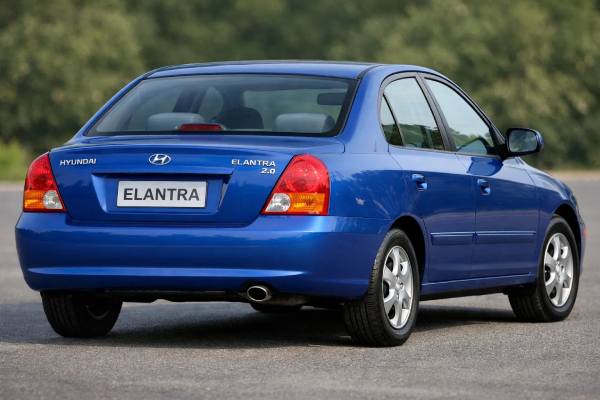
The facelifted Hyundai Elantra XD 2.0 is one of those compact sedans that becomes more appealing once you stop judging it by badge prestige alone. In 2003–2006 facelift form, it brought sharper styling, a tidier interior, and a more polished ownership experience than many people expected from Hyundai at the time. The 2.0-litre four-cylinder is the version that makes the car feel complete, because it gives the Elantra enough torque for daily traffic, open-road cruising, and a full passenger load without turning it into a thirsty or overly complex car. The real appeal today is not excitement. It is value, mechanical simplicity, and honest practicality. The main complication is that facelift-era 2.0 figures vary by market. Some U.S. official documents list lower emissions-based outputs, while many export-market facelift listings use the 143 hp or 105 kW figure. That makes VIN and market verification important, but the core ownership story stays the same: buy a clean, well-serviced car, and the XD can still be a sensible compact.
What to Know
- The 2.0-litre engine gives the facelift XD the performance it always needed for relaxed everyday use.
- Ride comfort, cabin space, and simple controls remain strong points for a compact from this era.
- The facelift brought a cleaner look, better trim presentation, and useful equipment on higher grades.
- Timing-belt history, cooling-system health, and rust inspection matter more than trim badge today.
- Treat any undocumented timing-belt service as due at about 96,000 km or 60,000 miles.
Section overview
- Hyundai Elantra XD facelift profile
- Hyundai Elantra XD 143 hp numbers
- Hyundai Elantra XD equipment and crash protection
- Failure points and factory campaigns
- Maintenance roadmap and buying tips
- Road feel and fuel use
- Facelift XD versus competitors
Hyundai Elantra XD facelift profile
The facelifted Elantra XD represents Hyundai in a very specific moment. By the mid-2000s, Hyundai was no longer selling cars that could be dismissed as simple low-price transport, but it had not yet become the design- and technology-led brand it is today. That gives the facelift XD a clear identity. It is a practical compact sedan built around space, comfort, and value, with just enough refinement to make it feel like a real alternative to class leaders rather than a cheaper imitation.
The 2003-on facelift sharpened the car in the right places. It updated the nose, grille, bumpers, lamps, and interior trim, and in many markets it also improved feature packaging. On the road, it still felt like the same basic XD underneath, which is mostly good news. The chassis remained comfort-oriented, the controls stayed simple, and the cabin kept the roomy feel that was one of the model’s strongest selling points. Hyundai also continued to lean on generous standard equipment and a long warranty, which helped the Elantra stand out in period.
The 2.0-litre version is the one that best suits the car’s size and mission. Smaller petrol engines can cope, but the 2.0 gives the XD a more relaxed, better-balanced character. It makes the car easier to drive with passengers, air conditioning, and luggage, and it reduces the need for constant downshifting or heavy throttle. This still is not a sports sedan. It is a compact family car that feels more complete with the bigger engine.
A key detail for buyers and readers is that the facelift-era 2.0 does not wear the same numbers in every country. Open-access U.S. Hyundai material for the facelift period often quotes 138 hp in ULEV form or 132 hp in SULEV form, while many non-U.S. listings for the facelift 2.0 use 105 kW or roughly 143 PS. That means the exact badge figure depends on rating method, emissions specification, and market. It does not change the basic character of the car. Whether your local paperwork says 138, 141, or 143, this is still the same broad Beta II 2.0-litre CVVT facelift package.
The chassis helps the car age well. Fully independent suspension, a longish wheelbase for the class, and sensible steering tuning give the XD a calm, easygoing feel that still works in daily use. Inside, the sedan remains pleasantly roomy, and higher trims can feel surprisingly well equipped for an early-2000s compact.
What matters most today is not how the car looked in the brochure, but how it has been cared for since. The facelift XD can still be a very reasonable used buy because the engineering is fairly straightforward and parts support is usually manageable. But like many compact sedans of its era, it becomes poor value quickly if rust, overheating, or neglected timing-belt service are already part of the story.
Hyundai Elantra XD 143 hp numbers
Because this facelift Elantra existed in several markets with different emissions calibrations and rating methods, the smartest way to present the data is to focus on the shared mechanical package and clearly note where outputs or efficiency figures differ. The table below reflects the facelift-era 2.0-litre CVVT car commonly described in export markets as 143 hp or 105 kW, while also noting where widely available U.S. official figures differ.
Powertrain and efficiency
| Item | Hyundai Elantra XD Facelift 2.0 |
|---|---|
| Code | Beta II 2.0 CVVT; verify exact engine code by VIN and market |
| Engine layout and cylinders | Inline-4, 4 cylinders |
| Valvetrain | DOHC, 16 valves, 4 valves per cylinder |
| Bore × stroke | 82.0 × 93.5 mm (3.23 × 3.68 in) |
| Displacement | 2.0 L (1,975 cc) |
| Induction | Naturally aspirated |
| Fuel system | MPFI |
| Compression ratio | About 10.1:1, market-dependent |
| Max power | 143 hp / 105 kW @ 6,000 rpm in many facelift export listings; some U.S. official facelift documents show 138 hp ULEV or 132 hp SULEV |
| Max torque | 186 Nm (137 lb-ft) @ 4,500 rpm in many facelift listings; some U.S. figures are slightly lower |
| Timing drive | Belt |
| Rated efficiency | Market test method varies widely; U.S. EPA data for 2005 2.0 shows 24 mpg combined auto and 26 mpg combined manual |
| Real-world highway @ 120 km/h (75 mph) | Usually around 7.0–8.2 L/100 km in good condition |
Transmission and driveline
| Item | Data |
|---|---|
| Transmission | 5-speed manual or 4-speed automatic |
| Drive type | FWD |
| Differential | Open |
Chassis and dimensions
| Item | Data |
|---|---|
| Suspension front / rear | MacPherson strut front / fully independent multi-link rear |
| Steering | Power-assisted rack-and-pinion |
| Brakes | Front ventilated discs; rear drums on many GLS sedans, rear discs on some GT, Limited, and five-door versions |
| Wheels and tyres | 195/60 R15 common on facelift 2.0 models |
| Ground clearance | Verify by market; not consistently published in official open-access data |
| Length | About 4,495 mm (177.0 in) sedan |
| Width | About 1,720 mm (67.7 in) |
| Height | About 1,425 mm (56.1 in) |
| Wheelbase | 2,609 mm (102.7 in) |
| Turning circle (kerb-to-kerb) | Roughly 10.4–10.6 m (34.1–34.8 ft), market-dependent |
| Kerb weight | Roughly 1,250–1,320 kg (2,756–2,910 lb), depending on transmission and trim |
| GVWR | Verify by VIN plate |
| Fuel tank | 55 L (14.5 US gal / 12.1 UK gal) |
| Cargo volume | Sedan trunk about 13.0 ft³; five-door cargo volume significantly larger |
Performance and capability
| Item | Data |
|---|---|
| 0–100 km/h (0–62 mph) | Roughly 9.0–10.5 s depending on market and transmission |
| Top speed | Roughly 190–208 km/h (118–129 mph) depending on market rating |
| Braking distance | No single factory figure widely published |
| Towing capacity | Market-dependent; verify locally |
| Payload | Usually around 430–500 kg depending on exact vehicle mass |
Fluids and service capacities
| Item | Data |
|---|---|
| Engine oil | Commonly 5W-30 or 10W-30 depending on climate and manual guidance; about 4.0 L (4.2 US qt) with filter |
| Coolant | Ethylene glycol coolant for alloy-head petrol engines, usually 50:50 mix; about 6.3 L (6.7 US qt) |
| Transmission / ATF | Verify by exact gearbox and market specification |
| Differential / transfer case | Not separately serviced on this FWD layout |
| A/C refrigerant | Verify by under-bonnet label |
| A/C compressor oil | Verify by compressor type |
| Key torque specs | Use VIN-specific service data only |
Safety and driver assistance
| Item | Data |
|---|---|
| Crash ratings | No modern ADAS-era ratings; IIHS frontal rating improved for 2004–06 cars after airbag revisions |
| Headlight rating | Not published in modern IIHS headlight format |
| ADAS suite | None |
The headline figures show why the 2.0 facelift feels like the right Elantra XD to own. It is not quick by modern standards, but it is strong enough to keep the car from feeling underpowered, and the mechanical package stays simple enough to remain attractive as an older daily driver.
Hyundai Elantra XD equipment and crash protection
Trim names differed by region, but the facelift XD usually followed a familiar structure: a well-equipped mainstream sedan grade, a sportier GT-style version, and in some markets a more comfort-focused upper trim such as Limited. The important thing is not the badge alone. It is what the trim changes in real life.
On a typical facelift GLS sedan, the Elantra already offered a strong value case. Air conditioning, power windows, power locks, heated mirrors, remote keyless entry, cruise control, a split-folding rear seat, and a decent audio system were part of the reason the Elantra felt generous in period. Hyundai leaned hard on this equipment story, because the car’s wider appeal depended on feeling like more than a stripped price leader.
GT and upper trims changed the ownership experience more clearly. Depending on market and body style, they could add leather seating surfaces, fog lamps, 15-inch alloy wheels, rear disc brakes, sport-tuned steering and suspension, a trip computer, unique instrument lighting, upgraded audio, and extra trim detailing. The five-door GT was especially interesting because it combined hatchback practicality with sharper suspension tuning and more useful cargo flexibility. If you want the XD at its most characterful, the GT is usually the version to chase. If you want the simplest and often cheapest long-term ownership path, a clean GLS sedan can still be the smarter buy.
The facelift also matters in safety terms. The Elantra’s strongest period safety message was value-based, not class-leading. Hyundai pushed side airbags as standard equipment on many facelift U.S. cars, plus front-seat belt pretensioners and solid basic crash structure. That was meaningful in the early 2000s and helped the Elantra look well specified next to major rivals.
Crash-test results need careful explanation. The early XD was criticized for frontal crash performance, particularly the original airbag timing. For the 2004–06 facelift period, IIHS re-evaluated the updated airbag system and the moderate-overlap frontal result improved to Good for 2004–06 models. That is a real improvement and one of the more important reasons the facelift is preferable to the earlier XD. However, the story is not fully positive. The same IIHS material still shows poor side-impact and head-restraint ratings for the 2001–06 generation. So the facelifted XD is safer than the earlier front-test result suggests, but it still does not come close to modern compact-car safety expectations.
There are no advanced driver-assistance systems to discuss here. No autonomous emergency braking, no lane support, no adaptive cruise control, and no blind-spot monitoring. That keeps repairs simple, but it also means all crash avoidance depends on the driver, tyres, brakes, lighting, and suspension condition.
For a used buyer, that last point matters. A well-kept XD with fresh brakes, good tyres, working airbags, and straight structure is far more reassuring than a higher-trim car with old tyres, accident history, and warning lights. On this generation, actual condition matters more than the original option sheet.
Failure points and factory campaigns
The facelift XD 2.0 is mechanically straightforward, but it is now old enough that reliability depends less on design reputation and more on how carefully each surviving car has been maintained. The broad pattern is familiar. The major trouble spots are not mysterious, and most are manageable if caught early. The real danger is accumulation: one neglected old-car problem quickly becomes three or four.
The single most important engine issue remains timing-belt service. The Beta II 2.0 uses a timing belt, and on an old Elantra that means paperwork matters. Any seller who cannot prove belt replacement should be treated as if the job is overdue. On these cars, the right approach is belt, tensioner, idlers, and preferably water pump together. A car with oil contamination around the timing cover deserves even closer inspection because leaking cam or crank seals shorten belt life.
Cooling-system age is the next major theme. Radiators, plastic tanks, thermostat housings, upper and lower hoses, and expansion components all wear out over time. The engine itself is usually robust if it is kept cool, but repeated overheating can undo that advantage quickly. Brown coolant, unexplained coolant loss, weak heater output, or signs of old sealant around the radiator are all warnings.
Oil leaks are common but usually not ruinous. Valve-cover gasket seepage, front seal sweating, and general oil mist around the upper engine are typical old-Hyundai problems. On their own, they are not a reason to reject a car. They become a problem when they are ignored long enough to contaminate belts, mounts, or electrical connectors.
Running-quality faults are usually low- to medium-cost. Think dirty throttle body, old spark plugs, worn ignition leads or coils, vacuum leaks, sticky idle control behaviour, or aging sensors. These tend to show up as rough idle, sluggish response, hesitant cold running, or fuel economy that is worse than expected. The good news is that the 2.0 remains a conventional port-injected petrol engine, so diagnosis is usually more straightforward than on later direct-injection cars.
Transmission problems depend on maintenance. Manual cars can develop clutch wear, hydraulic faults, or synchromesh weakness, but they are usually durable when treated properly. The 4-speed automatic is not inherently fragile, but neglected fluid and rough use can produce shift flare, delayed engagement, or harsh warm shifts. Any used automatic deserves a long test drive when hot.
Suspension wear is common and expected. Lower-arm bushes, ball joints, drop links, top mounts, rear bushes, and wheel bearings are all normal wear items on a car of this age. None of them is shocking individually, but several together can make a decent car feel loose, noisy, and far older than it is.
Factory campaigns and recalls are important here. For facelift-era cars, a 2004 recall addressed improperly positioned vapor-tube hose clamps near the fuel tank, and later 2004–2005 campaigns addressed occupant-classification-system behaviour on the front passenger seat. Separately, the well-known front lower control arm and subframe corrosion campaign mainly targets 2001–2003 cars in salt-belt regions, but very early crossover-period 2003 cars should still be checked carefully for campaign history and underbody condition. The lesson is simple: verify recall completion by VIN and never assume an old Hyundai has already had every campaign performed.
Maintenance roadmap and buying tips
A facelift XD 2.0 can still be a dependable compact, but only if you maintain it like an aging mechanical sedan instead of waiting for problems to announce themselves. The good news is that the car rewards basic preventive care. The bad news is that many surviving examples have already seen years of low-budget ownership, so the first owner after purchase often ends up doing a backlog of work.
A practical maintenance plan for the 2.0 looks like this:
| Item | Practical interval |
|---|---|
| Engine oil and filter | Every 8,000–10,000 km or 12 months |
| Engine air filter | Inspect every service; replace around 20,000–30,000 km |
| Cabin air filter | If fitted, inspect yearly |
| Coolant | Inspect yearly; renew about every 2–3 years unless verified long-life service is documented |
| Spark plugs | Around 30,000–40,000 km for standard plugs; longer for correct long-life plugs |
| Fuel filter | Replace by market schedule or when fuel-delivery symptoms suggest age |
| Timing belt | Replace at the factory interval; if history is unknown, treat as overdue now |
| Water pump | Best replaced during timing-belt service |
| Auxiliary belts and hoses | Inspect every service |
| Manual gearbox oil | Check leaks and shift quality; renew preventively on older cars |
| Automatic transmission fluid | Inspect condition and shift behaviour; old fluid is not harmless |
| Brake fluid | Every 2 years |
| Pads, discs, drums, and shoes | Inspect every service |
| Tyre rotation and alignment | Rotate around every 10,000 km; align if wear is uneven |
| 12 V battery | Test from about year 4 onward and replace on condition |
The most useful capacities for owner planning are the oil and coolant amounts. Engine oil is about 4.0 L with filter, and coolant capacity is about 6.3 L. Beyond that, especially for transmission fluid and exact torque settings, you really should use the correct market service information rather than generic internet guesses. This is especially true on older cars that may already have had engine or gearbox replacements.
For buyers, inspection should start underneath. Rust is the issue that most often decides whether the car is worth saving. Check front lower control arms, front subframe edges, jacking points, floor seams, rear arches, brake lines, and the lower edges of the doors and sills. Surface rust can be managed. Structural corrosion is where a cheap Elantra becomes expensive fast.
Then move to the engine bay. You want clear coolant, stable idle, no overheating signs, and believable timing-belt paperwork. Look closely around the timing cover, radiator top tank, thermostat area, and rocker cover. During the drive, check hot idle quality, clutch take-up, second-gear engagement, straight-line tracking, brake balance, and suspension noise over rough surfaces.
Common reconditioning jobs on an older XD include tyres, front brakes, battery, drop links, top mounts, cooling hoses, and basic fluid services. None of these is unusual. What matters is whether you are buying a fundamentally sound car or one that needs every ordinary job at once.
The best cars are usually the later, rust-free ones with side airbags, clean service history, and evidence of sensible long-term upkeep. A GT can be the most enjoyable facelift XD, but a simpler GLS with a better body is the smarter buy than a shinier GT with hidden rust or poor maintenance.
Road feel and fuel use
The facelift XD 2.0 feels like a compact sedan that was tuned by people who cared more about everyday ease than about headline sportiness. That is a good thing. Even now, the car is easy to place in traffic, simple to park, and relaxed enough to serve as a useful daily driver. The steering is light to moderate, visibility is good, and the basic controls are intuitive.
Ride quality is still one of the Elantra’s strongest traits. The independent rear suspension gives the car a composure that helps it feel more settled than some rivals with simpler rear layouts. It does not corner like a hot hatch, but it absorbs broken city streets well and stays calm on longer journeys. Sedan versions lean more toward comfort, while GT versions feel slightly firmer and more tied down without turning harsh.
The 2.0-litre engine suits this character. It does not feel exciting at the top end, but it has enough low- and mid-range pull to make the car feel useful rather than strained. Around town, the throttle response is linear and predictable because there is no turbocharger and no complex power delivery to manage. On the highway, the car cruises comfortably, though fast overtakes still require planning, especially with passengers or an automatic transmission.
The manual gearbox is the better choice for drivers who want the most direct feel and the best response. It also tends to make the car feel a little lighter on its feet. The 4-speed automatic is better judged as a comfort feature than as a performance enhancer. It works well enough when healthy, but it is an older automatic design, so shift speed and ratio spread are not especially modern.
Noise levels are acceptable for the era. Hyundai put real effort into refinement through the XD program, and that shows. At city speeds, the car feels more polished than old stereotypes suggest. At motorway speed, tyre and wind noise become more obvious, but the car still feels usable and grown-up rather than crude.
Real-world fuel use depends heavily on condition and transmission. EPA data for the 2005 2.0 shows 21 city and 29 highway mpg for the automatic, and 23 city and 31 highway mpg for the manual. In practical ownership, that usually means something like 9.5–11.0 L/100 km in heavy city use, about 7.0–8.0 L/100 km on steady highway work, and around 8.0–9.2 L/100 km in mixed driving. Cold weather, short trips, old spark plugs, dragging brakes, or poor alignment can push those numbers upward quickly.
There is no stability control on many versions, and no traction-management intelligence to flatter the chassis. That makes tyre quality more important than some owners realise. Good tyres improve wet-weather braking, steering consistency, and the car’s overall sense of control more than almost any cheap modification ever will.
Facelift XD versus competitors
The facelift XD 2.0 competed against some of the toughest compact cars of its era: Toyota Corolla, Honda Civic, Mazda3, Ford Focus, Nissan Sentra, and Mitsubishi Lancer. It was rarely the segment leader in prestige or sharpness, but it usually made a strong case on space, features, and value. That same logic still defines it today as a used car.
Compared with a Corolla, the Elantra generally feels roomier and often comes with a better equipment list for the money. The Toyota usually wins on reputation and resale, but the Hyundai can be the smarter bargain when condition is equal. Compared with a Civic, the Elantra feels softer and less agile, but often more comfortable and less expensive. Against an early Mazda3 or Focus, the Hyundai is not as fun to steer, yet it often feels calmer and simpler to live with.
One of the facelift XD’s biggest strengths is that it genuinely feels like a compact family sedan, not just a basic commuter. Cabin space, ride comfort, and feature content are all good enough to make the car useful beyond short urban trips. That matters because many budget compact cars from the same era feel small, noisy, or stripped once the novelty of their low price wears off.
Its weak points are easier to define. Safety is still dated. Even with the facelift airbag improvements, the XD does not deliver the all-round crash performance of newer rivals. Rust protection is not class-leading. The 2.0 is the right engine for the car, but it does not make the Elantra quick enough to stand out. And because many examples have lived through budget ownership, the difference between a good one and a bad one is unusually wide.
That last point is crucial. A clean facelift XD 2.0 with recent timing-belt work, a healthy cooling system, a straight body, and solid underbody condition can be a very sensible used buy. A rough one with old tyres, vague maintenance records, and hidden rust is not a bargain at all, even if the price looks attractive.
So how does it compare in the real world? The facelift XD remains one of the more underrated compact sedans of its era. It does not beat every rival on every measure, but it combines comfort, space, simplicity, and value in a way that still makes sense. If you buy carefully, it can be the rational underdog of the group. If you buy carelessly, it can become a reminder that old economy cars must be chosen on condition, not just on price.
References
- A “CLASS ABOVE” THE COMPETITION 2005 (Manufacturer Press Release)
- 2005 Hyundai Elantra 2026 (Safety Rating) ([IIHS][1])
- Gas Mileage of 2005 Hyundai Elantra 2026 (Fuel Economy) ([Fuel Economy][2])
- Vehicle Detail Search – 2005 HYUNDAI ELANTRA 4 DR | NHTSA 2026 (Recall Database) ([NHTSA][3])
- HYUNDAI FOR 2004 2004 (Manufacturer Specifications)
Disclaimer
This article is for informational purposes only and is not a substitute for professional diagnosis or repair. Specifications, torque values, service intervals, procedures, and equipment can vary by VIN, market, emissions calibration, transmission, and trim, so always verify the details against the official service documentation for the exact vehicle.
If this guide helped you, please consider sharing it on Facebook, X/Twitter, or other social platforms to support our work.