


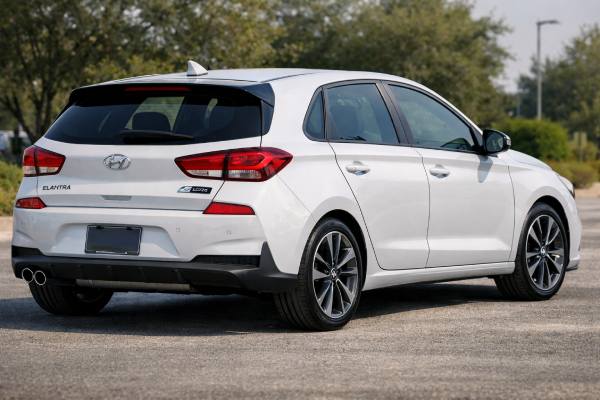
The Hyundai Elantra GT N Line is one of those rare compact hatchbacks that manages to be practical and genuinely entertaining without becoming expensive or fragile by design. Built on the PD platform and closely related to the i30 sold in other markets, the 2019–2020 GT N Line combines a roomy hatchback body with Hyundai’s 1.6-liter turbocharged direct-injection four-cylinder, a standard six-speed manual, and an optional seven-speed dry-clutch dual-clutch transmission. With 201 horsepower and 195 lb-ft of torque, it is quick enough to feel special, yet it still works as a daily family car with real cargo space and useful rear seating. The stronger brakes, firmer chassis tune, and N Line-specific styling help separate it from the regular Elantra GT. The main ownership question is not whether the concept is good. It is whether the specific car has been serviced properly, had campaigns completed, and avoided the clutch, turbo, and direct-injection neglect that can make any fast compact feel older than it should.
Core Points
- The 1.6 T-GDi engine gives the GT N Line strong mid-range punch and real everyday pace.
- Independent rear suspension, larger brakes, and 18-inch wheels make it more than just a cosmetic trim.
- The hatchback body is genuinely useful, with strong cargo space for the class.
- Dry-clutch DCT cars need especially careful inspection for smooth engagement and campaign completion.
- A sensible oil and filter interval is every 8,000 to 10,000 km or 12 months if you want to protect chain and turbo health.
Explore the sections
- Hyundai Elantra GT N Line profile
- Hyundai Elantra GT N Line data
- Hyundai Elantra GT N Line trims and safety
- Reliability trends and service actions
- Maintenance guide and buyer tips
- Driving character and real economy
- Rivals and buying verdict
Hyundai Elantra GT N Line profile
The Elantra GT N Line arrived as Hyundai’s first U.S. N Line model, and that matters because it framed the car correctly from the start. This was never a full N product in the way a Veloster N was. It was meant to sit between a normal hatchback and a true hot hatch. That sounds like a compromise, but in practice it works very well. The GT N Line takes the already practical Elantra GT hatchback and gives it the hardware needed to feel engaging, not merely dressed up.
The biggest part of that transformation is mechanical. Under the hood sits Hyundai’s 1.6-liter turbocharged GDI inline-four, making 201 hp at 6,000 rpm and 195 lb-ft of torque from 1,500 to 4,500 rpm. Hyundai paired it with a six-speed manual as standard and a seven-speed dry-clutch DCT as an option. Compared with the regular GT, the N Line also receives larger brakes, 18-inch wheels, sport seats, unique bodywork, and a more serious rear suspension setup. That is important because it means the badge is backed by substance. This is not a simple appearance package.
The hatchback body is a major part of the ownership appeal. Hyundai gave the GT N Line 24.9 cubic feet of cargo space with the rear seats up and 55.1 cubic feet with them folded, which makes it much more useful than most compact sedans at similar prices. Rear-seat room is good enough for adults, and the overall shape makes the car easier to use day to day than a coupe or a sedan with similar performance. If you need one car to commute, carry luggage, and still feel lively on a back road, the GT N Line makes a convincing case.
What also helps is that Hyundai did not overcomplicate the formula. This is still a front-wheel-drive car with a conventional turbo four, not an all-wheel-drive performance experiment packed with specialized systems. That keeps running costs more manageable. It also means the ownership experience depends heavily on how the car has been maintained. Because this is a turbocharged direct-injection hatchback with either a manual or dry-clutch DCT, condition matters more than brand image. A well-kept GT N Line feels sharp, responsive, and more premium than its price suggests. A neglected one can feel grabby, noisy, and much less special.
That balance is what defines the car. It is not the fastest hatchback of its era, and it is not the most prestigious. But it is one of the more rational enthusiast-friendly hatchbacks from the period because it combines real pace with real practicality. That makes the 2019–2020 GT N Line a more interesting used buy than many buyers realize.
Hyundai Elantra GT N Line data
The figures below focus on the 2019–2020 Elantra GT N Line for North America. Because Hyundai sold both manual and DCT versions, some weight, tyre, and fuel-economy figures vary by transmission.
| Powertrain and efficiency | Data |
|---|---|
| Code | 1.6 T-GDi, Gamma-family turbo GDI engine |
| Engine layout and cylinders | Inline-4, DOHC, 4 valves per cylinder, 77.0 × 85.4 mm (3.03 × 3.36 in) |
| Displacement | 1.6 L (1,591 cc) |
| Motor | Not applicable |
| Induction | Turbocharged |
| Fuel system | Gasoline direct injection |
| Compression ratio | 9.5:1 |
| Max power | 201 hp (150 kW) @ 6,000 rpm |
| Max torque | 264 Nm (195 lb-ft) @ 1,500–4,500 rpm |
| Timing drive | Chain |
| Rated efficiency | Manual: about 9.0 L/100 km combined; DCT: about 8.4 L/100 km combined |
| Real-world highway @ 120 km/h | Roughly 7.0–8.0 L/100 km, depending on tyres, weather, and transmission |
| Transmission and driveline | Data |
|---|---|
| Transmission | 6-speed manual or 7-speed dry-clutch DCT |
| Drive type | FWD |
| Differential | Open |
| Chassis and dimensions | Data |
|---|---|
| Suspension (front/rear) | MacPherson strut front / multi-link independent rear |
| Steering | Rack and pinion with motor-driven power steering |
| Steering ratio | About 13.4:1 |
| Brakes | Front ventilated discs 12.0 in (305 mm), rear solid discs 11.2 in (284 mm) |
| Wheels and tyres | 18 × 7.5J alloys with 225/40 R18 tyres; manual cars were available with Michelin Pilot Sport 4 summer tyres in U.S. spec |
| Ground clearance | 5.9 in (150 mm) |
| Length / Width / Height | 170.9 in / 70.7 in / 57.7 in (4,341 mm / 1,796 mm / 1,466 mm) |
| Wheelbase | 104.3 in (2,650 mm) |
| Turning circle (kerb-to-kerb) | 34.78 ft (10.6 m) |
| Kerb weight | Manual: about 3,014–3,102 lb (1,367–1,407 kg); DCT: about 3,067–3,155 lb (1,391–1,431 kg) |
| GVWR | Manual: 4,035 lb (1,830 kg); DCT: 4,079 lb (1,850 kg) |
| Fuel tank | 14.0 US gal (53 L / 11.7 UK gal) |
| Cargo volume | 24.9 ft³ seats up / 55.1 ft³ seats down, SAE |
| Performance and capability | Data |
|---|---|
| Acceleration | Not officially published by Hyundai; real-world performance is strong for the class |
| Top speed | Not officially published in the sources reviewed |
| Braking distance | Not officially published by Hyundai in the reviewed spec sheets |
| Towing capacity | Not a main use case; verify locally before towing |
| Payload | Market-dependent; verify from the certification label |
| Fluids and service capacities | Data |
|---|---|
| Engine oil | SAE 5W-20 or 5W-30 depending on market guidance; for the 1.6 T-GDI the reviewed owner data recommends 5W-30 for fuel economy in many markets; capacity 4.5 L (4.76 US qt) |
| Coolant | Phosphate-based ethylene glycol coolant for aluminum radiator; 6.2 L (6.55 US qt) |
| Transmission / DCT fluid | Manual: GL-4 SAE 70W class MTF, 1.7–1.8 L (1.8–1.9 US qt); DCT: GL-4 SAE 70W DCT fluid, 1.9–2.0 L (2.01–2.11 US qt) |
| Differential / transfer case | Not applicable |
| A/C refrigerant | R-1234yf; 500 g (17.63 oz) |
| A/C compressor oil | PAG; 110 ± 10 cc (3.88 ± 0.35 oz) |
| Key torque specs | Wheel lug nut torque 11–13 kgf·m, about 108–127 Nm (79–94 lb-ft) |
| Safety and driver assistance | Data |
|---|---|
| Crash ratings | IIHS 2019 GT hatchback: Good in driver-side small overlap, passenger-side small overlap, moderate overlap, side, roof strength, and head restraints |
| Headlight rating | Varies by trim and option; ratings range from Acceptable to Poor across configurations |
| ADAS suite | Optional depending on trim/package: forward collision avoidance, pedestrian detection, lane keeping assist, smart cruise control, blind-spot collision warning, rear cross-traffic warning, high beam assist, driver attention warning |
The most interesting part of the table is how much real hardware Hyundai packed into the N Line. The independent rear suspension, larger brakes, and serious tyre package tell you this was designed to drive differently, not just look different.
Hyundai Elantra GT N Line trims and safety
The GT N Line was sold in a relatively simple trim structure, but there were still meaningful differences depending on transmission and options. In basic form, the six-speed manual N Line already included the mechanical upgrades that matter most: the 1.6 turbo engine, independent rear suspension, 18-inch wheels, sport seats, dual-zone climate control, leather seating surfaces, heated front seats, a panoramic sunroof, LED lighting, and N Line-specific interior and exterior trim. That is a strong starting point because it means even the base N Line did not feel stripped.
The optional DCT version often added more comfort and technology depending on market. In Canadian trim language, the N Line Ultimate DCT layered on features such as navigation, power driver seat adjustment, BlueLink, auto-dimming rearview mirror, Infinity audio, ventilated front seats, adaptive cruise control, forward collision avoidance with pedestrian detection, high beam assist, lane departure warning with lane-keeping assist, and driver attention warning. In the U.S., IIHS front-crash-prevention ratings for the Elantra GT hatchback were tied to optional front crash prevention and specific headlights, so safety-tech availability matters if you are shopping used.
Quick identifiers are useful here. All GT N Lines have the unique bumpers, dual chrome exhaust outlets, sport seats, and 18-inch wheels. Manual cars are often the ones enthusiasts seek because they avoid DCT behavior at low speed and, in U.S. specification, could come with summer-oriented Michelin Pilot Sport 4 tyres. DCT cars are easier in traffic and often better equipped, but that convenience comes with more drivetrain complexity.
Safety deserves a balanced explanation. In IIHS testing, the Elantra GT hatchback earned Good ratings in driver-side small overlap, passenger-side small overlap, moderate overlap front, side impact, roof strength, and head restraints. That is a strong crashworthiness result for a small hatchback. The 2019–20 Elantra GT hatchback also qualified as a Top Safety Pick when equipped with optional front crash prevention and specific headlights. The weak spot is not the crash structure itself. It is that headlight ratings vary by configuration, and the full award depended on the correct lighting and safety package.
Euro NCAP adds useful context, but with an important caveat. There is no separate Euro NCAP listing under the U.S.-market “Elantra GT N Line” name. The structurally related Hyundai i30 family earned a five-star Euro NCAP rating in 2017 with 88% adult occupant protection, 84% child occupant protection, 64% vulnerable road user protection, and 68% safety assist. That result helps support the platform’s overall safety credibility, but it is still an i30 assessment rather than a dedicated Elantra GT N Line test.
For buyers, the practical rule is simple. Do not assume every GT N Line has the same safety content. Check the specific car for its options, headlights, camera calibration status, and whether the warning lights all behave properly. On a car like this, the best version is usually the one with the strongest maintenance history and the desired safety package, not simply the lowest mileage.
Reliability trends and service actions
The Elantra GT N Line is generally solid if maintained properly, but it is a car that rewards discipline and punishes neglect faster than a base non-turbo hatchback. That is normal for a compact performance-oriented turbo model. The engine itself is not inherently fragile, yet it works harder than the regular 2.0-liter GT engine and therefore depends more on oil quality, clean cooling, and responsible warm-up behavior.
The main engine-related watchpoints are predictable. First is the timing-chain system. Like many modern chain-driven turbo fours, the 1.6 T-GDi depends on regular oil changes with the correct viscosity and quality. Stretch, guide wear, or tensioner issues are not the norm on a well-serviced car, but cold-start rattle, rough startup, or timing-correlation faults deserve attention. Second is direct-injection carbon buildup. Because the engine is GDI, intake-valve deposits can accumulate over time, especially on short-trip cars. This usually shows up as rough idle, weaker response, or misfire tendencies rather than a sudden failure. Third is ignition demand under boost. Old spark plugs or weak coils are more noticeable here than on an ordinary naturally aspirated commuter.
Turbo-system health also matters. Oil seepage, tired diverter or boost-control components, and neglected warm-up or shutdown habits can shorten life over time. That does not make the turbo engine a bad choice. It simply means the GT N Line is not a car to service lazily. A thick folder of regular oil changes is far more valuable than a seller saying the car was “always babied.”
Transmission choice makes a real difference in the reliability story. The six-speed manual is mechanically simpler and usually the safer long-term recommendation if overall condition is equal. The seven-speed dry-clutch DCT can work very well, but low-speed hesitation, shudder, or rough engagement should not be dismissed casually. Hyundai also issued Service Campaign T4Q to replace the DCT on certain 2019 Elantra GT (PD), Elantra Sport (AD), and Kona (OS) vehicles. That is a major point to verify before purchase if you are looking at a 2019 DCT N Line.
Chassis wear is less dramatic and more conventional. Front drop links, bushings, tyres, and brake consumables are the usual recurring items, especially on cars driven hard or on rough roads. Manual cars with the stickier tyre package may also show more uneven tyre wear if alignment was ignored. Rear suspension wear should not be overlooked, because the multi-link setup is part of what makes the N Line better than the regular GT. A tired N Line can feel ordinary very quickly.
There are also software and service-action considerations. Hyundai issued a service campaign related to ECM logic improvement for P0128 thermostat-related detection on certain related 1.6T models, and campaign completion history is always worth checking on Hyundai performance-leaning models. For the GT N Line specifically, the safest approach is simple: request proof of completed campaigns, ask for dealer printouts where possible, and verify open items through Hyundai’s official VIN lookup. On this car, paperwork is not a bonus. It is part of the mechanical condition.
Maintenance guide and buyer tips
The GT N Line can be a very satisfying long-term car if you service it like a turbo hatchback rather than like a disposable commuter. The best maintenance plan is slightly conservative, especially if the car sees short trips, repeated boost use, or hot climate driving. The goal is not over-servicing for the sake of it. The goal is staying ahead of wear points that are cheaper to prevent than to repair.
| Item | Practical interval | Notes |
|---|---|---|
| Engine oil and filter | Every 8,000–10,000 km or 12 months | Shorter intervals are wise for turbo and chain health |
| Engine air filter | Inspect every service, replace around 20,000–30,000 km | Earlier in dusty use |
| Cabin air filter | Every 15,000–20,000 km or 12 months | Helps HVAC performance |
| Spark plugs | Around 45,000–60,000 km | Turbo GDI engines are sensitive to plug condition |
| Coolant | Every 2–3 years or by official schedule | Keep the correct phosphate-based coolant type |
| Brake fluid | Every 2 years | Important on a car with larger brakes and sport use |
| Manual gearbox oil | Around 60,000–80,000 km if driven hard | Helps shift quality and synchronizer life |
| DCT fluid | Check for correct service history and use the exact specified fluid | Do not improvise with substitutes |
| Timing chain | No fixed interval; inspect on noise, rattle, or timing faults | Oil quality is the main preventive factor |
| Auxiliary belt and hoses | Inspect every service | Replace on visible wear or cracking |
| Tyre rotation and alignment | Rotate if tyre pattern permits, align regularly | Especially important on 18-inch setups |
| Battery testing | Yearly from age 4 onward | Weak voltage can confuse modern systems |
Fluid specifications matter more here than on a low-output base hatchback. The reviewed owner data lists 4.5 liters of engine oil for the 1.6 T-GDi, 1.7–1.8 liters of manual-transmission fluid, 1.9–2.0 liters of DCT fluid, about 6.2 liters of coolant, and 500 grams of R-1234yf refrigerant with PAG oil for the air-conditioning system. Those are useful planning figures, but they should still be checked against the exact VIN and service literature before parts or fluids are ordered.
As a used buy, the smartest GT N Line is usually the one that balances performance appeal with maintenance honesty. The manual is the enthusiast choice and the simpler long-term proposition. The DCT is more convenient in traffic and often paired with stronger driver-assistance equipment, but it deserves more scrutiny and campaign verification. If two cars cost the same, I would generally prefer the better-documented manual unless the DCT car has clear dealer records and demonstrably smooth operation.
When inspecting one, check in this order:
- Cold-start engine sound.
- DCT or clutch behavior.
- Service records and campaign completion.
- Tyres and alignment wear.
- Brake condition and rotor state.
- Suspension noise and rear-end composure.
- Turbo response and boost consistency.
Cars to seek are unmodified or lightly modified with good records, matching tyres, and intact interior trim. Cars to avoid are the obvious ones: startup rattle, rough DCT engagement, cheap mixed tyres, warning lights, sloppy crash repair, or sellers who cannot explain the service history. The GT N Line is durable enough to justify ownership, but only when bought on condition rather than temptation.
Driving character and real economy
The Elantra GT N Line feels most impressive when you stop judging it as a bargain hot hatch and start judging it as a quick, versatile hatchback with real personality. It has much more urgency than the base GT, yet it is still civil enough for commuting, family use, and longer trips. That broad ability is its biggest advantage.
The 1.6 T-GDi engine gives the car strong low- and mid-range shove. With 195 lb-ft available from 1,500 rpm, the GT N Line feels energetic in the way buyers actually notice day to day. You do not need to chase the redline to access performance. Passing maneuvers and highway merges are easy, and the car feels much livelier than its 201 horsepower figure alone might suggest. The manual keeps the experience more engaging and more predictable at low speed. The DCT can be very quick on the move, but at parking-lot pace it may still show the slightly hesitant or grabby behavior typical of dry-clutch designs.
The chassis is what really separates the N Line from a cosmetic trim package. The multi-link rear suspension, firmer damping, bigger brakes, and 18-inch wheel package give the car better body control and more confidence in quick direction changes than the regular GT. Steering is still light by performance-car standards, but it is accurate enough and fast enough to suit the car’s role. This is not a hardcore track hatch. It is a practical fast hatch that knows how to carry speed.
Ride quality depends heavily on tyres. On the standard 18-inch setup, the GT N Line is firmer than the base car but not punishing. Manual cars on stickier summer tyres can feel sharper and more alert, though they may also ride more firmly and wear rubber faster. The chassis remains stable on the motorway, and the hatchback body does not feel flimsy or noisy in normal use. NVH is well judged for a car in this segment. There is some turbo four-cylinder harshness under load, but not enough to make it tiring.
Real-world economy is respectable rather than brilliant. Hyundai’s EPA figures put the manual at 23/30/26 mpg and the DCT at 25/32/28 mpg. In practical metric terms, that means roughly the high-8s to low-9s L/100 km in town, the mid-7s on steady highway work, and the mid-8s combined for many owners. Driven gently on a long motorway run, the GT N Line can do better. Driven hard, it will not. That is the fair trade for a 201 hp turbo hatch with real usefulness.
The best way to describe the GT N Line is simple: it feels more complete than many affordable performance trims. It is quick enough to be fun, comfortable enough to live with, and useful enough that owning one does not require compromise in the way some sport compacts do.
Rivals and buying verdict
The Elantra GT N Line sat in an interesting market position because it was neither a base hatchback nor a full-blooded hot hatch. That put it against cars like the Volkswagen GTI, Honda Civic hatchback, Mazda 3 hatchback, Toyota Corolla hatchback, and even the regular Hyundai Veloster Turbo in the minds of many buyers. Its strongest asset was that it mixed practicality and performance more evenly than some of those rivals.
Against a Volkswagen GTI, the Hyundai usually loses on steering polish, interior richness, and outright enthusiast prestige. But it can win on warranty backing, purchase price, and value for hardware. Against a Civic hatchback, the Elantra GT N Line feels torquier and more special in standard form, though the Honda counters with a broader cabin feel and a very polished control set. Against a Mazda 3 hatch, the Hyundai is quicker and more playful under boost, while the Mazda offers a more premium cabin and calmer refinement. Against the Corolla hatchback, the Hyundai usually wins on power and cargo flexibility, while the Toyota answers with a stronger low-risk reputation.
The GT N Line’s most direct internal rival is arguably the Veloster Turbo of the same era. The Veloster is the bolder car and can feel more distinctive, but the Elantra GT N Line is the more practical choice by a wide margin. It has better rear-seat access, better cargo flexibility, and a more conventional, easier-to-live-with body shape.
That is really where the GT N Line makes sense. It is not the pure driver’s choice of the segment and not the ultimate version of Hyundai’s N performance story. What it offers instead is maturity. It feels like a car designed for someone who wants genuine pace and useful space in one package. For many buyers, that is the smarter choice than chasing the most famous badge in the class.
The final verdict is straightforward. The 2019–2020 Hyundai Elantra GT N Line is a genuinely worthwhile used performance hatchback if you buy carefully. Its engine is strong, its chassis upgrades are real, its hatchback body is practical, and its safety story is solid when properly equipped. The risks are also clear: direct-injection maintenance, DCT behavior, tyre costs, and the need to verify campaigns and service history. Buy a clean, documented one and it is one of the more underrated fast hatchbacks of its era. Buy a tired one because the price looks attractive, and it can quickly feel more expensive than it first appeared.
References
- 2019 Elantra GT Specifications 2018 (Technical Specifications)
- 2020 Elantra GT Specifications 2020 (Technical Specifications)
- 2019 Hyundai Elantra GT 2019 (Safety Rating)
- Official Hyundai i30 safety rating 2017 (Safety Rating)
- Service Campaign T4Q Dealer Best Practice 2020 (TSB)
Disclaimer
This article is for informational purposes only and is not a substitute for professional diagnosis or repair. Specifications, torque values, service intervals, procedures, and equipment vary by VIN, market, transmission, trim, and build date, so always verify the exact vehicle against official service documentation before buying parts, servicing, or making repair decisions.
If this guide helped you, please consider sharing it on Facebook, X, or another platform to support our work.