
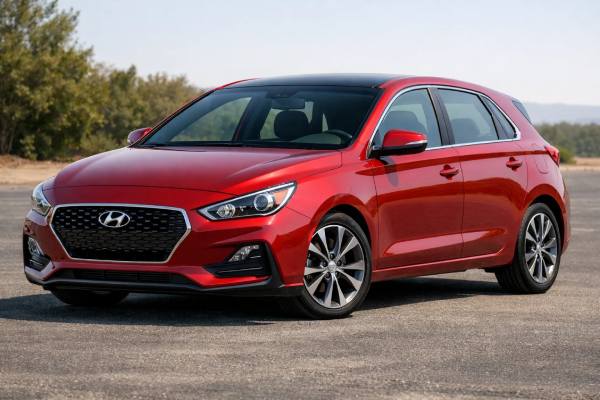
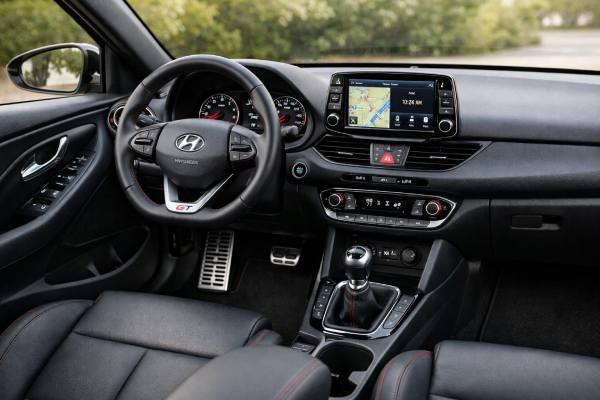
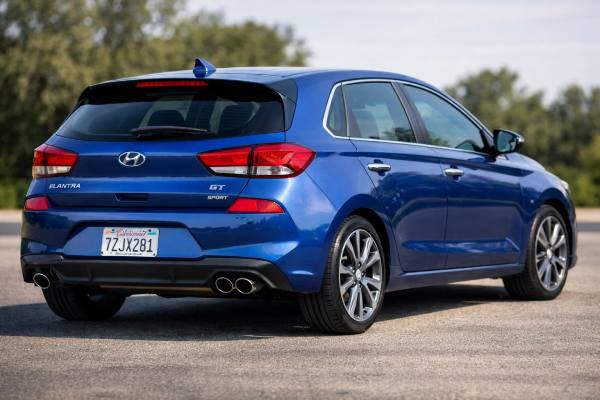
The 2018 Hyundai Elantra GT Sport is one of those cars that makes more sense the closer you look. On the surface, it is a compact hatchback with sporty trim and a strong spec sheet. In practice, it is a useful blend of warm-hatch pace, everyday practicality, and relatively simple ownership compared with newer turbo performance cars. The key engineering story is strong for the class: a 201 hp 1.6-litre turbocharged direct-injection engine, standard six-speed manual or available seven-speed dual-clutch transmission, independent multi-link rear suspension, larger brakes, and a genuinely roomy hatchback body. That gives the GT Sport more substance than a cosmetic trim package. Today, its appeal depends on condition and service history more than age alone. The engine is capable, the chassis is well sorted, and the cabin is practical, but direct-injection maintenance, DCT behavior, turbo plumbing, and recall completion all matter. Bought carefully, it remains one of the smarter hot-hatch alternatives in its price band.
Quick Overview
- The GT Sport’s best traits are its 201 hp turbo engine, multi-link rear suspension, and real hatchback practicality.
- Manual cars are the cleaner enthusiast choice, while the 7DCT is quicker and easier in traffic but needs careful test-driving.
- Standard equipment is generous, including 18-inch wheels, four-wheel disc brakes, blind-spot monitoring, and heated front seats.
- The main ownership caveats are carbon buildup, DCT drivability complaints on neglected cars, and the need to verify recall work.
- A practical oil-service interval is every 6,000 to 8,000 km or 6 months in mixed real-world use.
Start here
- Hyundai Elantra GT Sport Identity
- Hyundai Elantra GT Sport Data
- Hyundai Elantra GT Sport Features and Protection
- Reliability Watch and Campaigns
- Ownership Schedule and Buyer Tips
- Driving Impressions and Fuel Use
- GT Sport Against Alternatives
Hyundai Elantra GT Sport Identity
The Elantra GT Sport is not just a faster trim of the regular Elantra GT. Hyundai built it as the performance version of the PD-generation hatchback before the later N Line took over. That matters because the upgrades are meaningful. The turbocharged 1.6 T-GDi engine gives the car a clear edge over the naturally aspirated 2.0-litre GT, while the suspension, brakes, tyre package, and rear-suspension layout help it feel more serious than the ordinary model. The result is a car that sits between a practical compact hatch and a full hot hatch.
What makes the GT Sport appealing today is the balance it strikes. It is quick enough to feel lively, but it is not so extreme that it becomes tiring or expensive to own. It has a real hatchback cargo bay, a folding rear seat, generous rear headroom for the class, and a useful driving position. At the same time, it gives you the sort of hardware that matters to drivers who care about road feel: independent rear suspension, four-wheel disc brakes, 18-inch wheels, and either a six-speed manual or a quick-shifting seven-speed DCT. Hyundai also gave it a more focused look with twin exhaust outlets, sport seats, and trim upgrades that stop it feeling like a base commuter.
The GT Sport also arrived at a useful moment for Hyundai. By 2018, the brand had become more confident with chassis tuning and interior presentation, but it had not yet moved fully into the more complex tech-heavy phase seen in newer models. That gives the GT Sport a practical advantage. There is enough modern hardware to make it feel current in normal use, yet not so much that every minor issue becomes expensive. Apple CarPlay, Android Auto, heated seats, blind-spot monitoring, rear cross-traffic alert, and a rearview camera are meaningful quality-of-life features, but the car is still understandable for a home mechanic or an independent shop.
There is also a subtle but important point about the GT Sport’s mission. Unlike later N products, it was not meant to be a track-day special. Hyundai tuned it as a sporty daily driver with real utility. That means the spring and damper rates are firmer than the regular GT, but still comfortable enough for rough roads. It means the turbo engine feels punchy, but not aggressively peaky. And it means the cabin remains calm enough for commuting, even if tyre roar is higher than on smaller-wheel trims.
That broad competence is why the car still deserves attention. It is not the most famous hatchback in the segment, and it does not have the aftermarket gravity of a GTI or Civic Si. But it offers a lot of the same core appeal at lower cost, especially if you value practicality as much as outright badge prestige.
Hyundai Elantra GT Sport Data
The 2018 Elantra GT Sport uses a single powertrain with two transmission choices. The numbers below focus on the U.S.-market GT Sport hatchback and highlight the details that matter most for ownership and parts decisions.
Powertrain and efficiency
| Item | Hyundai Elantra GT Sport 1.6 T-GDi |
|---|---|
| Code | Gamma 1.6 T-GDi |
| Engine layout and cylinders | Inline-4, DOHC, 4 cylinders, 4 valves per cylinder |
| Bore × stroke | 77.0 × 85.0 mm (3.03 × 3.35 in) |
| Displacement | 1.6 L (1,591 cc) |
| Induction | Turbocharged |
| Fuel system | Gasoline direct injection |
| Compression ratio | 9.5:1 |
| Max power | 201 hp (150 kW) @ 6,000 rpm |
| Max torque | 264 Nm (195 lb-ft) @ 1,500–4,500 rpm |
| Timing drive | Chain |
| Rated efficiency | 6MT: 9.0 / 7.6 / 8.4 L/100 km city/highway/combined (22 / 29 / 25 mpg US; 25.6 / 34.8 / 33.6 mpg UK) |
| Rated efficiency | 7DCT: 9.0 / 7.4 / 8.4 L/100 km city/highway/combined (26 / 32 / 28 mpg US combined rating in U.S. format; 31.2 / 38.4 / 33.6 mpg UK combined equivalent) |
| Real-world highway @ 120 km/h (75 mph) | about 6.8–7.8 L/100 km (34.6–30.2 mpg US / 41.5–36.2 mpg UK) |
Transmission and driveline
| Item | Value |
|---|---|
| Transmission | 6-speed manual or 7-speed dry dual-clutch automatic |
| Transmission code | DCT listed as D7UF1 in Hyundai feature material |
| Drive type | FWD |
| Differential | Open |
| Final drive | 6MT: 4.467:1 / DCT: FGR1 4.643:1, FGR2 3.611:1 |
Chassis and dimensions
| Item | Value |
|---|---|
| Suspension front | MacPherson strut with coil springs |
| Suspension rear | Multi-link independent |
| Steering | Rack-and-pinion motor-driven power steering |
| Steering ratio | 13.4:1 |
| Turns lock-to-lock | 2.60 |
| Brakes | 12.0 in (305 mm) front ventilated discs / 11.2 in (284 mm) rear solid discs |
| Wheels and tyres | 225/40 R18 on 18 × 7.5 in alloy wheels |
| Ground clearance | 5.9 in (150 mm) |
| Length / Width / Height | 170.9 / 70.7 / 57.7 in (4,341 / 1,796 / 1,466 mm) |
| Wheelbase | 104.3 in (2,649 mm) |
| Turning circle | 34.78 ft (10.60 m) |
| Kerb weight | 6MT: 3,014–3,102 lb (1,367–1,407 kg) / DCT: 3,067–3,155 lb (1,391–1,431 kg) |
| GVWR | 6MT: 4,035 lb (1,830 kg) / DCT: 4,079 lb (1,850 kg) |
| Fuel tank | 14.0 US gal (53 L / 11.7 UK gal) |
| Cargo volume | 24.9 ft³ seats up / 55.1 ft³ seats down (705 / 1,560 L), EPA |
| Towing capacity | Not broadly advertised for this U.S. version; verify locally |
| Payload | Door-label specific |
Fluids and service capacities
| Item | Value |
|---|---|
| Engine oil | 5W-30 preferred in official GT manual context; 4.5 L (4.76 US qt) |
| Coolant | Phosphate-based ethylene-glycol coolant for aluminum radiator; about 6.2 L (6.55 US qt) for 6MT |
| DCT fluid | API GL-4 SAE 70W DCTF; 1.9–2.0 L (2.01–2.11 US qt) |
| Manual transmission fluid | API GL-4 SAE 70W; 1.7–1.8 L (1.8–1.9 US qt) |
| Brake and clutch fluid | DOT 3 or DOT 4; 0.7–0.8 L (0.74–0.85 US qt) |
| A/C refrigerant | R-1234yf; 500 g (17.63 oz) |
| A/C compressor oil | PAG; 110 ±10 cc (3.88 ±0.35 fl oz) |
| Key torque specs | Wheel nuts 88–107 Nm (65–79 lb-ft) |
Safety and driver assistance
| Item | Value |
|---|---|
| Euro NCAP | No commonly cited GT Sport-specific Euro NCAP rating |
| IIHS crashworthiness | Good in driver-side small overlap, passenger-side small overlap, moderate overlap, side, roof strength, and head restraints |
| IIHS award | Top Safety Pick for qualifying configurations |
| IIHS headlight rating | GT Sport standard LED setup after April 2018: Marginal; GT Sport Tech Package with high-beam assist: Acceptable |
| ADAS suite | Standard blind-spot detection and rear cross-traffic alert; no full AEB or lane-centering package listed in the core GT Sport feature sheet |
This data explains the car’s appeal clearly. The GT Sport is not heavy, it has useful torque, and it combines stronger hardware with a spacious hatchback body. That is a convincing formula even years later.
Hyundai Elantra GT Sport Features and Protection
The 2018 Elantra GT Sport is relatively easy to shop because Hyundai kept the trim structure clean. The regular GT used the naturally aspirated 2.0-litre engine, smaller wheels, and a simpler chassis. The GT Sport is the version enthusiasts actually want. It gets the 201 hp 1.6 T-GDi, the larger brakes, multi-link rear suspension, 18-inch wheels, and a more upscale interior and equipment mix. That makes the Sport feel like a real step up, not just a badge package.
Standard equipment is one of the GT Sport’s strongest selling points. Hyundai gave it a broad list of useful features rather than forcing buyers into a long options chain. Heated front seats, leather seating surfaces, dual-zone climate control, proximity entry with push-button start, rearview camera, blind-spot detection, rear cross-traffic alert, Android Auto, Apple CarPlay, LED daytime running lights, LED taillights, projector headlights, and a panoramic sunroof are all part of the GT Sport’s appeal. The interior also looks and feels more substantial than many budget-hatch competitors from the same period.
There was also an optional package structure that matters when buying used. The Sport Premium Package added navigation, Infinity audio, Clari-Fi music restoration, Blue Link services, an auto-dimming rearview mirror, and related convenience upgrades. Those options do not change the core driving hardware, but they do change how complete the car feels in daily use. If you care about cabin quality and tech more than the bare minimum, the package is worth having. If you want the cleanest long-term ownership story, the base Sport spec without every extra convenience item can sometimes be the simpler used buy.
Mechanically, the main choice is manual versus DCT. The six-speed manual is the purist’s version and also the one with the cleaner long-term durability outlook. The seven-speed dry DCT is quicker and more modern-feeling when driven hard or on open roads, but it deserves more careful inspection at used-car age. Low-speed hesitation, clutch shudder, or awkward creeping behavior are not unusual on dry-clutch transmissions when poorly maintained or abused in constant stop-and-go traffic.
Safety equipment is strong for the class and era. The GT Sport includes a driver’s knee airbag in addition to the usual front, side, and curtain airbags, plus electronic stability control, traction control, brake assist, ABS, and vehicle stability management. Child-seat hardware is straightforward, and the hatchback body gives good rear access.
Crash-test results are also reassuring. IIHS gives the 2018 Elantra GT hatchback Good ratings across all the major crashworthiness categories, including both small-overlap tests, and the model line qualifies for a Top Safety Pick award in the right configurations. The main caveat is headlights. Not every setup earned the same result. The GT Sport’s standard LED arrangement scored worse than the better-equipped high-beam-assist version. So if safety equipment is a major buying priority, the exact lighting setup matters.
There are no modern driver-assistance systems in the full current sense. Blind-spot monitoring and rear cross-traffic alert are helpful, but this is not a lane-centering, adaptive-cruise, forward-collision-heavy car in standard GT Sport form. Buyers stepping out of newer hatchbacks should keep that in mind.
Reliability Watch and Campaigns
The Elantra GT Sport is fundamentally a solid car, but it is not one you buy casually. Its issues are understandable, yet some of them can become expensive if ignored. The most important thing is separating normal wear from the specific weak points of the 1.6 T-GDi engine and the available seven-speed DCT.
The engine is generally strong when serviced properly, but there are a few patterns worth watching. Because it is a direct-injection turbo engine, carbon buildup on the intake valves is more likely over time than on an older port-injected motor. That does not mean every car needs immediate blasting, but rough idle, misfire under load, or poor response on higher-mileage cars should put intake deposits on the inspection list. Ignition coils and spark plugs are also worth checking early, because a weak coil on a turbo GDI car can cause drivability problems quickly.
Turbo system issues are not especially common, but they do exist. Split boost hoses, intercooler connection leaks, sticky wastegate behavior, and oil seepage around turbo oil-feed or return areas can all show up on older cars. These are usually medium-cost problems rather than catastrophic failures, but they need attention. The engine also responds badly to neglected oil-change intervals. Thick or dirty oil is one of the fastest ways to shorten turbo life.
The DCT is the second major ownership question. Hyundai’s dry-clutch seven-speed unit can work very well when healthy. It shifts quickly and suits the GT Sport’s personality. But it is still a dry-clutch design, and that means crawling traffic, repeated hill starts, and poor prior maintenance can leave you with shudder, hesitation, or odd engagement behavior. A little awkwardness at parking speed is normal. Heavy shudder, delay into drive, or clumsy shifting when warm is not.
Other issues are more routine:
- front stabilizer links and bushings
- wheel bearings
- rear brake drag from lack of use
- panoramic sunroof rattles or drains
- hatch trim and cargo-area squeaks
- occasional steering-column or MDPS noises
There is also one official campaign you should absolutely check on cars fitted with the panoramic sunroof. A 2018 recall covered certain Elantra GT vehicles because the panoramic sunroof motor may have been incorrectly programmed and might not detect an obstruction properly when closing. The remedy involved inspection and replacement where needed. This is not a reason to avoid the car, but it is a clear reason to verify the VIN and obtain dealer proof.
Software and calibrations matter too. Transmission control logic, infotainment updates, and dealer software revisions can affect drivability even when no hard parts are failing. That is especially true for DCT cars. So a good pre-purchase check should include not just a scan for current fault codes, but a dealer history printout if possible.
The safest used-car strategy is simple: choose the cleanest service history over the cheapest asking price. A documented GT Sport with honest maintenance is usually a good bet. A modified or poorly serviced one can get expensive very quickly.
Ownership Schedule and Buyer Tips
The GT Sport is best maintained on a conservative schedule. Hyundai’s longer normal-service intervals may be fine for ideal highway use, but most older turbo hatchbacks do not live ideal lives. Short trips, traffic, enthusiastic driving, and age all argue for shorter intervals.
| Item | Practical interval |
|---|---|
| Engine oil and filter | every 6,000–8,000 km or 6 months |
| Severe-service oil interval | 6,000 km is the safer rule |
| Engine air filter | inspect every service, replace around 24,000–30,000 km |
| Cabin air filter | every 15,000–20,000 km or 12 months |
| Spark plugs | inspect by 60,000 km, replace by 75,000–90,000 km on tuned or hard-used cars |
| Timing chain | no fixed replacement interval; inspect if startup rattle, poor oil history, or timing-correlation faults appear |
| Drive belts | inspect every service, replace when cracked or noisy |
| DCT fluid | inspect for service history and refresh on schedule if applicable to local guidance; do not ignore drivability symptoms |
| Manual transmission oil | refresh around 80,000–100,000 km |
| Coolant | check strength and condition regularly; replace by time if history is unclear |
| Brake fluid | every 2 years |
| Tyre rotation | every 10,000–12,000 km |
| Alignment check | yearly or after major pothole strikes |
| Battery test | yearly from year 4 onward |
The fluid and capacity picture is straightforward. Engine oil is 4.5 litres. The DCT takes roughly 1.9 to 2.0 litres of its correct fluid. The manual takes roughly 1.7 to 1.8 litres. Coolant is about 6.2 litres on the manual car, with similar but not always identically published figures on the DCT depending on source formatting. Brake fluid capacity is small, but replacement every two years matters. Wheel-nut torque stays in the 88–107 Nm range.
If you are buying one, I would inspect it in this order:
- Start it fully cold. Listen for chain rattle, ticking, boost leaks, and uneven idle.
- Check for modifications. Tune boxes, intake kits, cheap blow-off valves, and cut springs often tell you how the car was treated.
- Drive the DCT in traffic if fitted. A five-minute test drive is not enough.
- Inspect tyres and brake condition. Cheap tyres on a GT Sport usually signal corner-cutting elsewhere.
- Look for turbo and intercooler leaks. Oil misting and loose couplers matter.
- Verify the panoramic sunroof recall if equipped.
- Scan it properly. Pending misfire, knock, or transmission codes matter even when no warning light is on.
The best buys are stock or lightly altered manual cars with full records, or clean DCT cars with documented service and smooth warm operation. Cars to avoid are those with mismatched tyres, open recalls, vague oil history, or any sign of tuning without supporting maintenance.
Long-term, the GT Sport can be durable, but it is not the sort of turbo hatchback that forgives neglect. Treat it like a performance version, not a base commuter, and it usually rewards the effort.
Driving Impressions and Fuel Use
The Elantra GT Sport feels more mature than many compact hot-hatch alternatives, and that is one of its strengths. It does not have the playful front-end bite of the very best performance hatchbacks, but it gives the driver a lot of confidence very quickly. The body stays composed, the rear suspension gives the chassis a more settled feel than a torsion-beam rival, and the steering has enough weight to feel purposeful without becoming tiring.
On the road, the Sport’s personality is defined by usable torque. The 1.6 T-GDi engine pulls strongly from low rpm, and the broad torque plateau means the car rarely feels caught out in normal driving. You do not have to wring it out to make progress. That makes the GT Sport an easy car to drive quickly without working very hard. The manual lets you enjoy that flexibility more, while the DCT turns it into an especially quick, easy fast commuter.
Ride quality is firmer than the standard GT, but not punishing. On smooth roads the car feels planted and calm. On rougher surfaces, the 18-inch tyres bring more impact harshness and some extra road noise, but the basic suspension tune stays composed. That is one reason the GT Sport works well as a daily driver. It feels sportier without becoming exhausting.
Braking performance is strong for the class. The larger discs give the car more confidence in repeated fast-road use than a normal compact hatch. Pedal feel is consistent when the brake system is healthy, though neglected rear calipers can dull the experience on older examples. Straight-line stability at highway speed is also good, and the hatchback body makes the car feel useful rather than compromised when traveling with luggage.
Real-world economy is respectable rather than exceptional:
- City: about 9.0–10.5 L/100 km
- Highway at 100–120 km/h: about 6.8–7.8 L/100 km
- Mixed use: about 7.8–9.0 L/100 km
That translates to roughly high-20s to mid-30s in US mpg depending on use, or low-30s to low-40s in UK mpg. The DCT is often the highway winner on steady runs, while the manual gives the driver more control and can be just as efficient if driven smoothly. Cold weather, short trips, aggressive throttle use, and cheap tyres can all move the result in the wrong direction.
The overall driving verdict is simple. The GT Sport is not the sharpest or most charismatic hatchback of its era, but it is one of the most rounded. It is quick enough, refined enough, and practical enough to make sense every day. That balance is a real advantage.
GT Sport Against Alternatives
The Elantra GT Sport’s natural rivals include the Volkswagen Golf GTI in base form, the Civic hatchback 1.5T, the Mazda3 2.5 hatch, and the Kia Forte5 SX Turbo in spirit. Each does something slightly different, which helps explain where the Hyundai fits.
Against a GTI, the Hyundai usually loses on badge prestige, steering feel, and outright polish at the limit. It wins on purchase price and often on basic feature value. Against a Mazda3 2.5 hatch, the Hyundai usually offers stronger mid-range punch and more hatch-specific utility, while the Mazda tends to feel more fluid and more engaging. Against a Civic hatchback 1.5T, the Hyundai feels a little more conservative but often offers more straightforward equipment and a less polarizing cabin.
| Rival | Where the GT Sport wins | Where the rival may win |
|---|---|---|
| Volkswagen GTI | Lower buy-in cost, good feature value, strong practicality | Chassis polish, steering feel, market reputation |
| Mazda3 2.5 hatch | Stronger turbo torque, more eager mid-range, useful equipment | More natural steering and driver engagement |
| Civic hatch 1.5T | Value, standard features, less overexposed market image | Cabin packaging efficiency and broader aftermarket |
| Kia Forte5 SX Turbo | Similar pace with slightly more mature hatch packaging | Depending on market, styling and price overlap |
The Hyundai’s best argument is that it avoids extremes. It is not as expensive to buy as a comparable GTI, not as soft as a base compact hatch, and not as compromised as some coupes or sedans pretending to be sporty. It also offers real hatchback versatility, which matters more in daily life than many buyers expect.
Its biggest weaknesses are also clear. The DCT is not as smooth in traffic as the best torque-converter automatics. The engine needs more care than a simple naturally aspirated four-cylinder. And while the car is good, it never quite builds the emotional connection that some rivals manage. That matters to enthusiasts more than to practical owners.
My verdict is that the 2018 Elantra GT Sport is one of the better under-the-radar sporty hatchbacks of its time. It makes the most sense for drivers who want one car to do many jobs well: commute, carry cargo, handle a fast back road, and keep running costs reasonable. The best examples are stock, documented, and either manual or very well-behaved DCT cars. Buy on condition, not just spec, and it is still an excellent used-hatch choice.
References
- 2018 HYUNDAI ELANTRA SPECIFICATIONS 2017 (Technical Specifications)
- Hyundai Announces 2018 Elantra GT Pricing 2017 (Manufacturer Publication)
- OWNER’S MANUAL 2017 (Owner’s Manual)
- 2018 Hyundai Elantra GT 2026 (Safety Rating)
- Part 573 Safety Recall Report 18V-891 2018 (Recall Database)
Disclaimer
This article is for informational purposes only and is not a substitute for professional diagnosis or repair. Specifications, torque values, service intervals, recall applicability, procedures, and equipment can vary by VIN, market, production date, transmission, and option package, so always verify details against the correct official service documentation for the exact vehicle.
If this guide helped you, please consider sharing it on Facebook, X, or another platform to support our work.