
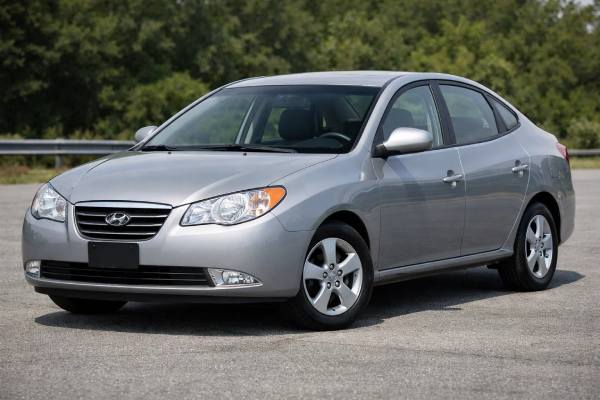
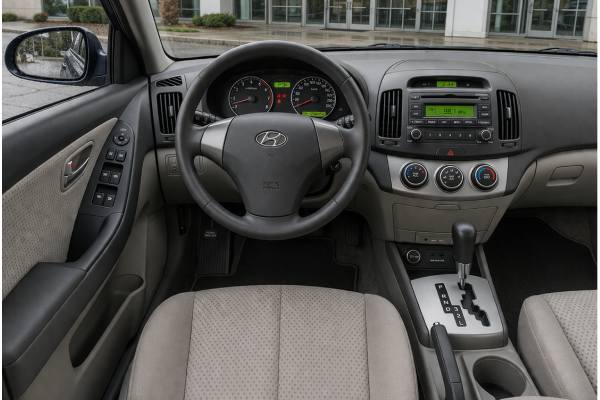

The Hyundai Elantra HD 1.6 is one of those compact sedans that makes more sense the longer you look at it. It does not sell itself with headline performance or premium branding. Instead, it wins on solid packaging, a roomy cabin, straightforward engineering, and ownership costs that can stay reasonable if the car has been maintained properly. For this version, the key mechanical feature is the 1.6-liter Gamma-family petrol engine, a naturally aspirated four-cylinder that is commonly catalogued around 119 hp in some markets and about 121 to 122 PS in others. Either way, the real appeal is not the number itself but the balance: enough power for daily driving, fewer expensive complications than later turbo engines, and a simple front-wheel-drive layout that remains easy for independent workshops to understand. A good 2007–2010 Elantra HD 1.6 can still be a practical used family car, but rust, recall history, and oil-service discipline matter much more than the badge.
Quick Specs and Notes
- The 1.6-liter petrol engine is smooth, simple, and cheaper to keep than many newer small engines.
- Interior space, rear-seat room, and boot capacity remain strong points for the class.
- Manual cars are usually the easiest long-term ownership choice.
- Poor oil service can accelerate timing-chain wear and make an otherwise good engine feel tired.
- A sensible oil and filter interval is every 10,000 to 12,000 km or 12 months.
What’s inside
- Hyundai Elantra HD basics
- Hyundai Elantra HD specs and data
- Hyundai Elantra HD trims and safety
- Common faults and service campaigns
- Maintenance plan and buyer checks
- Driving feel and real efficiency
- How it compares with rivals
Hyundai Elantra HD basics
The HD-generation Elantra marked a real step forward for Hyundai in the compact class. Earlier Elantras were sensible enough, but the HD felt more complete. It was larger inside, more mature on the road, and better aligned with what mainstream family-car buyers actually wanted. That matters when you assess the 1.6 version today. This is not a bargain-basement relic. It is a genuinely usable compact sedan from an era when manufacturers were still trying to improve refinement and durability without loading every car with expensive electronics.
The 1.6-liter version is especially interesting because it sits in the middle of the range in the best possible way. It avoids the extra fuel use and tax exposure that can come with larger engines in some markets, but it is still strong enough to move the HD body without feeling painfully underpowered. The engine itself is the Gamma-family G4FC, a 1,591 cc naturally aspirated inline-four with dual overhead camshafts, four valves per cylinder, and multi-point injection. In catalogues, it is often listed at around 119 hp in one system and 121 to 122 PS in another. In practical terms, the output difference on paper matters less than the character: clean throttle response, predictable power delivery, and none of the complexity of direct injection or turbocharging.
The HD also improved one of Hyundai’s long-standing weak points: perceived solidity. Doors close with more confidence than on many earlier models, the cabin layout is straightforward, and the car feels designed for everyday use rather than brochure theater. Rear-seat room is generous for the class, the boot is properly useful, and visibility remains good by modern standards. Even now, the Elantra’s proportions help it. It is large enough to feel like a real family car, but compact enough to park easily and run on modest tyre sizes.
Of course, age changes the picture. The newest HD is still an old car now. Rubber bushes harden, suspension joints wear, seals sweat, and neglected examples can deteriorate quickly. The Elantra HD 1.6 is not special because it escapes aging. It is special because, when looked after, it ages in a very understandable way. Most of its weaknesses are mechanical, visible, and repairable. That is the real reason it still deserves attention in the used market.
Hyundai Elantra HD specs and data
For this article, the focus is the 2007–2010 Elantra HD sedan with the 1.6-liter petrol engine. Some specifications vary slightly by region, body style, emissions tune, and transmission, so the figures below reflect the common European-style 1.6 manual car and note where market differences matter.
| Powertrain and efficiency | Data |
|---|---|
| Code | G4FC |
| Engine layout and cylinders | Inline-4, DOHC, 4 valves per cylinder, 77.0 × 85.4 mm (3.03 × 3.36 in) |
| Displacement | 1.6 L (1,591 cc) |
| Motor | Not applicable |
| Induction | Naturally aspirated |
| Fuel system | Multi-point manifold injection |
| Compression ratio | 10.5:1 |
| Max power | 119 hp (89 kW), commonly catalogued as 121–122 PS depending on market and standard, @ about 6,200 rpm |
| Max torque | About 153–157 Nm (113–116 lb-ft) @ about 4,200 rpm |
| Timing drive | Chain |
| Rated efficiency | Roughly 6.8–7.2 L/100 km combined, depending on market cycle and gearbox |
| Real-world highway @ 120 km/h | About 6.4–7.3 L/100 km in a healthy manual car |
| Transmission and driveline | Data |
|---|---|
| Transmission | 5-speed manual or 4-speed automatic |
| Drive type | FWD |
| Differential | Open |
| Chassis and dimensions | Data |
|---|---|
| Suspension (front/rear) | MacPherson strut front / independent multi-link style rear layout |
| Steering | Rack and pinion power steering |
| Brakes | Front ventilated discs, rear discs on many trims and markets; some lower-spec versions used rear drums |
| Wheels and tyres | 185/65 R15 or 195/60 R15 were common; some markets also used 16-inch alloys |
| Ground clearance | Around 160 mm (6.3 in) |
| Length / Width / Height | 4,505 mm / 1,775 mm / 1,490 mm (177.4 / 69.9 / 58.7 in) |
| Wheelbase | 2,690 mm (105.9 in) |
| Turning circle (kerb-to-kerb) | About 11.3 m (37.1 ft) |
| Kerb weight | About 1,156–1,220 kg (2,549–2,690 lb), depending on transmission and trim |
| GVWR | About 1,680 kg (3,704 lb) where published |
| Fuel tank | 53 L (14.0 US gal / 11.7 UK gal) |
| Cargo volume | 460 L (16.2 ft³) for the sedan |
| Performance and capability | Data |
|---|---|
| Acceleration | 0–100 km/h in about 10.5 s for a manual |
| Top speed | About 191 km/h (119 mph) |
| Braking distance | No single validated period figure confirmed for the exact 1.6 trim |
| Towing capacity | Market dependent; confirm on VIN plate and local documentation |
| Payload | Roughly 500 kg (1,100 lb), depending on specification |
| Fluids and service capacities | Data |
|---|---|
| Engine oil | Commonly 5W-30 or 5W-40 depending on climate and oil approval; about 4.0 L (4.23 US qt) |
| Coolant | Ethylene glycol-based coolant; about 6.6 L (6.97 US qt) |
| Transmission / ATF | Manual: GL-4 75W-90 class fluid, about 2.1–2.2 L; automatic: Hyundai SP-III type fluid, verify exact fill by gearbox |
| Differential / transfer case | Not applicable |
| A/C refrigerant | R-134a; verify exact charge on the under-bonnet label |
| A/C compressor oil | Verify by system label or workshop data |
| Key torque specs | Wheel nuts 90–110 Nm (66–81 lb-ft) |
| Safety and driver assistance | Data |
|---|---|
| Crash ratings | IIHS moderate overlap front Good for 2007–10; side test Marginal for 2007–10 cars built before December 2009 |
| Headlight rating | Not applicable for this era |
| ADAS suite | None in the modern sense |
The key point behind the table is simple. The Elantra HD 1.6 is not fast, but the numbers are better than the conservative image suggests. More importantly, the specifications show a car built with practical, conventional engineering. That gives it lasting value in the used market.
Hyundai Elantra HD trims and safety
Trim structure on the HD varies enough by region that a used buyer should think in equipment groups rather than in one universal badge hierarchy. In some markets, the 1.6 appeared in entry and mid-range trims only. In others, it could be ordered with a surprisingly generous specification including alloy wheels, automatic climate control, upgraded audio, leather, and a better airbag and brake package. The lesson is clear: buy the actual car in front of you, not the trim name printed in an old brochure or copied into an online listing.
Mechanical differences by trim were usually subtle but important. Better-equipped cars were more likely to get rear disc brakes, ABS with EBD, electronic stability control in some markets, larger wheels, and a fuller airbag count. Some markets also bundled the nicer safety equipment into premium or “comfort plus” versions rather than offering it broadly across the range. That means the best used examples are not always the cars with the fanciest interior trim. Sometimes the most desirable version is the one with the best safety hardware and the least questionable aftermarket modification.
Quick identifiers help. Higher trims often have alloy wheels, steering-wheel audio controls, climate control or at least a more complete A/C panel, better seat fabric, and cleaner switchgear. Some cars also received trip computers, fog lamps, and body-colour mirrors and handles. Lower trims may still be worthwhile if the condition is excellent, but you need to be honest about what they are. A base 1.6 with missing service history, steel wheels, no ABS, and tired suspension is much harder to justify than a better-kept mid-spec example with documented maintenance.
Safety is a mixed but still respectable story for the period. The strongest official data in widely available open sources comes from IIHS. The HD-era Elantra earned a Good rating in the moderate-overlap frontal test, which is a real strength for a compact sedan of its time. The side-impact picture was less impressive for early and mid-run cars, with IIHS assigning a Marginal side rating to 2007–10 examples built before December 2009. That is worth noting because many buyers remember only the frontal result and assume the whole safety picture was equally strong.
In practical ownership terms, the HD’s safety setup is still decent for an early-2000s compact. Many cars came with six airbags, ABS, front seat active head restraints, and ISOFIX or LATCH-style child-seat anchorage depending on market. What it does not have is the layer of modern crash avoidance most drivers now take for granted. There is no AEB, no lane support, and no blind-spot system. On this Elantra, condition is a safety feature. Straight crash structure, correct airbag warning-light behavior, good tyres, and proper brake service matter more than any badge on the trunk.
Common faults and service campaigns
The Elantra HD 1.6 is generally dependable, but it has reached an age where reliability is shaped as much by previous owners as by original engineering. The good news is that most common faults are well understood. The bad news is that neglected examples can hide a long backlog of ordinary maintenance under the surface. On this car, there is rarely one dramatic failure that defines the model. Instead, condition usually declines through a pile-up of manageable issues.
The most important engine-related watchpoint is the timing chain system. Unlike older Hyundai four-cylinders that used belts, the 1.6 G4FC uses a chain. That is an advantage, but it is not a free pass. Long oil-change intervals, cheap oil, or repeated short-trip use can accelerate chain, guide, or tensioner wear. The usual warning signs are cold-start rattle, rougher running, or timing-correlation faults rather than instant catastrophe. In most cases, the remedy is straightforward: verify oil condition first, diagnose properly, and replace chain-set components if the engine is noisy or out of spec.
Other engine issues are mostly familiar and medium-cost. Common examples include rocker-cover seepage, tired ignition coils, aging spark plugs, thermostat wear, oxygen-sensor faults, and occasional rough running caused by intake contamination or vacuum leaks. None of these are unusual for a naturally aspirated compact car of this age. Cooling systems are also worth watching. Radiator end tanks, hoses, and reservoir caps age normally, and an apparently small coolant leak should be taken seriously before it becomes an overheating event.
Chassis problems are typical of an older front-wheel-drive sedan. Front drop links, lower arm bushes, ball joints, rear suspension bushes, and wheel bearings are all predictable wear points. So are sticky rear brake components on lightly used cars. The Elantra should feel calm and stable. If it clonks over bumps, wanders on the motorway, or drags a rear brake, budget for suspension and brake reconditioning rather than blaming the design itself.
Electrical faults are usually minor, but they do occur. Door-lock actuators, window regulators, blower resistors, and steering-assist oddities are not unheard of. U.S.-market cars also saw a notable EPS-related recall campaign for certain 2008–2009 examples, involving software updates or electronic power steering unit replacement. A separate later ABS-related fire-risk recall affected certain 2007–2010 Elantras in the U.S. because moisture could enter the ABS electrical circuit and create a short. These campaigns are market-specific, but they underline an important buying rule: always check VIN-based recall history instead of assuming an old car is too old to have open campaigns.
Corrosion is the real separator between a good HD and a bad one. Check rear arches, sill seams, subframe areas, floor edges, lower door seams, boot floor, suspension pick-up points, and brake-line zones. Rust is the failure point that turns a cheap Elantra into an expensive mistake. A clean shell with average mechanical wear is usually recoverable. A rusty shell with a sweet engine usually is not.
Maintenance plan and buyer checks
The Elantra HD 1.6 responds well to a simple maintenance strategy: stay ahead of age-related wear, shorten intervals slightly versus optimistic brochure schedules, and treat fluids as preventive medicine rather than as lifetime fill marketing. This model does not need exotic care, but it does benefit from consistency.
| Item | Practical interval | Notes |
|---|---|---|
| Engine oil and filter | Every 10,000–12,000 km or 12 months | Shorter is better for short trips and chain life |
| Engine air filter | Inspect every service, replace around 20,000–30,000 km | Earlier in dust-heavy use |
| Cabin filter | About every 15,000 km or 12 months | Replace sooner in polluted city use |
| Spark plugs | Around 30,000–45,000 km for standard plugs, longer for long-life types | Use the correct heat range |
| Coolant | Every 2–3 years | Keep the system clean and mixed correctly |
| Brake fluid | Every 2 years | Important for ABS health and brake feel |
| Manual gearbox oil | Refresh around 60,000–80,000 km | Helps shift quality and synchro life |
| Automatic fluid | Check regularly and service conservatively if history is clear | Use correct Hyundai ATF |
| Timing chain | No fixed belt-style interval; inspect for rattle, stretch symptoms, or timing faults | Good oil service is the real prevention |
| Auxiliary belt and hoses | Inspect every service | Replace on cracks, glazing, or swelling |
| Tyre rotation | About every 10,000–12,000 km | Also check alignment |
| Battery test | Yearly from age 4 onward | Weak voltage can trigger misleading faults |
Useful service figures include roughly 4.0 L engine oil capacity, around 6.6 L coolant capacity, and about 2.15 L for the manual gearbox. Wheel-nut torque is typically 90–110 Nm. Those are practical decision-making numbers, but buyers still need to verify the exact car by VIN, especially where transmission or market equipment differs.
A good used-buy inspection follows a simple order:
- Body shell and underside.
- Recall and service history.
- Cooling-system integrity.
- Chain noise on cold start.
- Clutch, gearbox, and steering feel.
- Brake condition and tyre wear pattern.
- Electrical functions and warning lights.
The best version to own long term is usually a manual 1.6 in a mid-range or upper-mid trim with ABS, decent tyres, and complete history. That combination gives you the simpler drivetrain with enough equipment to make the car comfortable and safer to live with. Automatic cars can still be fine, but only when the transmission behaves cleanly and the service story is believable. The cars to avoid are predictable: rust in structural places, no proof of maintenance, obvious accident repair, mixed tyres, persistent warning lights, and sellers who insist that chain rattle is “normal.”
Long-term durability is still one of the HD’s strengths. The car is not fragile. It just needs the kind of steady, grown-up maintenance that older mainstream sedans always needed.
Driving feel and real efficiency
The Elantra HD 1.6 is easy to underestimate from the driver’s seat, because it never tries too hard to impress. Its strengths are calmness and usability. Steering is light enough for town work, visibility is good, and the overall driving position is natural. Around the city, the car feels narrower and more manageable than many newer compact sedans, which helps it stay pleasant in tight traffic and parking spaces.
The 1.6 engine suits the car’s character. It is not especially quick, but it is smoother and more willing than the basic image suggests. With a manual gearbox, the car has enough performance to feel alert in everyday driving, and the naturally aspirated response makes it easier to meter than a small turbo engine in stop-start traffic. The engine prefers moderate revs and does not offer much low-rpm punch if fully loaded, but it is honest and predictable. That matters more than a headline figure in a used family sedan.
Ride quality is one of the HD’s better traits. Hyundai tuned the chassis for comfort first, and that still shows. A healthy car deals with broken surfaces well, keeps noise under control for its age, and remains stable at motorway speed. It is not a sporty setup, but it does not feel vague either when the suspension is fresh. The rear suspension helps the HD feel more composed than some cheaper rivals over rough roads. The downside is that neglected bushes and dampers make a very visible difference. A tired Elantra feels older than it is. A sorted one still feels perfectly civil.
Brake feel is straightforward. Cars with rear discs and fresh fluid usually inspire more confidence, while neglected rear hardware can make the pedal feel duller than it should. Good tyres matter a lot on this platform. Cheap rubber makes the steering feel slower, the braking weaker, and the car noisier. A decent set of mid-range tyres transforms the HD more than many buyers expect.
Fuel use is reasonable for the class and age. In real conditions, expect roughly 8.5 to 9.5 L/100 km in dense city use, around 6.4 to 7.3 L/100 km on a steady 120 km/h motorway run, and roughly the low-7s in mixed driving if the engine is healthy and the alignment is correct. That is not class-leading by modern standards, but it is perfectly acceptable given the engine size, age, and simplicity. More importantly, the Elantra combines that fuel use with modest maintenance bills. That overall balance is why the 1.6 still works. It is never exciting, but it is often satisfying.
How it compares with rivals
The Elantra HD 1.6 lived in one of the toughest parts of the market. It faced the Toyota Corolla, Honda Civic, Ford Focus, Mazda 3, Nissan Almera or Tiida depending on region, plus various value-driven alternatives from Kia and Chevrolet. It was not the prestige choice, and it was not the default enthusiast pick either. What it offered instead was value through space, equipment, and mechanical simplicity.
Against a Toyota Corolla of similar age, the Hyundai usually loses on long-term brand reputation and sometimes on interior-material aging. But it often wins on purchase price and can offer more equipment for the same money. Against a Honda Civic, the Elantra feels less sharp and less image-led, yet it is often easier to buy well without paying a premium for the badge. Against a Ford Focus, it gives away steering sparkle and chassis playfulness, but many buyers will find the Hyundai easier to justify as a comfort-focused daily driver.
Compared with the Mazda 3, the Hyundai again feels softer and less driver-focused. But the Elantra’s quieter value proposition is exactly what many used buyers want. It is roomy, comfortable enough, and usually not overvalued. That matters in the real world more than a road-test ranking from when the cars were new. Against a Nissan Almera or Tiida, the result is closer. The Elantra usually wins on cabin design and perceived maturity, while the Nissan often counters with a good mechanical reputation of its own.
The Hyundai’s biggest weakness versus the strongest rivals is not the engine or basic chassis. It is how badly a neglected example can age in the body and small details. Rust, tired trim, and deferred servicing can make a cheap Elantra look like a worse design than it really is. By contrast, a clean, well-kept HD 1.6 makes a convincing case for itself. It has enough space, enough power, enough comfort, and enough simplicity to remain useful today.
That is the real verdict. The 2007–2010 Elantra HD 1.6 is not the most glamorous compact sedan of its era. It is one of the more sensible ones. For buyers who want a straightforward used family car and who understand that condition matters more than brand mythology, it remains an easy car to recommend. The key is simple: buy the best-maintained example you can find, not the cheapest one you can reach.
References
- ALL-NEW 2007 HYUNDAI ELANTRA REDEFINES COMPACT CAR SEGMENT 2006
- HYUNDAI 2007 ELANTRA AUTOMOBILE OWNER’S MANUAL | ManualsLib 2007 (Owner’s Manual)
- 2008 Hyundai Elantra 2008 (Safety Rating)
- Part 573 Safety Recall Report 20V-061 2020 (Recall Database)
- Hyundai Elantra IV 1.6 i 16V (122 Hp) | Technical specs, data, fuel consumption, Dimensions 2006
Disclaimer
This article is for informational purposes only and is not a substitute for professional diagnosis or repair. Specifications, torque values, intervals, procedures, and equipment can vary by VIN, market, trim, transmission, and body style, so always verify the exact vehicle against official service documentation before buying parts or carrying out repairs.
If this guide was useful, please consider sharing it on Facebook, X, or another platform to support our work.