
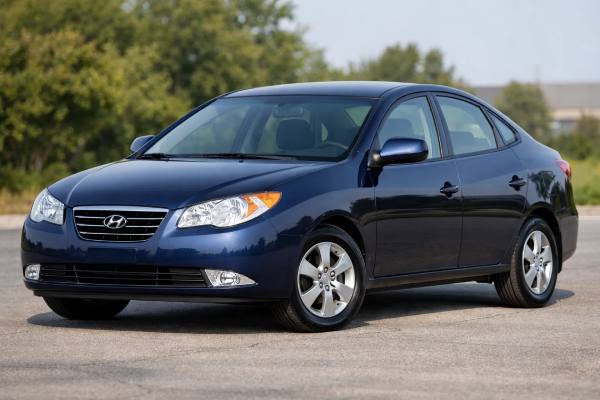
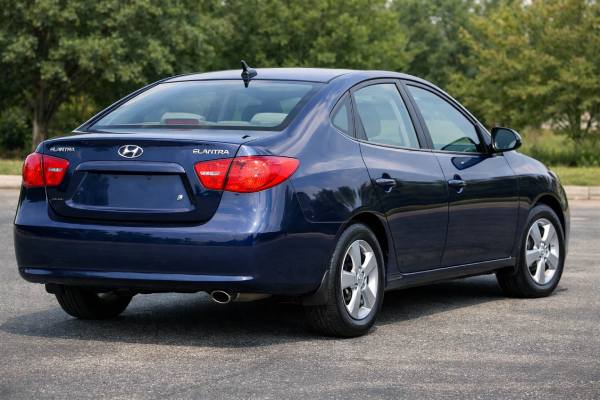
The Hyundai Elantra HD 2.0 from 2007 to 2010 is one of those compact sedans that rewards a practical mindset. It was designed to be roomy, comfortable, economical to run, and easier to own than many rivals once the warranty years were over. In 2.0-litre 138 hp form, the HD gets the engine that best suits its size, because it gives the car enough torque for city traffic, highway cruising, and daily family use without adding real complexity. It also benefits from a fully independent suspension layout, a large cabin for the class, and simple port-injected petrol hardware that is easier to diagnose than many later compact cars. The catch is age and maintenance history. A well-kept HD can still be a dependable low-cost sedan. A neglected one can quickly need a timing-belt job, cooling-system work, suspension parts, and rust repair. In this generation, condition matters more than trim badge.
Essential Insights
- The 2.0-litre engine makes the HD feel more relaxed and usable than the smaller-engine versions.
- Cabin space, trunk room, and ride comfort are real strengths for a compact sedan from this period.
- Simple naturally aspirated MPI hardware keeps repair complexity lower than on many newer cars.
- Timing-belt history, cooling-system condition, and underbody rust are the main ownership concerns.
- Plan timing-belt service at about 96,000 km or 60,000 miles unless documented more recently.
Quick navigation
- Hyundai Elantra HD design brief
- Hyundai Elantra HD hard data
- Hyundai Elantra HD trims and restraint tech
- Aging faults and recall history
- Maintenance plan and buyer advice
- Ride quality and real economy
- HD Elantra versus rivals
Hyundai Elantra HD design brief
The HD-generation Elantra marked an important step in Hyundai’s rise from value brand to credible mainstream compact-car maker. Compared with the older XD, the HD became larger, quieter, and more mature in its proportions, while also pushing much harder on interior room and comfort. Hyundai made a big deal of that at launch, and it had a good reason. This Elantra was designed to feel bigger inside than buyers expected from a compact sedan, and that remains one of its strongest qualities today.
In 2.0-litre 138 hp form, the HD gets the engine that best matches its overall character. This is not a performance sedan, but it is not underpowered in the way some smaller-engined compact cars can feel once passengers, luggage, and air conditioning are involved. The Beta II 2.0 with CVVT gives the car enough mid-range usefulness to feel relaxed in normal traffic, which is exactly what this generation was trying to deliver. The engine is also straightforward by modern standards: naturally aspirated, port injected, and paired with either a 5-speed manual or a 4-speed automatic.
The chassis deserves credit too. Hyundai used a MacPherson strut front suspension and an independent multi-link rear suspension, which helped the HD ride with more composure than some budget rivals that still relied on simpler rear layouts. That decision gave the Elantra a more planted and refined feel over broken roads, even if it never tried to be the sharpest-handling car in the segment. The steering is light, the controls are easy, and the overall balance is tuned for daily use rather than excitement.
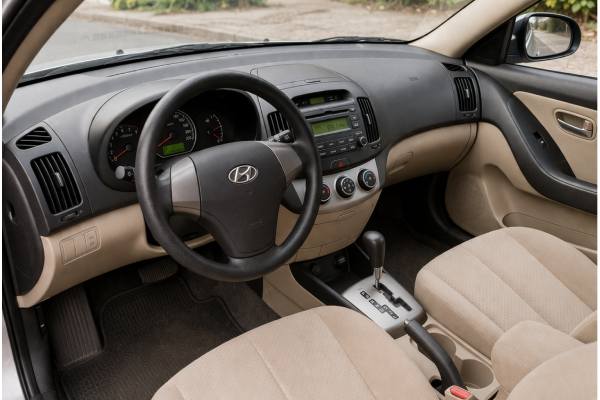
Inside, the HD’s value proposition still makes sense. Passenger space is generous, visibility is good, the sedan trunk is genuinely useful, and the control layout is simple enough that little time is needed to feel at home. In period, Hyundai also pushed standard features and warranty coverage hard, which helped the Elantra stand out next to more established rivals.
The downside is that every HD is now an older car. At this point, timing-belt history, coolant condition, rust prevention, and the quality of previous repairs matter far more than the original brochure. That means the best HD is not always the highest trim. It is usually the cleanest, driest, best-documented example.
That is the right way to understand the HD 2.0. It is a practical compact sedan with strong packaging, low-stress road manners, and simple engineering. Its advantages are real, but they only stay real when the car has been maintained with care.
Hyundai Elantra HD hard data
The HD 2.0 was sold in multiple markets, but the broad mechanical package stayed very consistent. Most open-access official-era U.S. material lists the 2.0-litre ULEV engine at 138 hp and 136 lb-ft, while certain PZEV automatic versions were slightly lower. The table below focuses on the widely published 138 hp specification and flags market or trim differences where they matter.
Powertrain and efficiency
| Item | Hyundai Elantra HD 2.0 |
|---|---|
| Code | Beta II 2.0 CVVT, commonly G4GC |
| Engine layout and cylinders | Inline-4, 4 cylinders |
| Valvetrain | DOHC, 16 valves, 4 valves per cylinder |
| Bore × stroke mm (in) | 82.0 × 93.5 mm (3.23 × 3.68 in) |
| Displacement | 2.0 L (1,975 cc) |
| Induction | Naturally aspirated |
| Fuel system | MPI / MPFI |
| Compression ratio | About 10.1:1 |
| Max power | 138 hp (103 kW) @ 6,000 rpm |
| Max torque | 184 Nm (136 lb-ft) @ 4,600 rpm |
| Timing drive | Belt |
| Rated efficiency | Around 8.1–7.8 L/100 km combined for typical U.S. 2010 sedan trims, depending on transmission |
| Real-world highway @ 120 km/h (75 mph) | Usually about 6.9–8.0 L/100 km in good condition |
Transmission and driveline
| Item | Data |
|---|---|
| Transmission | 5-speed manual or 4-speed automatic |
| Drive type | FWD |
| Differential | Open |
Chassis and dimensions
| Item | Data |
|---|---|
| Suspension front / rear | MacPherson strut front / independent multi-link rear |
| Steering | Power rack-and-pinion; ratio about 15.4:1 on commonly published sedan specs |
| Brakes | Front ventilated discs; rear drums on many GLS trims, rear discs on some SE and upper trims |
| Wheels and tyres | 195/65 R15 common; some higher trims used 16-inch wheels |
| Ground clearance | About 150 mm (5.9 in) |
| Length / Width / Height | 4,505 mm / 1,775 mm / 1,481 mm (177.4 / 69.9 / 58.3 in) |
| Wheelbase | 2,650 mm (104.3 in) |
| Turning circle (kerb-to-kerb) | About 10.3 m (33.9 ft) |
| Kerb weight | Roughly 1,235–1,285 kg (2,721–2,833 lb), depending on trim and transmission |
| GVWR | Verify by VIN plate and market |
| Fuel tank | 53 L (14.0 US gal / 11.7 UK gal) |
| Cargo volume | About 402 L (14.2 ft³) seats up, sedan |
Performance and capability
| Item | Data |
|---|---|
| 0–100 km/h (0–62 mph) | Roughly 9.6–10.8 s, depending on transmission |
| Top speed | About 190–200 km/h (118–124 mph) |
| Braking distance | No single official factory figure commonly published |
| Towing capacity | Market-dependent; verify locally |
| Payload | Usually around 430–500 kg depending on exact specification |
Fluids and service capacities
| Item | Data |
|---|---|
| Engine oil | Commonly 5W-20, 5W-30, or 10W-30 depending on climate and manual guidance; about 4.0 L (4.2 US qt) with filter |
| Coolant | Ethylene-glycol coolant for aluminum engines, typically 50:50 mix; about 6.6 L (7.0 US qt) |
| Transmission / ATF | Verify by exact gearbox and market specification |
| Differential / transfer case | Not separately serviced on this FWD layout |
| A/C refrigerant | Verify by under-bonnet label |
| A/C compressor oil | Verify by compressor type |
| Key torque specs | Use VIN-specific service data only |
Safety and driver assistance
| Item | Data |
|---|---|
| Crash ratings | IIHS moderate overlap front: Good for 2007–10; side rating changed from Marginal on early cars to Good on 2010 cars built after November 2009 |
| Headlight rating | Not published in modern IIHS headlight format |
| ADAS suite | None |
These numbers explain why the HD still appeals. It is roomy, reasonably efficient, and strong enough to avoid feeling strained, all while keeping the mechanical package simple.
Hyundai Elantra HD trims and restraint tech
The HD Elantra was sold with a trim structure that emphasized value first and sportier presentation second. In many markets, the core sedan line revolved around GLS, SE, and later Blue or Limited-style variants. The important point is that the 2.0-litre engine remained central to the range, so trim differences were mostly about suspension tuning, wheel size, brake hardware, cabin materials, and convenience equipment rather than about major powertrain changes.
A typical GLS was the practical middle ground. It usually paired the 2.0 with 15-inch wheels, softer suspension tuning, and comfort-focused equipment such as air conditioning, power windows, power locks, split-folding rear seats, and useful storage. That made it the best fit for buyers who cared about easy ownership and lower running costs. SE trims changed the character slightly by adding firmer suspension calibration, upgraded wheels and tyres, and in some cases rear disc brakes instead of drums. The SE is the one to consider if you want the HD at its most responsive, but it also tends to be a little firmer and more dependent on tyre quality.
The later Blue model is worth noting because it shows how Hyundai kept stretching the HD formula. It used the same 2.0-litre basic engine family, but with detail changes aimed at lower fuel use rather than stronger performance. For a buyer focused on the standard 138 hp sedan, the Blue is more of an efficiency offshoot than the central version of the range.
Safety equipment was a real selling point for the HD in period. Hyundai highlighted six standard airbags, including dual front airbags, front seat-mounted side airbags, and side curtain airbags. Active front head restraints were part of the package in many markets, and anti-lock braking with electronic brake-force distribution was widely available. Electronic stability control availability varied by trim and market, so it should always be verified on the exact car rather than assumed.
Crash-test performance needs a nuanced reading. The HD did well in frontal crash testing, and IIHS rated the 2007–10 Elantra Good in the moderate overlap front test. That is a meaningful strength for a mainstream compact from this period. Side protection is more complicated. Early cars built before the late-2009 update received a Marginal IIHS side result, while 2010 models built after November 2009 improved to Good after revisions to the side airbags and body-side structure. That makes late-production 2010 cars more appealing from a safety standpoint.
There are no modern driver-assistance systems here. No autonomous emergency braking, no lane support, no adaptive cruise control, and no blind-spot monitoring. That keeps the car simpler to maintain, but it also means the HD depends heavily on tyre condition, brake quality, lighting performance, and driver judgement.
For used buyers, the safest approach is to look for a clean later car with side-airbag equipment, documented maintenance, and no crash-warning lights. Original equipment matters, but honest condition matters more.
Aging faults and recall history
The Elantra HD 2.0 has a generally solid mechanical base, but like most older compact sedans it becomes expensive only when maintenance has been ignored for too long. Most of the known trouble spots are straightforward and familiar. That is good news, because surprises are relatively rare. The bad news is that several small deferred jobs can quickly stack up on a cheap example.
The first issue to treat seriously is the timing belt. The 2.0-litre Beta II does not use a timing chain, and that matters. Any HD with undocumented timing-belt history should be treated as overdue immediately. The correct approach is not just to fit a new belt. It is to inspect or replace the tensioner, idlers, and ideally the water pump at the same time. On an older car, that is often the difference between one proper service and a repeat job later.
Cooling-system age is the second major concern. Radiators, thermostat housings, plastic tanks, hose ends, and heater hoses all become weaker over time. The engine itself usually copes well when coolant quality and temperature control are right, but repeated overheating can push the car into head-gasket or cylinder-head trouble. Brown coolant, unexplained coolant loss, weak heater output, and old dried coolant marks around the radiator are all warning signs.
Oil leaks are common rather than dramatic. Valve-cover gasket seepage, cam-seal sweating, and general oil mist around the front of the engine are typical age-related faults. They are usually low- to medium-cost repairs, but they should not be ignored because oil contamination shortens belt life and softens nearby rubber parts.
Running-quality faults are usually simple. Rough idle, hesitant throttle response, and poor cold running are often caused by old plugs, weak coils or leads, dirty throttle bodies, vacuum leaks, or tired sensors. Because the engine is port injected and naturally aspirated, diagnosis is generally less painful than on later direct-injection or turbocharged compact cars.
Transmission issues vary by maintenance. Manual gearboxes are usually durable, but clutch wear, hydraulic leaks, or weak synchromesh can appear on higher-mileage cars. The 4-speed automatic is serviceable but not tolerant of neglect forever. Delayed engagement, shift flare, or harsh warm shifts are signs to take seriously.
On recalls, the HD has a few documented items worth checking. One important campaign covered 2008 Elantras built in a defined production window for a fuel-pump subassembly issue that could lead to stalling or no-start symptoms. Another long-term concern for current owners is the later ABS fuse-related fire-risk recall that affected 2007–2010 HD Elantras. Even if a car has been reliable for years, that recall status should still be checked by VIN. The best used-car habit is simple: do not guess. Verify every open campaign with official records before purchase.
Maintenance plan and buyer advice
A Hyundai Elantra HD 2.0 can still be a very easy car to live with, but only if you treat it like a conventional aging sedan and stay ahead of predictable wear items. The car does not need exotic care. It needs consistent care. Most ownership disappointments come from buyers who expect an old compact to behave like a newer one after years of deferred maintenance.
A practical service schedule looks like this:
| Item | Practical interval |
|---|---|
| Engine oil and filter | Every 8,000–10,000 km or 12 months |
| Engine air filter | Inspect every service; replace around 20,000–30,000 km |
| Cabin air filter | If fitted, inspect yearly |
| Coolant | Inspect yearly; renew about every 2–3 years unless long-life coolant history is documented |
| Spark plugs | Usually 30,000–40,000 km for conventional plugs; longer for correct long-life plugs |
| Fuel filter | Replace to market schedule or when age and fuel-delivery condition suggest it |
| Timing belt | Replace at the factory interval; if the history is unknown, treat it as overdue |
| Water pump | Sensible to replace during timing-belt service |
| Auxiliary belts and hoses | Inspect every service |
| Manual gearbox oil | Check leaks and shift quality; renew preventively on older cars |
| Automatic transmission fluid | Inspect condition and shifting behaviour; do not ignore old fluid |
| Brake fluid | Every 2 years |
| Brake pads, discs, drums, and shoes | Inspect every service |
| Tyre rotation and alignment | Rotate around every 10,000 km; align if wear is uneven |
| 12 V battery | Test from about year 4 onward and replace on condition |
For fluids, the most useful public planning figures are about 4.0 L of engine oil with filter and roughly 6.6 L of coolant capacity. Beyond that, especially for automatic transmission fluid and torque values, it is smart to use VIN-specific service information rather than generic internet charts.
When shopping for an HD, start underneath. Rust is not as notorious as on some older compacts, but it still matters. Check the front subframe, lower control-arm mounting areas, floor seams, jacking points, rear arches, brake lines, and the lower edges of the doors. Surface rust can be manageable. Structural corrosion is usually a reason to walk away unless the car is exceptional.
Then inspect the engine bay carefully:
- Look for clean coolant and no obvious overheating history.
- Check around the timing cover and rocker cover for oil leaks.
- Listen for belt noise, rough idle, or cold-start misfire.
- Ask directly for timing-belt receipts, not verbal promises.
- Confirm recall work by VIN.
On the road, test hot idle stability, clutch take-up, gearbox smoothness, brake balance, steering return, and suspension noise over broken surfaces. Common reconditioning items on old HDs include tyres, front brakes, batteries, top mounts, anti-roll-bar links, and radiator-related parts. None are shocking. What matters is whether the car needs one or two of them, or all of them at once.
The best buy is usually a clean later sedan with documented timing-belt service, working air conditioning, and no cooling-system drama.
Ride quality and real economy
The Elantra HD 2.0 drives like a compact sedan developed with comfort, space, and predictability as the main priorities. That still works in its favour. The seating position is natural, visibility is good, the steering is light enough for city use, and the car is easy to place on narrow streets or in tight parking spaces. Nothing about it is dramatic, but very little is tiring either.
Ride quality is one of the model’s genuine strengths. The independent rear suspension helps the HD absorb rough surfaces with a calm, controlled feel that many buyers do not expect from an affordable compact of this period. It is not soft in a loose or floaty way. Instead, it feels measured, which makes the car pleasant both in town and on longer A-road or motorway journeys. Higher trims with firmer tuning feel more tied down but also depend more on good dampers and tyres to stay composed.
The 2.0-litre engine suits the chassis well. It is not fast, but it does enough to keep the car from feeling strained. Around town, throttle response is predictable and fairly linear. There is no turbo lag, no complex transmission logic, and no need to constantly work around a narrow power band. On the open road, the engine feels adequate rather than energetic, but it is stronger and more relaxed than the lower-output alternatives.
The 5-speed manual is the better choice for drivers who want the most direct feel and slightly simpler long-term ownership. The 4-speed automatic is better understood as a comfort feature. When healthy, it is smooth enough and easy to live with, but it is not quick or especially efficient by modern standards. Because it has only four ratios, it can feel busier at speed than a newer compact with a 6-speed or CVT.
Noise levels are respectable for the era. At low and medium speeds, the HD is quieter than many people expect from an older Hyundai. At motorway pace, tyre and wind noise become more obvious, but it never feels crude if the car is on good tyres and the door seals are still in decent condition.
Real-world fuel use is sensible. EPA data for the 2010 sedan shows 26 city and 34 highway mpg for the automatic, and 25 city and 34 highway mpg for the manual in the standard 2.0 sedan, which is roughly 9.0 and 6.9 L/100 km. In daily ownership, a healthy car often lands around 8.0–9.0 L/100 km in mixed driving. City-heavy use can move into the mid-9s or low-10s, while steady 120 km/h highway cruising usually stays in the high-6s to high-7s depending on load, weather, and tyre choice.
The HD is at its best when driven as intended: smoothly, steadily, and without pretending it is a sports sedan.
HD Elantra versus rivals
The Elantra HD competed in one of the toughest compact-car classes of its time. Its main rivals included the Toyota Corolla, Honda Civic, Mazda3, Ford Focus, Nissan Sentra, Chevrolet Cobalt, and Kia Spectra/Forte depending on year. Against those cars, the Hyundai rarely led on image, but it often made a strong case on value, space, and standard equipment.
That remains true today. Compared with a Corolla, the HD usually feels roomier and often gives you more features for the same money. The Toyota still tends to win on reputation and resale confidence, but the Hyundai can be the better bargain if condition is equal. Compared with a Civic, the Elantra feels softer and less sharp, though also less demanding and often more comfortable. Against a Mazda3 or Focus, the Hyundai is less engaging to steer, but calmer over rough surfaces and less likely to have been bought by drivers looking for a sportier feel.
One of the HD’s biggest strengths is how much car it gives you for the price. The cabin is generous, the trunk is useful, and the 2.0-litre engine avoids the underpowered feel that affects some older compact sedans. That makes the Elantra more versatile than its modest badge value might suggest. It works as a commuter, a first car, or even a low-cost long-distance tool if the car is healthy.
Its weaknesses are just as clear. The 4-speed automatic feels old now. The cabin materials are durable rather than premium. Safety is decent for the period, but still dated compared with anything much newer. And because many examples have lived through budget ownership, the difference between a good HD and a bad HD is large. A clean, well-kept car can feel composed and reliable. A neglected one can feel loose, noisy, and surprisingly expensive to sort.
That is why the Elantra HD should be chosen on evidence rather than optimism. The better buy is not always the cheapest one, and it is not always the highest trim. It is the one with the best service records, the cleanest underside, the healthiest cooling system, and believable timing-belt history.
Overall, the 2007–2010 Hyundai Elantra HD 2.0 remains one of the more sensible under-the-radar compact sedans of its era. It combines space, comfort, and simplicity in a way that still works. Buy carefully, and it can be a very rational used car. Buy by price alone, and it can remind you very quickly why maintenance history matters more than bargain hunting.
References
- ALL-NEW 2007 HYUNDAI ELANTRA REDEFINES COMPACT CAR SEGMENT 2006
- HYUNDAI RECEIVES FIVE-STAR SAFETY RATINGS FROM NHTSA 2007 (Safety Rating)
- 2010 Hyundai Elantra 2026 (Safety Rating)
- Gas Mileage of 2010 Hyundai Elantra 2026 (Fuel Economy)
- Elantra 2008 (HD) 2008 (Recall Notice)
Disclaimer
This article is for informational purposes only and is not a substitute for professional diagnosis or repair. Specifications, torque values, intervals, procedures, and equipment can vary by VIN, market, trim, transmission, emissions package, and prior repair history, so always verify the exact details against official service documentation for the specific vehicle.
If this guide helped you, please consider sharing it on Facebook, X/Twitter, or other social platforms to support our work.