
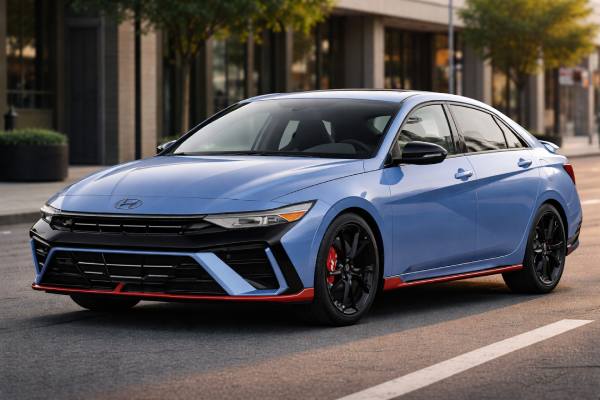

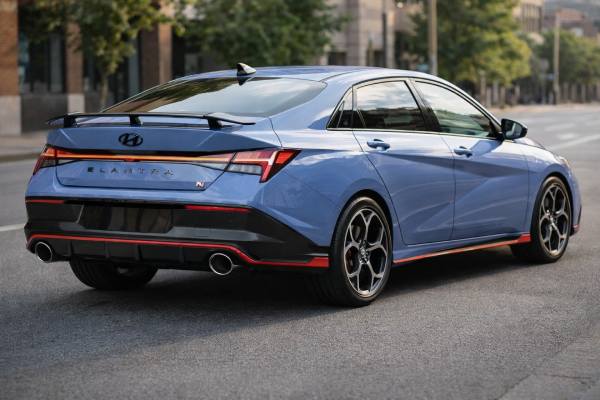
The 2021–2023 Hyundai Elantra N is the point where the Elantra stopped pretending to be merely sporty and became a real performance sedan. Hyundai gave the CN7 body a 2.0-litre turbocharged direct-injection engine, an electronically controlled limited-slip differential, adaptive dampers, larger brakes, a reinforced chassis, and either a 6-speed manual or an 8-speed wet dual-clutch transmission. That hardware matters because the Elantra N is not just an appearance package or an N Line trim. It is a genuine N model built to handle track work, fast road driving, and daily use in one package. The engineering is unusually serious for the money, yet the car still keeps a usable rear seat and a proper trunk. For owners today, the big question is not whether it is fun. It clearly is. The more important question is whether its performance hardware, tire costs, fuel appetite, and maintenance needs fit real-world ownership. For many buyers, the answer is yes.
Quick Overview
- The 2.0 T-GDi engine, e-LSD, adaptive dampers, and multi-link rear suspension make the Elantra N a true performance sedan, not a styling trim.
- The manual offers a simpler enthusiast experience, while the wet DCT is quicker and still robust when maintained properly.
- Track-capable brakes, cooling, and body reinforcement are real strengths that separate it from ordinary sport compacts.
- The main ownership caveat is that it rewards disciplined servicing, correct tires, and careful attention to any high-pressure fuel pump or warning-light issue.
- A sensible oil-service baseline is every 10,000 km or 12 months, sooner if the car sees repeated hard driving or track use.
Guide contents
- Hyundai Elantra N CN7 overview
- Hyundai Elantra N CN7 specifications
- Hyundai Elantra N CN7 trim and safety
- Common issues and factory actions
- Maintenance and buyer’s guide
- Driving experience and efficiency
- Elantra N versus key rivals
Hyundai Elantra N CN7 overview
The Elantra N arrived as the most serious road-going Elantra Hyundai had ever built, and it did not get there by relying on power alone. The CN7 platform already had a dramatic shape and a low, wide stance, but Hyundai’s N division changed the parts that matter most to drivers. The Elantra N received the 2.0-litre turbocharged “flat power” engine, a reinforced front structure, a rear stiffening bar, integrated drive axle hardware, torque-feedback steering, a dedicated electronic limited-slip differential, and a full suite of N-specific drive functions. These include configurable N modes, launch control, variable exhaust, track-oriented instrumentation, and on DCT cars, N Grin Shift, N Power Shift, and N Track Sense Shift.
That hardware list is why the Elantra N feels different from the ordinary Elantra line. Even compared with the earlier Elantra Sport, this is a much more complete performance package. The front brakes are huge, the cooling is more serious, the tires are wider, and the chassis has more mechanical grip and better body control. Hyundai also gave the car bucket-style N seats, a lowered seating position, a proper mechanical handbrake in the U.S. market, and enough rigidity upgrades that the sedan remains stable and precise even when driven hard. This is unusually ambitious for a front-wheel-drive compact sedan that still has to serve normal commuting duties.
The other part of the Elantra N’s appeal is that it stays practical. Hyundai did not turn it into a cramped coupe substitute. It still has a useful rear seat, good trunk space, decent infotainment, and the ergonomics of a modern mainstream sedan. That makes the N easier to live with than some rivals that lean more heavily into rawness. You can drive it to work all week, do a long highway trip, and still take it to a track day without feeling that it is pretending to be something it is not.
For buyers now, the 2021–2023 range is quite consistent. Output remains 276 hp, with a temporary 286 hp overboost function on DCT cars via N Grin Shift. The 2023 model year mostly reflects equipment and pricing adjustments rather than a full mechanical rethink. The real ownership split is transmission choice. Manual buyers get the purer and simpler version. DCT buyers get the fastest Elantra N, but also more software and transmission behavior to evaluate closely. In both cases, the CN7 N is one of the clearest examples of Hyundai turning motorsport lessons into a road car that still makes sense off the track.
Hyundai Elantra N CN7 specifications
The official North American reveal and subsequent Hyundai product sheets make the Elantra N’s hardware unusually easy to document. This is helpful because the car’s appeal depends heavily on the details, not just the headline horsepower figure.
Powertrain and efficiency
| Item | Hyundai Elantra N (CN7) |
|---|---|
| Code | 2.0 T-GDi “Flat Power” |
| Engine layout and cylinders | Inline-4, transverse, 4 cylinders |
| Valvetrain | DOHC, 4 valves per cylinder |
| Bore × stroke | 86.0 × 86.0 mm (3.39 × 3.39 in) |
| Displacement | 2.0 L (1,998 cc) |
| Induction | Turbocharged |
| Fuel system | Gasoline direct injection |
| Compression ratio | 9.5:1 |
| Max power | 276 hp (206 kW) @ 5,500–6,000 rpm |
| Max torque | 392 Nm (289 lb-ft) @ 2,100–4,700 rpm |
| Overboost | 286 hp temporary output with N Grin Shift on DCT cars |
| Timing drive | Chain |
| Rated efficiency | Varies by transmission; manual and DCT both require premium fuel |
| Real-world highway @ 120 km/h (75 mph) | Usually around 7.8–8.8 L/100 km in steady cruising, often higher on summer tires and aggressive routes |
Transmission and driveline
| Item | Hyundai Elantra N (CN7) |
|---|---|
| Transmission | 6-speed manual or N 8-speed wet dual-clutch transmission |
| Drive type | Front-wheel drive |
| Differential | Electronically controlled limited-slip differential |
| Launch control | Standard |
| Special transmission functions | N Power Shift, N Track Sense Shift, and N Grin Shift on DCT |
Chassis and dimensions
| Item | Hyundai Elantra N (CN7) |
|---|---|
| Suspension front / rear | MacPherson strut / multi-link independent |
| Steering | Rack-mounted motor-driven power steering |
| Brakes | Front 360 mm (14.2 in) discs; rear large performance discs |
| Wheels and tyres | 245/35 R19 Michelin Pilot Sport 4S summer tires on 19-inch wheels |
| Length | 4,676 mm (184.1 in) |
| Width | 1,826 mm (71.9 in) |
| Height | 1,415 mm (55.7 in) |
| Wheelbase | 2,720 mm (107.1 in) |
| Ground clearance | Not consistently published in open official sources reviewed |
| Kerb weight | Roughly 1,490–1,560 kg (3,285–3,439 lb), depending on transmission and market |
| Fuel tank | About 47–50 L class depending on market specification |
| Cargo volume | Sedan trunk; market method varies, but still practical for the class |
Performance and capability
| Item | Hyundai Elantra N (CN7) |
|---|---|
| 0–100 km/h (0–62 mph) | About 5.3–5.8 s depending on transmission and launch conditions |
| Top speed | Commonly cited around 250 km/h (155 mph), market-dependent |
| Braking distance | Official open figure not consistently published in the reviewed source set |
| Towing capacity | Not a towing-oriented performance sedan; verify by market if relevant |
| Payload | Market-dependent; verify by VIN and local data plate |
Fluids and service capacities
| Item | Practical guidance |
|---|---|
| Engine oil | Fully synthetic oil meeting the correct Hyundai specification; 0W-30 or 5W-30 often seen depending on market and climate |
| Engine oil capacity | Verify by VIN and owner documentation before service |
| Coolant | Ethylene glycol-based coolant, correct Hyundai-approved mix |
| Transmission fluid | Manual and wet DCT use different specified fluids; verify by VIN before ordering |
| Differential | Integrated into transaxle system; use only the specified transmission and differential-related service approach |
| A/C refrigerant | R-1234yf or market-specified refrigerant; verify under-hood label |
| Key torque specs | Wheel nuts typically 90–110 Nm (66–81 lb-ft); confirm performance-brake service values from service literature |
Safety and driver assistance
| Item | Hyundai Elantra N (CN7) |
|---|---|
| IIHS | Good crashworthiness ratings across major tests for the 2021-on sedan family |
| Top Safety Pick status | Depends on exact configuration and headlight / front crash prevention setup |
| Headlight rating | Varies by trim and equipment in IIHS family data |
| ADAS suite | Forward collision-avoidance assist, lane-keeping / lane-following support, blind-spot monitoring, rear cross-traffic alert, driver attention warning, and related systems depending on market |
The spec sheet explains the car’s personality clearly. This is a front-wheel-drive performance sedan with unusually serious chassis hardware, not a basic commuter that happens to have extra power.
Hyundai Elantra N CN7 trim and safety
The Elantra N trim structure is simpler than the ordinary Elantra range, but there are still meaningful differences that matter in ownership. The base idea remained constant through 2021–2023: every Elantra N came with the full N powertrain and chassis package, the performance seats, the 19-inch Michelin summer tires, the larger brakes, the N drive-mode system, and the visual package with red lower trim accents, a rear wing, and motorsport-inspired interior details. That is useful because buyers do not need to decode whether they are looking at a genuine N mechanically. If it is an Elantra N, the core hardware is there.
What varies more is convenience, transmission choice, and year-specific equipment packaging. In the North American market, the biggest decision is manual versus N wet DCT. The manual gives the purer driver connection, a simpler mechanical layout, and the least complicated long-term ownership path. The DCT version adds its own performance personality with launch control and the N-specific shift features, plus the temporary overboost function that raises output to 286 hp for short bursts. Buyers who track the car or simply want the quickest acceleration often prefer the DCT. Buyers who want long-term mechanical simplicity often prefer the manual.
The cabin is one of the car’s underrated strengths. Hyundai avoided turning the N into an uncomfortable stripped shell. The sports seats are supportive without making daily use miserable, and the digital cluster and infotainment system integrate the N performance displays in a way that feels purposeful rather than gimmicky. The seats also help preserve rear-seat room by reducing back thickness, which is a small but useful engineering detail. This is still one of the most practical performance sedans in its class.
Safety is stronger than many buyers expect from a 276 hp compact sedan. The CN7 Elantra family performed well in IIHS crash testing, with Good results across the core crashworthiness categories for the redesigned 2021-on sedan. Where things become more nuanced is award status. Top Safety Pick or Top Safety Pick+ qualification depends on the exact mix of headlights and front crash prevention equipment, and the N’s performance focus means buyers should confirm the precise configuration rather than assuming all variants carry the same headline award status. The underlying shell, however, is fundamentally strong.
The active-safety story is also useful. The Elantra N includes modern driver-assistance features that many older sport compacts lacked. Depending on market and year, buyers can expect forward collision-avoidance support, lane-keeping and lane-following functions, blind-spot collision warning, rear cross-traffic alert, safe-exit warning logic, driver attention warning, and highway-oriented assistance features integrated with the CN7 platform. These do not change the car into an autonomous system, and many owners will turn down some of the more intrusive settings when driving hard, but they do make the N more complete as an everyday car.
In used-buying terms, the trim question is refreshingly simple. You are not choosing between soft and hard versions of the Elantra N. You are choosing transmission, history, and condition. That makes the market easier to read than many rivals where special packages blur the picture.
Common issues and factory actions
The Elantra N has a fairly encouraging reliability profile for a high-output front-wheel-drive performance sedan, but it is still a modern turbo GDI car with real heat, pressure, and software complexity. That means the right question is not “does it have problems?” Every performance car does. The right question is whether its issues are predictable and manageable. In the Elantra N’s case, they mostly are.
The first area to watch is the high-pressure fuel system. Hyundai issued Safety Recall 262 covering certain 2022–2023 Elantra N and Kona N models due to a high-pressure fuel pump issue involving the fuel control valve, which could create an overly rich mixture and result in loss of drive power. The repair path involved ECU software updates and, where needed, pump replacement. That is not the kind of issue to ignore on a used car, because a seller may present the vehicle as “running perfectly” even if the campaign was never completed. VIN verification matters.
The second area is heat and oil discipline. The 2.0 T-GDi engine is a much more serious unit than Hyundai’s ordinary commuter engines, and it should be treated that way. Hard driving, repeated short trips, and infrequent oil changes are a poor mix for any turbocharged direct-injection engine. A healthy Elantra N should not scare buyers with normal operating sounds, but irregular knock, unusual smoke, rough boost delivery, or a habit of needing oil top-ups without explanation all deserve closer inspection. On a track-driven car, fluid history matters even more. It is better to buy a car that was driven hard and serviced correctly than one that was driven gently and neglected.
Carbon buildup is the third predictable topic. As with most GDI engines, intake-valve deposits can accumulate over time because fuel is not washing the backs of the valves. The Elantra N does not have an unusual reputation here, but over higher mileage, rough cold starts, inconsistent idle, or a slightly dulled response can point in that direction. It is a maintenance issue rather than an identity crisis, but it is still part of ownership.
The driveline split is important too. Manual cars are mechanically simpler but can still show the effects of repeated hard launches through clutch wear. DCT cars generally benefit from the use of Hyundai’s wet eight-speed unit, which is stronger and better suited to repeated torque than the older dry-clutch seven-speed found in lesser Hyundai products. Still, DCT behavior should be checked closely. Smoothness in traffic, correct shift logic, and absence of warning messages matter. These are performance transmissions, not magic gearboxes.
A practical issue map looks like this:
| Issue | Prevalence | Severity | Typical symptoms | Likely remedy |
|---|---|---|---|---|
| HPFP recall condition | Occasional on affected cars | High | Loss of power, rich-running fault condition, warning light | Verify recall completion, ECU update, pump replacement if needed |
| Poor oil history on turbo engine | Common used-car risk | High | Noisy running, oil use, weak boost feel | Restore correct oil service and diagnose before purchase |
| Intake-valve deposit buildup | Occasional over mileage | Medium | Rough cold idle, slightly reduced response | Intake cleaning and tune-up work |
| Manual clutch wear from abuse | Occasional | Medium | Slipping under load, high bite point, smell after launch | Clutch inspection and replacement if needed |
| DCT behavior concerns | Occasional | Medium | Shift hesitancy, warning messages, unusual harshness | Diagnostic scan, software check, proper transmission service |
| Track-use wear | Common on enthusiast cars | Low to high depending on abuse | Tire shoulder wear, cooked pads, heat-cycled rotors | Tires, brake service, alignment, inspection of cooling and fluids |
The good news is that the Elantra N’s known issues are not hidden mysteries. The bad news is that a car with a loud exhaust and shiny paint can still hide skipped campaigns, cooked tires, and stretched service intervals. This is a car where records matter.
Maintenance and buyer’s guide
The Elantra N rewards owners who treat it like a serious performance car instead of a merely faster commuter. That does not mean it is fragile. It means the maintenance standard should be higher. Good fluids, good tires, and honest inspections do more for long-term durability here than cosmetic care ever will.
A practical owner schedule should look like this:
| Item | Practical interval |
|---|---|
| Engine oil and filter | Every 10,000 km or 12 months, sooner with repeated hard use or track days |
| Engine air filter | Inspect every service, replace around 20,000–30,000 km depending on use |
| Cabin air filter | Every 15,000–20,000 km or yearly |
| Spark plugs | Inspect earlier than on a normal sedan; replace to schedule and sooner if tuned or tracked |
| Timing chain | No routine replacement interval; inspect if noisy or if timing-correlation faults appear |
| Coolant | Every 3–5 years, earlier if track use is frequent |
| Brake fluid | Every 2 years minimum, sooner with track work |
| Brake pads and rotors | Inspect every service; performance use can shorten life dramatically |
| Manual transmission fluid | About every 60,000–90,000 km or earlier with track use |
| N DCT fluid and service | Follow Hyundai service guidance exactly; inspect behavior closely |
| Tires | Rotate as appropriate by wear pattern, inspect often, and align yearly or after curb or track abuse |
| 12 V battery and charging | Test yearly after year 4 |
Fluid choice matters. This is not the car for generic bargain-bin fluids. The engine wants the correct synthetic oil grade and specification. The transmission, especially the N DCT, wants the exact Hyundai-approved fluid. Brake fluid condition matters more here than on an ordinary Elantra because the car is genuinely fast and can generate real heat. The same is true for tires. The stock Michelin Pilot Sport 4 S summer tires are excellent, but they are not cheap, and they wear according to how the car is driven. Buyers who do not budget for tires and brake consumables are often surprised by what “performance sedan” actually means.
For used buyers, the inspection routine should be strict:
- Verify all recalls and campaigns by VIN.
- Check service records for regular oil changes.
- Inspect tire brand, date, and shoulder wear.
- Check front brake condition and rotor life.
- Test the differential’s behavior under corner exit with no warning lights present.
- On manual cars, check clutch bite and any slip under load.
- On DCT cars, test low-speed operation, warm shifting, and launch-control history clues.
- Inspect alignment and suspension for track-related wear.
- Check for modifications, especially tunes, blow-off hardware, intake changes, or non-factory calibration.
- Look for signs of repeated heat use, not just visual abuse.
The best cars to seek are usually unmodified or lightly modified examples with full records, recent tires, and proof of recall completion. Cars to avoid are the ones with unknown software, mixed tires, vague servicing, or sellers who dismiss warning lights as “normal N stuff.” Long-term durability looks promising when the car is maintained correctly. Neglect is the real enemy, not the base engineering.
Driving experience and efficiency
On the road, the Elantra N feels much more serious than most front-wheel-drive sedans at this price level. The engine is the obvious headline. It makes strong torque from low rpm, pulls hard through the middle of the rev range, and keeps delivering at the top in a way many small turbo engines do not. Hyundai’s flat-power tuning is not marketing fluff. The car feels eager at the top end, especially when you are not just short-shifting around town.
The manual version is the more involving car. It suits the N’s playful side, works well with the electronically controlled limited-slip differential, and gives experienced drivers a stronger sense of mechanical connection. The DCT, however, is brutally effective. In the right mode it shifts quickly, works well with launch control, and makes the Elantra N feel like a much more expensive performance sedan in straight-line acceleration. On track or on a fast road, the DCT’s logic and speed are real strengths rather than gimmicks.
Handling is where the car really earns its badge. The front axle has remarkable bite for a front-wheel-drive sedan, and the e-LSD does real work on corner exit. Hyundai also gave the car enough front-end stiffness, damping control, and steering precision that it resists the sloppiness often found in fast economy-car derivatives. Adaptive dampers help widen the car’s range. In softer settings, the N is firm but usable every day. In aggressive settings, it becomes track-serious without feeling chaotic. The rear end is cooperative, the body control is strong, and the whole car feels engineered rather than simply stiffened.
Braking performance is also a major strength. The large 14.2-inch front rotors, high-friction pads, and dedicated cooling measures give the car real repeatability under hard use. On the road, pedal confidence is high. On track, the car is genuinely capable, though as always with heavy repeated braking, consumable life depends on driving style and setup.
Refinement is one of the car’s more surprising skills. Yes, there is tire roar from the 19-inch Michelin setup, and yes, the variable exhaust can be loud in its more aggressive modes. But in calmer modes, the Elantra N is still civil enough for long journeys. It is not a stripped-out weekend special. That is a major part of its appeal.
Fuel economy is acceptable rather than impressive. In gentle cruising, the car can return decent highway numbers for its performance level, but mixed driving typically lands much higher than a normal Elantra. Expect something like 8.5–10.5 L/100 km in everyday mixed use depending on transmission, tire choice, climate, and driving style. On a track day, those numbers can move sharply upward. Owners who buy this car for performance and complain that it consumes more than a regular compact are really complaining about physics.
Elantra N versus key rivals
Against the Honda Civic Type R, the Elantra N faces the toughest benchmark in the class. The Honda still has the more established reputation, a sharper front axle in the eyes of many enthusiasts, and a level of chassis finesse that makes it the natural comparison target. But the Hyundai answers in two important ways. First, it often costs less to buy. Second, it offers a more playful dual personality. The Elantra N can be civil in daily use and still feel track-serious when set up properly. The Civic may remain the purist’s default choice, but the Hyundai is closer than badge snobs like to admit.
Compared with the Volkswagen Golf R or even GTI-related alternatives, the Elantra N takes a different approach. It does not offer all-wheel drive, a hatchback body, or the same polished interior atmosphere as the VW line. What it offers instead is a louder, more animated, more openly mechanical experience. For buyers who want subtle premium polish, Volkswagen still has the edge. For buyers who want a sedan that feels alive and engineered around driver feedback, the Hyundai can be more memorable.
The Subaru WRX is another natural rival because it also promises real-world practicality and enthusiast credibility. The Subaru brings all-wheel drive and a different character, especially in poor-weather traction. The Hyundai responds with a more sophisticated front-drive chassis than many expect, stronger brake confidence, and a sharper overall polish in some areas of cabin design and interface. Buyers choosing between them usually decide whether they want all-weather security or front-drive brilliance.
The Civic Si is the less expensive internal comparison point in spirit, even if it is not a direct horsepower match. The Si is lighter on its feet and cheaper to run, but it is not as fast or as track-ready as the N. The Elantra N feels like the bigger, angrier answer. That makes it a stronger value for buyers who genuinely want performance rather than just a sporty daily driver.
So where does the Elantra N sit overall? It sits in a rare middle ground. It is more practical than many track-oriented cars, more serious than most sport compacts, and better value than some better-known rivals. It is not perfect. Tire costs, fuel use, and performance-car maintenance are real. But taken as a whole, the CN7 Elantra N is one of the most complete modern performance sedans Hyundai has ever produced.
References
- Hyundai Unveils Thrilling ELANTRA N for North America In Virtual Debut 2021 (Manufacturer Specifications)
- 2023 Elantra Specifications 2022 (Manufacturer Specifications)
- 2023 PRICING Elantra N 2023 (Pricing Sheet)
- 2022 Hyundai Elantra 2026 (Safety Rating)
- Check for Recalls: Vehicle, Car Seat, Tire, Equipment | NHTSA 2026 (Recall Database)
Disclaimer
This article is for informational purposes only and is not a substitute for professional diagnosis or repair. Specifications, torque values, intervals, capacities, procedures, and even safety-equipment content can vary by VIN, market, model year, transmission, and installed options, so always verify the exact details against official service documentation before servicing, repairing, or buying a vehicle.
If this guide was useful, please consider sharing it on Facebook, X, or another social platform to support our work.