
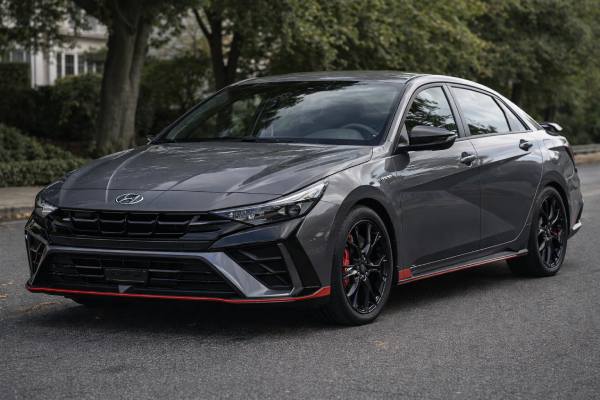
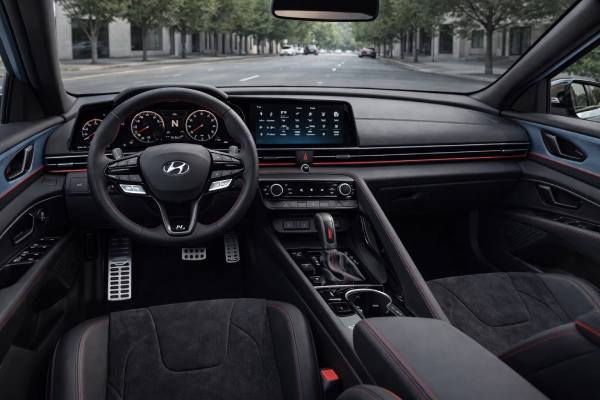
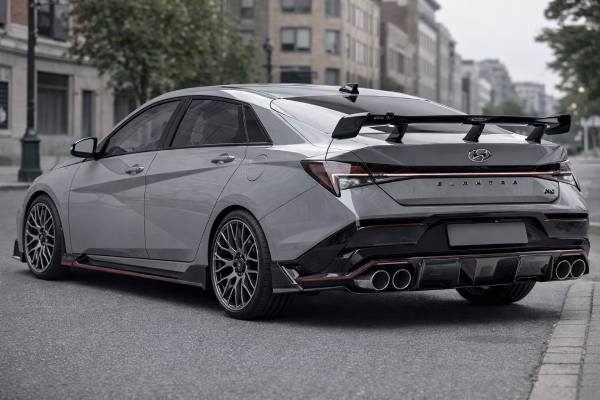
The facelifted Hyundai Elantra N is a rare kind of modern performance car. It is fast enough to feel special, practical enough to use every day, and still honest enough to make sense to an owner who plans to keep it beyond the warranty period. For 2024 and later, Hyundai sharpened the front and rear design, kept the proven 2.0-litre turbocharged engine, and retained the mechanical hardware that made the earlier Elantra N so respected: a limited-slip differential, adaptive dampers, serious brakes, a proper manual option, and a wet dual-clutch alternative that is genuinely good. The biggest attraction is balance. This is not just a straight-line sedan with a loud exhaust. It is a front-drive performance car with real chassis depth. The biggest caution is also clear: it is a highly stressed turbocharged car on 19-inch summer tyres, so maintenance quality, warm-up habits, and recall history matter more than they would on an ordinary Elantra.
Owner Snapshot
- The chassis is one of the best-tuned front-wheel-drive setups in the class, with real track-day credibility.
- Standard e-LSD, adaptive suspension, and strong brakes make the car feel engineered rather than merely modified.
- The six-speed manual is still a major advantage if you want maximum driver involvement.
- Because the powertrain is shared with earlier CN7 N models, fuel-system history and software-campaign awareness still matter.
- Treat engine oil and filter changes as a 5,000 km or 6-month job if you follow the factory performance-car maintenance logic.
Navigate this guide
- Elantra N Facelift Character
- Elantra N Turbo Data Map
- Elantra N Equipment and Protection
- Pattern Failures and Recall Checks
- Running Costs and Purchase Strategy
- Elantra N on Real Roads
- Why It Beats Alternatives
Elantra N Facelift Character
The facelifted Elantra N is not a reinvention of the original CN7 N. It is a refinement of something that was already unusually good. Hyundai kept the formula because the formula worked: a turbocharged 2.0-litre four-cylinder, front-wheel drive, a six-speed manual or eight-speed wet dual-clutch transmission, electronically controlled suspension, an electronically controlled limited-slip differential, and enough cooling, braking, and structural hardware to support real hard driving. The facelift mainly sharpened the styling and tightened the presentation. That sounds minor, but in this class the visual change matters because the car now looks more serious without losing the extrovert attitude that buyers expect from an N model.
What still makes the Elantra N stand out is not raw horsepower. It is how intelligently the package is put together. Plenty of compact performance cars can feel fast in a straight line. Fewer can manage torque steer, front-end bite, damping control, brake heat, and daily drivability as cleanly as this one does. Hyundai’s N division designed the car as a complete system, not just as an ordinary Elantra with more boost and bigger wheels. That is easy to feel on the road. The steering, differential, damping, exhaust, throttle mapping, and transmission logic all work toward the same goal.
The engine stays familiar in facelift form. It is still the 2.0-litre turbocharged direct-injected “flat power” four-cylinder with 276 hp and 289 lb-ft, and it still wants premium fuel. On DCT cars, you also get N Grin Shift, which briefly lifts output for a short burst and sharpens the whole drivetrain response. That feature is useful more for overtakes and entertainment than for daily commuting, but it underlines the point that the Elantra N is meant to feel interactive. The manual version keeps the purist case strong with rev-matching and a proper mechanical feel. The wet DCT, though, is not a compromise transmission. It genuinely adds pace and breadth.
Another strength is practicality. Unlike many hot hatches and compact performance cars, the Elantra N gives you a proper sedan trunk, a useful rear seat, and a driving position that works just as well in traffic as it does on a fast road. It is firm, but not punishing. It is loud in its sportier modes, but it settles down in Normal or Eco well enough to be a realistic daily car. That dual character is the heart of the appeal.
The only thing buyers should not do is mistake “usable” for “cheap to neglect.” This is still a high-output turbo car on Michelin Pilot Sport 4S summer tyres with aggressive brake hardware and complex electronic chassis controls. It rewards serious care. But that is also why a good one feels special in a way many faster-looking cars never do.
Elantra N Turbo Data Map
The facelift Elantra N keeps the core CN7 N formula intact. Official 2024 specifications and later pricing information show that Hyundai retained the same 2.0-litre turbo engine, the same manual and wet-DCT choices, the same 19-inch Michelin fitment, and the same major chassis hardware that made the earlier car so effective.
| Powertrain and efficiency | 6MT | N 8DCT |
|---|---|---|
| Code family | 2.0 T-GDi “Flat Power” | 2.0 T-GDi “Flat Power” |
| Engine layout and cylinders | Inline-4, DOHC, 16-valve | Inline-4, DOHC, 16-valve |
| Displacement | 2.0 L (1,998 cc) | 2.0 L (1,998 cc) |
| Bore × stroke | 86 × 86 mm (3.39 × 3.39 in) | 86 × 86 mm (3.39 × 3.39 in) |
| Induction | Turbocharged | Turbocharged |
| Fuel system | Direct injection | Direct injection |
| Compression ratio | 10.0:1 | 10.0:1 |
| Max power | 276 hp (206 kW) @ 5,500–6,000 rpm | 276 hp (206 kW) @ 5,500–6,000 rpm |
| Max torque | 392 Nm (289 lb-ft) @ 2,100–4,700 rpm | 392 Nm (289 lb-ft) @ 2,100–4,700 rpm |
| Temporary overboost | — | Available with N Grin Shift |
| Timing drive | Chain | Chain |
| Recommended fuel | Premium unleaded | Premium unleaded |
| Real-world highway @ 120 km/h | Usually around 8.0–9.0 L/100 km | Usually around 7.8–8.8 L/100 km |
| Transmission and driveline | 6MT | N 8DCT |
|---|---|---|
| Transmission | 6-speed manual with rev-matching | 8-speed wet dual-clutch |
| Drive type | FWD | FWD |
| Differential | N Corner Carving Differential, electronically controlled LSD | N Corner Carving Differential, electronically controlled LSD |
| Chassis and dimensions | Figure |
|---|---|
| Front suspension | MacPherson strut |
| Rear suspension | Multi-link independent rear |
| Steering | Rack-mounted motor-driven power steering |
| Adaptive damping | Electronically Controlled Suspension |
| Front brakes | 13.6 in (345 mm) rotors |
| Rear brakes | 12.4 in (315 mm) rotors |
| Wheels and tyres | 19 × 8 forged alloy wheels with 245/35 R19 Michelin Pilot Sport 4S |
| Wheelbase | 2,720 mm (107.1 in) |
| Length | 4,709 mm (185.4 in) |
| Width | 1,826 mm (71.9 in) |
| Height | 1,415 mm (55.7 in) |
| Minimum ground clearance | About 140 mm (5.5 in) |
| Track width, front / rear | About 62.2 / 62.6 in on 19-inch setup |
| Fuel tank | About 47.0 L (12.4 US gal / 10.3 UK gal) |
| Trunk volume | About 402 L (14.2 ft³), sedan layout |
| Performance and capability | Figure |
|---|---|
| 0–100 km/h (0–62 mph) | DCT officially quoted in some current market materials at about 5.3 s with launch control |
| Top speed | Generally understood to be electronically limited around 250 km/h (155 mph) |
| Towing capacity | Not a core factory use case; verify by market |
| Payload | Market and label dependent |
| Fluids and service capacities | Figure |
|---|---|
| Engine oil | 4.1 L (4.33 US qt) including filter |
| Oil specification | Use the exact approved oil grade in the owner literature; performance use justifies stricter discipline |
| Coolant | Long-life coolant; full-system capacity is not clearly published in consumer-facing U.S. N material |
| Transmission fluid | Manual and DCT use different Hyundai-approved fluids; verify by gearbox and market |
| Brake fluid | DOT 4 |
| A/C refrigerant | R-134a; verify exact charge from vehicle label |
| Key torque specs | Verify by VIN-specific workshop data before service-critical work |
The important point is that the Elantra N’s spec sheet supports what you feel from the driver’s seat. This is not just a power bump. The brakes, tyres, differential, suspension, and steering are all specified like they matter, because they do.
Elantra N Equipment and Protection
The trim story on the facelift Elantra N is simple compared with ordinary Elantras. In most markets, there is essentially one N trim with a choice of transmission rather than a wide ladder of equipment grades. That makes buying easier, but it also means the details that do vary matter more. The first distinction is transmission. Manual cars appeal to buyers who want the purist version, while DCT cars add launch control, N Grin Shift, and in some markets the power sunroof that the manual does not always get. The second distinction is market packaging. Hyundai bundles some convenience and driver-assistance features differently by region, and that is why VIN-level verification still matters.
Even without a complex trim ladder, the Elantra N is well equipped. Official pricing sheets show standard forged 19-inch wheels, Michelin Pilot Sport 4S tyres, full LED lighting, a rear wing spoiler, heated mirrors, heated front seats, dual-zone climate control, proximity key access, a full digital instrument cluster, N Light sport bucket seats with illuminated logos, the red rear chassis brace, and the N Grin Control System drive modes. That last point is crucial because the N’s personality is partly software-defined. Eco, Normal, Sport, N, and Custom modes genuinely change the car’s feel rather than serving as decorative menu options.
The cabin itself is a strong part of the car’s appeal. Unlike some rivals that chase either luxury or track minimalism, the Elantra N lands in the middle. The bucket seats hold you well but are still usable daily. The steering wheel layout is busy, yet functional once learned. The digital cluster and infotainment are modern enough to make the car feel current, not like a rough-edged special built around one party trick. That matters because the Elantra N’s selling point is not that it is a weekend-only toy. It is that it can be the only car in the driveway for the right owner.
Safety needs a little more explanation. There is no verified Euro NCAP result specifically tied to the facelift Elantra N sedan in current open sources. The most useful public benchmark is the IIHS result for the Elantra sedan platform. That matters because the CN7 N uses the same basic body shell, but buyers still need to understand trim-specific differences. The 2024 Elantra structure gained side-impact improvements, and IIHS assigns Good side results to 2024 models. The broader 2025 rating page shows Good results in small overlap, side, roof strength, and head restraints, but the updated moderate overlap front result changed over time: 2024–25 cars built before November 2024 scored Marginal there, while 2025–26 cars built after October 2024 improved to Good. Headlight ratings also depend on the exact setup.
ADAS content is generous for a performance sedan, but it is not identical everywhere. Depending on market, you may see forward collision avoidance, lane keeping and lane following support, blind-spot warning, rear cross-traffic warning, parking sensors, smart cruise control, and highway-driving support. Calibration and sensor condition matter after accident repair, bumper replacement, or windshield work, so any repaired car deserves extra scrutiny.
The headline here is simple. The Elantra N is not stripped just because it is the fast model. It is comprehensively equipped, and that helps explain why it feels like a complete performance car rather than just a tuner special with a factory warranty.
Pattern Failures and Recall Checks
The honest reliability story on the facelift Elantra N is mixed in a useful way. On one hand, the 2024-and-later cars are still relatively new, so there is not yet a deep long-term public failure map built around very high mileage and age. On the other hand, the facelift kept the same core engine and drivetrain family as earlier CN7 N models, so earlier service actions and weak points still matter as context. The right way to read the car is not “problem-free” or “problem car.” It is “well engineered, but highly stressed and worth checking carefully.”
The best known official issue in the recent Elantra N story is the high-pressure fuel pump campaign, but it is important to read that correctly. Hyundai’s Safety Recall 262 applies in the U.S. to certain 2022–2023 Elantra N models, not the facelift 2024-and-later cars. The problem was fuel-control-valve wear inside the HPFP that could make the engine run too rich and potentially reduce or cut motive power at low speeds. The official remedy included an ECU update, DTC inspection, and pump replacement where needed. For facelift buyers, the useful lesson is not that the 2024-present car is part of the recall. It is that the powertrain family already has a known fuel-system sensitivity worth respecting if drivability symptoms appear.
In practical ownership terms, the main issues to watch are the usual high-output turbo four-cylinder issues plus a few model-specific wear points. Occasional symptoms that deserve prompt attention include cold-start rattles that linger, high-pressure fuel errors, rough idle, misfire under load, weak response after heavy heat soak, abnormal boost behavior, and sudden rich-running smell or exhaust soot. A good Elantra N should feel sharp and eager. If it feels hesitant, soft, or noisy in a mechanical way rather than a sporty way, that is a reason to investigate, not to shrug.
Direct injection also means intake-valve deposits are possible over time, especially on cars used mostly for short trips and gentle driving. This is not unique to the Elantra N, but it matters more on a performance car because you will feel the loss in throttle response and upper-rpm pull sooner than you would on an ordinary commuter. Ignition coils and spark plugs are also consumables here, not lifetime parts.
The rest of the risk profile comes from how the car is driven. Track use accelerates brake wear, tyre wear, and fluid stress. Aggressive launches and repeated hot laps also put far more heat into the DCT, differential, and front tyres than normal road driving does. That does not make the car fragile. It just means a “one owner, never tracked” example and a “lightly modified, track-day used” example can be worlds apart in future running cost.
So the key reliability verdict is this: the facelift Elantra N does not currently show a clear new-model-specific failure pattern in the official sources reviewed, but the earlier HPFP campaign and the car’s high-performance operating envelope make service quality and driving history especially important. Always check recall completion by VIN and ask direct questions about track use, modifications, and fuel quality.
Running Costs and Purchase Strategy
The Elantra N is a performance car that rewards disciplined maintenance. It is not the kind of car to neglect because “it still feels fine.” Hyundai’s official N maintenance material is noticeably stricter than the casual-service mentality many owners bring to ordinary compact cars, and that is appropriate. This engine, tyre package, brake setup, and cooling load ask for real attention.
A practical maintenance schedule looks like this:
| Item | Practical interval | Notes |
|---|---|---|
| Engine oil and engine oil filter | Every 5,000 km or 6 months | Treat this as non-negotiable if driven hard |
| Fuel injector cleaner | Every 10,000 km or 12 months | Officially listed in the N maintenance schedule |
| Cabin air filter | Replace regularly with service rhythm | Keep HVAC airflow strong |
| Air cleaner filter | Inspect and replace as needed | Shorten interval in dusty or track use |
| Spark plugs | Replace every 70,000 km | Earlier if tuned, tracked, or misfiring |
| Drive belts | Inspect at 75,000 km or 72 months, then regularly | Replace on noise or cracking |
| Valve clearance | Inspect every 90,000 km or 72 months | Use factory procedure |
| Brake fluid | DOT 4 only | Change more often if the car sees track work |
| Brake pads and rotors | Inspect at every service | Track use can consume them quickly |
| DCT fluid | Use only the correct Hyundai-approved fluid and inspect service history carefully | Heat matters |
| Manual transmission fluid | Refresh on hard use or unknown history | Use the correct manual gearbox fluid |
| Tyres | Check pressure monthly and before spirited driving | These cars are very sensitive to tyre condition |
| Wheel alignment | Check after potholes, kerb strikes, or any uneven wear | Front-end precision depends on it |
| 12 V battery | Test yearly after year 3–4 | Weak voltage can create false electronic complaints |
For fluids, the official baseline is fairly clear even if not every quantity is published in consumer sheets. Engine oil capacity with filter is 4.1 L, premium fuel is required, brake fluid should be DOT 4, and the car uses dedicated transmission fluids depending on whether it is manual or DCT. Cooling-system full capacity is not clearly published in the consumer-facing U.S. N material reviewed here, so do not rely on generic internet fill numbers when servicing it. The same rule applies to torque specs. Wheel nuts, spark plugs, brake fasteners, and drain plugs should be torqued by VIN-specific workshop data, not by guesswork or forum memory.
As a used buy, the Elantra N should be inspected more like a lightly track-capable performance car than a normal Elantra. Ask about track days, autocross, tuning, intake and exhaust changes, ECU flashes, wheel and tyre history, and whether the car has ever seen non-approved fuel. Inspect the front tyres closely for shoulder wear. Check the inside edges too, because alignment and enthusiastic driving show up there. Look at the front brake rotors for lip, heat checking, and pad deposit. Listen for HPFP or injector oddities on cold start. If it is a DCT car, make sure takeoff is clean and there is no warning-light history.
The strongest used example is usually an unmodified or lightly modified car with detailed records, stock calibration, quality tyres, and proof that recalls and software campaigns were handled properly. The weakest buy is the “enthusiast owned, tastefully modded” car with no invoices, unknown fuel, and mixed aftermarket parts. On an Elantra N, condition and honesty matter more than spec-sheet fantasy.
Elantra N on Real Roads
The Elantra N is unusually good because it feels exciting even when you are not using all of it. That is not true of every fast compact. Some only come alive at speeds or effort levels that are unrealistic on the road. The Elantra N has enough low- and mid-range urgency, enough steering sharpness, and enough front-end bite that it feels alive almost immediately.
In town, it is firmer than a normal Elantra, but not ridiculous. The adaptive dampers help here. In softer modes, the car is completely daily-usable unless your roads are truly terrible. The clutch on the manual is manageable, the steering is light enough in Comfort, and visibility is reasonable for such a sharply styled sedan. The exhaust note can be subdued or theatrical depending on mode, which is a major part of the car’s dual personality.
Once the road opens up, the Elantra N’s chassis becomes the headline. The front axle feels determined, the e-LSD pulls the car toward the exit of a corner rather than letting it wash wide too early, and the damping keeps body control impressively tight without making the car nervous. This is one of the few front-wheel-drive performance cars that feels engineered to rotate and accelerate cleanly at the same time. You are always aware that the front tyres are working hard, but the car manages that load better than most.
The powertrain has real character too. The 2.0 T-GDi does not just make numbers. It has a broad, muscular mid-range and enough top-end willingness to feel like a performance engine rather than a torque-only turbo motor. The manual version feels more interactive and perhaps more satisfying on a good road. The DCT is faster, more dramatic, and arguably the better all-round transmission if you use the car in mixed traffic and want the quickest possible version. With launch control, current official market material quotes the DCT at about 5.3 seconds to 100 km/h, which is enough to make the car properly quick in real conditions.
Fuel use, predictably, depends heavily on how you drive. In calm daily use, mixed figures around 8.5–9.5 L/100 km are realistic, with steady highway cruising often landing in the high-7s to low-8s. In heavy city use or enthusiastic driving, the car quickly moves into double digits. Track driving or repeated hard runs can push consumption much higher. That does not make it inefficient for what it is. It just means the N’s economy story is workload dependent in a way a normal Elantra’s is not.
Braking feel is strong and confidence-inspiring when the fluid, pads, and tyres are right. Pedal response is firm, heat resistance is good for stock hardware, and the car feels like it was designed with repeated hard use in mind. That is part of why the Elantra N stands out. It does not just feel quick once. It feels repeatable.
Why It Beats Alternatives
The Elantra N sits in a fascinating part of the performance-car market because its rivals are not all trying to do the same thing. The Honda Civic Type R is more expensive and more singularly focused. The Volkswagen Golf GTI is more refined and more understated. The Jetta GLI is cheaper and easiergoing, but less serious. The Toyota GR Corolla brings all-wheel drive and hatchback utility, but also a very different ownership profile and packaging compromise. The Hyundai’s advantage is that it lands between all of them in a very effective way.
Compared with the Civic Type R, the Elantra N gives away some polish and ultimate front-end sophistication, but it often gets surprisingly close in road enjoyment while costing less and offering a stronger value proposition. Compared with the GTI, the Hyundai is more intense, louder, and more committed to performance hardware. The GTI is the gentler daily car. The Elantra N is the more thrilling one. Against the GLI, the N simply operates in a different league dynamically. The GLI is quick and pleasant. The Elantra N feels purpose-built.
The most impressive part is that Hyundai achieved this without making the car feel compromised in ordinary life. The rear seat is useful, the trunk is large, and the cabin technology is good enough that the Elantra N does not feel like an old-school special built around one great chassis trick. You can genuinely use it as a one-car solution if you accept the tyre, fuel, and maintenance realities of a serious front-drive performance sedan.
That is why the Elantra N has been so successful with enthusiasts who actually drive their cars. It offers manual and DCT choices, real chassis engineering, real brake hardware, and enough configurability that you can tailor the car’s mood to the road or to your commute. Many rivals do one or two of those things well. The Hyundai does all of them well enough to make a very persuasive case.
The short verdict is simple. If you want the last word in hot-hatch prestige, you may look elsewhere. If you want one of the most rewarding and complete performance bargains of the current era, the facelift Elantra N deserves to be near the top of the list.
References
- Refreshed 2024 Hyundai Elantra N Adds Motorsport-inspired Performance and Design 2023 (Manufacturer Overview)
- 2024 Elantra Specifications 2023 (Technical Data)
- 9. Maintenance 2024 (Owner’s Manual)
- 2025 Hyundai Elantra 2025 (Safety Rating)
- Safety Recall 262: ECU Update and DTC P0088 Inspection/High Pressure Fuel Pump Repair [Remedy] – Dealer Best Practice 2024 (Recall Database)
Disclaimer
This article is for informational purposes only and is not a substitute for professional diagnosis or repair. Specifications, torque values, service intervals, procedures, and equipment can vary by VIN, market, transmission, and model year, so always verify details against the vehicle’s official service documentation before performing maintenance or making a buying decision.
If this guide was helpful, please consider sharing it on Facebook, X, or another platform to support our work.