
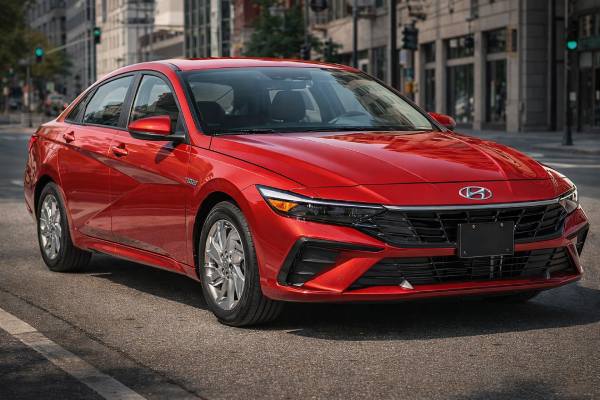
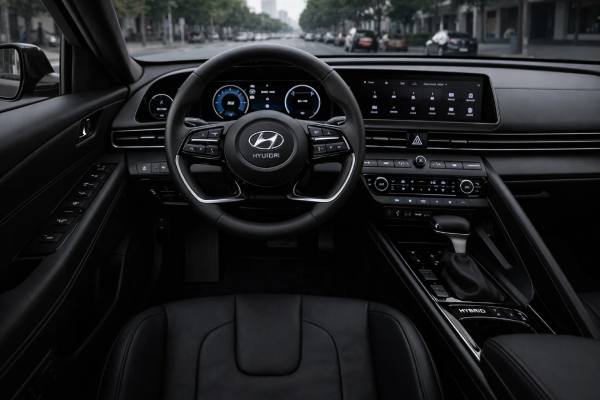

The facelifted 2024–present Hyundai Elantra N Line (CN7) is the version of the Elantra range that best balances daily usability with genuine performance flavor. It sits below the full Elantra N, but it is far more than an appearance package. Hyundai pairs a 201 hp 1.6-litre turbocharged direct-injection engine with a 7-speed dual-clutch transmission, larger brakes, a multi-link rear suspension, sport seats, and sharper styling. The result is a compact sedan that feels quicker, more tied down, and more engaging than the standard Elantra without becoming high-strung or expensive to live with.
That mix makes the N Line appealing on the used market, especially because the facelift continues into current model years with only minor carry-over changes. The main ownership caveat is complexity. This is a turbo GDI engine with a dry-clutch DCT, so clean oil, careful warm-up habits, and proper transmission behavior matter more than they do on the base 2.0-litre cars.
Quick Overview
- The facelift N Line gives the Elantra real performance hardware, not just trim changes, including 201 hp, larger front brakes, and a multi-link rear suspension.
- Cabin space and trunk room stay strong, so it still works as a true daily driver rather than a compromised sport compact.
- The 1.6 T-GDi delivers strong mid-range torque and better response than the standard 2.0-litre Elantra.
- The main caveat is the powertrain: the turbo engine and 7-speed dry-clutch DCT need disciplined maintenance and a careful test drive.
- In severe service, use 5,000 km or 6 months as the oil-change ceiling instead of stretching intervals.
Navigate this guide
- Hyundai Elantra N Line facelift view
- Hyundai Elantra N Line spec breakdown
- Hyundai Elantra N Line equipment and safety
- Reliability, campaigns and known concerns
- Maintenance plan and used-buying tips
- Real-world driving and fuel use
- N Line compared with rivals
Hyundai Elantra N Line facelift view
The facelifted Elantra N Line is easier to appreciate when you think of it as the sweet spot of the CN7 sedan range rather than as a junior Elantra N. Hyundai did not set out to turn it into a track special. Instead, it took the already spacious and efficient Elantra sedan and gave it the hardware needed to feel genuinely quicker and more composed without making it harsh or overly expensive.
That approach shows up everywhere. The 1.6 T-GDi engine makes 201 horsepower and 195 lb-ft of torque, which is a big step up from the regular 2.0-litre Elantra. The N Line also gets a 7-speed dual-clutch transmission, larger 12-inch front brake rotors, rack-mounted power steering, and a multi-link rear suspension instead of the standard car’s torsion-beam arrangement. Those changes matter more than the dark trim and the rear spoiler. They change the way the car responds on the road.
The facelift itself helped the N Line’s identity. Hyundai’s 2024 refresh brought a more assertive shark-nose front design, a cleaner rear treatment, new wheel designs, new safety content, and more standard tech across the lineup. On the N Line, those updates fit naturally because the trim already had the most aggressive road-car look in the regular Elantra family. The facelift also coincided with stronger safety hardware for the overall platform, including rear side airbags and updated rear-seat belt features in the wider lineup, which matters when you are buying a car meant to serve as both commuter and family transport.
Another reason the N Line stands out is that it remains current. Hyundai’s official North American model information shows the Elantra N Line continuing as a carry-over into 2025 and 2026, which means the 2024 facelift is not an orphaned one-year update. For a used buyer, that is a good sign. It usually means parts, service familiarity, and trim recognition stay healthy for longer.
Practicality remains a strong point. This is still an Elantra underneath, so you keep the roomy cabin, decent rear-seat comfort, and 14.2-cubic-foot trunk. That gives the N Line an advantage over many warm compact sedans and hatchbacks that lean harder into sportiness but give up everyday ease. You can drive this car to work every day, take people in the back seat, and still enjoy the extra shove and sharper chassis on the way home.
The main limitation is that the N Line is not as hardcore as the badge might make some buyers hope. It is faster and more alert than the base Elantra, but it is not an Elantra N with less power. If you buy it expecting a full performance car, you may be underwhelmed. If you buy it expecting a refined, quick, well-equipped daily sedan with genuine chassis upgrades, it makes much more sense.
Hyundai Elantra N Line spec breakdown
For the facelifted 2024–present Elantra N Line, the core mechanical package has remained effectively unchanged in North America. Hyundai’s official 2024 specification sheet and current 2026 trim page continue to describe the same basic formula: a 1.6-litre turbocharged four-cylinder, 201 hp, 195 lb-ft, 18-inch wheels, and a 7-speed dual-clutch transmission.
Powertrain and efficiency
| Item | Hyundai Elantra N Line (CN7 facelift) |
|---|---|
| Code | 1.6 Turbo GDI / Smartstream 1.6 T-GDi |
| Engine layout and cylinders | Inline-4, 4 cylinders, DOHC, 4 valves per cylinder |
| Bore × stroke | 75.6 × 89.0 mm (2.98 × 3.50 in) |
| Displacement | 1.6 L (1,598 cc) |
| Induction | Turbocharged |
| Fuel system | GDI / gasoline direct injection |
| Compression ratio | 10.0:1 |
| Max power | 201 hp (150 kW) @ 6,000 rpm |
| Max torque | 264 Nm (195 lb-ft) @ 1,500–4,500 rpm |
| Timing drive | Chain |
| Rated efficiency | About 8.4 / 6.7 / 7.6 L/100 km city / highway / combined |
| Rated efficiency in mpg | 28 / 35 / 31 mpg US combined EPA equivalent for current U.S. N Line figures |
| Real-world highway @ 120 km/h | Typically about 6.8–7.8 L/100 km, depending on traffic, wind, tyre choice, and temperature |
Transmission and driveline
| Item | Hyundai Elantra N Line (CN7 facelift) |
|---|---|
| Transmission | 7-speed DCT (code D7UF1), dry double plate with diaphragm spring |
| Drive type | FWD |
| Differential | Open |
Chassis and dimensions
| Item | Hyundai Elantra N Line (CN7 facelift) |
|---|---|
| Suspension (front/rear) | MacPherson strut / multi-link independent rear |
| Steering | Rack-mounted Motor Driven Power Steering |
| Steering ratio | 12.2:1 |
| Turns lock-to-lock | 2.2 |
| Brakes | Front ventilated discs 12.0 in (305 mm), rear solid discs 10.3 in (262 mm) |
| Wheels and tyres | 18-inch alloy wheels; 235/40 R18 is common on North American N Line cars |
| Ground clearance | About 140 mm (5.5 in) |
| Length | 4,709 mm (185.4 in) |
| Width | 1,826 mm (71.9 in) |
| Height | 1,415 mm (55.7 in) |
| Wheelbase | 2,720 mm (107.1 in) |
| Minimum turning radius | 19.2 ft |
| Kerb weight | About 2,965 lb (1,345 kg) |
| GVWR | About 4,079 lb (1,850 kg) |
| Fuel tank | 12.4 US gal (46.9 L / 10.3 UK gal) |
| Cargo volume | 14.2 ft³ (about 402 L) |
Performance and capability
| Item | Hyundai Elantra N Line (CN7 facelift) |
|---|---|
| 0–100 km/h | About 7.2–7.8 s |
| 0–62 mph | About 7.2–7.8 s |
| Top speed | About 210 km/h (130 mph), market and limiter dependent |
| Braking distance | Usually in the mid-36 to high-38 m range from 100 km/h with good tyres, but tyre choice changes the result |
| Towing capacity | Market dependent; verify by VIN plate and handbook before towing |
| Payload | Check door-jamb label; varies by market and tyre load rating |
Fluids and service capacities
| Item | Hyundai Elantra N Line (CN7 facelift) |
|---|---|
| Engine oil | About 4.5 L (4.8 US qt) with filter; use the correct full-synthetic oil grade and specification for turbocharged GDI service |
| Coolant | About 6.0–6.2 L (6.3–6.6 US qt), phosphate-based ethylene glycol coolant, 50:50 mix |
| Transmission / DCT fluid | Public official sources reviewed do not present a single easy service-fill figure for the D7UF1 on the consumer pages; confirm exact fluid type and quantity by VIN in workshop literature |
| Differential / transfer case | Not applicable |
| A/C refrigerant | R-134a or market-specific equivalent depending on exact vehicle labeling; verify under-hood sticker |
| A/C compressor oil | PAG type; verify exact charge on service data or under-hood label |
| Key torque specs | Wheel lug nuts 88–107 Nm (65–79 lb-ft) |
Safety and driver assistance
| Item | Hyundai Elantra N Line (CN7 facelift) |
|---|---|
| IIHS crashworthiness | Good in small overlap front, updated moderate overlap front on late builds, and updated side |
| 2024 IIHS award status | Top Safety Pick for 2024–25 Elantra |
| 2025–26 IIHS award status | Top Safety Pick+ for 2025–26 Elantra built after October 2024 |
| Headlight rating | Good on current better-equipped cars, depending on exact specification |
| ADAS suite | Blind-spot warning, lane departure warning and prevention, rear automatic braking, pedestrian front crash prevention, and additional assist systems depending on market and trim |
The raw figures show why the N Line is so appealing. It is not the most extreme Elantra, but it gets enough real hardware to feel genuinely different from the standard sedan while keeping the everyday practicality intact.
Hyundai Elantra N Line equipment and safety
The facelift N Line is easier to shop than many performance-flavored trims because Hyundai bundles most of the important mechanical items into the name itself. If the car is a real 2024–present Elantra N Line, it already has the engine, transmission, rear suspension, brake, and appearance package that define the model. That means buyers do not need to decode a long list of hidden performance packages the way they sometimes do with German rivals.
The hardware difference from the regular Elantra is significant. Hyundai’s official specification sheet lists the N Line with the 1.6 Turbo GDI engine, 7-speed DCT, larger 12-inch front rotors, rack-mounted power steering, and multi-link rear suspension. Those are not cosmetic upgrades. They change the car’s driving feel and make the N Line the right choice for buyers who care about more than just appearance.
The trim identity is also clear from the outside. The facelift brought the more aggressive front end to the whole Elantra range, but the N Line remains the easiest regular Elantra to spot because of its 18-inch alloys, darker trim treatment, spoiler, sport seats, and twin exposed exhaust finishers. Hyundai also offered N Line-specific colours in some markets, including Exotic Green in the early facelift launch material, which helped the trim stand out visually.
Inside, the N Line gets more than just badges. Current official trim pages highlight N Line leather and cloth combination sport seats, upgraded infotainment availability, digital key functionality, and a generally stronger convenience package than entry Elantras. In Canada and the U.S., N Line models also sit higher in the audio and technology hierarchy, which is useful because it helps the car feel appropriately premium for its price and positioning.
Safety is one of the strongest facelift improvements. Hyundai’s 2024 refresh added rear side airbags and a rear seat-belt reminder across the lineup, along with steering-wheel haptic feedback tied to several driver-assistance systems. That matters because it strengthens the overall CN7 safety story rather than limiting improvements to the high trims only.
The IIHS record is a little more nuanced, but ultimately positive. The Elantra earned a Top Safety Pick award for 2024–25, then improved to Top Safety Pick+ for 2025–26 cars built after October 2024 once Hyundai updated rear-seat belt hardware to improve rear occupant protection in the updated moderate-overlap front test. That is an important detail for used buyers because it means a later build can be a meaningfully better safety bet than an earlier facelift car, even though the styling looks the same.
Driver assistance is also strong by compact-sedan standards. IIHS lists standard blind-spot detection, standard lane departure warning and prevention, and standard rear automatic braking on the 2026 Elantra. Hyundai’s own current and launch material also references features such as front crash prevention, digital key, and additional safety technology on better-equipped trims. In practice, the N Line offers more assistance than most sport-oriented compact sedans used to. The main thing to remember is that build date and market matter, especially when safety awards changed during this facelift run.
Reliability, campaigns and known concerns
Because the facelift N Line is still relatively new, the long-term reliability picture is less settled than it is for older Elantras. That means honesty matters here. There is not yet a broad public pattern of one universally famous failure that defines the 2024–present N Line. At the same time, this is a turbocharged direct-injection engine with a dry-clutch 7-speed DCT, so there are clear areas that deserve extra attention in used ownership.
A practical reliability map looks like this.
Common and usually low to medium cost
- Fast front-tyre wear if alignment is off or cheap tyres are fitted.
- Larger-brake rotor and pad wear, especially on urban cars.
- Cabin rattles and trim noises on rough roads.
- Battery weakness on cars used for frequent short trips.
- Occasional horn failure on affected CN7-family vehicles.
Occasional and medium cost
- DCT low-speed hesitation or judder if the clutch pack is overheated, badly adapted, or driven roughly in traffic.
- Ignition-coil or spark-plug complaints under boost.
- Rough idle or minor drivability complaints as intake deposits build over time on the GDI engine.
- Sensor-related turbo or fuel-system warnings that require diagnosis rather than simple parts swapping.
Rare, but expensive if ignored
- Turbocharger damage from poor oil-change discipline.
- DCT clutch or actuator wear on abused cars.
- Extended high-temperature stress from repeated hard driving with poor maintenance.
The engine itself is promising, but still young enough that family-level caution is smarter than sweeping certainty. The 1.6 T-GDi’s strength is its broad torque and good efficiency. Its vulnerability is the usual one for small turbo GDI engines: oil quality matters, heat management matters, and long “economy” service intervals matter more than owners like to admit. Clean oil at shorter intervals is cheap insurance here.
The DCT deserves its own paragraph. Hyundai’s official 2024 specification sheet explicitly identifies the N Line transmission as a dry double-plate 7-speed DCT. That is important because dry-clutch dual-clutch transmissions can feel a little less smooth than a conventional automatic at parking-lot speeds even when healthy. Light low-speed hesitation is not always a defect. Harsh repeated shudder, slipping, refusal to engage cleanly, or warning messages are much more serious and should not be brushed off as “just how they all are.”
Official campaign history also matters. While no broad N Line-specific engine or transmission recall was identified in the official sources reviewed, Hyundai did issue a 2025 warranty extension for horn replacement on certain 2021–2025 CN7 Elantra-family vehicles due to inoperable horn complaints. That is not a major failure, but it is the kind of detail that tells you Hyundai is actively still refining support on the platform.
The used-car takeaway is simple. Because this model is still relatively new, condition and service history matter more than crowd wisdom. Buy one with clean software history, quiet cold starts, proper tyres, and smooth DCT behavior. Avoid cars with tune-related modifications, vague service records, or sellers who claim the transmission “just feels weird because it’s sporty.”
Maintenance plan and used-buying tips
The facelift Elantra N Line is not difficult to maintain, but it does need more attentive servicing than the ordinary 2.0-litre Elantra. The combination of turbocharging, direct injection, and a dry-clutch DCT means this is a car that rewards disciplined ownership rather than minimal-cost ownership.
A practical real-world schedule looks like this:
| Item | Sensible interval |
|---|---|
| Engine oil and filter | Every 10,000 km or 12 months; every 5,000 km or 6 months in severe use |
| Engine air filter | Inspect every service; replace about every 30,000 km, sooner in dust |
| Cabin air filter | Every 20,000–24,000 km or yearly |
| Spark plugs | Inspect by about 45,000 km and replace with correct turbo-rated plugs as needed |
| Coolant | Follow factory interval, but inspect condition and level regularly |
| Timing chain | No routine replacement interval; inspect only if correlation faults, unusual noise, or poor maintenance suggest trouble |
| Accessory belt and hoses | Inspect at every major service and replace on condition |
| DCT service | Check for software updates, leaks, abnormal engagement, and adaptation issues; do not ignore worsening low-speed shudder |
| Brake fluid | Every 2 years |
| Brake pads and rotors | Inspect every service |
| Tyre rotation | Every 10,000–12,000 km if wear pattern allows |
| Wheel alignment | Check after pothole hits or any sign of shoulder wear |
| 12 V battery test | Yearly after year four |
The most important maintenance item is the oil service. Turbocharged GDI engines dilute the old “once a year, maybe later” mindset very quickly if the car does short trips, cold starts, and traffic. That is why a 5,000 km or 6-month severe-use ceiling is a smart rule even if factory language can sound more generous.
For fluids, stick to the correct specifications instead of improvising. Use the proper full-synthetic oil grade and API/ILSAC specification for the turbo engine. Use the correct Hyundai-approved DCT fluid and never assume the N Line shares its gearbox needs with the base IVT or manual Elantra. Brake fluid and coolant are less glamorous, but just as important over time. On a relatively new performance-leaning car, neglect often shows up first in the brakes and tyres, not the engine.
As a used buy, the inspection checklist should be structured:
- Verify VIN-based recall and campaign status.
- Start the engine fully cold and listen for smoke, chain rattle, or rough idle.
- Drive the car long enough to test low-speed DCT behavior in traffic and repeated pull-aways.
- Check boost response under load for hesitation or misfire.
- Inspect tyre brand, matching set quality, and inside-edge wear.
- Look at front brake condition, because cheap pads and warped rotors are common on driven cars.
- Scan for stored or pending codes even if no warning light is on.
The best N Lines are usually unmodified cars with dealer or specialist service history, premium tyres, and zero “it’s been tuned but reverted to stock” stories. Cars to avoid are those with intake or exhaust modifications, bargain tyres, unconvincing DCT behavior, or obvious hard-driving signs without maintenance proof.
Long term, the N Line should age well if serviced properly. But it is not the Elantra to buy if you only want the cheapest possible ownership path. It is the Elantra to buy if you want extra pace and are willing to maintain it accordingly.
Real-world driving and fuel use
The facelift N Line feels like the Elantra sedan Hyundai should have built from the start for drivers who want a little more involvement without giving up daily comfort. It is not as intense as the full Elantra N, but it is much more entertaining than the regular 2.0-litre models and still more relaxed than many hot compact hatches.
The biggest difference is the powertrain. The 1.6 T-GDi has real mid-range shove, and the 195 lb-ft torque plateau arrives early enough that the car feels stronger than its horsepower number suggests. In city driving, that means easy gaps in traffic and less need to floor it. On the highway, it means confident passing. The engine is not especially dramatic in sound, but it is usefully quick.
The DCT suits the N Line when driven with a little intent. In medium and heavy throttle, shifts are quick and the car feels much sharper than a normal automatic Elantra. In crawling traffic, the dry-clutch design can still feel a little more mechanical than a torque-converter automatic. That trade-off is part of the ownership experience. Most drivers adapt to it quickly, but buyers coming from very smooth conventional automatics should expect a different feel.
Ride quality is better than many buyers assume. Because the N Line gets genuine chassis upgrades, including the multi-link rear suspension, it manages to feel more planted without becoming punishing. It is firmer than the standard Elantra, but not harsh. On decent roads, the extra body control is welcome. On rough pavement, the 18-inch wheel and tyre package brings a little more impact noise, but the suspension still has enough travel to stay civilized.
Handling is tidy rather than wild. Turn-in is sharper than the base car, the steering ratio is quicker, and the rear suspension helps the car hold a line more confidently through faster corners. But this is still a front-wheel-drive compact sedan with comfort in its DNA. The N Line feels composed and fast enough, not radically playful. That is exactly why it works so well every day.
Noise levels are also well judged. The cabin stays quiet enough at motorway speed that the N Line never feels like a compromised performance special. It is happier on a long highway drive than many rivals that lean harder into stiffness and synthetic engine drama.
Real-world fuel economy is solid for a 201 hp compact sedan:
- city: about 8.5–9.8 L/100 km
- highway at 100–120 km/h: about 6.8–7.8 L/100 km
- mixed use: about 7.6–8.8 L/100 km
Cold weather, aggressive use, and poor tyres can move those numbers noticeably, but the basic efficiency is good. That is part of the N Line’s appeal. It is quick enough to feel special and efficient enough to live with every day. For most owners, that balance matters more than whether it can keep up with the full N on a back road.
N Line compared with rivals
The Elantra N Line competes in an interesting space because it is not a base compact sedan and not a full performance car. Its natural rivals are cars like the Honda Civic Si, Volkswagen Jetta GLI, Mazda3 turbo in some markets, and sporty versions of the Kia Forte or K4 lineup. Against those cars, the Hyundai’s main strengths are value, daily usability, and balanced chassis upgrades.
Compared with the Civic Si, the N Line loses on manual-gearbox engagement and overall enthusiast credibility. The Honda is still the sharper, more focused driver’s car. The Hyundai answers with a stronger feature set in many markets, an easier daily-driving character, and often a lower used buy-in. If you want the most rewarding manual, buy the Civic. If you want the more relaxed all-rounder, the N Line deserves a look.
Against the Jetta GLI, the Hyundai feels less mature at the limit but also less intimidating from an ownership perspective. The Volkswagen usually has the more premium highway demeanor and a stronger performance image. The Hyundai responds with cleaner value, a fresher current-platform safety story, and fewer reasons to worry about expensive German out-of-warranty surprises. It feels like the simpler choice, even if not always the more sophisticated one.
The Mazda3 turbo is quicker and richer-feeling, but it also sits a step higher in price and complexity. Its all-wheel-drive option and more upscale cabin make it attractive, yet the Elantra N Line stays competitive because it gives enough pace for daily use at a lower cost and with more rear-seat room than many buyers expect. If your budget is finite, the Hyundai often makes more rational sense.
The Forte GT is perhaps the most direct comparison because it shares a similar basic corporate philosophy: compact sedan, turbocharged 1.6, dual-clutch transmission, and value-focused sport trim. In practice, these cars often come down to pricing, local support, and which cabin or chassis personality you prefer. The Hyundai generally feels a little more polished and current in its facelifted form, while the Kia can sometimes undercut it on price.
Inside Hyundai’s own lineup, the N Line is the sweet spot if you want more performance without stepping all the way into Elantra N territory. The full N is the better enthusiast car by a large margin, but it is also stiffer, thirstier, and more demanding. The regular Elantra 2.0 is cheaper and simpler, but much less exciting. The N Line threads the middle well.
That is the final verdict. The facelift CN7 Elantra N Line is not a junior race car. It is a compact sedan with real mechanical upgrades, current safety credentials, strong everyday practicality, and just enough performance to make daily driving more interesting. For many buyers, that is exactly the right amount of N.
References
- Hyundai Unveils Refreshed 2024 Elantra Lineup for North American Market in Digital News Conference 2023 (Manufacturer Release)
- 2026 Elantra N Line | Trim Features 2026 (Model Specifications)
- 2026 Elantra (ICE, HEV, N-Line) – Carry-over Model 2025 (Model Update)
- 2026 Hyundai Elantra 2026 (Safety Rating)
- Check for Recalls: Vehicle, Car Seat, Tire, Equipment 2025 (Recall Database)
Disclaimer
This article is for informational purposes only and is not a substitute for professional diagnosis, repair, or official service information. Specifications, torque values, service intervals, procedures, software campaigns, and equipment vary by VIN, market, trim, and build date, so always verify details against your vehicle’s official service documentation and manufacturer records before carrying out maintenance or repairs.
If this guide was useful, please consider sharing it on Facebook, X, or another platform to support our work.