
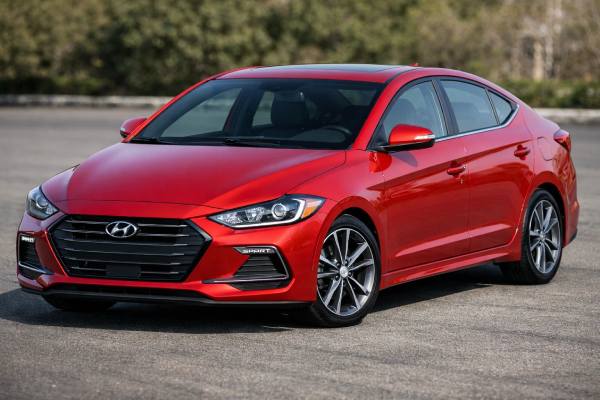
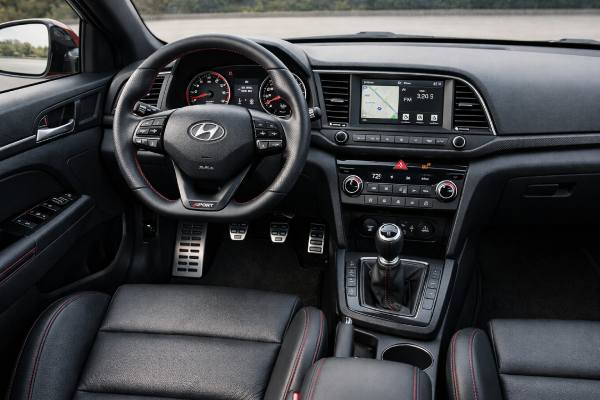
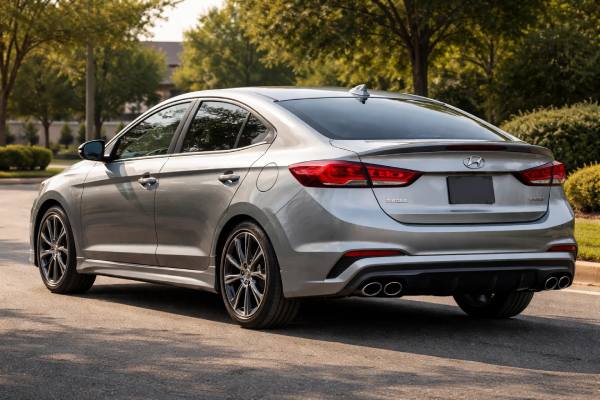
The 2017–2018 Hyundai Elantra Sport (AD) is the version of the compact Elantra sedan that finally gave the chassis the engine it always wanted. Hyundai paired the AD body with a 1.6-litre turbocharged direct-injection four-cylinder, a 6-speed manual or optional 7-speed dual-clutch transmission, a multi-link rear suspension, larger brakes, and sharper steering calibration. That combination matters because this is not just a trim package with wheels and badges. The Elantra Sport keeps the sedan’s excellent cabin space, strong trunk, and everyday comfort, but adds enough power and chassis hardware to feel genuinely quicker and more serious than the regular car. The ownership picture is also fairly clear now. Its strengths are speed, practicality, and value. Its risks are the usual ones for a small turbo GDI car: carbon build-up over time, careful oil-service discipline, and extra scrutiny if the car has the 7-speed DCT. Bought well, though, it is one of Hyundai’s most convincing sport sedans of the decade.
Core Points
- The 1.6 T-GDi and multi-link rear suspension make this a far more engaging Elantra than the standard sedan.
- Interior room and trunk space remain standout strengths, so it still works well as a daily family car.
- The 6-speed manual is the simpler long-term choice, while the 7-speed DCT is quicker but needs more careful evaluation.
- The main ownership caveat is service quality, especially oil changes, spark-plug condition, and any signs of DCT judder.
- A sensible baseline is engine oil and filter every 10,000–12,000 km or 12 months, with earlier attention under hard use.
On this page
- Hyundai Elantra Sport AD identity
- Hyundai Elantra Sport AD specs
- Hyundai Elantra Sport AD trims and safety
- Known faults and campaign history
- Maintenance and buying checklist
- Real-world driving and economy
- Sport AD against compact rivals
Hyundai Elantra Sport AD identity
The AD-generation Elantra Sport was Hyundai’s answer to a simple question: what happens if you take a roomy, efficient compact sedan and give it the kind of hardware enthusiasts usually have to hunt for elsewhere? The answer was surprisingly good. Instead of treating “Sport” as a cosmetic exercise, Hyundai gave the sedan a meaningful engineering upgrade. The car received the Gamma 1.6 T-GDi engine with 201 horsepower and 195 lb-ft of torque, a standard 6-speed manual transmission, an optional 7-speed dual-clutch transmission, a sport-specific rear multi-link independent suspension, larger front and rear stabilizer bars, stiffer springs and dampers, bigger front brakes, and quicker steering tuning. That is a real hardware list, not marketing filler.
That extra engineering changes the Elantra’s character in an important way. The ordinary AD sedan is spacious, comfortable, and efficient, but not especially eager. The Sport adds exactly the missing ingredients. The turbocharged engine brings low-rpm torque and stronger mid-range acceleration. The multi-link rear suspension gives the car a more settled rear axle over broken pavement and a more composed feel in faster corners. The larger brakes and performance tyres support the extra pace. Yet the cabin, trunk, and general ergonomics stay as practical as the standard sedan. That is why the Sport still works so well today. It offers a genuine step up in driver appeal without compromising the daily-driver qualities that make compact sedans useful.
Visually, Hyundai also made sure the Sport stood apart. Standard cues included unique front and rear fascias, a black grille with subtle Turbo badging, dual chrome exhaust outlets, LED daytime running lights, LED taillights, 18-inch alloy wheels, and a cleaner, more aggressive stance. Inside, Hyundai fitted heated leather sport seats, red contrast stitching, a flat-bottom steering wheel, alloy pedals, and a sport-specific instrument cluster. Those touches were well judged because they made the car feel distinct without crossing into boy-racer territory.
The 2017 and 2018 versions are closely related, but there are useful differences. The 2017 car launched with a Premium Package that added the biggest convenience and safety upgrades. For 2018, Hyundai broadened standard Sport equipment and simplified the option structure. Blind Spot Detection with Rear Cross-traffic Alert became standard, and the package strategy shifted more toward infotainment and convenience than core chassis hardware. Mechanically, though, the formula stayed intact.
Today, the Elantra Sport is best understood as a warm-sport compact sedan. It is not an all-out hot sedan like a Civic Type R or a Golf R. It is a quick, practical, affordable sedan with just enough real engineering to stay interesting long after the novelty of the badge has worn off.
Hyundai Elantra Sport AD specs
The Sport-specific sedan specification is unusually well defined because Hyundai published separate Sport materials for both the launch car and the 2018 model year. That makes it easier than usual to separate real Sport hardware from broader Elantra-line data.
Powertrain and efficiency
| Item | Hyundai Elantra Sport (AD) 1.6 T-GDi |
|---|---|
| Code | Gamma 1.6 T-GDi |
| Engine layout and cylinders | Inline-4, transverse, 4 cylinders |
| Valvetrain | DOHC, 4 valves per cylinder |
| Bore × stroke | 77.0 × 85.44 mm (3.03 × 3.36 in) |
| Displacement | 1.6 L (1,591 cc) |
| Induction | Turbocharged |
| Fuel system | Gasoline direct injection |
| Compression ratio | 9.5:1 |
| Max power | 201 hp (150 kW) @ 6,000 rpm |
| Max torque | 264 Nm (195 lb-ft) @ 1,500–4,500 rpm |
| Timing drive | Chain |
| Rated efficiency | 9.4 / 7.8 / 8.7 L/100 km manual city / highway / combined; 9.0 / 7.1 / 8.1 L/100 km DCT city / highway / combined |
| Real-world highway @ 120 km/h (75 mph) | Usually about 6.8–7.8 L/100 km in a healthy car |
Transmission and driveline
| Item | Hyundai Elantra Sport (AD) 1.6 T-GDi |
|---|---|
| Transmission | 6-speed manual or 7-speed dry dual-clutch DCT |
| Drive type | Front-wheel drive |
| Differential | Open front differential |
| Final drive, manual | 4.467:1 |
| Final drive, DCT | FGR1 4.643:1 / FGR2 3.611:1 |
Chassis and dimensions
| Item | Hyundai Elantra Sport (AD) sedan |
|---|---|
| Suspension front / rear | MacPherson strut / multi-link independent |
| Steering | Rack-and-pinion motor-driven power steering |
| Steering ratio | 13.7:1 |
| Turns lock-to-lock | 2.6 |
| Brakes | Front 305 mm (12.0 in) ventilated discs; rear 262 mm (10.3 in) solid discs |
| Wheels and tyres | 225/40 R18 on 18-inch alloy wheels |
| Length / width / height | 4,569 mm (179.9 in) / 1,801 mm (70.9 in) / 1,435 mm (56.5 in) |
| Wheelbase | 2,700 mm (106.3 in) |
| Turning circle | 10.6 m (34.78 ft) |
| Ground clearance | 140 mm (5.5 in) |
| Kerb weight | 1,380–1,390 kg (3,042–3,064 lb) manual; 1,410–1,420 kg (3,109–3,131 lb) DCT |
| GVWR | 1,810 kg (3,990 lb) manual; 1,840 kg (4,057 lb) DCT |
| Fuel tank | 53 L (14.0 US gal / 11.7 UK gal) |
| Cargo volume | 408 L (14.4 ft³), seats up, EPA method |
Performance and capability
| Item | Hyundai Elantra Sport (AD) 1.6 T-GDi |
|---|---|
| 0–100 km/h (0–62 mph) | Typically around 7.2–7.8 s depending on transmission and conditions |
| Top speed | Not officially published in the reviewed Hyundai source set |
| Braking distance | Not officially published in the reviewed Hyundai source set |
| Towing capacity | Not commonly published for the U.S. Sport sedan; verify by market |
| Payload | Roughly 420–460 kg depending on transmission |
Fluids and service capacities
| Item | Practical guidance |
|---|---|
| Engine oil | API SN or better; commonly 5W-30, with market and climate differences |
| Engine oil capacity | Commonly listed at about 4.5 L (4.76 US qt) with filter; verify by VIN and owner documentation |
| Coolant | Ethylene glycol-based coolant, usually 50/50 mix |
| Coolant capacity | Commonly listed around 6.1 L (6.4 US qt); verify by VIN and service literature |
| Manual transmission fluid | Hyundai-approved manual transmission fluid; verify exact spec by VIN |
| DCT fluid | Hyundai-approved DCT gear oil / transmission fluid as specified for the 7-speed dry DCT; verify before service |
| A/C refrigerant | R-134a |
| A/C compressor oil | PAG type matched to the installed compressor |
| Key torque specs | Wheel nuts 90–110 Nm (66–81 lb-ft); oil drain plug about 39 Nm (29 lb-ft) |
Safety and driver assistance
| Item | Hyundai Elantra Sport (AD) sedan |
|---|---|
| IIHS crashworthiness | Good in small overlap front, moderate overlap front, side, roof strength, and head restraints |
| IIHS award status | Top Safety Pick+ only in qualifying sedan configurations with optional front crash prevention and specific headlights |
| Headlight rating | Varies by trim and equipment in IIHS family data |
| ADAS suite | Blind Spot Detection and Rear Cross-traffic Alert on later Sport cars; no standard adaptive cruise or lane-centering system on this trim |
The main lesson from the numbers is straightforward. The Elantra Sport is not a mere appearance package. The engine, suspension, steering, brakes, and tyres are all materially upgraded over the regular sedan.
Hyundai Elantra Sport AD trims and safety
In North America, the Elantra Sport sedan was simpler than many rivals in trim structure but not identical year to year. The 2017 car was effectively a dedicated Sport trim with a substantial standard-equipment list and an optional Premium Package. The 2018 car kept the same basic identity but shifted some equipment into standard fitment and made the option structure more convenience-focused. That matters because used buyers will find two Sport sedans with the same badge but meaningfully different equipment.
The 2017 Sport came well equipped from the start. Standard items included the turbo engine, multi-link rear suspension, 18-inch wheels, heated leather sport seats, red contrast stitching, a flat-bottom steering wheel, alloy pedals, HID-style premium lighting elements, LED taillights, a 7-inch touchscreen with Android Auto and Apple CarPlay, proximity-key entry, push-button start, and a strong visual package. The optional Premium Package added the more expensive convenience items and safety extras: 8-inch navigation, Infinity premium audio, a power sunroof, Blue Link services, Blind Spot Detection, Rear Cross-traffic Alert, and Lane Change Assist. In other words, the 2017 Sport could be bought as either a strong standard car or a genuinely feature-rich compact sedan.
For 2018, Hyundai broadened standard Sport content and simplified the trim walk. Sunroof, leather seating, heated front seats, proximity key, 7-inch display audio, and Blind Spot Detection with Rear Cross-traffic Alert were standard according to the Sport-specific features sheet. The Sport Premium Package shifted toward infotainment and convenience, bringing the 8-inch navigation system, Infinity audio, Clari-fi processing, Blue Link services, and auto-dimming mirror. This means a 2018 Sport is often the easier car to recommend if you want a richly equipped example without hunting for a specific options package.
Mechanically, there were no major year-to-year changes that redefine the verdict. The Sport always had the key hardware: 1.6 T-GDi engine, manual or DCT, multi-link rear suspension, 18-inch wheels, bigger front brakes, and sport-tuned steering and damping. The biggest real choice is transmission. The 6-speed manual is the purist’s pick and the simpler long-term option. The 7-speed DCT is faster and more convenient in traffic, but it is the gearbox that deserves the stricter pre-purchase inspection.
Safety is strong but requires nuance. Structurally, the AD sedan family performed well in IIHS crashworthiness testing. The 2017 sedan earned Good results across the major crashworthiness categories, and the sedan line could qualify for Top Safety Pick+ in configurations with optional front crash prevention and specific headlights. That does not automatically mean every Sport is a Top Safety Pick+ car. The Sport’s exact safety-equipment mix depends on year and package. For example, the driver-aid content on the Sport focuses more on blind-spot and rear cross-traffic coverage than on the full forward-collision and lane-support suite offered on certain other Elantra trims.
In practical terms, that means the Sport’s safety value comes from two things. First, the sedan shell itself is strong for the class. Second, later Sport examples can be nicely equipped with core active-safety technology, especially blind-spot coverage. Buyers should still verify exact equipment by VIN, especially if they care about headlight type, driver aids, and production date.
Known faults and campaign history
The Elantra Sport’s reliability picture is more focused than dramatic. This is not a car with a single universal failure point that defines every example. Instead, it has a handful of known risk areas that separate well-kept cars from neglected ones. The most important are direct-injection maintenance, DCT behavior on automatic cars, and the ordinary heat and stress management that comes with any small turbocharged engine.
The 1.6 T-GDi engine itself is generally capable and strong when maintained properly. But it is still a direct-injected turbo four-cylinder, which means it asks for more discipline than a basic naturally aspirated commuter engine. Carbon build-up on the intake valves can become an issue over time because fuel is injected directly into the combustion chamber, not over the back of the intake valves. Cars used mostly for short trips or driven very gently can show rough cold starts, unstable idle, and slightly dulled throttle response as mileage climbs. That does not make the engine fragile. It means owners should not ignore tune quality just because the engine still starts.
Oil service matters just as much. Turbochargers reward clean, timely oil and punish stretched intervals. A seller who cannot show consistent oil-change history on a turbo GDI sedan is asking you to accept hidden risk. Likewise, worn spark plugs or weak ignition coils show up faster on a boosted engine than on a mild naturally aspirated one. Under load, a tired ignition system can feel like hesitation, soft misfire, or jerky mid-range pull rather than an obvious failure.
The bigger specific trouble spot is the optional 7-speed dry dual-clutch transmission. Hyundai service literature later documented low-speed judder and abnormal vibration on 2017–2018 Elantra Sport 1.6 turbo models equipped with this transmission, with inspection, clutch replacement, and TCU software updates forming the repair path where required. That does not mean every DCT car is bad. Many are fine. But it does mean that shuddering launches, hesitation in stop-start traffic, or rough low-speed creep are not quirks you should dismiss casually. A good DCT Sport should feel decisive and reasonably smooth once warm, even if it never behaves exactly like a torque-converter automatic.
The rest of the car follows familiar compact-sedan patterns. Front-end suspension wear, especially links and bushings, is normal. The low-profile 18-inch tyres also make alignment and wheel condition more important than on base Elantras. Brake wear can be accelerated if the car has seen hard use and cheap pad replacements. Cosmetic issues like wheel rash and split lower lip trim are also common on enthusiast-owned cars.
A practical risk map looks like this:
| Issue | Prevalence | Severity | Typical symptoms | Likely remedy |
|---|---|---|---|---|
| DCT clutch judder or low-speed vibration | Occasional, DCT only | Medium | Shudder on takeoff, rough low-speed creep, odd clutch feel | Judder inspection, TCU update, clutch replacement if needed |
| Intake-valve carbon build-up | Occasional | Medium | Rough cold idle, slightly lazy response, uneven running | Intake cleaning and tune-up work |
| Worn plugs or coils under boost | Occasional | Low to medium | Hesitation, misfire under load, check-engine light | Plugs, coils, and boost-leak inspection |
| Poor oil history on turbo engine | Common used-car risk | High | Noise, oil use, reduced turbo life | Strict oil service, diagnosis before purchase |
| Suspension and tyre wear | Common | Low to medium | Clunks, tramlining, inner-edge tyre wear | Links, bushings, dampers, alignment |
| Open recalls or service campaigns | Occasional | High if ignored | Sometimes no obvious symptom | VIN check and documented completion |
The good news is that none of these issues is mysterious. The bad news is that a cheap Elantra Sport can hide them behind a clean wash and a loud exhaust note. Inspection still matters more than enthusiasm.
Maintenance and buying checklist
The Elantra Sport is one of those cars that becomes much easier to own when you service it as if it were a turbocharged sport compact, not just a cheap compact sedan. That means shorter thinking cycles, better fluid discipline, and closer attention to the transmission if the car is not a manual.
A practical service plan should look like this:
| Item | Practical interval |
|---|---|
| Engine oil and filter | Every 10,000–12,000 km or 12 months |
| Engine air filter | Inspect every service, replace about every 20,000–30,000 km |
| Cabin air filter | Every 15,000–20,000 km or yearly |
| Spark plugs | Inspect early and replace to schedule; boosted engines are less forgiving of worn plugs |
| Timing chain | No routine replacement interval; inspect if noisy or if timing faults appear |
| Coolant | Every 3–5 years |
| Brake fluid | Every 2 years |
| Manual transmission fluid | About every 60,000–90,000 km |
| DCT service | Follow transmission-specific guidance and investigate any shudder early |
| Accessory belt and hoses | Inspect yearly |
| Brake pads, discs, caliper pins | Inspect every service |
| Tyre rotation | About every 10,000 km |
| Alignment check | Yearly or when wear or pull appears |
| Battery and charging test | Yearly after year 4 of battery life |
The fluid side is more important on this car than on the basic Elantra. Engine oil quality matters because of the turbocharger. DCT cars deserve transmission-specific attention rather than “lifetime fluid” optimism. And because the Sport rides on 225/40 R18 tyres, tyre pressure and alignment affect both feel and running cost more than many owners expect. A Sport on cheap tyres and poor alignment usually feels much worse than the car is meant to feel.
From a used-buyer perspective, the checklist is straightforward:
- Start the engine cold and listen for any rattle, knock, or unstable idle.
- Verify consistent oil-change history.
- On DCT cars, drive in stop-start traffic and feel for clutch judder or hesitation.
- Check boost delivery under load for smooth, even pull.
- Inspect tyres for matching brand, even wear, and sidewall damage.
- Listen for front suspension noise over broken pavement.
- Check brake feel and rotor condition.
- Verify VIN recall and campaign status.
- Confirm which safety and convenience package the car actually has.
- Inspect wheels, front lip, and interior bolsters for signs of hard ownership.
The best years to seek are more about equipment than reliability. A 2017 Premium Package car can be especially attractive if you want the richer content mix, while a clean 2018 car with standard blind-spot coverage is often the easier one to recommend at the same money. Transmission choice matters more. The manual is simpler, lighter, and often the safer long-term enthusiast buy. The DCT can be excellent, but only when it has been maintained and behaves correctly.
Long-term durability is good if the basics are done. What shortens the Sport’s life is not the badge. It is being treated like a cheaper, slower car than it really is.
Real-world driving and economy
The Elantra Sport feels faster than the numbers suggest because the powertrain arrives with purpose. The 195 lb-ft torque plateau starts early, and that gives the car a much stronger mid-range than the regular Elantra. In ordinary driving, it does not need much provocation to feel lively. Slip-road merges, quick passes, and climbing grades all happen with less effort than you expect from a compact sedan with a modest curb weight.
The 6-speed manual is the sweeter pairing if you enjoy driving. It makes the engine feel sharper, adds involvement, and avoids the low-speed personality quirks of the DCT. The 7-speed dual-clutch, however, is the more efficient and faster-shifting transmission once you are moving. Its weakness is low-speed traffic, where it can feel more mechanical and less fluid than a traditional automatic even when healthy. That is a trait, not always a defect. But when the gearbox starts to shudder or vibrate more than normal, it stops feeling like character and starts feeling like pending service.
Handling is the other genuine step up over the normal Elantra. The multi-link rear suspension is not marketing fluff. It gives the Sport a better-controlled rear axle and a more composed attitude over mid-corner bumps than the torsion-beam cars. Hyundai also backed it up with firmer springs, dampers, and stabilizer bars. The car turns in more cleanly, resists roll better, and carries speed more confidently than the regular sedan. The electric steering is still not rich with feel, but the quicker ratio and sport-specific tune make it more precise than you would expect from the badge.
Ride quality remains usable, which is one of the Sport’s biggest advantages. Yes, the 18-inch tyres and firmer suspension add sharpness. But the car never becomes exhausting. It stays comfortable enough for commuting and long trips, which is exactly what a sport-trim compact sedan should do. That balance is the main reason it has aged well.
Real-world fuel economy is also solid. Official figures put the manual at 22 city, 30 highway, 25 combined mpg, while the DCT is rated at 26 city, 33 highway, 29 combined. In practice, a healthy manual car driven briskly often lands around 8.2–9.2 L/100 km in mixed use, while the DCT can do a little better on steady highway travel. At a true 120 km/h cruise, something in the high-sixes to high-sevens is realistic if the tyres, alignment, and ignition system are all right.
This is the dynamic verdict in plain language: the Elantra Sport is quick enough to be fun, composed enough to feel different from the base car, and comfortable enough to live with every day. That is a harder balance to find than it looks.
Sport AD against compact rivals
Against the Civic Si, the Elantra Sport loses the purity contest. The Honda is more focused, more celebrated, and ultimately the better enthusiast’s car. Its chassis feels tighter, the manual gearbox is better, and the whole car is more coherently tuned around spirited driving. The Hyundai responds with a softer ride, a friendlier price on the used market, and a more relaxed daily-driver character. If the Civic Si is the sharper tool, the Elantra Sport is the more comfortable and usually cheaper one.
Compared with the Volkswagen Jetta GLI of the same era, the Hyundai again trades polish for value. The GLI feels more mature and often more premium inside, with a stronger brand cachet among buyers who want a sport compact sedan that still looks understated. But the Elantra Sport hits back with lower acquisition cost, simpler ownership math in some cases, and a cabin that remains very practical. The Hyundai does not feel as expensive. That is exactly why some buyers prefer it.
The Mazda3 2.5 is a closer emotional match. It is quick enough, genuinely enjoyable, and far more refined than its price suggests. The Mazda wins on steering feel and general driver engagement, but the Elantra Sport often feels roomier and more distinct as a trim-specific package. If you value communication and chassis feel, the Mazda is better. If you want a compact sedan that feels turbocharged, spacious, and feature-rich without paying too much, the Hyundai holds its ground well.
The Forte SX is perhaps the most natural comparison because it shares so much corporate DNA. The two cars overlap in drivetrain philosophy and target audience, but the Elantra Sport often feels slightly more polished in cabin layout and a little more mature in overall execution. At this point, though, condition and maintenance history matter far more than platform cousins arguing over fine margins.
That is where the Elantra Sport AD lands in the used market. It is not the class hero, and it is not the safest badge bet. What it offers is a strong mix of performance, practicality, and value with just enough real engineering depth to feel special. Buyers who want the most exciting compact sedan will still look elsewhere. Buyers who want one of the most sensible quick sedans for the money should not overlook it.
References
- 2017 HYUNDAI ELANTRA SPORT BRINGS EXCITEMENT TO THE DAILY DRIVE 2016 (Manufacturer Specifications)
- 2018 HYUNDAI ELANTRA SPORT SPECIFICATIONS 2017 (Manufacturer Specifications)
- 2018 HYUNDAI ELANTRA SPORT FEATURES & OPTIONS 2017 (Manufacturer Specifications)
- 2017 Hyundai Elantra 2026 (Safety Rating)
- Check for Recalls: Vehicle, Car Seat, Tire, Equipment | NHTSA 2026 (Recall Database)
Disclaimer
This article is for informational purposes only and is not a substitute for professional diagnosis or repair. Specifications, torque values, intervals, procedures, and even equipment levels can vary by VIN, market, transmission, and package, so always verify the exact details against official service documentation before servicing, repairing, or buying a vehicle.
If this guide helped you, please consider sharing it on Facebook, X, or another social platform to support our work.