
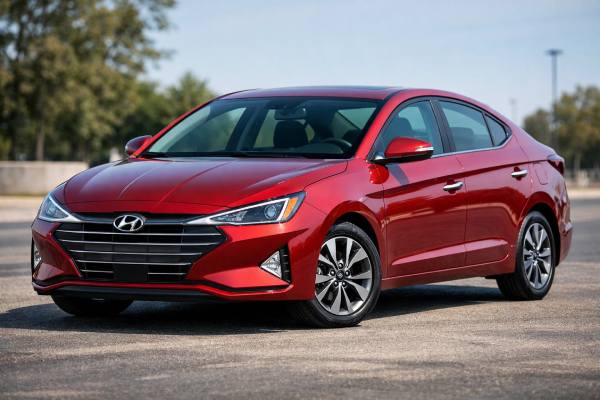
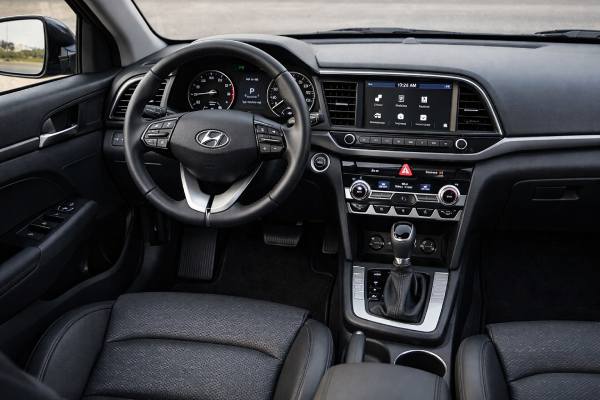

The facelifted 2019–2020 Hyundai Elantra Sport (AD) is the version that proved Hyundai could build a compact sedan with real driver appeal without sacrificing the things daily owners actually need. It kept the 201 hp 1.6-litre turbocharged direct-injection engine, the stronger brakes, the multi-link rear suspension, and the sharper steering and chassis tuning that already made the earlier Sport interesting, then wrapped them in the facelifted Elantra body with updated safety tech and cleaner cabin equipment. That combination matters because this is not just a trim with badges and larger wheels. It is a genuinely quicker, better-resolved Elantra that still offers a roomy back seat, useful trunk space, and manageable running costs. The ownership story is fairly clear now. The strengths are pace, practicality, and value. The watch points are typical modern small-turbo concerns: oil-service discipline, intake-deposit buildup over time, and careful evaluation of the optional 7-speed dual-clutch transmission.
Fast Facts
- The 1.6 T-GDi engine and multi-link rear suspension make this a meaningfully different car from the standard Elantra.
- Cabin room, trunk space, and daily comfort remain real strengths despite the sportier setup.
- The 6-speed manual is the simpler enthusiast choice, while the 7-speed DCT is quicker but deserves a careful test drive.
- The main ownership caveat is service quality, especially oil history, spark-plug condition, and any low-speed DCT shudder.
- A practical baseline is engine oil and filter every 10,000–12,000 km or 12 months, with earlier service under hard use.
Start here
- Hyundai Elantra Sport AD facelift view
- Hyundai Elantra Sport AD technical data
- Hyundai Elantra Sport AD equipment and safety
- Reliability patterns and service bulletins
- Care schedule and shopper tips
- On-road character and efficiency
- Rivals and value position
Hyundai Elantra Sport AD facelift view
The facelifted AD Elantra Sport arrived for 2019 with a new nose, a sharper rear treatment, revised lighting, and broader active-safety availability, but its real appeal stayed underneath. Hyundai wisely left the essential Sport formula alone. The car kept the 1.6 T-GDi turbo four, the sport-tuned suspension, the larger brakes, the quicker steering feel, and most importantly the independent multi-link rear suspension that separated it from the ordinary Elantra sedan. That last point matters more than many buyers realize. Plenty of compact sedans wear sporty badges, but very few receive meaningful rear-suspension hardware changes. Hyundai did.
This facelifted Sport is therefore best understood as a warm sport sedan rather than a full-blooded performance model. It is not a Civic Type R rival and it was never supposed to be. Instead, it offered a practical middle ground for buyers who wanted a true compact family sedan with extra power and better body control, but without moving into a more expensive or harsher high-performance niche. That balance still makes sense now. The car is quick enough to feel special, roomy enough to remain useful, and subtle enough that it does not attract the same attention as more obvious hot compacts.
The engine is the heart of the package. Hyundai’s Gamma 1.6-litre turbocharged GDI four delivers 201 horsepower and 195 lb-ft of torque, which is a healthy figure in a sedan of this size and weight. More important than the peak number is the way the torque arrives. The engine pulls strongly from low rpm, making the Sport feel more effortless in normal traffic than many naturally aspirated rivals. Hyundai paired it with a 6-speed manual as standard in 2019, while a 7-speed dual-clutch transmission remained optional. For 2020 in the U.S. market, the manual was discontinued, leaving the DCT as the Sport’s transmission. That makes 2019 manual cars especially attractive to buyers who want the purer, simpler long-term option.
The facelift also improved the Sport’s broader value story. Hyundai added or standardized more safety content across the 2019–2020 Elantra range, including forward collision-avoidance support, lane-keeping assistance, driver attention warning, blind-spot monitoring, and rear cross-traffic alert depending on year and trim content. On the Sport, those features helped the car feel more complete than the earlier version, which had stronger mechanical appeal than driver-assistance coverage.
As a used buy today, the facelifted Sport makes the most sense for someone who wants a genuinely fun sedan without sacrificing comfort, rear-seat usability, or fuel economy. It is not the class icon, but it is one of the better all-rounders. The biggest dividing line is not style or color. It is maintenance quality.
Hyundai Elantra Sport AD technical data
The facelifted 2019–2020 Elantra Sport sedan stayed mechanically close to the earlier 2017–2018 model, which is good news because the original Sport formula was already strong. Hyundai’s own 2019 and 2020 specification sheets confirm that the engine output, basic suspension concept, wheel package, and braking hardware remained in place through the facelift.
Powertrain and efficiency
| Item | Hyundai Elantra Sport (AD) 1.6 T-GDi |
|---|---|
| Code | Gamma 1.6 T-GDi |
| Engine layout and cylinders | Inline-4, transverse, 4 cylinders |
| Valvetrain | DOHC, 4 valves per cylinder |
| Bore × stroke | 77.0 × 85.44 mm (3.03 × 3.36 in) |
| Displacement | 1.6 L (1,591 cc) |
| Induction | Turbocharged |
| Fuel system | Gasoline direct injection |
| Compression ratio | 9.5:1 |
| Max power | 201 hp (150 kW) @ 6,000 rpm |
| Max torque | 264 Nm (195 lb-ft) @ 1,500–4,500 rpm |
| Timing drive | Chain |
| Rated efficiency | About 8.7 L/100 km combined for 2019 manual and about 8.1 L/100 km combined for DCT, depending on year and EPA cycle |
| Real-world highway @ 120 km/h (75 mph) | Usually around 6.8–7.8 L/100 km in a healthy car |
Transmission and driveline
| Item | Hyundai Elantra Sport (AD) 1.6 T-GDi |
|---|---|
| Transmission | 6-speed manual (2019) or 7-speed dry dual-clutch DCT (2019–2020) |
| Drive type | Front-wheel drive |
| Differential | Open front differential |
| Final drive, manual | 4.467:1 |
| Final drive, DCT | FGR1 4.643:1 / FGR2 3.611:1 |
Chassis and dimensions
| Item | Hyundai Elantra Sport (AD) sedan |
|---|---|
| Suspension front / rear | MacPherson strut / multi-link independent |
| Steering | Column-mounted motor-driven power steering |
| Steering ratio | 12.7:1 in 2019 spec sheet; facelift Sport steering tune remains model-specific |
| Turns lock-to-lock | 2.44 |
| Brakes | Front 305 mm (12.0 in) ventilated discs; rear 262 mm (10.3 in) solid discs |
| Wheels and tyres | 225/40 R18 on 18 x 7.5J alloy wheels |
| Length / width / height | 4,620 mm (181.9 in) / 1,801 mm (70.9 in) / 1,435 mm (56.5 in) |
| Wheelbase | 2,700 mm (106.3 in) |
| Turning circle | 10.6 m (34.78 ft) |
| Ground clearance | About 140 mm (5.5 in) |
| Kerb weight | About 1,280–1,348 kg (2,822–2,972 lb), depending on year and transmission |
| GVWR | About 1,810–1,840 kg (3,990–4,057 lb) depending on transmission |
| Fuel tank | 53 L (14.0 US gal / 11.7 UK gal) |
| Cargo volume | 408 L (14.4 ft³) |
Performance and capability
| Item | Hyundai Elantra Sport (AD) 1.6 T-GDi |
|---|---|
| 0–100 km/h (0–62 mph) | Typically around 7.2–7.8 s depending on transmission and conditions |
| Towing capacity | Not commonly published for the U.S. Sport sedan; verify by VIN and local homologation if relevant |
| Payload | Usually about 420–460 kg depending on year and gearbox |
Fluids and service capacities
| Item | Practical guidance |
|---|---|
| Engine oil | API SN or better; commonly 5W-30, with climate-specific guidance by market |
| Engine oil capacity | About 4.5 L (4.76 US qt) with filter; verify by VIN and owner documentation |
| Coolant | Ethylene glycol-based coolant, usually 50/50 mix |
| Coolant capacity | About 6.1 L (6.4 US qt); verify by VIN |
| Manual transmission fluid | Hyundai-approved manual transmission oil; verify exact grade by VIN |
| DCT fluid | Hyundai-approved DCT gear oil only, as specified in the owner documentation |
| A/C refrigerant | R-134a |
| A/C compressor oil | PAG type matched to the installed compressor |
| Key torque specs | Wheel nuts 90–110 Nm (66–81 lb-ft); oil drain plug about 39 Nm (29 lb-ft) |
Safety and driver assistance
| Item | Hyundai Elantra Sport (AD) facelift |
|---|---|
| IIHS crashworthiness | Good in driver-side small overlap, moderate overlap, side, roof strength, and head restraints for the 2017–20 sedan family |
| IIHS award status | Qualifying 2019–2020 sedan configurations could meet Top Safety Pick+ criteria with the right headlight and front crash prevention setup |
| Headlight rating | Varies by configuration in IIHS family data |
| ADAS suite | FCA, LKA, Driver Attention Warning, Blind-Spot Detection, Rear Cross-traffic Warning and related features, depending on year and equipment |
These numbers explain why the facelifted Sport remains attractive. It combines strong real-world pace with a genuinely useful body, and it does so without the size, weight, or complexity creep of larger sport sedans.
Hyundai Elantra Sport AD equipment and safety
The facelifted 2019–2020 Elantra Sport was sold in a simpler structure than many rivals, but there were still important differences between the two years. In 2019, Hyundai retained the broad Sport concept buyers already knew: turbo engine, 18-inch wheels, sport-tuned chassis, multi-link rear suspension, larger front brakes, dual exhaust, and a more aggressive interior and exterior treatment. The real story was how the facelift integrated that package into the broader Elantra lineup, which had just received a more angular front end, revised lighting, and a stronger emphasis on active safety.
For 2019, the Sport kept its enthusiast-facing identity. It still offered the 6-speed manual as standard in the U.S., with the 7-speed DCT optional. That alone makes 2019 especially interesting today, because it is the last facelift-year Sport sedan available with three pedals in this market. Visually, the Sport used LED exterior lighting elements, unique bumpers, dark trim accents, and the 18-inch wheel package to separate itself from the regular SE, SEL, Value Edition, and Limited trims. Inside, the Sport typically included sport seats, alloy pedals, a more focused steering wheel, and a stronger infotainment baseline than many earlier Hyundai sport trims had offered.
For 2020, Hyundai made the Sport easier to position inside the lineup by simplifying one major decision: the 6-speed manual disappeared, and the Sport became DCT-only in the U.S. market. The rest of the formula largely carried over. The engine output stayed the same, the chassis hardware stayed the same, and the wheel-and-tyre package remained intact. Equipment breadth also improved in useful ways. Hyundai’s 2020 features guide shows Forward Collision-avoidance Assist, Driver Attention Warning, Blind-Spot Detection, Lane Keeping Assist, Lane Departure Warning, Blind-Spot Collision Warning, and Rear Cross-traffic Collision Warning on the Sport line, along with LED headlights, LED rear lamps, heated seats, leather seating surfaces, proximity-key access, and available navigation or premium audio depending on exact package mix.
That means a 2020 Sport is not only a quick compact sedan but also a more modern-feeling one in day-to-day ownership. The safety-tech story is stronger than many buyers expect from a 201 hp warm sedan of this era. It is still not a modern ADAS-heavy car in the current sense. There is no full-speed adaptive cruise with lane centering or advanced hands-on automation. But for its class and time, the facelifted Sport offers a useful layer of active-safety support that helps it age well.
Crashworthiness is also a strong point. IIHS testing for the 2017–2020 Elantra sedan family shows Good results in driver-side small overlap, moderate overlap, side impact, roof strength, and head restraints. Passenger-side small overlap performance improved during production, and qualifying late configurations reached the level needed for Top Safety Pick+ when paired with the necessary front-crash-prevention and headlight outcomes. That nuance matters because not every Elantra sedan is identical, and not every Sport is automatically the award-winning configuration. Still, the core sedan shell is fundamentally strong.
For used buyers, the best equipment sweet spot often comes down to priorities. A 2019 manual car is the purist’s choice. A 2020 DCT car offers the broadest standard active-safety coverage and the easiest feature case for most buyers. Both can be excellent, but the exact option mix should always be confirmed by VIN and actual equipment on the car.
Reliability patterns and service bulletins
The facelifted Elantra Sport’s reliability story is much more about system behavior and maintenance quality than about one infamous universal failure. That is good news for buyers who inspect carefully, because the known weak points are understandable. The engine, transmission, and chassis do not ask for magic. They ask for disciplined service and honest evaluation.
The 1.6 T-GDi engine is generally a strong performer, but it combines turbocharging with direct injection, and that creates predictable ownership needs. The first is oil discipline. Turbochargers are hard on oil, and small-displacement turbo engines do not reward long, vague intervals. A Sport with patchy oil-change history deserves skepticism, even if it sounds fine on a short warm test drive. The second is intake-valve deposit buildup over time. Because the engine is direct-injected, fuel does not wash the intake valves in the way it would on a port-injected engine. Over high mileage, especially with short-trip use, carbon deposits can contribute to rough idle, cold hesitation, and softened response. That is not unique to Hyundai, but it is a real maintenance consideration.
Ignition wear also shows up more clearly on boosted engines. Spark plugs and coils that would still seem “good enough” on a milder naturally aspirated car can feel weak under boost. A Sport that hesitates under load, stumbles in the mid-range, or misfires only when driven hard often points first to ignition and boost-system basics before anything more exotic. Boost-hose integrity, PCV function, and clean air filtration all matter too.
The more specific issue is the optional 7-speed dry dual-clutch transmission. Hyundai service bulletins covering earlier Sport models with this gearbox documented low-speed judder, abnormal vibration, clutch replacement procedures, and TCU software updates. Those bulletins name 2017–2018 Elantra Sport models explicitly, but the mechanical lesson still matters for facelift buyers because the 2019–2020 Sport continued with the same basic D7UF1 dry-clutch transmission concept. That means any used 2019–2020 DCT car should be driven long enough to evaluate low-speed crawl, parking-lot takeoff, hill starts, and warm traffic behavior. A healthy DCT still feels more mechanical than a torque-converter automatic, but it should not shudder heavily, flare oddly, or behave as if the clutches are confused.
The rest of the car is comparatively straightforward. Suspension wear at the front end, especially links and bushes, is normal by mileage. The 18-inch tyres make alignment more important than on lesser Elantras, and cheap tyres can make the car feel worse than it really is. Brake wear can also run faster than buyers expect if the car has been driven hard and serviced cheaply. Cosmetic signs of enthusiastic ownership, such as rash on all four wheels or worn seat bolsters, are not necessarily deal-breakers, but they should push you toward a closer mechanical inspection.
| Issue | Prevalence | Severity | Typical symptoms | Likely remedy |
|---|---|---|---|---|
| Poor oil history on turbo engine | Common used-car risk | High | Uncertain records, noise, oil use, tired turbo feel | Restore strict oil service, diagnose before purchase |
| Intake-valve carbon buildup | Occasional | Medium | Rough cold idle, soft response, uneven running | Intake cleaning and tune-up work |
| Worn plugs or coils under boost | Occasional | Low to medium | Hesitation, misfire under load, check-engine light | Replace plugs and coils as needed |
| DCT low-speed judder or clutch wear | Occasional on DCT cars | Medium | Shudder on takeoff, harsh creep, abnormal vibration | Software check, clutch diagnosis, repair if needed |
| Front suspension wear | Common | Low to medium | Clunks, loose feel, inner-edge tyre wear | Links, bushes, dampers, alignment |
| Brake drag or uneven wear | Common | Medium | Pulling, hot wheel, uneven pad wear | Caliper service, pads, discs, fluid |
| Open recall or campaign history | Occasional | High if ignored | Sometimes no obvious symptom | Verify by VIN and complete all open actions |
The takeaway is simple. The facelifted Sport is not fragile, but it is not a car to buy on appearance alone. A clean, documented example is a very different proposition from a cheap one with unknown servicing and a stressed DCT.
Care schedule and shopper tips
A practical maintenance plan for the facelifted Elantra Sport should treat the car as a genuine turbo sport sedan, even if it is an affordable one. That means shorter, clearer service thinking than many ordinary compact buyers are used to. Do that, and the car is straightforward. Ignore it, and the same hardware that makes the Sport enjoyable starts to feel expensive.
A real-world service schedule looks like this:
| Item | Practical interval |
|---|---|
| Engine oil and filter | Every 10,000–12,000 km or 12 months |
| Engine air filter | Inspect every service, replace about every 20,000–30,000 km |
| Cabin air filter | Every 15,000–20,000 km or yearly |
| Spark plugs | Inspect early and replace to schedule; turbo engines are less forgiving of worn plugs |
| Timing chain | No routine replacement interval; inspect if noisy or if timing faults appear |
| Coolant | Every 3–5 years |
| Brake fluid | Every 2 years |
| Manual transmission fluid | About every 60,000–90,000 km |
| DCT fluid and clutch behavior | Follow transmission-specific guidance and investigate any judder early |
| Accessory belt and hoses | Inspect yearly |
| Brake pads, discs, and caliper sliders | Inspect every service |
| Tyre rotation | About every 10,000 km |
| Alignment check | Yearly or whenever wear or pull appears |
| 12 V battery and charging test | Yearly after year 4 of battery life |
For fluids, accuracy matters. Engine oil capacity is about 4.5 L with filter, and the car wants the correct turbo-approved viscosity and specification rather than whatever happens to be cheap on the shelf. Coolant capacity sits around 6.1 L, using the correct ethylene glycol-based mix. DCT cars are especially sensitive to using the right Hyundai-specified gear oil. Hyundai’s own transmission bulletins are explicit that aftermarket universal fluids or additives are not the right answer. Wheel nuts should be tightened correctly, and even simple jobs such as drain-plug torque deserve attention because stripped threads and over-tightened service parts are completely avoidable.
For buyers, the inspection order matters:
- Start the car fully cold.
- Check for clear oil-change history.
- Test for smooth, even turbo pull under load.
- On DCT cars, drive slowly in traffic and on inclines.
- Inspect tyres for matching brand and even wear.
- Listen for front-end clunks over rough surfaces.
- Check brake feel, rotor condition, and straight-line stability.
- Confirm every recall or service campaign by VIN.
- Verify the exact feature and safety package.
- Look for signs of cheap performance ownership, not just spirited use.
Common reconditioning items include tyres, front links or bushes, brakes, battery, plugs, and DCT-related work on cars with rough low-speed behavior. None of those is automatically fatal, but together they can wipe out the price advantage of a cheap car very quickly.
The versions to seek depend on what you value. A 2019 manual car is the enthusiast’s pick and the easiest long-term recommendation for someone who wants to keep the car. A 2020 DCT car can be an excellent daily driver if it behaves correctly and has the broader standard safety content you want. In both cases, a documented car with boring maintenance records is worth far more than a shinier example with no proof of proper care.
On-road character and efficiency
The facelifted Elantra Sport feels convincingly different from the regular Elantra the moment you accelerate or turn into a corner. The engine is the most obvious change. With 201 horsepower and a broad 195 lb-ft torque band, the 1.6 T-GDi gives the car an easy, muscular mid-range that the standard sedan never had. This is not a peaky engine that only wakes up near redline. It feels useful in normal driving, which is exactly what a warm compact sedan should do.
In manual form, the Sport is the more satisfying driver’s car. The six-speed gearbox makes the powertrain feel more connected and gives the car a cleaner, simpler character. In DCT form, the Sport is quicker-shifting and easier in traffic once moving, but it can never match the manual’s natural interaction. Even when the DCT is working perfectly, it still behaves more mechanically than a conventional automatic at parking speeds. That is not necessarily a flaw. It is just part of the ownership feel.
The chassis upgrades matter just as much as the power. The multi-link rear suspension is the single biggest reason the Sport feels more composed than lesser Elantras. Over mid-corner bumps and imperfect surfaces, the rear axle settles the car rather than skittering lightly. Combined with the bigger stabilizer bars, firmer damping, and 225/40 R18 tyres, the Sport turns in more cleanly and carries more confidence than the torsion-beam cars. The steering still does not have benchmark feedback, but it is accurate, quick enough, and well matched to the rest of the setup.
Ride quality is firmer than a normal Elantra, as expected, but Hyundai kept the car usable. It does not crash over every imperfection, and it remains comfortable enough for commuting and long trips. That balance is one of the Sport’s strongest achievements. Many affordable sport trims chase aggression and end up tiring. The Elantra Sport remains a practical family sedan first, just one with genuinely improved reflexes.
Real-world efficiency is also respectable. Official numbers show the DCT version as the economy leader, and that plays out on the road. A healthy DCT Sport can return mixed-use consumption in the low- to mid-8 L/100 km range if driven sensibly, while a manual typically lands a little higher. On steady highway runs at 120 km/h, high-6 to high-7 L/100 km figures are realistic with good tyres, correct alignment, and a healthy ignition system. Push hard, run cheap fuel, or ignore maintenance, and those numbers drift upward quickly.
Braking feel is another Sport strength. The 12-inch front rotors give the car a more confident pedal than the basic Elantra, and repeated everyday stops are handled well. True performance braking numbers are not widely published in official material, but in practice the car feels appropriately equipped for its power and weight. The overall verdict is clear: this is not just a fast-trim badge. It is a well-rounded, quick compact sedan that stays enjoyable without becoming inconvenient.
Rivals and value position
The facelifted Elantra Sport lives in a difficult but interesting part of the market. It sits below the all-out performance heroes yet above ordinary commuter trims, which means it gets judged against several very different rivals at once. That can make it easy to overlook, but it also explains why it ages so well for the right buyer.
Against the Civic Si, the Hyundai loses the purity argument. The Honda has the stronger enthusiast reputation, the sharper manual gearbox, and the more obviously focused personality. If your main goal is the best front-wheel-drive compact-sedan driving experience, the Civic Si is still the clearer answer. But the Elantra Sport fights back with a softer ride, stronger everyday comfort, and often a better equipment-per-dollar story on the used market. It is the easier daily driver even if it is not the sharper one.
Compared with the Volkswagen Jetta GLI, the Hyundai again trades ultimate polish for value. The GLI often feels more mature and more premium inside, and its brand image still carries weight with buyers who want an understated sport sedan. The Elantra Sport responds with simpler ownership math, lower buy-in cost in many markets, and a roomy cabin that does not feel compromised by the sporting intent. The Hyundai may not feel as expensive, but that is often exactly why it makes sense.
The Mazda3 2.5 remains the chassis benchmark for many non-turbo compact buyers, and it offers richer steering feel than the Hyundai. Yet the Elantra Sport’s turbo torque gives it a more relaxed sense of shove in normal driving, especially at mid-range speeds. The Mazda is still the more natural handler. The Hyundai is the more overtly punchy everyday car.
The Forte GT and related Kia products are perhaps the most direct comparison because they share corporate engineering philosophy. In those cases, condition and pricing usually matter more than theoretical differences. The Elantra Sport’s advantage is that it arrived earlier with a mature, well-integrated package that still looks restrained and usable rather than overstyled.
That is ultimately where the Sport sits. It is not the cult hero, and it is not the safest badge bet for buyers who only shop by reputation. What it offers is a genuinely useful blend of pace, space, comfort, and value with enough real engineering to feel special. For a buyer who wants a compact sedan that can commute, travel, and still entertain on the right road, the facelifted Elantra Sport remains one of the quietest smart choices in the class.
References
- 2019 Elantra Specifications 2018 (Manufacturer Specifications)
- 2020 Elantra Specifications 2019 (Manufacturer Specifications)
- 2020 Elantra Features 2019 (Manufacturer Features Guide)
- 2019 Hyundai Elantra 2026 (Safety Rating)
- Check for Recalls: Vehicle, Car Seat, Tire, Equipment | NHTSA 2026 (Recall Database)
Disclaimer
This article is for informational purposes only and is not a substitute for professional diagnosis or repair. Specifications, torque values, intervals, capacities, and procedures vary by VIN, market, model year, transmission, and equipment, so always verify the correct details against official service documentation before servicing, repairing, or buying a vehicle.
If this guide was useful, please consider sharing it on Facebook, X, or another social platform to support our work.