
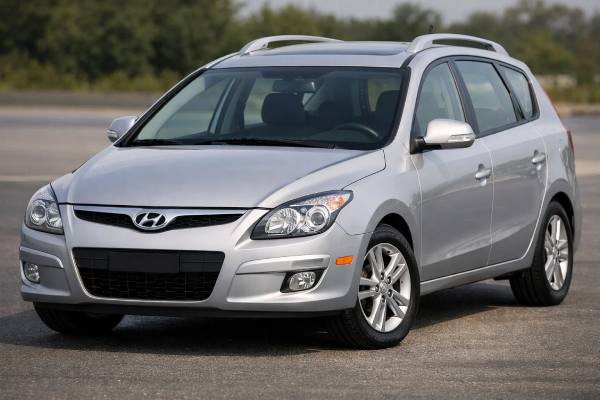

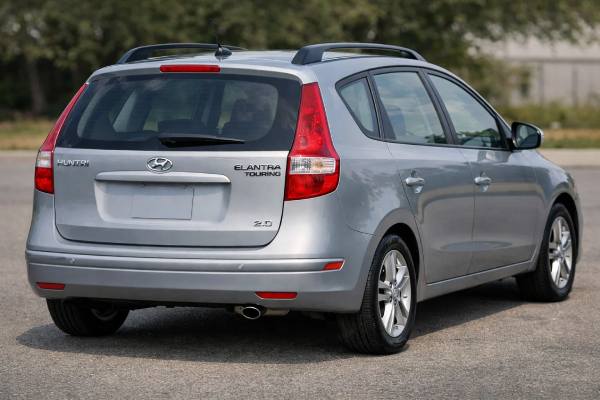
The 2011–2012 Hyundai Elantra Touring is the practical branch of the FD-generation Elantra family. Instead of following the sedan toward sleeker styling and maximum fuel economy, the Touring stayed focused on space, utility, and straightforward engineering. In facelift form, it paired a 2.0-litre naturally aspirated MPI four-cylinder with a 5-speed manual or optional 4-speed automatic, plus a roomy five-door body that could genuinely replace a small crossover for many owners.
That matters today because the Touring offers something newer compact wagons often do not: mechanical simplicity. There is no turbocharger, no dual-clutch gearbox, and no direct-injection carbon issue to dominate ownership. The trade-off is that it is now an aging car, so timing-belt history, cooling-system health, and rust inspection matter far more than trim level alone. Bought carefully, the 138 hp Elantra Touring can still be a useful, honest, low-cost family hatch with unusually good cargo flexibility.
Quick Specs and Notes
- The 2.0 MPI engine is simple, proven, and easier to own than many later small turbo engines.
- Cargo space is a real strength, with useful room even before folding the rear seats.
- Standard four-wheel disc brakes, ESC, and six airbags were strong value points for the class.
- Timing-belt history is critical, and neglected cooling systems can turn a cheap car into an expensive one.
- A sensible oil-service target is every 12,000 km or 12 months, with shorter intervals in severe city use.
Explore the sections
- Hyundai Elantra Touring FD essentials
- Hyundai Elantra Touring FD numbers
- Hyundai Elantra Touring FD equipment map
- Wear points and recall fixes
- Service planning and used checks
- On-road character and economy
- Touring FD against wagons and hatches
Hyundai Elantra Touring FD essentials
The facelifted Elantra Touring occupies a niche that has become harder to find. It is a compact five-door that behaves like a small wagon rather than a tall hatchback pretending to be an SUV. Hyundai aimed it at buyers who needed real cargo space, fold-flat practicality, and honest driving manners without moving into a larger segment or paying for a more premium badge.
That underlying purpose explains why the car still makes sense on the used market. The 2.0-litre engine is a naturally aspirated MPI unit with conventional service requirements and predictable behavior. Output is modest by current standards, but the Touring is not meant to feel quick. It is meant to be useful. The long wheelbase, roomy cabin, large rear opening, and low cargo floor are the features that define the ownership experience more than the brochure horsepower number.
This 2011–2012 update is often called the facelift phase in practical buying terms, even though the changes were evolutionary rather than dramatic. Hyundai revised equipment, appearance details, and option packaging, while keeping the proven FD Touring shape. For 2011, added convenience features included standard one-touch triple turn-signal operation and a headlight welcome function, while the SE model gained leather seating. For 2012, the packaging shifted again, with the Preferred Package replacing the earlier Popular Equipment Package and adding 16-inch alloy wheels in that bundle. These year-to-year changes matter because they can materially change how a used car feels.
The Touring also stood out for value. Even the GLS came with air conditioning, power accessories, heated mirrors, keyless entry, rear wiper and washer, a decent standard audio system, and a strong cargo setup. The SE then layered on 17-inch wheels, fog lamps, heated front seats, leather trim, sunroof, and a sportier appearance. Unlike some rivals, you were not paying only for the body style.
Its engineering mix is part of the appeal now. Four-wheel disc brakes were standard. Electronic Stability Control and traction control were standard. Six airbags were standard. The rear suspension used a multi-link layout rather than a cheaper beam axle. In period, that gave the Touring a more polished feel than some basic compact wagons and hatchbacks. Today, it means the car still feels competent if the suspension is fresh.
The caution is age. This is an old Hyundai, and age-related neglect matters more than design purity. A good Touring feels practical and refreshingly simple. A bad one feels like a backlog of mounts, belts, worn dampers, poor tyres, and small electrical annoyances. The model itself is not the problem. Deferred maintenance is.
Hyundai Elantra Touring FD numbers
For the 2011–2012 Elantra Touring in U.S.-market facelift trim, the core identity is consistent: one 2.0-litre MPI engine, one front-wheel-drive layout, a 5-speed manual or 4-speed automatic, and a long-wheelbase five-door body with unusually strong luggage space for the segment.
Powertrain and efficiency
| Item | Hyundai Elantra Touring (FD) 2.0 MPI |
|---|---|
| Code | Beta II 2.0 MPI / CVVT family |
| Engine layout and cylinders | Inline-4, 4 cylinders, DOHC, 4 valves per cylinder |
| Bore × stroke | 82.0 × 93.5 mm (3.23 × 3.68 in) |
| Displacement | 2.0 L (1,975 cc) |
| Induction | Naturally aspirated |
| Fuel system | MPI / multipoint injection |
| Compression ratio | About 10.1:1 |
| Max power | 138 hp (103 kW) @ 6,000 rpm |
| Max torque | 184 Nm (136 lb-ft) @ 4,600 rpm |
| Timing drive | Belt |
| Rated efficiency | 9.0 L/100 km combined (26 mpg US / 31.2 mpg UK) for the 5-speed manual |
| Real-world highway @ 120 km/h (75 mph) | Usually about 7.0–8.0 L/100 km (29.4–33.6 mpg US / 35.3–40.3 mpg UK) |
Transmission and driveline
| Item | Hyundai Elantra Touring (FD) 2.0 MPI |
|---|---|
| Transmission | 5-speed manual or optional 4-speed automatic |
| Drive type | FWD |
| Differential | Open |
Chassis and dimensions
| Item | Hyundai Elantra Touring (FD) |
|---|---|
| Suspension (front/rear) | MacPherson strut / multi-link rear |
| Steering | Rack-and-pinion with electric power assist |
| Brakes | 300 mm (11.8 in) front ventilated discs, 262 mm (10.3 in) rear solid discs |
| Wheels and tyres | 195/65 R15, 205/55 R16, or 215/45 R17 depending on trim |
| Length | 4,475 mm (176.2 in) |
| Width | 1,765 mm (69.5 in) |
| Height | 1,519 mm (59.8 in) |
| Wheelbase | 2,700 mm (106.3 in) |
| Turning circle | About 10.7 m (35.1 ft) |
| Kerb weight | About 1,340–1,390 kg (2,954–3,064 lb), depending on trim and gearbox |
| Fuel tank | About 53–55 L (14.0–14.5 US gal / 11.7–12.1 UK gal), verify by market data plate |
| Cargo volume | 688 L (24.3 ft³) seats up / 1,849 L (65.3 ft³) seats folded |
Performance and capability
| Item | Hyundai Elantra Touring (FD) 2.0 MPI |
|---|---|
| 0–100 km/h | About 9.8–10.5 s |
| Top speed | About 190 km/h (118 mph) |
| Towing capacity | Market dependent; many North American cars were not prominently tow-rated, so verify by VIN and local handbook |
| Payload | Varies by trim and tyre rating; check door-jamb label |
| Braking distance | No widely published factory stop figure found for this exact 2011–2012 Touring variant |
Fluids and service capacities
| Item | Hyundai Elantra Touring (FD) 2.0 MPI |
|---|---|
| Engine oil | 5W-20 or 5W-30 meeting Hyundai/API requirements; about 3.8–4.0 L (4.0–4.2 US qt) with filter |
| Coolant | Ethylene-glycol long-life coolant, 50:50 mix; about 6.0 L (6.3 US qt) |
| Manual transmission | GL-4 manual trans fluid, typically around 1.9–2.1 L (2.0–2.2 US qt), verify transmission code |
| Automatic transmission | Hyundai SP-III type fluid; total capacity roughly 6.8–7.1 L (7.2–7.5 US qt), drain fill uses less |
| A/C refrigerant | R134a; verify exact charge on under-hood label |
| A/C compressor oil | PAG type; verify exact quantity on label or service data |
| Key torque specs | Wheel nuts typically about 90–110 Nm (66–81 lb-ft); verify drain-plug and suspension fasteners before service |
Safety and driver assistance
| Item | Hyundai Elantra Touring (FD) |
|---|---|
| Euro NCAP | No direct facelift Touring Euro NCAP result commonly cited for this U.S.-market variant |
| IIHS | Moderate overlap frontal rating applied to the Touring from the earlier Elantra test: Good; 2012 Touring head restraints and seats: Good |
| Headlight rating | Not applicable for this era |
| ADAS suite | None; no AEB, ACC, lane assist, blind-spot monitoring, or traffic-sign assist |
The numbers confirm the Touring’s character. It is not a fast wagon, but it is spacious, mechanically plainspoken, and well equipped where it counts.
Hyundai Elantra Touring FD equipment map
The easiest way to shop a 2011–2012 Elantra Touring is to think in two trims and two transmissions. The two trims are GLS and SE. The two transmissions are the standard 5-speed manual and optional 4-speed automatic. Most of the character differences come from wheels, seating trim, convenience features, and a few sport-oriented touches, not from major mechanical separation.
The GLS was the rational choice. It already included the 2.0-litre CVVT engine, four-wheel disc brakes, six airbags, ABS with electronic brake-force distribution, ESC with traction control, active front head restraints, power windows, power locks, heated mirrors, keyless entry, rear wiper and washer, a cooled glovebox, 60/40 split-fold rear seatbacks, hidden cargo-area storage, and a 172-watt six-speaker audio system with USB and auxiliary inputs. That is a strong baseline, especially for a used family hatch.
The SE added the features most buyers notice immediately. It came with 17-inch alloy wheels and lower-profile tyres, fog lights, leather seating, heated front seats, a leather-wrapped steering wheel and shift knob, and a power sunroof. Manual SE cars also included the B&M short-throw sport shifter. The result is not a performance version in the hot-hatch sense, but it does feel more purposeful and slightly more special.
Year-to-year changes matter. For 2011, Hyundai made leather seats standard on the SE and added EZ Lane Change Assist and the headlight welcome function across the range. For 2012, the packaging changed again, and the Preferred Package on GLS automatic cars brought 16-inch alloys, telescopic steering, steering-wheel audio controls, trip computer, improved seat adjustment, a retractable cargo cover, and silver roof side rails. That means a late GLS with the right package can be a smarter buy than an early SE in poorer condition.
Mechanically, differences are modest but real. The SE gets the sportier tyre and wheel package and the manual short shifter, which sharpen the feel a bit. Ride quality on the smaller 15-inch or 16-inch wheels is usually more forgiving, and replacement tyres are cheaper. Buyers who drive on rough roads often prefer the GLS setup. Buyers who want the better interior presentation and a slightly more tied-down look usually prefer the SE.
Safety equipment is one of the Touring’s stronger points for the era. Six airbags, ESC, traction control, ABS, electronic brake-force distribution, tyre-pressure monitoring, and active front head restraints were standard. That does not make it a modern safety benchmark, but it does mean the Touring was not stripped of essential hardware.
There is no modern ADAS evolution to track because the car predates that wave. No adaptive cruise, no forward emergency braking, no blind-spot monitoring, and no lane support. From a used-car perspective, that means fewer sensors and zero calibration headaches after bumper or windscreen work. The trade-off is obvious: the driver remains the full safety net.
Wear points and recall fixes
The Elantra Touring’s reliability story is better than its age sometimes suggests. The 2.0 MPI engine is not especially fragile, and the car’s core systems are conventional. The risk profile is mostly about wear, climate, and maintenance habits rather than one famous design flaw. That is good news, because most problems are understandable before they become catastrophic.
A useful pattern looks like this:
Common and usually low to medium cost
- Front anti-roll-bar links and bushes.
- Engine mounts, especially upper mounts that add vibration at idle.
- Rear hatch struts and hatch-area trim rattles.
- Battery weakness and charging complaints after repeated short-trip use.
- Brake corrosion on lightly used cars, especially at the rear.
Occasional and medium cost
- Cooling-system leaks from radiator end tanks, hoses, or thermostat housing.
- Clutch wear on manual cars that lived in stop-start traffic.
- Wheel-bearing hum and front suspension joint wear.
- Automatic shift laziness or harshness if fluid service was ignored.
- Air-conditioning performance loss from age-related leakage rather than major compressor failure.
Higher-risk if ignored
- Timing-belt and water-pump neglect.
- Repeated overheating that harms the head gasket.
- Rust around the underside, subframe areas, brake lines, and suspension mounting points in salt-belt cars.
The biggest engine-specific ownership issue is not the MPI system itself. It is the timing belt. This is not a chain-driven engine, so unknown belt history should be treated as urgent, not academic. If a seller cannot prove belt service, budget for the belt, tensioner, idlers, and preferably the water pump. That single decision matters more than most option packages.
Cooling system health is the second big theme. These cars are old enough that hoses harden, radiators seep, and thermostats age out. Overheating is far more expensive than routine cooling-system upkeep, so it makes sense to be proactive.
There are also important service actions and recalls to understand. For 2010–2012 Elantra Touring models, Hyundai issued a recall related to headliner support brackets that could become displaced during side-curtain-airbag deployment. That is a real pre-purchase checkpoint because it directly affects safety hardware. Separately, some earlier Elantra Touring vehicles, including 2011 model-year examples, later fell under an ABS-module fire-risk recall. That does not mean every 2011–2012 Touring is unsafe, but it does mean every shopper should run the VIN and look for documented completion.
A newer ownership wrinkle is theft exposure on certain key-start Hyundai models in the U.S. Some Elantra Touring cars were not eligible for the software-based fix applied to later vehicles, so buyers should verify what anti-theft countermeasure, if any, has been installed.
The Touring is not a car with exotic hidden disasters. It is a car that punishes buyers who assume “simple” means “maintenance-free.”
Service planning and used checks
A practical maintenance plan for the Elantra Touring should be slightly more conservative than the original marketing tone of the car suggests. The goal is not to over-service it. The goal is to stay ahead of belt age, fluid breakdown, and small faults that become expensive only when ignored.
Practical maintenance schedule
| Item | Sensible interval |
|---|---|
| Engine oil and filter | Every 12,000 km or 12 months; every 7,500–10,000 km in severe use |
| Engine air filter | Inspect every service; replace around 30,000 km |
| Cabin air filter | About every 20,000 km or yearly in dusty use |
| Coolant | Every 4–5 years or about 80,000 km as a cautious real-world target |
| Spark plugs | Around 100,000–160,000 km depending on plug type and actual condition |
| Fuel filter | Check market specification; replace if serviceable and contamination is suspected |
| Timing belt | Replace around 90,000 km or about 6 years, sooner if history is unknown |
| Water pump | Strongly recommended during timing-belt service |
| Accessory belt and hoses | Inspect every service and replace on condition |
| Manual transmission fluid | Replace around 60,000–90,000 km |
| Automatic transmission fluid | Drain and refill around 50,000–60,000 km if the car sees regular stop-start use |
| Brake fluid | Every 2 years |
| Brake pads and rotors | Inspect every service |
| Tyre rotation | Every 10,000–12,000 km |
| Alignment check | On pull, steering-angle change, or uneven shoulder wear |
| 12 V battery test | Yearly after year four |
Fluid choices matter because these drivetrains do best when they get the correct specification rather than the cheapest shelf substitute. Engine oil should meet Hyundai/API requirements and suit the climate. Manual gearboxes want the right GL-4 fluid, not just any heavy gear oil. The automatic wants the correct Hyundai-type fluid. Power steering, brake fluid, and coolant should also be kept to the proper spec rather than topped off indefinitely with whatever is at hand.
As a used buy, the Touring rewards a methodical inspection. Check the underside first, not the shiny paint. Look for rust, crushed jacking points, brake-line corrosion, and subframe decay. Then inspect the cooling system for old hoses, crust around seams, and signs of past overheating. After that, verify the timing-belt record. Only then is it worth caring about leather trim or the sunroof.
Common reconditioning items are predictable: tyres, brakes, battery, mounts, sway-bar links, dampers, filters, fluids, and often a belt job. None of that is unusual for the age. The problem is buying a car that needs all of it at once.
The smartest versions to seek are usually 2012 cars with good service records, completed recall work, healthy tyres, and either a clean GLS with the right package or a well-kept SE if you want the extra equipment. The trims to avoid are not defined by badge. They are defined by neglect.
Long-term durability is decent if you treat the Touring like a real wagon worth maintaining. Do that, and it will usually return the favor.
On-road character and economy
The Elantra Touring drives with a different mindset from many later compact hatches. It does not try to feel aggressively sporty, and it does not isolate the driver the way a small crossover can. Instead, it aims for balance: easy controls, confident body control, a useful rear suspension, and enough engine to make a loaded family hatch feel competent.
Ride quality is one of the Touring’s better traits. The long wheelbase helps it settle on rough roads, and the multi-link rear suspension gives it more composure over mid-corner bumps than many cheaper rear-axle setups. On 15-inch or 16-inch wheels, it rides with a maturity that still feels good today. The 17-inch SE setup looks better and turns in more cleanly, but it also transmits more sharp edges and costs more to re-tyre.
The 2.0 MPI engine fits the car well. It is not exciting, but it is willing. Throttle response is clean, and because it is naturally aspirated there is no turbo delay or artificial step in power delivery. Low-rpm pull is adequate rather than muscular, and the engine is happiest when you drive it smoothly through the middle of the rev range. That makes the 5-speed manual the better match for drivers who actually enjoy the car. The 4-speed automatic is fine for commuting, but it blunts response and feels dated on hills or quick merges.
Steering is light and accurate enough, with more natural response than some over-assisted systems from the same era. Braking performance is a quiet strength. Standard four-wheel discs, ABS, and ESC give the Touring a planted feel in emergency stops, especially compared with older compact wagons that still relied on rear drums.
Noise levels are average for its age. At city speeds the Touring feels refined enough, but highway use brings more tyre and wind noise than a modern hatchback. Good tyres, healthy door seals, and fresh mounts make a big difference.
Real-world fuel use is fair rather than spectacular:
- city: about 9.5–10.8 L/100 km
- highway at 100–120 km/h: about 7.0–8.0 L/100 km
- mixed use: about 8.2–9.2 L/100 km
That puts it close to its official 23 mpg city and 30 mpg highway manual rating in careful driving, though older cars with worn plugs, neglected filters, poor tyre pressure, or short-trip use will do worse. Full load and roof-rack use can add another 0.5–1.0 L/100 km.
The overall verdict from the driver’s seat is straightforward. The Touring is not memorable for speed. It is memorable for how normal, useful, and composed it feels.
Touring FD against wagons and hatches
The Elantra Touring makes the most sense when compared with other practical compact five-doors of its era, not with later crossover-shaped hatchbacks. Against the Mazda3 hatch, it loses on steering sharpness and driver appeal. The Mazda is the more entertaining car. The Hyundai answers with a calmer ride, simpler cabin layout, strong cargo flexibility, and often lower purchase cost. For family duty, that trade can be worth making.
Compared with the Toyota Matrix and Pontiac Vibe twins, the Hyundai feels more like a conventional wagon and less like a tall compact utility hatch. The Toyota pair wins on reputation and usually on long-term resale, but the Touring often feels more refined in ride and cabin presentation. Buyers who want the lowest-risk ownership image will still lean Toyota. Buyers who want more features per dollar often find the Hyundai hard to ignore.
Against the Kia Rondo, the Touring is less mini-MPV and more car-like. The Rondo offers more vertical space and sometimes a stronger value case for outright practicality, but it is bulkier and not as tidy to drive. The Touring is the better answer for owners who want wagon utility without the feel of a compact people carrier.
The Volkswagen Jetta SportWagen is another interesting rival. It feels more premium and offers stronger highway manners in some versions, but used examples can carry much higher parts and repair risk, especially once turbo, DSG, or diesel complexity enters the picture. The Hyundai cannot match the Volkswagen’s polish, yet it often wins the ownership-stress argument.
Where the Touring clearly falls behind is modern safety and powertrain sophistication. It has no advanced driver-assistance technology, and its 4-speed automatic already felt old in period. It also depends more on condition than reputation now. A tired Touring is easier to dislike than a freshly sorted one.
That is the key point. The Elantra Touring FD is not the class icon, the sportiest hatch, or the prestige choice. It is the compact wagon for buyers who care most about usable space, straightforward mechanicals, decent chassis polish, and manageable running costs. In that role, it still deserves a serious look.
References
- 2011 ELANTRA TOURING ADDS VALUE AND CONVENIENCE FEATURES 2010 (Manufacturer Release)
- HYUNDAI ANNOUNCES 2012 ELANTRA TOURING PRICING 2011 (Manufacturer Release)
- 2012 Hyundai Elantra Touring 2012 (Safety Rating)
- Fuel Economy of the 2012 Hyundai Elantra Touring 2012 (Official Fuel Economy Data)
- Part 573 Safety Recall Report 20V-061 2020 (Recall Report)
Disclaimer
This article is for informational purposes only and is not a substitute for professional diagnosis, repair, or factory service information. Specifications, torque values, intervals, procedures, and equipment vary by VIN, market, transmission, trim, and production date, so always verify details against official service documentation and the labels fitted to the vehicle before carrying out maintenance or repair work.
If this guide was useful, please consider sharing it on Facebook, X, or another platform to support our work.