

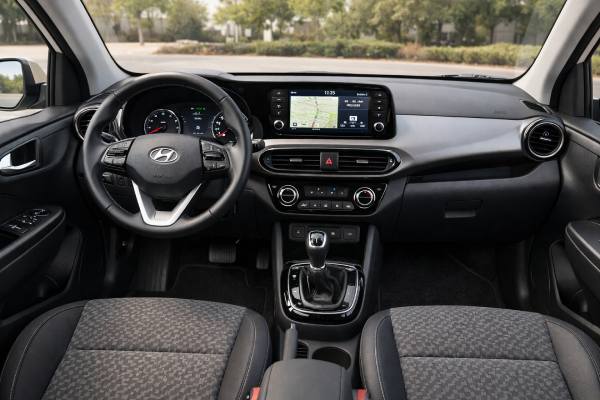
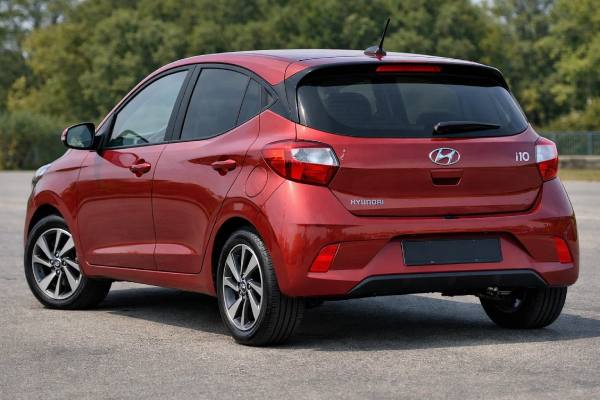
The 2020–2023 Hyundai i10 (AC3) 1.0 MPi is a modern city car built around the basics that matter most in daily use: compact size, low running costs, easy controls, and clever cabin packaging. In this form, it uses Hyundai’s naturally aspirated 1.0-litre three-cylinder petrol engine with 67 hp, paired mainly with a 5-speed manual gearbox. That does not make it quick, but it does make it light, simple, and usually inexpensive to own. The AC3 generation also moved the i10 forward in the areas buyers notice right away, including cabin space, technology, and active-safety equipment. It is still a small car with small-car limits, especially on fast roads, but it feels more mature than many older A-segment rivals. For used buyers, the appeal is clear: a straightforward petrol engine, a chain-driven valvetrain, good urban practicality, and fewer long-term worries than many tiny turbocharged alternatives.
Owner Snapshot
- Excellent city-car packaging with a useful 252-litre boot and easy parking manners.
- Simple 1.0 MPi petrol engine avoids the added heat and complexity of a turbo setup.
- Safety kit is stronger than many older small-car rivals, especially in European trim.
- Performance is modest, so motorway overtakes need planning and good tyre condition.
- Change engine oil and filter every 15,000 km or 12 months, sooner in hard city use.
Section overview
- Hyundai i10 AC3 In Daily Use
- Hyundai i10 AC3 Technical Details
- Hyundai i10 AC3 Grades and Safety
- Reliability and Usual Trouble Spots
- Maintenance and Smart Buying
- Real-World Driving and Economy
- Versus the Main Rivals
Hyundai i10 AC3 In Daily Use
The third-generation i10, known internally as AC3, is the version that made Hyundai’s city car feel properly modern rather than merely inexpensive. It is still short enough to fit almost anywhere, but it is no longer as narrow, upright, or sparse-feeling as older budget hatchbacks. In basic 1.0 MPi form, that matters because the car’s main strength is not speed. Its strength is that it feels neatly judged for real use. You get a compact five-door hatchback with a proper boot, adult-friendly front seating, a useful rear bench for short and medium trips, and controls that do not demand a learning curve.
This 67 hp engine is the honest choice in the range. There is no turbocharger to provide a burst of mid-range shove, and there is no big number on the brochure to distract from the fact that this is a small, naturally aspirated three-cylinder designed around low mass and sensible fuel use. In town, though, it works well. The car is light, visibility is good, and the engine is responsive enough at lower speeds if you use the gearbox properly. That combination is why the 1.0 MPi still makes sense for buyers who want a straightforward commuter rather than a miniature hot hatch.
The AC3 body is also one of the i10’s strongest selling points. At around 3.67 metres long and 1.68 metres wide, it remains easy to place in crowded streets, but the longer wheelbase and more modern interior layout make it feel less cramped than many older rivals. Hyundai also did a decent job of giving the cabin a more grown-up atmosphere. Higher trims gained a better infotainment screen, camera support, more active-safety features, and cleaner dashboard design. Even in simpler trim, it is a car that feels intentionally designed, not merely cost-cut.
Ownership advantages go beyond packaging. The 1.0 MPi engine is a multi-point injected petrol unit, which usually means fewer long-term worries than direct-injection or turbocharged small engines when mileage rises and warranty coverage is gone. The chain-driven timing system also removes the fixed belt-change expense that some buyers still worry about. None of that makes the car maintenance-free, but it does make it easier to understand.
The limits are just as important as the strengths. This is not the right i10 for drivers who regularly carry four adults on fast roads, climb steep motorways with full loads, or expect strong overtaking without a downshift. It will do those jobs, but not effortlessly. Noise also rises once you sit at higher motorway speeds for long stretches. For buyers who understand that, the AC3 1.0 MPi is a very coherent package: simple engine, light controls, small footprint, decent safety, and fewer unpleasant surprises than many tiny cars at this end of the market.
Hyundai i10 AC3 Technical Details
The table below focuses on the mainstream European-style Hyundai i10 AC3 1.0 MPi 67 hp, mainly in 5-speed manual form. Because the model was sold in many markets, some figures vary with trim, seat count, gearbox, tyre size, and local homologation. Where that happens, the entry is marked as approximate or market-dependent.
| Powertrain and efficiency | Specification |
|---|---|
| Code | Smartstream G1.0 |
| Engine layout and cylinders | Inline-3, 3 cylinders, DOHC, 4 valves per cylinder |
| Bore × stroke | 71.0 × 84.0 mm (2.80 × 3.31 in) |
| Displacement | 1.0 L (998 cc) |
| Induction | Naturally aspirated |
| Fuel system | Multi-point injection |
| Compression ratio | 11.0:1 |
| Max power | 67 hp (49.3 kW) @ 5,500 rpm |
| Max torque | 96.1 Nm (70.9 lb-ft) @ 3,750 rpm |
| Timing drive | Chain |
| Rated efficiency | WLTP combined about 5.0–5.5 L/100 km (47.0–44.0 mpg US / 56.5–51.4 mpg UK), depending on trim and gearbox |
| Real-world highway @ 120 km/h (75 mph) | Usually about 5.6–6.4 L/100 km in healthy condition |
| Transmission and driveline | Specification |
|---|---|
| Transmission | 5-speed manual; 5-speed automated manual in some markets |
| Drive type | FWD |
| Differential | Open |
| Chassis and dimensions | Specification |
|---|---|
| Suspension, front / rear | MacPherson strut / torsion-beam rear axle |
| Steering | Rack-and-pinion, motor-assisted |
| Steering ratio / turns lock-to-lock | About 2.6 turns lock-to-lock |
| Brakes | Front ventilated disc / rear drum or rear disc depending on version |
| Wheels and tyres | 175/65 R14 most common; 185/55 R15 on higher trims |
| Ground clearance | About 149 mm (5.9 in) |
| Length / width / height | 3,670 / 1,680 / 1,480 mm (144.5 / 66.1 / 58.3 in) |
| Wheelbase | 2,425 mm (95.5 in) |
| Turning circle (kerb-to-kerb) | Radius about 4.9 m; turning circle about 9.8 m (32.2 ft) |
| Kerb weight | About 996 kg (2,196 lb) for 5MT; market-dependent |
| GVWR | About 1,410 kg (3,109 lb) |
| Fuel tank | 36 L (9.5 US gal / 7.9 UK gal) |
| Cargo volume | 252 L / 1,050 L (8.9 / 37.1 ft³), VDA |
| Performance and capability | Specification |
|---|---|
| 0–100 km/h (0–62 mph) | 14.8 s (5MT) |
| Top speed | 156 km/h (97 mph) |
| Braking distance | Not consistently published in open Hyundai model material |
| Towing capacity | Often around 300 kg braked in open market sheets; verify by VIN and registration market |
| Payload | Roughly 311–414 kg depending on trim and seat configuration |
| Fluids and service capacities | Specification |
|---|---|
| Engine oil | SAE 0W-20, API SN Plus or equivalent; 3.1 L (3.28 US qt) drain and refill |
| Coolant | Year-round antifreeze coolant; exact chemistry by Hyundai spec; verify by market |
| Transmission / manual gear oil | Use Hyundai-specified manual-transmission fluid; verify exact grade by VIN and market |
| Differential / transfer case | Not applicable |
| Brake / clutch fluid | DOT 3 or DOT 4 |
| A/C refrigerant | R-134a or R-1234yf depending on market and production spec |
| Key torque specs | Wheel nuts: 11–13 kgf·m, about 79–94 lb-ft; verify critical fasteners by service data |
| Safety and driver assistance | Specification |
|---|---|
| Crash ratings | Euro NCAP 2020: 3 stars; Adult 69%, Child 75%, Vulnerable Road Users 52%, Safety Assist 59% |
| IIHS | Not applicable |
| Headlight rating | Not applicable |
| ADAS suite | Market-dependent Hyundai Smart Sense items may include FCA, LKA, LFA, DAW, ISLW, HBA, rear camera, rear parking aids |
The most important thing these numbers show is balance. The i10 is not powerful, but it is light. It is not large, but it uses its size well. The 67 hp engine only makes sense because the rest of the package is so compact and efficient. Buyers who want easy parking, low tyre and fuel bills, and simple mechanical layout will understand why this car works. Buyers who look only at the acceleration number probably need a different class of vehicle.
Hyundai i10 AC3 Grades and Safety
Trim names varied by country, so the best way to understand the AC3 i10 is by equipment group rather than by one global trim ladder. In most European-style markets, the 1.0 MPi sat at the heart of the range. It could appear in simple but usable trims with steel wheels, manual air conditioning, basic infotainment, and cloth seats, or in more polished versions with better screens, camera support, extra convenience features, alloy wheels, and stronger visual detailing. The underlying mechanical package usually stayed the same: 1.0 MPi petrol, front-wheel drive, and either a 5-speed manual or a 5-speed automated manual depending on market.
That means the real differences from trim to trim were not about suspension tuning or special driveline hardware. They were about daily comfort, wheel and tyre package, seat count, convenience tech, and active-safety fitment. Some markets also sold four-seat and five-seat versions, and that changes both payload math and practical usefulness. A used buyer should therefore check the exact car rather than assuming every 1.0 MPi has identical equipment.
Quick identifiers help. Smaller wheels, simpler lights, and a more basic cabin screen often point to entry cars. Mid-spec versions typically add more useful everyday features rather than cosmetic extras alone. If possible, confirm the original market specification by VIN, because imports and dealer descriptions are often incomplete. This matters even more with driver-assistance features, which were sometimes standard in one country and optional in another.
Safety is one of the AC3 i10’s strongest advantages over older city cars. Euro NCAP gave the 2020 Hyundai i10 a 3-star result under the much tougher modern test regime. The headline star count looks modest until you remember how much stricter the protocols had become. The detailed scores were 69 percent for adult occupant protection, 75 percent for child occupant protection, 52 percent for vulnerable road users, and 59 percent for safety assist. That is not class-leading, but it is a credible modern baseline for a small hatchback.
More importantly, Hyundai gave the i10 a broader active-safety story than many older rivals ever had. Depending on market and trim, the i10 could include Forward Collision-Avoidance Assist, Lane Keep Assist, Lane Following Assist, Driver Attention Warning, High Beam Assist, and Intelligent Speed Limit Warning. Rear parking sensors, a reversing camera, and cruise control with a speed limiter also became common on better-equipped versions. The key phrase is “depending on market and trim.” The 67 hp manual car you are looking at may not have all of those systems, and early 2020 cars do not always match later 2023 equipment lists.
In practical ownership terms, that means two things. First, the AC3 is meaningfully safer than many cheap older city cars because even modest trims often include safety hardware that was once rare in the segment. Second, when buying used, you should physically verify the feature set. A seller may say “lane assist” or “emergency braking,” but the car itself and its VIN-backed equipment sheet tell the real story.
Reliability and Usual Trouble Spots
The AC3 i10 1.0 MPi has a good reputation for being straightforward rather than dramatic. That is exactly what many buyers want in a city car. The naturally aspirated multi-point petrol engine is simpler than a small direct-injection turbo engine, and the model does not have a long public history of expensive systemic failure points. Most issues are either age-and-use related or linked to routine maintenance being delayed.
Common low-cost or medium-cost trouble spots usually include:
- Weak 12 V batteries on cars that do repeated short trips, sit for long periods, or use a lot of stop-start city driving.
- Brake wear patterns linked to urban use, especially rear drum drag, rusty friction surfaces, or handbrake imbalance on cars that are not driven enough.
- Tyre and wheel damage from potholes, kerbs, or poor alignment. Light city cars are sensitive to tyre condition, and cheap tyres can hurt braking and refinement more than owners expect.
- Interior rattles, trim buzzes, and small convenience faults such as reversing-camera image issues, sensor warnings, or infotainment glitches.
- Clutch wear on heavily urban manual cars, especially learner cars or delivery-type cars that have spent years in stop-start use.
Occasional but more expensive issues are usually not engine disasters. They are more often the sort of faults that appear when a small car has had a hard life:
- Ignition-related rough running from overdue spark plugs or a weak coil.
- Suspension wear at drop links, bushes, or top mounts on poor roads.
- Air-conditioning performance loss from age-related leaks, condenser damage, or underuse.
- Automated manual gearbox complaints on AMT-equipped cars, which are often calibration or actuator-related rather than traditional automatic gearbox failures.
The engine itself is generally one of the safer bets in the range. It uses a timing chain rather than a belt, and its multi-point injection layout avoids the worst intake carbon worries that can affect some direct-injection small engines. That does not mean you ignore it. Long oil-change gaps, poor-quality oil, or repeated low-oil running can still shorten chain life and accelerate wear. If a used car shows chain noise at start-up, poor idle quality, or timing-correlation fault history, treat that as a warning sign, not as “normal for a three-cylinder.”
Software and calibration updates can matter too. On later small Hyundais, not every drivability complaint is mechanical. Infotainment glitches, camera issues, sensor warnings, or odd stop-start behaviour can sometimes be improved through dealer updates. A seller with documented Hyundai service history is therefore worth more than a seller with only generic garage stamps and vague promises.
One recall item worth knowing is the market-specific AC3 campaign covering certain 2020 production cars for a front passenger seat belt tensioner issue. Public EU safety-alert material identifies affected AC3 vehicles produced from 5 September 2020 to 16 October 2020 under company recall code 21DT02. That does not mean every 2020 i10 is affected. It means VIN checks matter.
Corrosion is not yet a defining weakness of this generation, but used buyers in harsh winter climates should still inspect the rear beam area, exhaust, brake pipes, subframe edges, and underbody seams. In short, the AC3 1.0 MPi is usually dependable when serviced on time. Most bad examples become bad through neglect, not because the core design is fundamentally flawed.
Maintenance and Smart Buying
This is an easy car to maintain well, and that is one of its biggest ownership advantages. The trick is not to confuse “simple” with “ignore it.” Small naturally aspirated petrol engines are durable when fluids, ignition parts, tyres, and brakes stay on schedule. They become annoying when owners assume cheap fuel and small size mean maintenance no longer matters.
A practical maintenance plan for the 1.0 MPi looks like this:
- Every 15,000 km or 12 months
Change the engine oil and filter. On city-only cars, repeated short-trip cars, or cars in very dusty or very cold use, shortening that interval is sensible. - Every 15,000 to 30,000 km
Inspect or replace the engine air filter depending on climate and road conditions. Replace the cabin filter as needed for airflow and heater performance. - Every 2 years
Replace brake fluid, inspect brake-pad wear, rear drum condition if fitted, handbrake operation, and brake-hose condition. - Every 30,000 to 60,000 km
Inspect spark plugs, ignition-coil condition, battery health, wheel alignment, and suspension wear. On hard-used city cars, do not wait for a misfire before thinking about plugs. - Every 60,000 to 90,000 km
Consider a manual-transmission fluid refresh even if the formal schedule sounds more inspection-based than replacement-based. It is inexpensive protection on a long-term car. - Ongoing by condition, not a fixed replacement interval
Inspect the timing chain system for start-up noise, fault codes, or evidence of poor oil history. There is no routine timing-belt replacement because this engine uses a chain, but that does not make it immortal.
Useful fluid and capacity figures are straightforward. Engine oil capacity is 3.1 litres. Brake and clutch fluid is DOT 3 or DOT 4. The fuel tank is 36 litres. Wheel-nut torque is about 79–94 lb-ft. The manual-transmission fluid must match Hyundai’s specified grade for the exact VIN and market. Coolant chemistry and A/C refrigerant can also vary by production spec, so never order those by guesswork alone.
As a used buy, the best versions are normally 5-speed manuals with a clear service record, original-size tyres, no crash-history signs, and working driver-assistance hardware where fitted. You want:
- Smooth cold start and stable idle
- No clutch slip or strong take-up shudder
- No steering pull, wheel-vibration, or uneven tyre wear
- Fully working infotainment, camera, and warning-light system
- Evidence of annual servicing, not just mileage-based servicing
- No water leaks in the boot or around the doors
- No underbody damage from kerb strikes or careless jack use
Cars to avoid are usually the obvious ones: heavy fleet use with poor records, warning lights, mismatched tyres, worn interiors that suggest hard city life, or sellers who cannot explain the service history. Long-term durability is good if the car is maintained annually and not treated as disposable transport. That is the AC3 i10’s real strength: it rewards basic care rather than demanding specialist devotion.
Real-World Driving and Economy
The i10 AC3 1.0 MPi drives like a well-sorted modern city car, which is not the same thing as a fast one. Around town it feels light, tidy, and easy to place. The clutch is usually light, the steering is light without feeling vague at parking speeds, and the short body helps in tight streets. Compared with older A-segment hatchbacks, the AC3 feels more substantial and more refined, especially in how it rides over ordinary urban surfaces. It still has a short wheelbase and a low mass, so sharp potholes and coarse broken roads remind you what class of car this is.
The powertrain character is honest. There is no turbo surge to mask the engine’s size, so you need to use revs and the gearbox if you want brisker progress. In urban driving, that is usually not a problem. The car feels alert enough at lower speeds, and the modest weight means it does not feel painfully slow when lightly loaded. On open roads, though, its limits appear quickly. Hills, passengers, and higher-speed overtakes all need planning. If you often drive fully loaded on fast roads, the 1.2 MPi or a larger class of car makes more sense.
Refinement is reasonable for a three-cylinder city car. At idle, the engine has a mild thrum, but it is not coarse by class standards. At 100–120 km/h, wind and road noise become a bigger part of the experience, and the 1.0 MPi no longer feels especially relaxed. That does not make it unsuitable for motorway work. It just means you buy it with realistic expectations.
Real-world fuel economy is one of the car’s better traits. Official WLTP combined figures usually sit around the low-to-mid 5 L/100 km range depending on trim, wheels, and gearbox. In everyday use, healthy manual cars often return numbers like these:
- City: about 5.8–7.0 L/100 km
- Mixed: about 5.2–6.0 L/100 km
- Highway at 100–120 km/h: about 5.6–6.4 L/100 km
Cold weather, very short trips, cheap tyres, poor alignment, bad fuel, and a weak battery can all make the car use more. So can constant high-speed motorway work, where the 1.0 has to work harder than larger engines. But for the kind of driving the i10 is designed for, economy is competitive and predictable.
The steering and chassis tune are more mature than the engine. Turn-in is clean, body control is tidy for a tall city hatch, and braking is reassuring as long as tyres are good and the rear drums or discs are not neglected. The handling balance is safe rather than playful. It will not thrill an enthusiastic driver, but it also does not feel clumsy. That is a good outcome in this class.
In simple terms, the i10 1.0 MPi performs best when you use it as intended: urban commuting, short regional trips, and everyday practical driving. Treat it like a tiny family runabout with modest power, and it makes sense. Expect effortless high-speed performance, and it will not.
Versus the Main Rivals
The 2020–2023 Hyundai i10 1.0 MPi occupies one of the most competitive parts of the small-car market, but it has a clearer identity than many rivals. It is not trying to be the cheapest old-style budget box, and it is not pretending to be sporty in base 67 hp form. Instead, it aims for a middle ground: decent room, sensible quality, useful safety tech, and low everyday cost.
The Kia Picanto is the most direct rival because it shares much of Hyundai’s philosophy. In practice, these two are often decided by trim, condition, and price rather than by engineering differences alone. The Volkswagen up!, Skoda Citigo, and SEAT Mii are also strong comparisons. They often feel a little more solid and mature on the road, but many examples are older, rarer, or priced more optimistically. The Hyundai fights back with newer-feeling safety features, good packaging, and often better used-value logic.
Against cars like the Toyota Aygo, Peugeot 108, and Citroën C1, the i10 offers a different kind of appeal. Those rivals are often charmingly simple and very easy to run, but the Hyundai usually feels roomier, more substantial, and more safety-conscious in later trim. The trade-off is that the Aygo/C1/108 group can feel a little livelier and more distinctive in character, while the i10 feels more grown-up and less playful.
The Fiat Panda deserves mention too. It remains one of the most practical small cars in shape and visibility, and some buyers love its upright feel. But the Hyundai usually wins on infotainment, perceived finish, and modern active-safety fitment. That matters if you want a city car that does not feel stripped to the bone.
Where does the i10 lose ground? Mostly in outright performance and, sometimes, in emotional appeal. The 67 hp 1.0 MPi is adequate, not exciting. If you want the strongest motorway pace or the most eager response, this is not the best small car for you. Some rivals also feel more distinctive to look at or more premium in small details. But the Hyundai’s core argument remains strong: it is easy to drive, easy to park, reasonably roomy, and generally honest to own.
That honesty is what gives it an edge as a used buy. Many rivals can match one or two of its strengths. Fewer combine room, simplicity, safety, and sensible operating cost as neatly. So the verdict is straightforward. Choose the AC3 i10 1.0 MPi if you want a small petrol hatchback with modern safety, light running costs, and no need for mechanical drama. Choose something stronger only if your driving pattern genuinely asks for more power than this little Hyundai was ever meant to provide.
References
- Hyundai Owners manuals | Hyundai Motor UK 2026 (Owner’s Manual Portal)
- OWNER’ S MANUAL 2020 (Owner’s Manual)
- Caratteristiche Tecniche HYUNDAI i10 2024 (Technical Data Sheet)
- Official Hyundai i10 2020 safety rating 2020 (Safety Rating)
- Home | Hyundai Recalls & Service Campaigns 2026 (Recall Database)
Disclaimer
This article is for informational purposes only and is not a substitute for professional diagnosis or repair. Specifications, torque values, intervals, procedures, and equipment can vary by VIN, market, production date, trim, and homologation standard, so always verify critical details against official service documentation for the exact vehicle.
If this guide helped you, please share it on Facebook, X, or another social platform to support our work.