
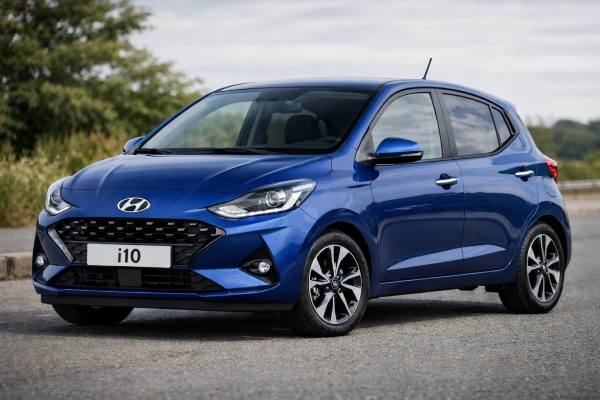
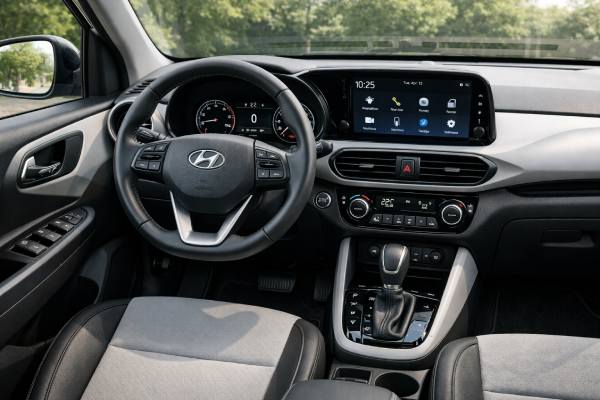
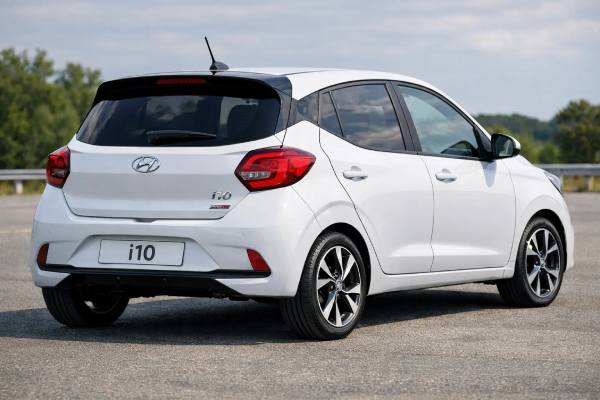
The facelifted Hyundai i10 AC3 1.0 LPG sits in a narrow but useful part of the market. It is built for drivers who still want a true city car, but one that keeps running costs low without moving to a hybrid or a battery-electric model. That makes it attractive in markets where LPG remains easy to find and meaningfully cheaper than petrol. The facelift kept the i10’s compact footprint, practical cabin, and good visibility, while refreshing the front-end design, infotainment, and safety technology. The LPG version adds another layer of logic: lower cost per kilometre, simple naturally aspirated engineering, and none of the turbo or hybrid complexity that can push long-term ownership costs higher. The catch is that this version is highly market-dependent. Early facelift material commonly places it in the 65 CV or roughly 63 hp class, while later listino material in some markets quotes a slightly lower homologated figure, so exact output, emissions, and equipment should always be confirmed by VIN and registration documents.
Essential Insights
- Very low fuel cost per kilometre where LPG is widely available and competitively priced.
- Compact 3.67 m footprint and 252 L boot make it genuinely useful in daily city life.
- Naturally aspirated 1.0 engine stays simpler than many small turbo alternatives.
- Output and trim details vary by market, so always verify the exact LPG version by VIN.
- Engine oil and filter every 15,000 km or 12 months is a sensible maximum interval.
Explore the sections
- Hyundai i10 AC3 LPGi today
- Hyundai i10 AC3 LPGi data tables
- Hyundai i10 AC3 equipment and safety
- Fault patterns and campaign checks
- Care schedule and used-buyer notes
- Road behavior and cost per km
- Against rival LPG city cars
Hyundai i10 AC3 LPGi today
The facelifted AC3 i10 remains one of the last proper city cars in the old sense. It is short, narrow, easy to park, and designed around daily urban use rather than crossover fashion. That matters because many small cars have grown larger, heavier, and more expensive. The i10 still focuses on simple packaging. At roughly 3.67 metres long and 1.68 metres wide, it is easy to place in traffic, easy to park in tight spaces, and still roomy enough inside to work as a real four-seat hatchback rather than just a short-distance commuter pod.
The LPG version adds a very specific ownership advantage. In markets where LPG remains common, the i10 can deliver a much lower cost per kilometre than the same car on petrol alone. That is the real reason to buy it. This is not a performance model and it does not pretend to be. The 1.0-litre naturally aspirated three-cylinder is tuned for thrift and simplicity, not excitement. But when paired with a factory LPG installation, it becomes a practical answer for drivers who cover steady local mileage, want predictable running costs, and do not want the extra complexity of mild-hybrid systems, turbochargers, or direct-injection servicing risks.
The facelift improved the design and tech story. Hyundai freshened the exterior with revised lighting signatures, a bolder grille, updated wheel designs, and a cleaner digital feel inside. Depending on market and trim, the facelift also brought an 8-inch touchscreen, navigation, Bluelink-type connected services, wireless updates, parking aids, and a wider spread of driver-assistance features than older city cars ever offered. That means the current i10 feels far more modern than the basic A-segment cars it competes with in people’s minds.
There is an important market nuance here. The LPG model is not sold the same way everywhere. In some markets it has been presented as a MY24 65 CV version, which places it in the 63 hp class in the way many English-language listings describe it. In later homologation and pricing documents, some versions are shown with a slightly lower 61 CV figure. That does not transform the car, but it matters for paper specs, insurance classes, taxation, and seller descriptions. The practical answer is simple: treat this as a low-60 hp LPG i10 and verify the exact registration and homologation data before buying or publishing parts information.
As a whole, the AC3 LPGi makes the most sense for drivers who want a cheap-to-run daily car, mostly drive in town or on secondary roads, and have reliable access to LPG refuelling. It makes less sense for heavy motorway users or buyers who live where LPG supply is sparse. In the right market, though, it remains one of the most rational small cars you can own.
Hyundai i10 AC3 LPGi data tables
The figures below reflect the facelifted Hyundai i10 AC3 LPG in 2024–present form as closely as current official material allows. Because this version is strongly market-specific, some details such as exact power, emissions, trim availability, wheel sizes, and rear-brake hardware vary by country and homologation. The most sensible way to read the data is as a verified low-60 hp factory LPG version of the facelifted AC3 i10.
| Powertrain and efficiency | Data |
|---|---|
| Code | Kappa 1.0 LPG family |
| Engine layout and cylinders | Inline-3, DOHC, 12 valves, 4 valves per cylinder |
| Bore × stroke | 71.0 × 84.0 mm (2.80 × 3.31 in) |
| Displacement | 1.0 L (998 cc) |
| Induction | Naturally aspirated |
| Fuel system | Multi-point petrol injection with factory LPG system |
| Compression ratio | 11.0:1 on the related 1.0 MPI petrol unit; verify LPG calibration by VIN |
| Max power | Low-60 hp class; commonly listed as 65 CV in MY24 promotional material and 61 CV in later MY25 listino data |
| Max torque | About 93–96 Nm (68.6–70.8 lb-ft), depending on homologation source |
| Timing drive | Chain |
| Transmission and driveline | Data |
|---|---|
| Transmission | 5-speed manual |
| Drive type | Front-wheel drive |
| Differential | Open differential |
| Chassis and dimensions | Data |
|---|---|
| Suspension front / rear | MacPherson strut / coupled torsion beam axle |
| Steering | Motor-driven power steering |
| Steering ratio | Not consistently published for every LPG market version; the related current i10 platform uses quick city-car gearing |
| Brakes | Front discs; rear-brake hardware varies by trim and market, with rear discs on some better-specified versions |
| Wheels and tyres | Common sizes include 185/55 R15 and 195/45 R16 depending on trim |
| Ground clearance | About 149–152 mm (5.9–6.0 in), market-dependent |
| Length / width / height | 3,670 / 1,680 / 1,480 mm (144.5 / 66.1 / 58.3 in) |
| Wheelbase | 2,425 mm (95.5 in) |
| Turning circle | 9.72 m (31.9 ft) |
| Kerb weight | Roughly low-900 kg to just under 1,000 kg in current non-turbo i10 specifications; confirm by trim and market |
| GVWR | About 1,410 kg in current 1.0-litre trim structures, but verify on the VIN plate |
| Fuel tank | Petrol tank 36 L (9.5 US gal / 7.9 UK gal) plus LPG tank with market-specific usable capacity |
| Cargo volume | 252 / 1,050 L (8.9 / 37.1 ft³), VDA |
| Performance and capability | Data |
|---|---|
| 0–100 km/h | Usually around the mid- to high-15-second range for the LPG version |
| Top speed | About 150–160 km/h (93–99 mph), depending on homologation |
| Braking distance | Strongly tyre-dependent and not consistently published for the LPG version |
| Towing capacity | Often around 300 kg braked and unbraked in current i10 data, but verify locally |
| Payload | Usually around 415–489 kg depending on trim and equipment |
| Fluids and service capacities | Data |
|---|---|
| Engine oil | Hyundai-approved low-viscosity synthetic, commonly 5W-30; exact approval and fill quantity must be confirmed by VIN |
| Coolant | Hyundai-approved long-life coolant mix; verify exact type and capacity from the owner’s literature |
| Transmission fluid | Hyundai-specified manual-transmission oil only; verify fill amount by service data |
| Differential / transfer case | Not applicable |
| A/C refrigerant | Verify by under-bonnet label before service |
| A/C compressor oil | Verify by refrigerant and system label |
| Key torque specs | Always confirm from VIN-specific workshop data before final tightening |
| Safety and driver assistance | Data |
|---|---|
| Crash ratings | Euro NCAP 2020: 3 stars; 69% adult, 75% child, 52% vulnerable road users, 59% safety assist |
| Headlight rating | IIHS not applicable |
| ADAS suite | FCA/AEB, lane-keeping and lane-follow support, driver-alertness monitoring, speed-limit recognition, high-beam assist, TPMS, and eCall depending on trim and market |
| Core safety equipment | 6 airbags, ABS, ESC, HAC, ISOFIX, rear-view camera and parking aids on many trims |
The most important reading of the table is simple: the facelifted LPG i10 stays compact, practical, and inexpensive to run, but it is also clearly a low-output city car whose official details vary by country.
Hyundai i10 AC3 equipment and safety
One of the biggest differences between the current AC3 i10 and older A-segment hatchbacks is that the Hyundai no longer feels like a stripped-down budget car by default. Even in lower trims, the facelifted car often includes a decent digital cluster, smartphone integration, LED lighting elements, and a far more complete basic safety package than city cars once offered. That matters on the LPG model because buyers are often focused on fuel savings and can overlook the fact that this car is also better equipped than many used alternatives at the same running-cost level.
Trim naming varies heavily by market. In the UK, current i10 trim structures include Advance, Premium, and N Line, but no LPG version. In Italy and other LPG-friendly markets, trim names such as Connectline and Prime appear, and the equipment split differs. On those LPG market cars, the better-equipped versions usually gain larger wheels, upgraded infotainment, climate control, parking sensors with camera, folding mirrors, ambient lighting, and sometimes rear disc brakes. That means you should not assume every LPG i10 is a bare-bones economy special. Some are, but many are much better specified than their mission suggests.
Safety is more interesting than you might expect. The facelifted i10 family can include Hyundai SmartSense features such as Forward Collision-Avoidance Assist with vehicle, pedestrian, and cyclist recognition, lane-keeping and lane-follow support, high-beam assist, driver-attention warning, rear-occupant alert, intelligent or manual speed-limit assistance, ESC, hill-start assist, TPMS, and eCall. Not all of these are universal across every trim or market, and some current listino documents show the fuller SmartSense bundle as optional rather than standard on every version. Still, by city-car standards, it is a serious set of tools.
Euro NCAP tested the current-generation i10 in 2020 and awarded it three stars under a much tougher modern protocol than older small cars faced. The headline category scores were 69% adult occupant protection, 75% child occupant protection, 52% vulnerable road users, and 59% safety assist. That is not a class-leading result, but it is also not directly comparable with much older four-star superminis or city cars that were tested under easier rules. In plain terms, the i10 offers meaningful active-safety technology, but the crash-test report also highlighted weak driver chest protection in the frontal offset test and poor driver abdominal protection in the full-width test.
For buyers, the smartest move is to focus less on badge or trim marketing and more on the actual equipment of the car in front of you. Check for ESC, the exact SmartSense package, the camera and parking sensors, correct tyre size, six-airbag fitment, and whether the vehicle still has its original safety-calibration hardware after any body repair. On a current small car, equipment matters. On a factory LPG version that already saves money at the pump, good trim and safety spec can make the ownership case much stronger.
Fault patterns and campaign checks
Because the facelifted AC3 LPG i10 is still a relatively new model, its long-term fault map is less established than that of the older PA or IA generations. That means there are fewer deeply proven age-related patterns, but there are still predictable areas to watch. The good news is that the core formula is simple: a naturally aspirated 1.0-litre three-cylinder, manual transmission, and factory LPG system. The bad news is that LPG-specific servicing discipline matters more than many owners realise.
Common or likely low-cost concerns
- Spark plugs and ignition components wearing earlier than on a petrol-only version.
- Rough hot idle or hesitant acceleration if LPG maintenance has been skipped.
- Rear brake drag or corrosion on cars used mainly in urban traffic.
- 12 V battery weakness affecting stop-start or warning systems.
- Wheel alignment and tyre-edge wear from city potholes and curb contact.
LPG cars are often less tolerant of weak spark. A plug or coil that still feels “acceptable” on petrol can start to show itself as hesitation, a rough changeover, or a misfire under load when the engine is running on gas. That is why the first step in any diagnosis should be simple: correct plugs, correct gap, healthy coils, and proof of routine servicing.
Occasional medium-cost concerns
- LPG injector or regulator wear as mileage rises.
- Changeover faults between petrol and LPG.
- Throttle-body contamination or intake deposits.
- Clutch wear on heavily urban cars.
- Noisy suspension links or bushes on rough-road use.
These are not exotic failures, but they are the kinds of faults that turn a cheap-to-run car into an annoying one. The most telling test-drive moment on a used LPG i10 is not a cold start on petrol. It is the fully warmed phase after switchover, with moderate throttle in second and third gear. That is where poor LPG maintenance often reveals itself.
Less common but worth watching
- Timing-chain noise on engines with weak oil-service history.
- Valve-clearance-related roughness on very hard-worked LPG examples over time.
- Minor infotainment or connectivity glitches resolved by dealer updates.
- Accident repair quality hidden behind fresh bumpers and smart trim.
Because this is a current-generation model, software and campaign history matter more than they did on older i10s. Infotainment updates, safety-system calibrations after windscreen or body work, and model-year running changes can all affect ownership. The right approach is simple: check the VIN through the official Hyundai campaign or recall system for your market, confirm dealer history where possible, and do not assume that a very new car is automatically a fully sorted car.
The reliability outlook is still encouraging. There is no widely established single-point design flaw defining this version. Most risk comes from incorrect servicing, poor LPG-system upkeep, neglected ignition maintenance, or cheap repairs after minor accidents. Buy the car with the best documented care, not just the lowest price.
Care schedule and used-buyer notes
The right way to maintain the AC3 LPG i10 is to treat it as a simple car that still deserves disciplined care. The naturally aspirated engine is mechanically easier than many downsized turbo alternatives, but the LPG system changes the maintenance priorities. In practice, that means more attention to spark plugs, ignition health, and fuel-system checks than many budget-car owners are used to giving.
| Practical maintenance schedule | Sensible interval |
|---|---|
| Engine oil and filter | Every 15,000 km or 12 months maximum |
| Engine air filter | Inspect every service, replace around 30,000 km or sooner in dusty use |
| Cabin filter | Every 15,000–20,000 km or yearly |
| Spark plugs | Around 30,000–40,000 km is a prudent working interval on LPG use |
| Coolant | Follow official schedule; many Hyundai long-life coolant plans begin with a major change around 5 years |
| Brake fluid | Every 2 years |
| Manual gearbox oil | Inspect for leaks and consider preventive change around 60,000–90,000 km |
| Timing chain | No fixed routine interval; investigate rattle, timing faults, or weak oil history |
| Serpentine belt and hoses | Inspect yearly |
| LPG system inspection | Leak check, regulator health, injector behaviour, and changeover quality during routine service |
| Tyre rotation and alignment | Every 10,000–12,000 km |
| 12 V battery test | Yearly once beyond about 4 years old |
This schedule is slightly more conservative than the bare minimum, but that is a strength rather than a weakness on an LPG city car. Most long-term trouble starts when small maintenance items are stretched too far. That is especially true with spark plugs, where “it still runs” is not the same as “it still runs well.”
A used-buyer inspection should focus on variant-specific issues:
- Cold start and idle quality on petrol.
- Clean switchover to LPG once warm.
- Smooth moderate-throttle acceleration without hesitation or misfire.
- Proof of plug and coil maintenance.
- Brake condition, especially rear-brake surface wear on lightly used cars.
- Correct tyre size and even tyre wear.
- Underside check for jacking-point damage and early corrosion.
- Full documentation for LPG system servicing and local tank or installation compliance.
- VIN-based recall and campaign verification.
The best examples will usually be late-build cars with complete servicing, an original factory LPG system, matching tyres, and no unresolved warning lights. Cars to avoid are the ones with vague service records, rough running “only on gas,” or sellers who cannot explain recent ignition or LPG-system work. Long-term durability should be good if the car is serviced properly. The danger is not the basic design. It is neglect disguised as thrift.
Road behavior and cost per km
From the driver’s seat, the facelifted i10 AC3 still does the things a good city car should do well. Visibility is good, the controls are light, and the car feels easy to place in narrow streets and tight parking spaces. The steering is not especially rich in feedback, but that is normal for the class and suits the mission. Around town, the i10 feels tidy and cooperative rather than nervous or flimsy.
The LPG version adds a distinct cost advantage, but not a performance one. This is still a low-output naturally aspirated 1.0-litre three-cylinder, so expectations need to be realistic. Pulling away from lights is easy enough in daily use, but fast overtakes, steep climbs with passengers, or sustained motorway cruising all remind you that this is the most economical powertrain choice, not the quickest. The five-speed manual helps because it is simple and predictable, but it also means the engine works quite hard at higher motorway speeds.
Ride comfort is generally good for the class. The AC3 platform feels more mature than many older city cars, and on smaller wheel packages it can absorb broken urban surfaces surprisingly well. Larger 16-inch wheels improve stance and response but can make sharp-edged bumps more obvious. Straight-line stability is fine for an A-segment hatchback, though crosswinds and heavy motorway turbulence will always be more noticeable in a short, light car like this than in a larger supermini.
The real ownership story is fuel cost per kilometre. LPG usually means higher volume consumption than petrol because the energy density is lower, so you should not expect a magical litres-per-100-km figure. The economic win comes from the price of the fuel itself. Where LPG remains widely available and significantly cheaper than petrol, the i10 LPG can be notably cheaper to run than the equivalent petrol model. In mixed urban and suburban use, that can make a real difference over a year.
At 120 km/h, the verdict is less flattering. The engine is busy, noise rises, and the performance reserve is small. That does not make the car unusable on the motorway, but it does explain why this version is best for city-and-regional work rather than constant long-distance high-speed use. In its proper environment, it feels honest and efficient. Outside that environment, it starts to feel like what it is: a compact city hatchback with a low-cost powertrain.
Against rival LPG city cars
The Hyundai i10 AC3 LPG no longer competes in a huge pool of direct rivals because factory LPG cars are now a niche. That actually helps define its role. Against petrol-only city cars such as the Toyota Aygo X or Peugeot 108 legacy used stock, the Hyundai stands out more on operating-cost logic than on style. Against the Kia Picanto, it faces its closest conceptual rival, especially in markets where both brands offered simple small engines and strong value. In practice, the Hyundai often feels slightly more mature in packaging, while the Kia can feel a little more youthful depending on trim.
The more interesting rivals are often larger LPG cars such as the Dacia Sandero ECO-G or Renault Clio ECO-G. Those cars usually offer stronger performance and more motorway ease, but they are also larger, often heavier, and less nimble in dense urban use. The i10 answers back with easier parking, a smaller footprint, lower likely tyre and brake costs, and a more traditional city-car feel. That makes it a better urban tool even if it is not the more versatile all-round family car.
Against the regular petrol i10, the LPG version wins primarily on fuel spend where the infrastructure supports it. If you do enough mileage and can refuel conveniently, that advantage can be meaningful. If LPG stations are sparse or inconvenient where you live, the petrol 1.0 or 1.2 i10 is easier to recommend because it removes the extra system complexity and reduces the number of ownership variables.
That leads to the key verdict. The facelifted i10 AC3 LPG is not the best i10 for every buyer. It is the right i10 for a specific buyer: someone who wants a genuinely compact daily car, values predictable cost per kilometre, and lives in a region where LPG still makes real economic sense. In that role, it remains a strong and unusually rational choice.
Its weaknesses are straightforward. Performance is modest, motorway refinement is average, and market-specific trim differences mean buyers must do more homework than they would with a generic petrol model. But the strengths are just as clear: compact dimensions, useful interior packaging, simple naturally aspirated engineering, solid safety equipment for the class, and very attractive day-to-day fuel cost when used in the right setting.
In short, the i10 AC3 LPG is not exciting. It is clever. For many owners, that is exactly why it deserves a closer look.
References
- Hyundai i10 | New Cars | Hyundai Motor UK 2026 (Model Page)
- Hyundai i10 | Technical, Specifications and Pricing | Model year 2025 | April 2024 2024 (Technical Data)
- Listino Hyundai i10 MY25 2025 (Technical Data)
- Hyundai Owners manuals | Hyundai Motor UK 2026 (Owner’s Manual)
- Hyundai i10 – Euro NCAP 2020 Results – 3 stars 2020 (Safety Rating)
Disclaimer
This article is for informational purposes only and is not a substitute for professional diagnosis or repair. Specifications, torque values, service intervals, capacities, procedures, and equipment can vary by VIN, market, homologation, and trim, so always verify the exact details against the official service documentation and registration data for the specific vehicle.
If this guide helped you, please consider sharing it on Facebook, X, or another platform to support our work.