
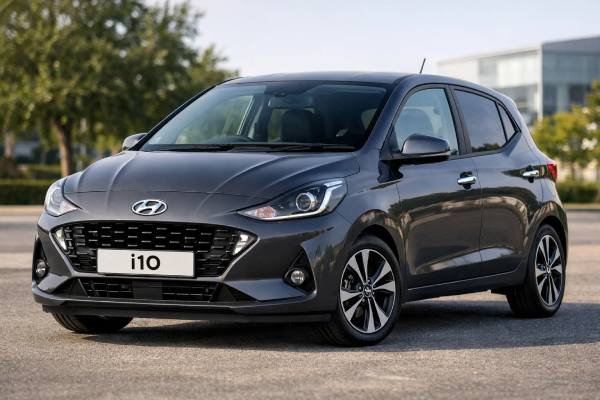
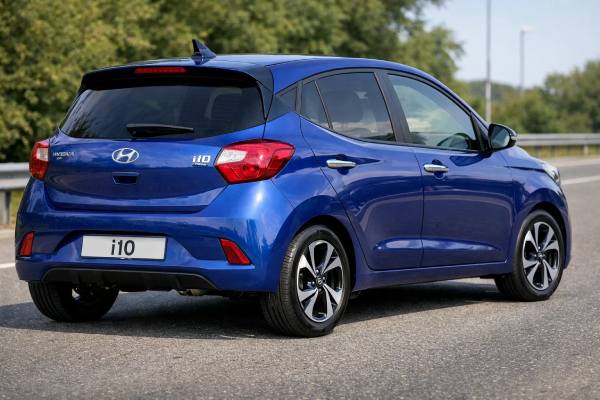
The facelifted Hyundai i10 (AC3) 1.0 MPi is a good example of how a modern city car can stay simple without feeling cheap. It remains compact outside, easy to park, and inexpensive to run, but it also feels more mature than many A-segment rivals thanks to its solid cabin layout, useful safety technology, and well-packaged interior. The 1.0-litre naturally aspirated three-cylinder engine is not quick, yet it suits the i10’s purpose: predictable urban performance, low fuel use, and less mechanical complexity than a small turbocharged alternative. The 2024 facelift sharpened the design, refreshed some cabin details, and kept a broad safety suite on the table. For owners, the key attraction is balance. You get a straightforward petrol engine, available manual or AMT transmission depending on market, a surprisingly roomy five-door body, and lower long-term risk than many trendier small cars. Market availability now varies by country, but the facelifted AC3 remains a very relevant used and nearly-new choice.
What to Know
- Compact size, light controls, and strong visibility make it excellent in city traffic.
- The 1.0 MPi engine is simple, chain-driven, and usually inexpensive to keep.
- Cabin space and the 252-litre boot are strong points for this class.
- Performance is modest, so motorway overtakes and heavy-load driving need planning.
- A sensible oil and filter interval is every 10,000–15,000 km or 12 months.
Explore the sections
- Hyundai i10 AC3 facelift essentials
- Hyundai i10 AC3 1.0 numbers
- Hyundai i10 AC3 cabin tech and protection
- Ownership risks and factory fixes
- Service routine and used-buy tips
- Daily driving and consumption
- Hyundai i10 facelift versus competitors
Hyundai i10 AC3 facelift essentials
The facelifted AC3 i10 keeps the same basic formula that made the pre-facelift car easy to recommend, but it presents it more cleanly. Hyundai sharpened the front-end treatment, revised the lighting graphics, updated wheel designs, and kept the upright, easy-to-use proportions that suit city driving so well. That matters because the i10’s appeal is not based on one headline feature. It is based on how coherently the whole package works. The car is short enough for tight streets, yet it still offers a useful rear seat, a genuinely practical boot for the segment, and a cabin that does not feel like an afterthought.
The 1.0 MPi version is the rational core of the range. It uses a naturally aspirated 998 cc three-cylinder petrol engine with multi-point injection, Idle Stop and Go, and a timing chain rather than a timing belt. In ownership terms, that is important. There is less complexity than in a small turbo engine, fewer expensive parts to age badly, and a more predictable service story over the long term. It is not a fast engine, and Hyundai does not pretend otherwise, but for urban and suburban use it makes sense. Throttle response is linear, cold-start behaviour is generally straightforward, and the engine matches the i10’s light weight well enough for daily tasks.
The facelift also keeps the AC3 car’s more modern safety and convenience profile. That is one of the reasons the i10 still stands out in a shrinking class. Even in non-premium trims, the car offers a safety package that many older city cars simply do not have. Lane support, forward collision assistance, driver-attention monitoring, speed-limit support, rear parking aids, eCall, and tyre-pressure monitoring make it feel like a newer design, not an old-budget leftover. In practical ownership, that is a bigger advantage than many buyers realise.
There are still clear boundaries. This is a city hatchback first. At higher motorway speeds, the short wheelbase, modest power, and light weight begin to define the experience. Noise rises, overtakes need planning, and full-load performance is limited. But that should not count against the car if it matches the job you need it to do. The i10 1.0 MPi works best for commuting, school runs, errands, short regional trips, and drivers who value simplicity and predictable costs more than speed. Seen through that lens, the facelifted AC3 is not just competitive. It is one of the more thoughtfully balanced small cars of its type.
Hyundai i10 AC3 1.0 numbers
The figures below describe the facelifted Hyundai i10 (AC3) 1.0 MPi in representative European and UK form. Public numbers vary slightly by market, trim, wheel size, emissions approval details, and whether the car uses the five-speed manual or five-speed automated manual transmission. Where official open sources disagree slightly, the differences are usually market-specific rather than mechanical.
| Item | Hyundai i10 (AC3 facelift) 1.0 MPi |
|---|---|
| Code | 1.0 MPi |
| Engine layout and cylinders | Inline-3, DOHC, 12-valve |
| Valves per cylinder | 4 |
| Displacement | 1.0 L (998 cc) |
| Bore × stroke | 71.0 × 84.0 mm (2.80 × 3.31 in) |
| Induction | Naturally aspirated |
| Fuel system | MPi |
| Compression ratio | 11.0:1 |
| Max power | 63 PS (46 kW, about 62 hp) @ 5,500 rpm |
| Max torque | 96 Nm (70.8 lb-ft) @ 3,750 rpm |
| Timing drive | Chain |
| Rated efficiency | roughly 5.0–5.4 L/100 km (47.0–43.6 mpg US / 56.5–52.3 mpg UK), depending on market, wheel size, and gearbox |
| Real-world highway @ 120 km/h | about 6.1–6.8 L/100 km in typical use |
| Transmission and driveline | Value |
|---|---|
| Transmission | 5-speed manual; 5-speed AMT in some markets |
| Drive type | FWD |
| Differential | Open |
| Chassis and dimensions | Value |
|---|---|
| Suspension, front / rear | MacPherson strut / coupled torsion beam axle |
| Steering | Motor-driven power steering |
| Steering ratio | Not consistently published in open official material |
| Lock-to-lock turns | 2.64 |
| Brakes | ABS with front ventilated discs and rear solid discs |
| Most popular tyre sizes | 185/55 R15 and 195/45 R16 |
| Length | 3,670 mm (144.5 in) |
| Width | 1,680 mm (66.1 in) |
| Height | 1,480 mm (58.3 in) |
| Wheelbase | 2,425 mm (95.5 in) |
| Turning circle | 9.72 m (31.9 ft) |
| Kerb weight | 921–993 kg (2,030–2,189 lb) manual; slightly higher for AMT |
| GVWR | 1,410 kg (3,109 lb) for common 1.0 versions |
| Fuel tank | 36 L (9.5 US gal / 7.9 UK gal) |
| Cargo volume | 252 L / 1,050 L (8.9 / 37.1 ft³), VDA |
| Performance and capability | Value |
|---|---|
| 0–100 km/h (0–62 mph) | about 15.6 s manual; slower with AMT |
| Top speed | about 143 km/h (89 mph) |
| Towing capacity | 300 kg (661 lb) braked / 300 kg (661 lb) unbraked in UK technical data |
| Payload | 417–489 kg (919–1,078 lb) |
| Fluids and service capacities | Value |
|---|---|
| Engine oil | SAE 5W-30 commonly specified in official Hyundai material; verify exact approval and fill quantity by VIN |
| Coolant | Hyundai long-life ethylene-glycol coolant; verify mix ratio and total capacity by VIN |
| Transmission / AMT fluid | Hyundai-specified transaxle fluid; exact spec and fill amount depend on gearbox version |
| Differential / transfer case | Not separate on this FWD transaxle layout |
| A/C refrigerant | Verify on under-bonnet label |
| A/C compressor oil | Verify on service label |
| Key torque spec | Wheel nuts typically 88–107 Nm (65–79 lb-ft) |
| Safety and driver assistance | Value |
|---|---|
| Euro NCAP | 3 stars under the 2020 protocol for the AC3 i10 line |
| Adult / child / vulnerable road users / safety assist | 69% / 75% / 52% / 59% |
| IIHS | Not applicable |
| ADAS suite | AEB, LKA, LFA, DAW, speed-limit support, HBA, LVA, eCall, ESC, TPMS; exact fit depends on market and trim |
The key takeaway is simple. The facelifted i10 1.0 MPi is not about one standout statistic. It is about low weight, sensible packaging, modest but usable performance, and a straightforward ownership profile that still feels modern enough to live with every day.
Hyundai i10 AC3 cabin tech and protection
For most buyers, trim level matters almost as much as the engine. In typical facelift-market structure, the 1.0 MPi sits in the practical core of the range rather than the sporty halo position. In UK-style line-ups, that usually means Advance and Premium rather than N Line. That distinction is useful. The 1.0 MPi is the sensible engine, and the trim choice determines whether the car feels basic, comfortably equipped, or almost surprisingly upscale for its size.
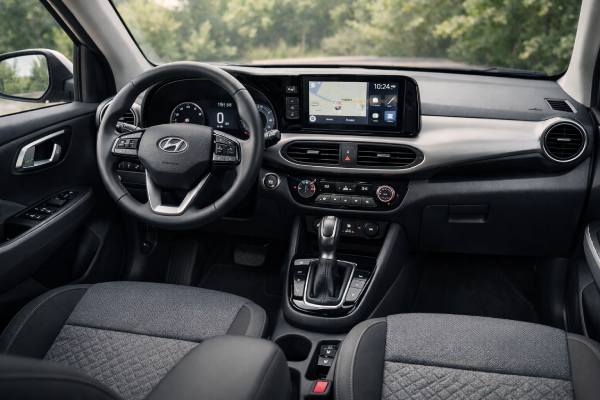
Advance-type versions usually cover the essentials well. Expect LED daytime running lights, a driver display, rear parking sensors, a rear-view camera, smartphone connectivity, cruise control, hill-start assist, air conditioning, split-folding rear seats, and the key safety systems. That makes even the cheaper versions feel complete rather than stripped down. Premium-type cars add the comfort features many private buyers actually notice every day: larger wheels, heated seats, heated steering wheel, upgraded lighting, folding mirrors, climate control, wireless charging, better infotainment, and sometimes navigation with connected services. If you want the best mix of long-term value and daily satisfaction, these better-equipped cars are often the sweet spot.
The cabin itself is one of the i10’s strongest assets. It feels intelligently packaged. Five doors are standard, five seats are standard in most markets, and the 252-litre boot is genuinely useful for a car this small. Fold the rear seats and you get 1,050 litres of load space, which is enough to make the car practical well beyond pure city errands. The dashboard layout is straightforward, the screen placement is sensible, and the storage areas are better than many rivals manage. That sounds like a small point, but owners notice it daily.
Safety equipment is where the facelifted i10 separates itself from older city cars. Hyundai Smart Sense gives the car a broader active-safety suite than many rivals of similar size. Depending on market and trim, this includes Forward Collision-Avoidance Assist with car, pedestrian, and cyclist recognition, Lane Keep Assist, Lane Following Assist, Driver Attention Warning, Intelligent Speed Limit Assist, High Beam Assist, Leading Vehicle Alert, ESC, TPMS, rear ISOFIX anchorages, and eCall. On some markets, this suite is standard or close to it. That is a serious advantage in a segment that once traded heavily on minimalism.
Euro NCAP’s public reference for the AC3 i10 remains the 2020 test. It produced a three-star result with 69% for adult occupant protection, 75% for child occupant protection, 52% for vulnerable road users, and 59% for safety assist. That is not class-leading by the standards of larger modern cars, but it is also not a sign that the i10 is unsafe by default. It is better read as a small car with decent modern assistance systems and some clear structural and protection limits under a demanding protocol. For used buyers, the practical lesson is simple: choose the right trim, verify every warning system works, and do not underestimate the importance of tyres and brakes on a light car with modest crash reserves.
Ownership risks and factory fixes
The facelifted i10 1.0 MPi is not a car with a dramatic fault profile, and that is one of its strongest selling points. The engine is naturally aspirated, chain-driven, and relatively low-stressed. There is no turbocharger, no direct injection, and no complex automatic gearbox in the conventional sense. Most issues that do appear are the sort of things owners can understand and budget for: wear, short-trip strain, battery weakness, and delayed servicing rather than exotic design failures.
The biggest long-term risk remains neglected oil service. Timing chains are durable when lubrication is clean and consistent, but they are not magic. Stretch, guide wear, or tensioner complaints usually start with poor maintenance rather than random bad luck. Symptoms are familiar: cold-start chain rattle, a rougher idle than normal, or timing-related fault codes on a neglected car. The likely cause is degraded oil or extended service intervals. The remedy is simple in theory and costly only if ignored: correct oil, on time, every time. A chain-driven petrol car can age beautifully, but only if the oil story stays clean.
Ignition and air-management faults are the next most likely trouble spots. Spark plugs, coils, and throttle-body deposits can cause uneven idle or a mild misfire. These are usually low- to medium-cost issues and do not point to a fundamentally weak engine. Short-trip city use also means 12 V batteries work hard. That matters on a car with stop-start, infotainment, parking cameras, and multiple driver-assistance functions. A weak battery can produce slow cranking, start-stop irregularities, warning lights, and occasional odd electronic behaviour that feels more serious than it is.
On the driveline side, the five-speed manual is usually the safer long-term bet. It is simple, familiar, and easy to judge on a test drive. Clutches wear in the normal way, especially in traffic-heavy urban use, but major trouble is uncommon if the car has not been abused. AMT versions deserve closer scrutiny. They are still far simpler than a torque-converter automatic or dual-clutch gearbox, but calibration feel, low-speed hesitation, and clutch-actuation wear can make a tired example less pleasant than a manual. Test-drive quality matters more than badge description here.
Chassis issues are generally minor. Potholes, kerb strikes, and larger wheel packages can bring on tyre damage, wheel imbalance, alignment drift, and front-end knocks. Bushes, drop links, and wheel bearings are all conventional wear points. Brakes are also worth watching because city driving is not always kind to discs, pads, and sliders. As for recalls and service actions, the right approach is always VIN-specific. Hyundai’s campaign tools and dealer records are the right places to verify completion. On a relatively recent i10, documented updates and clean service history still mean far more than hopeful seller claims.
Service routine and used-buy tips
The i10 1.0 MPi rewards routine maintenance more than clever maintenance. It is not an engine that needs exotic treatment. It just needs consistency. That is good news for owners, because it keeps running costs realistic. It also means a neglected car is easier to spot. When the basics are missing, the warning signs usually show up early in how the engine starts, how the transmission feels, and how the chassis behaves over poor roads.
A practical service plan looks like this:
| Service item | Practical interval |
|---|---|
| Engine oil and filter | Every 10,000–15,000 km or 12 months |
| Engine air filter | Inspect yearly; replace around 20,000–30,000 km |
| Cabin air filter | Every 12–24 months |
| Spark plugs | Around 45,000–60,000 km |
| Coolant | First major renewal around 5 years, then by official schedule |
| Brake fluid | Every 2 years |
| Manual transmission oil | Around 60,000–90,000 km for long-term smoothness |
| AMT checks | Follow Hyundai schedule and check calibration behaviour |
| Timing chain | Inspect for noise or timing faults; replace only if wear symptoms appear |
| Auxiliary belt and hoses | Inspect at every annual service |
| Brake pads, discs, and rear hardware | Inspect at every service |
| Tyre rotation and alignment | About every 10,000–15,000 km or when wear suggests it |
| 12 V battery test | Annually after year 3 |
Fluid and specification decisions should be made carefully. A common official oil grade is SAE 5W-30, but the exact approval and fill quantity should be checked against the VIN-specific manual or dealer data for the exact market and gearbox. Coolant, refrigerant, and compressor-oil quantities also vary enough by build and region that guessing is poor practice. Where owners get into trouble is assuming all small petrol i10s are identical. They are similar, but not identical enough to skip verification.
For used buyers, the inspection checklist is refreshingly direct:
- Start the car fully cold and listen for chain rattle, unstable idle, or warning lights.
- Check the service history for annual oil changes, plugs, and brake-fluid replacement.
- Inspect all tyres for age, matching brands, shoulder wear, and sidewall damage.
- Drive on rough roads to listen for suspension knock or wheel vibration.
- Test clutch take-up and warm-shift quality on manual cars.
- On AMT cars, check creep behaviour, hesitation, and low-speed smoothness.
- Verify the camera, sensors, infotainment, USB ports, and climate functions.
- Confirm every safety light behaves normally at start-up and goes out correctly.
- Look underneath for wheel damage, poor previous repairs, and early corrosion around seams.
The best buys are usually well-documented, privately owned cars with sensible tyres and no warning-light drama. The ones to avoid are often not catastrophically bad, just carelessly maintained: stretched oil intervals, mismatched tyres, weak batteries, missed brake-fluid changes, or AMT cars that feel jerky and tired. Long-term durability is good because the basic hardware is simple. That advantage only pays off if the owner respected the service schedule.
Daily driving and consumption
The facelifted i10 1.0 MPi feels exactly as a well-judged city hatchback should. It is easy to place, easy to park, and easy to drive smoothly. The light steering and upright seating position reduce stress in traffic, while the small body gives the driver confidence on narrow streets and in tight parking bays. This is where the i10 earns most of its praise. It is not exciting, but it is very user-friendly, and that often matters more over time.
The 1.0 MPi engine has a gentle, linear character. It does not have the mid-range shove of a turbocharged unit, and it needs revs more often than the 1.2 four-cylinder, but it responds predictably and rarely feels awkward at low speed. That suits city driving well. Pulling away from junctions, creeping through traffic, and threading through town all feel natural. The manual gearbox is usually the more satisfying partner because it lets the driver keep the little engine in its useful zone without the pause or hesitation that some AMT systems can show.
Ride quality is decent for the class. The i10 does not hide sharp bumps the way a bigger supermini can, but it avoids feeling crude if the suspension is healthy and the tyres are good. Smaller wheel packages generally help comfort. The larger 16-inch wheel setups on higher trims look better, and they sharpen the steering response slightly, but they also make potholes and sharp ridges more noticeable. The chassis is stable rather than playful. Grip is adequate, body control is tidy enough, and the car feels secure at normal speeds, but its focus is confidence and predictability, not entertainment.
At motorway pace, the segment limits become clear. A manual 1.0 MPi takes about 15.6 seconds to reach 100 km/h, and top speed is roughly 143 km/h. That means it can handle occasional longer trips, but fast overtakes, steep inclines, and heavy passenger loads demand patience. At 120 km/h, wind noise and engine effort are much more obvious than they would be in a larger car. Still, straight-line stability is respectable for a light hatchback, and the car does not feel nervous if the tyres and alignment are right.
Fuel use is one of the model’s strongest everyday strengths. Official combined figures generally sit in the low-5 L/100 km range, while real mixed driving often lands around 5.3–6.0 L/100 km. Gentle extra-urban use can dip closer to the official numbers, while winter commuting, short trips, and sustained faster motorway work will push it upward. Around 120 km/h, a realistic figure is about 6.1–6.8 L/100 km. That is not miraculous, but it is honest and easy to live with. For many owners, that honesty is exactly the point.
Hyundai i10 facelift versus competitors
The facelifted i10 1.0 MPi sits in a class where the right choice depends heavily on what you value most. Against the Kia Picanto 1.0, it faces a very close relative in concept: small, practical, well equipped, and easy to own. The Hyundai usually makes its case with slightly more mature packaging and a cabin that feels a touch more grown up, while the Kia often wins buyers on styling or value depending on trim. In real life, service history and equipment often matter more than the badge.
Against the Toyota Aygo X, the Hyundai feels more like a conventional hatchback and less like a style-led city crossover. The Toyota has a distinctive look and a cheerful urban personality, but the i10 generally offers better rear-seat usability, a more practical boot arrangement, and a stronger sense of everyday completeness. If you want something that feels like a small grown-up car rather than a fashionable city accessory, the Hyundai usually has the advantage.
The Volkswagen up!, Skoda Citigo, and SEAT Mii still matter as benchmarks, even though they are older designs now. Those cars often feel slightly cleaner in steering and body control, and some drivers still prefer their road manners. The Hyundai counters with fresher safety technology, more modern infotainment, and a better blend of current-day equipment. As an ownership proposition, the facelifted i10 is easier to recommend if you want a newer-feeling car with broader assistance features and a less dated interior.
The bigger question is whether the 1.0 MPi is the right i10. For many buyers, yes. It is not the quickest engine in the range, and it is not the most relaxed at higher speed, but it is the simplest. That simplicity matters on the used market. Compared with the turbocharged option, the 1.0 MPi trades pace for lower mechanical stress and potentially lower long-term risk. For drivers whose lives revolve around cities, suburbs, school runs, and short regional journeys, that is often the better trade.
So the facelifted i10 1.0 MPi is best seen as the thoughtful choice in a shrinking class. It is not the fastest, the quietest, or the most glamorous small car. It is one of the most balanced. It offers strong packaging, modern safety features, predictable running costs, and straightforward petrol engineering. For buyers who want a compact hatchback that still behaves like a proper everyday car, it remains one of the smartest options available from this era.
References
- Hyundai i10 | Technical, Specifications and Pricing | Model year 2025 | April 2024 2024 (Technical Specifications)
- Hyundai Motor UK announces new i10 pricing and specification 2023 (Press Release)
- Hyundai i10 | Features | Hyundai Motor UK 2026 (Model Features)
- Official Hyundai i10 2020 safety rating 2020 (Safety Rating)
- Home | Hyundai Recalls & Service Campaigns 2026 (Recall Database)
Disclaimer
This article is for informational purposes only and is not a substitute for professional diagnosis or repair. Specifications, torque values, service intervals, procedures, and equipment can vary by VIN, market, model year, and trim, so always verify critical details against official service documentation for the exact vehicle.
If this guide helped you, please consider sharing it on Facebook, X, or another platform to support our work.