
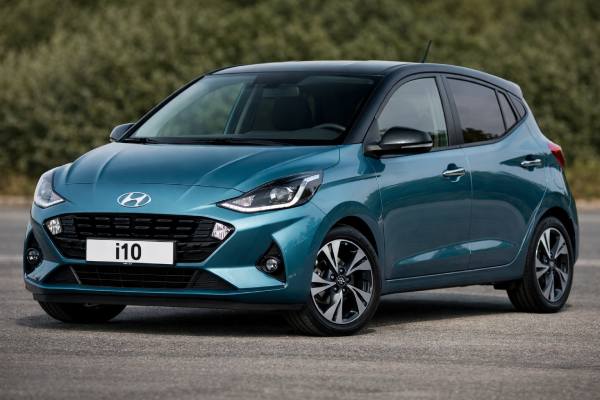
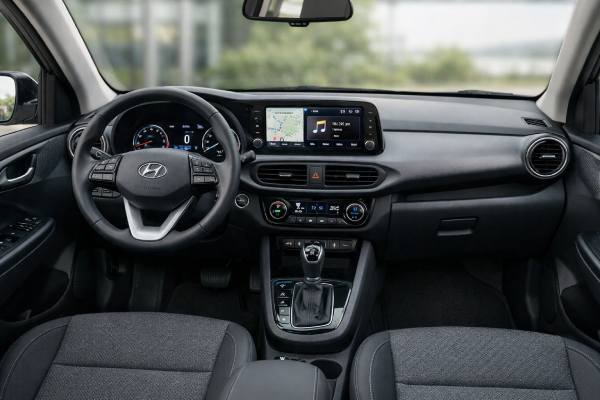
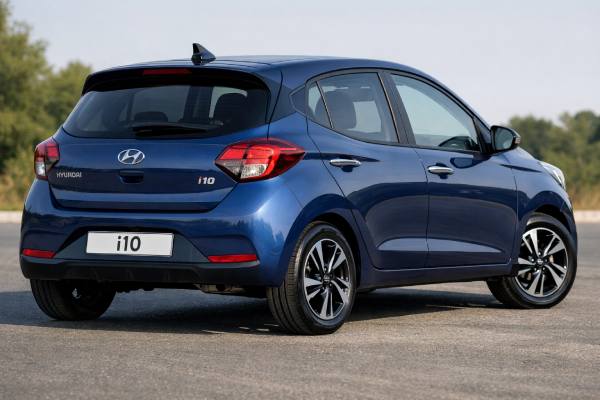
The facelifted 2023–2024 Hyundai i10 (AC3) 1.2 MPi is the version of Hyundai’s city car that makes the most sense for buyers who want a small footprint without accepting the weakest engine in the range. It keeps the AC3 i10’s sharp packaging, easy parking manners, and updated safety technology, but adds a smoother four-cylinder petrol engine that feels more relaxed than the 1.0 MPi in everyday use. That matters in real ownership. The 1.2 MPi does not turn the i10 into a fast hatchback, yet it is more comfortable with passengers, gradients, and faster roads. The facelift also brought design updates, improved lighting signatures, and a more polished cabin feel. For most buyers, the appeal is straightforward: a simple naturally aspirated petrol engine, compact dimensions, low running costs, and fewer long-term worries than many downsized turbo rivals. It is a practical, modern city car with honest strengths and clear limits.
What to Know
- The 1.2 MPi is smoother and more flexible than the 1.0 MPi, especially with passengers aboard.
- Facelift AC3 models keep a useful 252-litre boot and compact city-friendly dimensions.
- Hyundai Smart Sense equipment is stronger than many older A-segment rivals.
- Power and torque figures vary slightly by market literature, so verify the VIN-specific spec sheet before ordering parts.
- Plan on an engine-oil and filter change every 15,000 km or 12 months.
Start here
- Hyundai i10 AC3 Facelift Explained
- Hyundai i10 AC3 1.2 Numbers
- Hyundai i10 AC3 Trims and Protection
- Reliability Faults and Campaigns
- Service Plan and Buying Checks
- Road Feel and Fuel Use
- Rivals and Real Alternatives
Hyundai i10 AC3 Facelift Explained
The 2023 facelift did not change the basic mission of the Hyundai i10. It remained a compact five-door city hatchback designed for narrow streets, easy parking, and low operating costs. What the facelift did was sharpen the presentation and make the car feel more current. The front and rear styling were revised, the lighting signature became more distinctive, and the interior presentation stayed neat and functional instead of trying too hard to look premium. That approach suits the i10 well. Buyers in this class usually care most about visibility, door openings, seat comfort, storage, and whether the car feels easy to live with every single day.
The 1.2 MPi version is the smart middle ground in the range. It uses a naturally aspirated four-cylinder petrol engine rather than the entry-level three-cylinder or the more complex turbocharged option. In practice, that means better smoothness, a more natural throttle response, and slightly less effort when merging, climbing hills, or carrying extra weight. It still does not deliver hot-hatch pace, but it is a better all-round match for the AC3 body than the smaller 1.0 if your driving extends beyond dense urban traffic.
This is also one of the i10’s most important ownership advantages. The 1.2 MPi is simple. It uses multi-point fuel injection, avoids the thermal load of a turbocharger, and stays mechanically easy to understand. Buyers who intend to keep a car beyond warranty often prefer that kind of engine because it tends to age more predictably. You still need to service it properly, but the long-term risk profile is usually friendlier than with more highly stressed small engines.
Packaging remains a core strength. At about 3.67 metres long, the i10 is genuinely easy to thread through old streets and tight car parks. Yet it does not feel cramped in the way some older A-segment cars did. The wheelbase and cabin layout help, and the 252-litre boot is useful enough for groceries, airport bags, or weekly family duties. That matters more than styling flourishes, because the reason many people buy a car like this is simple practicality.
The limits are easy to understand too. The facelift i10 is more mature than an older city car, but it is still a light hatchback with modest power. Long motorway stretches, strong crosswinds, and four-adult loads will remind you what class of car this is. If most of your driving happens in town or on mixed secondary roads, the 1.2 MPi feels well judged. If you spend your life on fast dual carriageways, you may want a bigger class of car. For the intended job, though, the facelift AC3 1.2 MPi is one of the cleaner, more rational small-car packages of its period.
Hyundai i10 AC3 1.2 Numbers
One detail needs to be stated clearly before the table. Hyundai’s open regional material does not present this facelift 1.2 MPi in exactly the same way everywhere. Some Hyundai sources group the i10 1.2 MPi at 84 PS and 117.6 Nm, while some country-specific facelift brochures list 58 kW and 113 Nm. That is why market-specific validation matters when ordering parts or comparing listings. This guide follows the 84 hp-style naming used in the title, while marking market-sensitive figures where relevant.
| Powertrain and efficiency | Specification |
|---|---|
| Code | Kappa / Smartstream G1.2 |
| Engine layout and cylinders | Inline-4, 4 cylinders, DOHC, 4 valves per cylinder |
| Bore × stroke | 71 × 76 mm (2.80 × 2.99 in) |
| Displacement | 1.2 L (1,197 cc) |
| Induction | Naturally aspirated |
| Fuel system | Multi-point injection |
| Compression ratio | Market-dependent in open sources; verify by VIN-specific data |
| Max power | Market-dependent: Hyundai Europe powertrain page groups 1.2 MPi at 84 PS, while some facelift brochures list 58 kW (79 PS) @ 6,000 rpm |
| Max torque | Market-dependent: commonly published as 113 Nm (83 lb-ft) @ 4,200 rpm, while broader Hyundai material groups the engine at 117.6 Nm |
| Timing drive | Chain |
| Rated efficiency | WLTP combined about 5.3–5.7 L/100 km (44.4–41.3 mpg US / 53.3–49.6 mpg UK), depending on wheel size and transmission |
| Real-world highway @ 120 km/h (75 mph) | Usually about 5.8–6.6 L/100 km in healthy condition |
| Transmission and driveline | Specification |
|---|---|
| Transmission | 5-speed manual or 5-speed automated manual, market and trim dependent |
| Drive type | FWD |
| Differential | Open |
| Chassis and dimensions | Specification |
|---|---|
| Suspension, front / rear | MacPherson strut / torsion-beam rear axle |
| Steering | Motor-assisted rack-and-pinion; exact ratio not usually published in open facelift brochures |
| Brakes | Front disc / rear drum on many trims; some market sheets vary by version |
| Wheels and tyres | 175/65 R14, 185/55 R15, and 195/45 R16 depending on trim |
| Ground clearance | About 149 mm (5.9 in) |
| Length / width / height | 3,670 / 1,680 / 1,480 mm (144.5 / 66.1 / 58.3 in) |
| Wheelbase | 2,425 mm (95.5 in) |
| Turning circle (kerb-to-kerb) | About 9.8 m (32.2 ft) |
| Kerb weight | About 1,007–1,082 kg (2,220–2,385 lb) for 1.2 MT in open facelift brochure data |
| GVWR | About 1,430 kg (3,153 lb) |
| Fuel tank | 36 L (9.5 US gal / 7.9 UK gal) |
| Cargo volume | 252 L / 1,050 L (8.9 / 37.1 ft³), VDA |
| Performance and capability | Specification |
|---|---|
| 0–100 km/h (0–62 mph) | About 13.2 s for 1.2 MT in open facelift brochure data |
| Top speed | About 158 km/h (98 mph) for 1.2 MT in open facelift brochure data |
| Braking distance | Not consistently published in open official facelift material |
| Towing capacity | About 310 kg (684 lb) braked / 310 kg (684 lb) unbraked in open brochure data; verify by VIN and registration market |
| Payload | Roughly 348–423 kg depending on trim and kerb weight |
| Fluids and service capacities | Specification |
|---|---|
| Engine oil | SAE 0W-20, API SN Plus or SP or ILSAC GF-6; 3.4 L (3.6 US qt) for 1.2 MPi drain and refill |
| Coolant | Ethylene-glycol aluminium-radiator coolant; about 4.77 L (5.04 US qt) for 1.2 MPi |
| Transmission / manual gear oil | API GL-4, SAE 70W, Hyundai original spec; about 1.3–1.4 L (1.4–1.5 US qt) |
| Differential / transfer case | Not applicable |
| Brake / clutch fluid | DOT 4; about 0.7–0.8 L (0.74–0.85 US qt) |
| A/C refrigerant | Market-dependent; verify by under-bonnet label and VIN-specific service data |
| Key torque specs | Wheel nuts commonly 11–13 kgf·m, about 108–127 Nm (80–94 lb-ft); verify critical fasteners by official workshop data |
| Safety and driver assistance | Specification |
|---|---|
| Crash ratings | Euro NCAP 2020 AC3 baseline: 3 stars, Adult 69%, Child 75%, Vulnerable Road Users 52%, Safety Assist 59% |
| IIHS | Not applicable |
| Headlight rating | Not applicable |
| ADAS suite | Depending on market and trim: FCA, LKA, LFA, DAW, ISLW, HBA, rear camera, parking aids, and eCall |
These numbers explain why the 1.2 is the more rounded i10 for many buyers. It is still light and compact, but it is not working as hard as the smaller 1.0. The main caution is not the engine itself. It is the regional variation in published output and trim detail. Buyers should always decode the VIN and inspect the actual car instead of trusting a listing headline.
Hyundai i10 AC3 Trims and Protection
The facelift i10 was sold in different trim structures depending on country, so it is better to think in terms of equipment groups than one universal global ladder. In broad terms, lower trims focused on price and practicality with smaller wheels, simpler upholstery, standard air conditioning, basic infotainment, and the core safety systems. Mid-spec cars added the features most owners actually notice every day, such as better screens, a reversing camera, nicer cabin trim, more convenience storage, and extra driver-assistance support. Upper trims added alloy wheels, upgraded lights, more polished interior details, and stronger connectivity.
Mechanically, the 1.2 MPi trim walk was not dramatic. You were not usually choosing between radically different suspension hardware or special differentials. The real differences came from wheel and tyre package, transmission choice, trim weight, and the presence or absence of convenience and safety features. That is important because some used-car ads make one trim sound mechanically superior when it is really just better equipped.
Quick identifiers help. Entry cars usually wear smaller wheels and plainer lighting. Better-equipped versions often have more pronounced exterior details, richer seat fabrics, bigger multimedia screens, and more visible assistance hardware such as a camera or additional parking aids. The facelift also brought a more distinctive front light signature, which makes 2023–2024 cars easier to spot against pre-facelift AC3 cars.
Safety is one of the strongest reasons to choose a recent i10 over many cheaper older city cars. Euro NCAP’s public result for the AC3 generation remains the key open reference point because there is no separate public facelift retest widely published in the same way. The 2020 i10 scored 69 percent for adult occupant protection, 75 percent for child occupant protection, 52 percent for vulnerable road users, and 59 percent for safety assist. Those percentages came under a much harder test protocol than the one used on older city cars that sometimes wore better-looking star counts.
The facelift also benefits from Hyundai Smart Sense content that would once have been unusual in this size class. Depending on market and trim, the i10 can include Forward Collision-Avoidance Assist, High Beam Assist, Lane Keep Assist, Driver Attention Warning, Intelligent Speed Limit Warning, and Lane Following Assist. Rear camera support, parking assistance, eCall, and improved infotainment integration also help the i10 feel like a smaller version of a regular modern hatchback rather than a stripped-down budget special.
Used buyers should still verify the actual equipment. A seller may say the car has emergency braking or lane-centering, but equipment can differ sharply by country and registration year. That matters after repairs too. Camera-based safety systems are not especially fragile, but windscreen replacement, front-end repairs, or sensor faults can affect function and may need calibration. The safest assumption is that every used i10 should be checked by VIN and then confirmed physically. In this class, the facelift i10 stands out not because it is luxurious, but because it brings a more complete safety and usability package than many older alternatives.
Reliability Faults and Campaigns
The facelift AC3 i10 1.2 MPi is generally a low-drama car, and that is the strongest compliment many owners could give it. The naturally aspirated multi-point injected engine is simpler than a small turbo or direct-injection unit, and there is no broad pattern in the open sources I checked suggesting a major engine-design flaw specific to the 2023–2024 facelift 1.2. Most ownership problems are the ordinary kinds of small-car issues that appear when maintenance slips, city use is heavy, or a car has had low-budget repairs.
Common and usually low-cost trouble spots include:
- Weak 12 V batteries on cars that spend most of their lives on short trips.
- Uneven tyre wear or steering pull caused by pothole strikes, kerb damage, or neglected alignment.
- Brake corrosion and rear-brake drag on lightly used urban cars.
- Interior rattles, infotainment glitches, or reversing-camera issues rather than major mechanical failure.
- Clutch wear on hard-used manual cars, especially if they have seen learner use, courier work, or dense city traffic.
Occasional medium-cost problems can include:
- Ignition-related rough running from overdue plugs or a weak coil pack.
- Suspension wear at drop links, top mounts, or bushes on rough roads.
- Air-conditioning performance loss from stone-damaged condensers, slow leaks, or long periods of underuse.
- AMT complaints on automated-manual cars, often related to shift logic, actuator behaviour, or calibration rather than catastrophic gearbox damage.
Rare but more serious issues are usually connected to neglect rather than to the core design. A timing chain can become noisy if oil changes have been stretched or the engine has run low on oil. Cooling-system leaks can become expensive if ignored until overheating happens. Accident-damaged cars can also create long-term frustration because misaligned camera systems, poor panel fit, or cheap suspension repairs show up slowly rather than all at once.
Software and calibrations do matter on a modern city car. The facelift i10 is still simple compared with a larger connected model, but infotainment updates, camera functionality, driver-assistance warnings, and AMT behaviour on equipped cars can all benefit from dealer attention. A full Hyundai history is therefore worth more than a pile of generic invoices with little detail.
On recalls and campaigns, the practical advice is straightforward. Hyundai’s official recall systems are VIN-based, and public campaign visibility varies by country. That means buyers should not assume that “no warnings on the dashboard” equals “no campaigns outstanding.” Always run the VIN through Hyundai’s official recall portal for the relevant market and ask a dealer to confirm campaign completion. For a 2023–2024 car, that step is quick and worth doing.
Before purchase, request:
- Full service history
- VIN recall and campaign confirmation
- Evidence of correct annual servicing
- A tyre and brake inspection
- A cold start and road test
- A scan for stored faults, especially if ADAS features are fitted
A good facelift i10 usually feels honest from the first drive. It should start cleanly, idle smoothly, track straight, brake evenly, and show no clutch slip or gearbox drama. That is why the 1.2 MPi makes sense as a long-term used buy: its biggest risks are usually neglect and hard use, not a flawed basic design.
Service Plan and Buying Checks
The i10 1.2 MPi is easy to maintain well, which is one reason it is attractive in the used market. Hyundai’s open brochure data shows a clear baseline: engine-oil changes every 15,000 km or one year, and general maintenance every 30,000 km or two years, whichever comes first. For a city car that often sees cold starts and short trips, that annual oil interval is sensible rather than generous.
A practical maintenance plan looks like this:
- Every 15,000 km or 12 months
Change engine oil and filter. Inspect coolant level, tyre condition, brake wear, battery health, and any seepage around the engine or gearbox. - Every 30,000 km or 24 months
Carry out the broader scheduled service. Replace the cabin filter if airflow has dropped, inspect the engine air filter closely, refresh brake fluid if due, and inspect the underbody for impact or corrosion damage. - Every 45,000 to 60,000 km in real-world city use
Inspect spark plugs and ignition performance closely. Even if a market schedule allows a longer plug life, earlier replacement is cheap insurance on a car used mainly in stop-start traffic. - Every 60,000 to 90,000 km
Consider refreshing manual-transmission oil. Hyundai’s official language is often lighter on fixed replacement than enthusiastic owners prefer, but a fresh fill is low-cost protection if you intend to keep the car. - Ongoing by condition, not a fixed belt interval
The 1.2 MPi uses a timing chain. That removes the normal timing-belt replacement job, but it does not remove the need to listen for start-up rattle, monitor oil quality, and act quickly on timing-related faults. - Coolant, belts, hoses, and 12 V battery
Inspect these every year. A small car can become unreliable very quickly if owners treat hoses, batteries, or accessory belts as invisible until failure.
Key decision-making fluid figures are simple. Engine oil is 3.4 L of 0W-20 meeting Hyundai’s stated quality standard. Manual-transmission fluid is about 1.3 to 1.4 L of GL-4 SAE 70W Hyundai-specified oil. Coolant capacity is about 4.77 L. Brake and clutch fluid is DOT 4, about 0.7 to 0.8 L. Wheel-nut torque is about 108–127 Nm. Always verify any critical fastener or fluid against VIN-specific service information before major work.
As a used purchase, the best facelift 1.2 MPi cars are usually manual cars with clean annual servicing, matching tyres, and no evidence of low-budget body repair. Look for:
- Smooth cold start and steady idle
- Clean clutch take-up with no slip or shudder
- Straight tracking and even steering weight
- Fully working screen, camera, parking aids, and warning lights
- Matching, quality tyres in the correct size
- Undamaged underbody and sills
- Proof that recalls and service campaigns were checked
Be more cautious with ex-delivery cars, rental-type use, badly kerbed wheels, or sellers who cannot explain the service record. The long-term outlook is good when the car is serviced annually and driven with basic mechanical sympathy. That is the real advantage of this powertrain. It does not ask for anything exotic, only consistency.
Road Feel and Fuel Use
The facelift i10 1.2 MPi feels exactly like a good city car should: light, tidy, and easy to drive without feeling flimsy. Around town, the four-cylinder engine is the main reason to choose this version. It is smoother at idle than the 1.0, it sounds less strained when you ask for more throttle, and it makes the car feel less busy with passengers aboard. The difference is not dramatic in headline numbers, but it is easy to notice in real driving.
Ride quality is sensible for the class. The AC3 chassis has enough maturity that the i10 no longer feels like an old-school microcar. It stays composed on ordinary urban roads, feels easy to place through tight gaps, and does not pitch around excessively at low speeds. Sharp potholes and broken surfaces still remind you that this is a short-wheelbase hatchback with relatively small tyres, but the overall impression is more grown-up than many cheap city cars from a generation ago.
The steering is light and direct enough for parking and tight manoeuvres, though nobody should expect genuine feedback. That is fine. The i10 is designed to reduce effort, not to entertain. What matters more is that it tracks cleanly, turns in predictably, and does not feel nervous in normal mixed driving. On a good set of tyres, braking feel is also reassuring. On poor tyres, the car’s lightness makes itself felt quickly, so tyre choice matters more than many owners think.
Powertrain character is honest. The 1.2 MPi does not produce a turbo shove, but it responds naturally and does not need to be worked as hard as the 1.0. In traffic and on rolling secondary roads, that gives the car a calmer feel. On faster dual carriageways or motorways, it is still only moderately powerful. Overtakes need planning, and steep gradients with passengers will require downshifts. That is not a flaw so much as a reminder of the class and mission.
Real-world economy is one of the 1.2’s stronger points, even if it is not quite as frugal as the smaller 1.0. Most healthy manual cars will usually sit in ranges like these:
- City: about 6.0–7.2 L/100 km
- Mixed: about 5.4–6.2 L/100 km
- Highway at 100–120 km/h: about 5.8–6.6 L/100 km
Cold weather, short trips, heavy air-conditioning use, poor alignment, cheap tyres, or a weak battery can all push those figures upward. Open official facelift brochure data for the 1.2 MT places WLTP combined consumption around 5.3–5.4 L/100 km, which lines up reasonably well with careful mixed driving in real life.
Performance is adequate rather than quick. Open official facelift data for the 1.2 manual gives about 13.2 seconds for 0–100 km/h and about 158 km/h for top speed. That tells the story. The 1.2 makes the i10 more versatile, not fast. For city commuting and regional driving, that is enough. For regular long-distance fast-road use, you may want more power or a larger class of car.
Rivals and Real Alternatives
The facelift Hyundai i10 1.2 MPi sits in a small but important part of the market: compact petrol hatchbacks that still prioritize simplicity, visibility, and low running cost over fashion or exaggerated complexity. Its closest direct rival is the Kia Picanto 1.2, and that comparison is usually the most logical one. The Kia feels similarly sized, similarly rational, and similarly easy to own. In used form, the better buy is usually the one with the clearer history and better tyres, not the one with the flashier trim badge.
Against the Toyota Aygo X, the Hyundai takes a different approach. The Toyota offers a more crossover-like image and a slightly more playful feel, but the Hyundai often wins on straightforward packaging, conventional hatchback practicality, and powertrain choice if you specifically want the smoother 1.2. The Aygo X is a charming urban tool; the i10 1.2 is usually the calmer all-rounder.
The Fiat Panda remains a useful comparison because it still embodies the basic, upright city-car idea better than most modern small cars. It can feel roomier in shape and easier to see out of in some situations, but the Hyundai usually feels more modern in infotainment, cabin finish, and driver-assistance availability. Buyers who want charm and upright practicality may still like the Fiat. Buyers who want a cleaner modern ownership experience often lean Hyundai.
Used Volkswagen up!, Skoda Citigo, and SEAT Mii models also deserve mention, even though they sit slightly outside the same new-car timeline. Those cars are famously sensible, feel solid, and are often excellent in the city. The Hyundai answers with fresher safety tech, newer styling, and a more recent used-car age profile. Depending on market prices, that can make it the easier recommendation.
Where the i10 1.2 MPi really scores is balance. It is not the most exciting rival, and it does not try to be. It gives you useful interior space, easy controls, decent comfort, modern safety features, and a petrol engine that does not ask you to live with the downsides of a highly stressed turbo. That makes it especially appealing for buyers who plan to keep a small car for years rather than just lease one through warranty.
So the verdict is simple. Choose the facelift i10 1.2 MPi if you want a city hatchback that feels modern, honest, and easy to justify on ownership costs. Choose a rival instead only if you care more about image, a slightly more distinctive driving feel, or a different packaging style. As a sensible used small car, the Hyundai is hard to argue against.
References
- Hyundai i10 | Features | Hyundai Motor UK 2026 (Official Features Page)
- Hyundai i10 2026 (Technical Brochure)
- i10 AC3 PE Kullanım Kılavuzu 2024 (Owner’s Manual)
- Official Hyundai i10 2020 safety rating 2020 (Safety Rating)
- Home | Hyundai Recalls & Service Campaigns 2026 (Recall Database)
Disclaimer
This article is for informational purposes only and is not a substitute for professional diagnosis or repair. Specifications, torque values, intervals, procedures, and equipment can vary by VIN, market, trim, production date, and homologation standard, so always verify critical details against the official service documentation for the exact vehicle.
If this guide was useful, please consider sharing it on Facebook, X, or another social platform to support our work.