

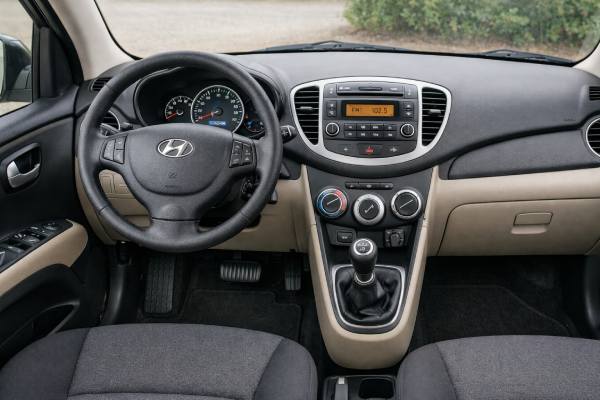

The facelifted Hyundai i10 PA with the 1.1 CRDi diesel is one of those small cars that makes more sense the more you look past the badge and the size. It is compact, light, and easy to park, but the diesel version adds a layer of long-range thrift and low-speed pulling power that the petrol models cannot match. That matters if the car is used for commuting, mixed rural driving, or regular dual-carriageway work rather than only short urban hops. The key strengths are simple packaging, strong fuel economy, decent cabin room for the class, and straightforward mechanical layout. The main caution is equally clear: this engine is happiest when it gets warm and runs properly, so neglected short-trip cars can be more troublesome than their petrol siblings. Another important detail is market variation. During the facelift years, the 75 hp diesel remained available in several export markets, but trim names, emissions hardware, and exact standard equipment can differ by country and VIN.
At a Glance
- Strong low-speed torque makes it easier to drive than the smaller petrol engines.
- Real-world fuel use can stay comfortably below 5.5 L/100 km with sensible mixed driving.
- Compact size, light controls, and a tight turning circle suit daily town use.
- Repeated short trips can accelerate EGR, intake, and DPF-related trouble on some late cars.
- Engine oil and filter should be changed every 15,000 km or 12 months at most.
What’s inside
- Hyundai i10 PA diesel profile
- Hyundai i10 PA CRDi figures
- Hyundai i10 PA grades and safety
- Fault trends and service actions
- Service needs and buyer tips
- Road feel and diesel economy
- Rival view for this i10
Hyundai i10 PA diesel profile
The facelifted i10 PA diesel is a niche version of an already practical city car. In most markets, buyers knew the first-generation i10 as a roomy but simple hatchback with low running costs and honest ergonomics. The 1.1 CRDi changes the character more than the brochure numbers suggest. Instead of needing revs like the 1.0 petrol, the diesel feels more relaxed at lower engine speeds and easier to keep moving in real traffic. For drivers who spend time on B-roads, ring roads, or hilly routes, that alone can make it the more satisfying version.
This is still a small hatchback, so expectations need to stay realistic. The i10 diesel is not quick in the modern sense and it is not especially refined by later supermini standards. But for its size, it offers useful mid-range pull, a longer effective cruising stride than the entry petrols, and very good fuel economy. That blend is why it still attracts budget-conscious buyers who want a cheap second car that can also handle longer trips without feeling strained all the time.
The facelift brought the familiar Hyundai “fluidic” front-end update, a tidier cabin presentation, and in many markets a cleaner emissions setup than the earliest diesel cars. Dimensions stayed compact enough for urban life, yet the body shape still gave the i10 one of the better cabin and luggage packages in the class. That is a big part of its appeal today. Many city cars from this era feel cramped in the rear or have awkward entry. The i10 does not feel generous, but it feels useful.
Ownership fit matters more than raw specification. This diesel makes the most sense for people who cover enough distance for the engine to warm fully and stay warm. A buyer who only makes five-minute urban trips will usually be better off in the 1.0 or 1.2 petrol. A buyer who commutes, does regular mixed driving, or wants a small car that can stretch a tank of fuel impressively far can see the point of the CRDi very quickly. In that role, its core advantages are clear: torque, thrift, and simple packaging. Its main drawbacks are also clear: more diesel-system complexity than the petrols, more noise, and greater sensitivity to neglected maintenance.
Hyundai i10 PA CRDi figures
Below is a practical technical summary for the facelift-era Hyundai i10 PA 1.1 CRDi 75 hp. Because this version varied by market, some equipment, emissions hardware, and weight figures can differ slightly by country and registration year.
| Powertrain and efficiency | Data |
|---|---|
| Code | D3FA 1.1 CRDi |
| Engine layout and cylinders | Inline-3, DOHC, 12-valve, 4 valves per cylinder |
| Bore × stroke | 75.0 × 84.5 mm (2.95 × 3.33 in) |
| Displacement | 1.1 L (1,120 cc) |
| Induction | Turbocharged |
| Fuel system | Common rail direct injection |
| Compression ratio | 17.8:1 on the earlier 75 hp calibration; verify by VIN on later market versions |
| Max power | 75 hp (55 kW) @ 4,000 rpm |
| Max torque | 153 Nm (113 lb-ft) @ about 1,900–2,750 rpm |
| Timing drive | Chain |
| Rated efficiency | Typically 4.0–4.3 L/100 km (58.8–54.7 mpg US / 70.6–65.7 mpg UK) combined, market-dependent |
| Real-world highway @ 120 km/h | Usually about 5.0–5.7 L/100 km (47.0–41.3 mpg US / 56.5–49.6 mpg UK) |
| Transmission and driveline | Data |
|---|---|
| Transmission | 5-speed manual |
| Drive type | Front-wheel drive |
| Differential | Open differential |
| Chassis and dimensions | Data |
|---|---|
| Suspension front / rear | MacPherson strut / coupled torsion beam axle |
| Steering | Rack-and-pinion with electric assist; about 2.99 turns lock-to-lock |
| Brakes | Front ventilated discs / rear drums; rear discs on some ESP-equipped variants |
| Wheels and tyres | Common sizes include 155/70 R13 and 165/60 R14, depending on trim |
| Length / width / height | About 3,585 / 1,595 / 1,540 mm (141.1 / 62.8 / 60.6 in) |
| Wheelbase | 2,380 mm (93.7 in) |
| Turning circle | 4.8 m (15.7 ft) |
| Kerb weight | Usually around 1,110–1,115 kg (2,447–2,458 lb) |
| Fuel tank | 35 L (9.25 US gal / 7.70 UK gal) |
| Cargo volume | 225 L / about 910 L (7.9 / 32.1 ft³), market method varies |
| Performance and capability | Data |
|---|---|
| 0–100 km/h | About 15.8 s |
| Top speed | About 163 km/h (101 mph) |
| Towing capacity | Usually around 700 kg braked / 400 kg unbraked, but confirm by registration data |
| Payload | Typically around 400–425 kg, trim-dependent |
| Fluids and service capacities | Data |
|---|---|
| Engine oil | 5W-30 typically suits this engine; service fill about 5.3 L (5.6 US qt), verify spec by VIN and emissions version |
| Coolant | Premixed ethylene-glycol type; system capacity about 5.3 L (5.6 US qt) |
| Manual transmission fluid | API GL-4 manual transmission oil, usually around 1.9–2.0 L (2.0–2.1 US qt) |
| A/C refrigerant | R134a |
| A/C compressor oil | PAG 46; charge amount depends on component replacement |
| Key torque specs | Always confirm from VIN-specific service data before final tightening |
| Safety and assistance | Data |
|---|---|
| Crash ratings | Euro NCAP older protocol: 4-star adult, 4-star child, 3-star pedestrian |
| Headlight rating | IIHS not applicable |
| ADAS suite | No modern ADAS; no AEB, ACC, lane assist, or blind-spot monitoring |
| Core safety kit | ABS, EBD, front airbags, front side airbags, ISOFIX outer rear seats; ESP optional in some markets |
The headline numbers tell the main story. The diesel is not dramatically faster than the small petrol cars, but it is notably more flexible and usually much more economical on longer runs.
Hyundai i10 PA grades and safety
One of the harder parts of buying a facelifted i10 diesel today is that trim naming was not fully consistent across markets. Some cars are listed as Classic, Comfort, Active, Style, Lounge, or i-Blue, and sellers often advertise only the engine and year. That matters because equipment can vary more than you might expect on a small car. Air conditioning, alloy wheels, body-colour trim, audio upgrades, remote locking, seat trim, and even tyre size may depend on trim rather than model year alone.
Mechanically, most 75 hp diesel cars stay quite simple. The major differences by trim are usually wheel and tyre package, exterior trim, convenience equipment, and sometimes the presence of stability control. You should not expect large suspension or braking changes across the range, though market-specific option packs can alter wheel size, tyre width, and sometimes rear brake hardware. The quickest visual identifiers are wheel design, front fog lamps, mirror caps, steering-wheel trim, and the presence or absence of a trip computer or upgraded audio head unit.
Safety is acceptable for the class and age, but it belongs firmly to an older era. The i10’s Euro NCAP result came under the old scoring system, so the star outcome should not be compared directly with a later city car that was tested under far tougher rules. Even so, the result is useful. It shows that the i10 had competent basic crash structure for its time, good child occupant performance in context, and clear limits in areas that later cars improved, especially head protection and active safety.
Typical passive safety equipment includes driver and front passenger airbags, front side airbags, seatbelt pretensioners, ABS, EBD, and ISOFIX points on the outer rear seats. Electronic stability control was not universal, which makes it an important feature to check if you are comparing cars. For a buyer who intends to use the car in poor weather or on faster roads, an ESP-equipped example is worth seeking out.
There is also an ownership detail many buyers miss: diesel versions are sometimes better specified because they were marketed as higher-value efficiency models rather than bare-bones entry cars. That can mean a nicer equipment mix than you get on the cheapest petrol equivalent. Still, the safest way to buy is by inspecting the exact car, not by assuming from the badge. Confirm airbag count, ISOFIX presence, tyre size, spare-wheel arrangement, and whether the car has stability control. On a small used hatchback, details like that can influence both daily use and the real value of the car more than a trim name on a classified ad.
Fault trends and service actions
The i10 1.1 CRDi is generally durable when serviced well, but it is less forgiving than the small petrol engines if maintenance has been delayed or if the car has lived on short, cold urban trips. The engine itself is compact and efficient, yet it brings the normal diesel baggage: EGR contamination, fuel-system sensitivity, and more complex emissions hardware on some late-market cars.
Here is the fault picture in practical terms.
| Issue | Prevalence and pattern | Symptoms | Usual remedy |
|---|---|---|---|
| EGR and intake carbon build-up | Common on short-trip cars | Hesitation, smoke, flat response, fault light | Clean or replace EGR valve, inspect intake path, update driving pattern |
| Injector wear or leak-off imbalance | Occasional, mileage-related | Hard starts, rough idle, diesel knock, smoke | Leak-off test, injector service or replacement, new seals |
| Timing-chain wear | Occasional, more likely with poor oil history | Cold-start rattle, timing correlation fault, rough running | Replace chain, guides, and tensioner promptly |
| Turbo hose leaks or boost loss | Common on older cars | Whistle, low power, over-fuelling feel | Check hoses, clamps, intercooler plumbing |
| Glow plug or relay faults | Common in colder climates | Poor cold starting, excess white smoke after start | Test plugs and control circuit, replace weak components |
| Rear brake drag or corrosion | Common on city cars | Heat, poor economy, uneven braking | Service drums and hardware, replace worn parts |
| Wheel bearing and bushing wear | Occasional | Humming noise, vague tracking, uneven tyre wear | Bearing or suspension joint replacement |
| Rust at seams and underbody | Occasional but increasingly age-related | Bubbling paint, flaky seams, crusty jacking points | Early treatment, welding only if structure is affected |
Late diesel cars can add one more complication: emissions equipment can vary by market. Some cars are simple oxidation-cat setups, while some later Euro 5-type versions can involve particulate-filter hardware. If the car has a DPF, repeated short trips are much less suitable. A buyer who mostly drives in town should check this carefully before purchase.
Software-related fixes are not a headline feature of this model the way they are on later cars, but dealer-level diagnosis still matters. Poor running is not always a failed hard part. A weak battery, low charging voltage, dirty sensor input, or poor injector correction values can mimic more serious problems. Do not let a seller dismiss diesel roughness as “they all do that.” A healthy i10 CRDi is not silent, but it should start cleanly, idle evenly, and pull smoothly.
Recall and campaign coverage is market-specific enough that a general internet list is not good enough. The right process is simple. Ask for full service history, then verify open and closed campaigns using the official Hyundai VIN checker and dealer records. That step matters because older city cars often change hands many times, and campaign paperwork is not always passed along.
Service needs and buyer tips
The best maintenance plan for this diesel is conservative rather than heroic. Short oil intervals and clean filters do more for long-term survival than expensive additives or speculative parts swapping. If you buy one with incomplete history, a baseline service is wise.
| Practical maintenance schedule | Sensible interval |
|---|---|
| Engine oil and filter | Every 15,000 km or 12 months maximum; sooner for short-trip use |
| Engine air filter | Inspect every service, replace about every 20,000–30,000 km or sooner in dusty use |
| Cabin filter | Every 15,000–20,000 km or yearly |
| Fuel filter | Usually every 30,000–40,000 km, or sooner if fuel quality is uncertain |
| Coolant | Around 5 years initially, then every 2–4 years depending on coolant type and service data |
| Brake fluid | Every 2 years |
| Manual gearbox oil | About every 60,000–90,000 km as preventive maintenance |
| Timing chain | No fixed replacement interval; inspect for rattle, stretch symptoms, and fault codes |
| Accessory belt and hoses | Inspect yearly, replace on condition |
| Glow plugs | Test if cold starts worsen; replace as a matched set when needed |
| Tyre rotation and alignment check | Around every 10,000–12,000 km |
| 12 V battery test | Yearly once the battery is older than 4 years |
For fluids, a safe buying-level summary is straightforward: use a quality diesel-rated 5W-30 that matches the exact emissions version, keep coolant premixed and correct, and use the proper GL-4 manual transmission fluid. Approximate working capacities are about 5.3 L for engine oil service fill, about 5.3 L for coolant, and about 1.9–2.0 L for manual gearbox oil. Always verify against VIN-specific service documentation before ordering fluids or tightening critical fasteners.
A pre-purchase inspection should focus on the following:
- Cold start quality, including cranking speed, smoke, and idle stability.
- EGR and intake cleanliness if the car has mostly urban history.
- Any chain rattle on first start.
- Clutch bite point and gearchange consistency.
- Underside corrosion, especially jacking points, sill edges, rear arches, and subframe areas.
- Brake drag, especially at the rear.
- Full service history with proof of regular oil changes.
- VIN-based campaign and recall check.
The best examples are usually cars with mixed-use mileage, regular servicing, and evidence of longer trips. The worst candidates are very cheap cars with vague history, repeated short-trip use, tired batteries, dirty intakes, and obvious rust. Long-term durability is decent when the car is used in the right way. In the wrong usage pattern, it becomes a false economy faster than the petrol versions.
Road feel and diesel economy
The diesel i10 does not turn the car into a hot hatch, but it does make the driving experience more mature in one important area: usable torque. Around town, the car pulls away more easily than the 1.0 petrol and needs fewer downshifts on inclines or with passengers aboard. On a rolling secondary road, that matters. The 1.1 CRDi feels less busy, even if the stopwatch does not flatter it.
Ride comfort is good enough for the class. Small Hyundais from this period tend to ride with a bit more softness than some rivals on low-profile tyres, and the tall body helps with easy access. The steering is light, accurate enough, and very helpful in parking. Feedback is limited, but that is normal for the job the car is meant to do. Straight-line stability is acceptable rather than outstanding. Crosswinds and lorry turbulence remind you that this is still a narrow, tall city car.
Noise, vibration, and harshness are where the diesel gives back some of its appeal. At idle and under load, it sounds like a small three-cylinder diesel because that is exactly what it is. Once warm, it settles down, but it never feels especially refined. At motorway speed, wind and engine noise are both more noticeable than in newer small cars. Buyers who value quiet cruising over fuel economy may still prefer the 1.2 petrol.
Fuel economy is the real reward. In healthy condition, mixed driving around 4.4–5.0 L/100 km is realistic. Calm highway use can sit around 4.5–5.2 L/100 km, while sustained 120 km/h cruising often lands closer to 5.0–5.7 L/100 km. Heavy city use, winter starts, short trips, and clogged EGR hardware can push that well past 5.5 L/100 km. Cold weather can also hurt economy noticeably because the engine needs longer to reach full operating temperature.
This version suits drivers who value range and running cost more than silence. It is also a better small-load car than the entry petrol versions because the torque helps with passengers, shopping, and mild gradients. If towing matters, always check the exact registration data, but the diesel usually feels more appropriate for light trailer work than the smallest petrol cars. In day-to-day use, its verdict is simple: more useful than exciting, and more convincing on longer journeys than many small hatchbacks of the same age.
Rival view for this i10
The facelifted i10 diesel sits in a slightly unusual place among rivals because most city cars of its era were either petrol-first or offered diesels that felt coarse, expensive, or too compromised for the size. Hyundai’s own closest rival was the Kia Picanto 1.1 CRDi, which shares much of the same thinking. The Kia can feel a bit more cheerful in styling, but the Hyundai often wins on packaging and, in some markets, used-value sense.
Against the Fiat Panda 1.3 Multijet, the i10 usually feels more conventional and easier to trust as an appliance. The Fiat can be more characterful and sometimes more entertaining, but it can also feel more fragile around the edges depending on condition. Against the Toyota Aygo, Peugeot 107, and Citroen C1 family, the Hyundai offers more cabin room and a more grown-up feel, though those cars can be simpler and cheaper when bought with petrol power.
A more serious comparison is with the Volkswagen up!, Skoda Citigo, and SEAT Mii, even though many of those are petrol-only in the way buyers shop them today. The Volkswagen Group cars feel more modern, better insulated, and a bit more polished dynamically. But they also often cost more on the used market, and they do not always match the diesel i10’s long-range economy.
The strongest case for the i10 diesel is not that it beats every rival in every category. It does not. Its real advantage is that it combines four useful traits at once: compact size, decent cabin practicality, strong fuel economy, and better real-road flexibility than the smallest petrol engines. The catch is that it only makes sense for the right owner. For mostly urban, cold-start driving, a petrol rival is easier to recommend. For mixed use or regular commuting, the i10 CRDi remains a smart and underrated choice.
References
- Hyundai Owners Manuals 2026 (Owner’s Manual)
- Home | Hyundai Recalls & Service Campaigns 2026 (Recall Database)
- Check if a vehicle, part or accessory has been recalled 2026 (Recall Database)
- Euro NCAP in 2008: Making safety your top priority 2009 (Safety Rating)
- Periodic Maintenance Service – Hyundai Sime Motors Malaysia 2026 (Service Schedule)
Disclaimer
This article is for informational purposes only and is not a substitute for professional diagnosis or repair. Specifications, torque values, service intervals, capacities, and procedures can vary by VIN, market, emissions version, and equipment, so always verify the exact details against official service documentation for the specific vehicle.
If this guide helped you, please share it on Facebook, X, or another platform to support our work.