
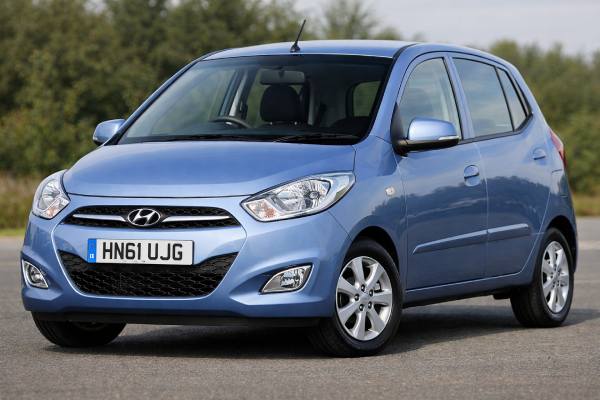
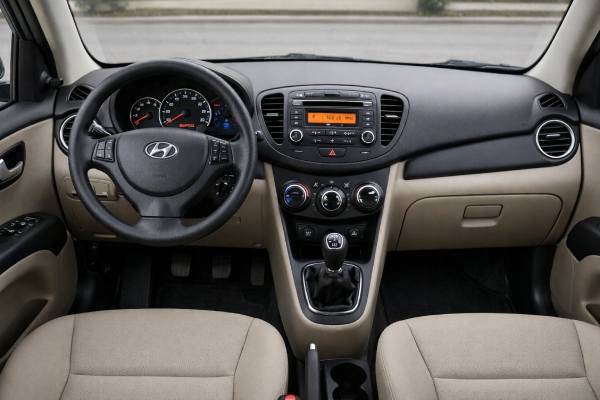

The facelifted Hyundai i10 PA with the 1.0-liter Kappa three-cylinder sits in a sweet spot of the small-car market. It is simple, light, cheap to run, and more spacious than many city cars of its era. In 2011, Hyundai refreshed the first-generation i10 with sharper styling, cleaner Euro 5 engines, and a stronger value story. In UK-market form, the 69 hp 1.0 was closely tied to the low-emissions Blue version, which added stop-start and efficiency-focused details to chase lower tax and fuel costs. What makes this car interesting today is not speed or advanced tech. It is the mix of honest engineering, easy parking, low tyre and brake costs, and generally solid mechanical durability when serviced on time. Its age shows in safety tech, motorway refinement, and some trim-specific weaknesses, but as an urban runabout or second car it still makes a lot of sense.
Quick Overview
- Roomy cabin and 225 L boot for such a short car.
- Official combined economy of 4.2 L/100 km on the Blue 1.0 manual.
- Light controls and a 4.8 m turning circle make it easy in town.
- Check clutch action, steering assist, and rust around seams on older cars.
- Engine oil and filter should be changed every 15,000 km or 12 months in normal use.
Guide contents
- Hyundai i10 PA facelift basics
- Hyundai i10 PA specs and data
- Hyundai i10 PA trims and safety kit
- Reliability and known faults
- Maintenance and buyer checks
- Driving feel and efficiency
- How the i10 PA compares
Hyundai i10 PA facelift basics
The 2011 facelift mattered because it turned the original i10 from a merely sensible budget hatchback into a more polished and more competitive one. The body stayed compact at 3,565 mm long, but the cabin still offered genuine four-seat usability, a useful 225-liter boot under the VDA method, and easy ingress compared with lower-roof rivals. Hyundai also improved the front and rear styling, refreshed trim, and leaned hard into running-cost value.
For this exact 1.0 Kappa version, the headline is efficiency rather than pace. The naturally aspirated 998 cc three-cylinder makes 69 hp and 95 Nm, driving the front wheels through a five-speed manual. Officially, the Blue variant returned 67.3 mpg UK combined, which converts to 4.2 L/100 km, with CO2 at 99 g/km. That made it one of the more tax-friendly petrol city cars of its time. The trade-off is modest performance: 0–100 km/h takes about 14.8 seconds, and top speed is roughly 150 km/h. For urban and suburban work that is acceptable. For fast overtakes or sustained motorway gradients, it feels about as strong as the numbers suggest.
The engineering is straightforward. You get a small naturally aspirated petrol engine, manual gearbox, electric power steering, MacPherson strut front suspension, and a torsion-beam rear axle. Simplicity is part of the appeal. There is less to go wrong than on a later turbocharged supermini, and routine parts such as tyres, brake components, and filters are usually inexpensive. Hyundai also backed the car with a strong warranty package when new, which helped its early reputation.
As a used buy today, the facelifted i10 1.0 works best for buyers who want predictable costs, city-friendly packaging, and a simple ownership experience. It is not the class leader for crash technology, long-distance quietness, or passing performance, and it lacks the active safety systems that later city cars made normal. But if your priorities are ease of use, cheap fuel, easy parking, and a cabin that feels bigger than the footprint suggests, the little Hyundai still has a strong case.
Hyundai i10 PA specs and data
Below are the key technical details for the facelifted 2011–2013 Hyundai i10 PA 1.0 Kappa manual in its UK and broader European context.
| Powertrain and efficiency | Data |
|---|---|
| Code | Kappa 1.0 MPI family |
| Engine layout and cylinders | Inline-3, SOHC, 12-valve, 4 valves per cylinder |
| Bore × stroke | 71.0 × 84.0 mm (2.80 × 3.31 in) |
| Displacement | 1.0 L (998 cc) |
| Induction | Naturally aspirated |
| Fuel system | Multi-point petrol injection |
| Compression ratio | 10.1:1 |
| Max power | 69 hp (51 kW) @ 6,200 rpm |
| Max torque | 95 Nm (70.1 lb-ft) @ 3,500 rpm |
| Timing drive | Chain-driven layout is typical for this Kappa engine family |
| Rated efficiency | 4.2 L/100 km (56.0 mpg US / 67.3 mpg UK) combined |
| Real-world highway @ 120 km/h | Typically about 5.5–6.2 L/100 km in steady use, not a factory claim |
| Transmission and driveline | Data |
|---|---|
| Transmission | 5-speed manual |
| Drive type | Front-wheel drive |
| Differential | Open differential |
| Chassis and dimensions | Data |
|---|---|
| Suspension front / rear | MacPherson strut / coupled torsion beam axle |
| Steering | Rack-and-pinion, electric assist, about 2.99 turns lock-to-lock |
| Brakes | Front ventilated discs, rear drums; rear discs possible on some ESP-equipped variants |
| Wheels and tyres | 155/70 R13 on Blue, 165/60 R14 on higher trims |
| Ground clearance | Around 165 mm (6.5 in), market-dependent |
| Length / width / height | 3,565 / 1,595 / 1,540 mm (140.4 / 62.8 / 60.6 in) |
| Wheelbase | 2,380 mm (93.7 in) |
| Turning circle | 4.8 m (15.7 ft) |
| Kerb weight | 948 kg (2,090 lb) |
| GVWR | 1,400 kg (3,086 lb) |
| Fuel tank | 35 L (9.25 US gal / 7.70 UK gal) |
| Cargo volume | 225 L / 910 L (7.9 / 32.1 ft³), VDA |
| Performance and capability | Data |
|---|---|
| 0–100 km/h | 14.8 s |
| Top speed | 150 km/h (93 mph) |
| 100–0 km/h braking | About 38 m (124.7 ft) in one independent repeated-stop test |
| Towing capacity | 700 kg braked / 400 kg unbraked (1,543 / 882 lb) |
| Payload | About 452 kg (996 lb), calculated from GVWR minus kerb weight |
| Fluids and service items | Data |
|---|---|
| Engine oil | API SL or above, ACEA A3 or above; verify viscosity and quantity by VIN and climate |
| Coolant | Ethylene-glycol antifreeze mixture; check handbook and under-bonnet label for exact spec and fill quantity |
| Manual transmission fluid | API GL-4 SAE 75W/85, described in handbook family as fill-for-life |
| Brake fluid | DOT 3 or DOT 4 specification |
| A/C refrigerant | Verify by VIN and under-bonnet label before servicing |
| Key torque specs | Always confirm from VIN-specific service data before tightening critical fasteners |
| Safety and assistance | Data |
|---|---|
| Euro NCAP | 2008 protocol: 4-star adult, 4-star child, 3-star pedestrian |
| Headlight rating | IIHS not applicable for this market and class context |
| Airbags | Front and front-side airbags commonly fitted |
| Core safety kit | ABS, EBD, pretensioners, ISOFIX on outer rear seats |
| ADAS | No modern ADAS; ESP was optional special order on some trims |
These figures reflect the facelift-period 1.0 manual and may vary slightly by market, trim, tyre package, and registration year.
Hyundai i10 PA trims and safety kit
For this facelift period, trims mattered because the 1.0 petrol was not spread evenly across the whole range in every market. In the UK, the 69 hp 1.0 was most closely tied to the Blue model, which focused on low emissions and economy. Blue added low rolling-resistance tyres, Intelligent Stop and Go stop-start, an alternator management system, a rear spoiler, and 13-inch steel wheels. The regular Classic, Active, and Style grades leaned more heavily toward the 1.2 petrol. That means many buyers searching for a facelift 1.0 are really shopping for a Blue-spec car, even if private sellers do not mention it clearly.
The trim walk-up was sensible. Classic brought the basics such as air conditioning, central locking, electric front windows, a split-fold rear seat, radio with CD and MP3 support, USB and Aux inputs, front and front-side airbags, and ISOFIX on the outer rear seats. Active added nicer exterior trim, electric mirrors, rear electric windows, front fog lamps, a height-adjustable driver seat, and remote locking. Style added comfort extras such as heated front seats, a sunroof, leather-trimmed touch points, and more decorative cabin trim. Mechanically, the main differences were more about wheel and tyre package, equipment weight, and engine pairing than about suspension or brake hardware tuning.
Safety equipment is respectable for the class and age, but clearly from an earlier era. ABS and EBD were core features, while electronic stability control was not standard in the UK and appears to have been a special-order option. Front and front-side airbags, pretensioners, a seatbelt reminder, and ISOFIX outer rear anchors were part of the safety story, but there was no autonomous emergency braking, no lane assistance, no blind-spot monitoring, and no other modern driver-assistance technology. That matters if this car will carry children frequently or spend much time in fast traffic.
Euro NCAP tested the first-generation i10 under an older protocol, and the result applies in general terms to the model line rather than only one exact trim. It scored four stars for adult occupant protection, four stars for child protection, and three stars for pedestrian protection. The passenger compartment was judged stable, but chest protection for the driver in the frontal test was only weak, and there was no head-protecting side curtain airbag for a pole test. The child result was solid for the time, though the test also highlighted some limitations in warning and marking clarity around the front passenger airbag and child-seat fitment information. The key takeaway is simple: acceptable passive safety for a late-2000s city car, but not something you should compare directly with a much newer supermini.
Reliability and known faults
The facelifted i10 1.0 is fundamentally a dependable small car, but age, city use, and patchy servicing now shape the ownership experience more than the original design. The good news is that the core package is simple. The less good news is that small cars often live hard lives: lots of short trips, curb strikes, skipped maintenance, budget tyres, and delayed brake work. On that basis, here is the practical fault map.
Common, usually low to medium cost
- Clutch drag, judder, or an awkward biting point on manual cars.
- Stiff or inconsistent shift into first or reverse.
- Brake binding, rear brake corrosion, or uneven wear from low-mileage urban use.
- Worn tyres and poor alignment from city potholes and parking impacts.
Trade case studies and owner reports point to clutch-cable issues on some right-hand-drive cars, where water and grime can affect the cable and make engagement feel rough or inconsistent. A worn clutch itself is not rare either, especially on heavily urban cars. The remedy depends on the symptom: cable lubrication or replacement for dragging action, full clutch replacement if slip or shudder persists, and gearbox oil refresh if the shift quality is poor but the clutch checks out.
Occasional, medium cost
- Electric power steering heaviness or intermittent assistance faults.
- Wheel bearing hum.
- Drop-link, bush, or ball-joint wear.
- Age-related exhaust corrosion and tired 12 V batteries.
A steering warning lamp, sudden heavy steering, or intermittent assist should not be ignored. Start with battery condition and charging voltage, because weak system voltage can cause odd electric-assist behavior on older small cars. If power and grounds are healthy, the EPS column or related sensors may need diagnosis. Wheel-bearing noise is typically a speed-related hum that gets louder with corner load. Suspension wear is less dramatic but common enough on rough-road cars.
Less common but worth checking carefully
- Timing-chain rattle on neglected oil-service histories.
- Cooling-system leaks or chronic low coolant.
- Rust around window frames, lower seams, arches, and underbody structure.
The Kappa 1.0 is not known as a chronic engine failure unit, but neglected oil changes are bad news for any chain-driven small petrol engine. A cold-start rattle, correlation fault, or rough idle after start-up deserves attention before purchase. Rust is also a growing age issue. Door and window-frame edges, rear arches, sill areas, and underbody seams are worth a careful inspection. Clean drain holes and prompt paint repair help more than many owners realise.
For service actions and recalls, do not rely on forum memory or seller claims. Hyundai’s recall portal and government recall checkers allow model-specific checking, and a dealer can confirm campaign completion by VIN. Because campaigns vary by market, year, and production batch, that VIN check is the right final step before money changes hands.
Maintenance and buyer checks
A facelift i10 1.0 that gets regular oil changes and basic inspections usually ages well. The important thing is to treat it like a real car, not like an appliance. Small engines work hard, and neglected fluids or sticky brakes show up fast.
| Practical maintenance schedule | Interval |
|---|---|
| Engine oil and filter | Every 15,000 km or 12 months; severe use about 10,000 km or 6 months |
| Engine air filter | Inspect at each service, replace sooner in dusty use |
| Cabin filter | Inspect yearly, replace when airflow drops or at routine annual service |
| Spark plugs | Check by VIN and market; many owners budget around 40,000–60,000 km |
| Coolant | First major replacement at 90,000 km or 60 months, then every 40,000 km or 24 months in period schedule |
| Brake fluid | Replace every 2 years |
| Manual gearbox oil | Often treated as fill-for-life, but a preventive change around 60,000–90,000 km is wise |
| Tyre rotation | Every 12,000 km or sooner if wear is uneven |
| Brake inspection | At every service; watch for rear brake corrosion and sticking |
| Timing chain | No fixed belt interval; inspect for rattle, stretch symptoms, and correlation faults |
| Serpentine belt and hoses | Inspect at each service for cracks, glazing, leaks, and swelling |
| 12 V battery | Test yearly once past 4 years old |
| Air conditioning | Inspect refrigerant performance and compressor operation during routine service |
For fluids, period handbook data points to API SL or higher and ACEA A3 or higher engine oil, manual gearbox oil of API GL-4 SAE 75W/85, and DOT 3 or DOT 4 brake fluid. Exact oil viscosity and fill quantities should be checked against VIN-specific handbook or service data, especially because handbook families can cover more than one engine.
A good pre-purchase inspection should include these checks:
- Start it fully cold and listen for chain rattle, uneven idle, or exhaust leaks.
- Test the clutch bite, hill-start behavior, and selection of first and reverse.
- Check for EPS warning lights or steering that goes heavy unexpectedly.
- Inspect brake condition, especially rear drums, for drag or corrosion.
- Look underneath for rust on seams, subframes, and jacking areas.
- Check tyre wear across the tread for alignment or suspension clues.
- Confirm service history and ask for proof of recall or campaign completion.
- Verify all electrics, air conditioning, window regulators, and central locking.
The best buys are usually clean, manual, well-documented cars with evidence of annual servicing, decent tyres, and recent brake work. Cars to approach carefully are those with vague history, a heavy clutch, electrical steering complaints, or visible corrosion around seams and door frames. Long term, the outlook is good rather than exceptional: the i10 lasts well when maintained, but it does not hide neglect.
Driving feel and efficiency
On the road, the facelifted i10 1.0 feels honest and light. Around town, it is easy to place, easy to park, and easier to see out of than many newer small cars with thicker pillars and higher beltlines. The steering is light rather than rich in feel, but that suits the mission. Ride quality is also better than many people expect on broken urban surfaces, helped by the tall body and modest wheel sizes. It is not sporty, but it is rarely tiring in city use.
The 69 hp three-cylinder is adequate from low speeds, though not eager. Throttle response is clean enough at city pace, but once you ask for a full-load overtake or climb a long grade with passengers aboard, the lack of torque becomes obvious. The five-speed manual is part of the character too: keep it in the right ratio and the car feels willing enough; let revs drop too far and it quickly feels flat. This is a drivetrain that rewards anticipation, not impatience.
Official economy is the strong point. The Blue 1.0 manual was rated at 4.2 L/100 km combined, 5.6 urban, and 3.8 extra-urban. In real use, a careful mixed driver can still expect excellent results for a non-hybrid. A realistic motorway expectation at about 120 km/h is usually somewhere in the mid-5s to low-6s L/100 km, depending on wind, temperature, traffic, and load. That is still respectable, but it reminds you this is a small naturally aspirated hatchback working fairly hard at that speed.
At higher speeds, refinement is the weak spot. Wind and engine noise build, and the i10 feels more settled than some older city cars but less relaxed than later superminis such as the Volkswagen up! family. Braking performance is decent for the class, and repeated stops from higher speeds are controlled enough for normal use, though the little Hyundai does not have the composure of a larger car on wider tyres. The turning circle, visibility, and light controls are where it wins most often. For urban driving, those traits matter more than raw pace.
How the i10 PA compares
The facelift i10 1.0’s rivals tell you exactly where it shines. Against the closely related Kia Picanto of the same era, the Hyundai usually feels like the more comfort-first choice, while the Kia can feel a little sharper in presentation depending on trim. Against the Toyota Aygo, Citroen C1, and Peugeot 107 trio, the Hyundai wins on cabin width, everyday practicality, and a more grown-up feel, while the Toyota-based cars feel lighter and more playful but also more basic on refinement and rear-seat usefulness.
Against the Volkswagen up!, Skoda Citigo, and SEAT Mii, the i10 gives away some polish. The Volkswagen Group trio generally feel more mature on the move, more refined at speed, and a little more sophisticated in cabin design. But they also tend to command stronger used prices, and the Hyundai still answers back with simple engineering, good packaging, and, in Blue trim, very strong official economy.
If value is the main goal, the i10 makes more sense than a prestige-badged small car and usually feels more substantial than ultra-cheap alternatives such as the Suzuki Alto or Nissan Pixo. It is not the enthusiast’s pick and not the safety-tech pick. It is the buyer’s pick for low running costs, city friendliness, and honest practicality. For a second car, a first car, or a low-mileage urban commuter, that remains a convincing brief. The best example is not necessarily the cheapest one. It is the one with history, healthy brakes, clean body seams, and no clutch or steering drama.
References
- Hyundai Owners manuals | Hyundai Motor UK 2026 (Owner’s Manual)
- Home | Hyundai Recalls & Service Campaigns 2026 (Recall Database)
- Check if a vehicle, part or accessory has been recalled – GOV.UK 2026 (Recall Database)
- Adult occupant protection Child restraints Pedestrian Hyundai i10 2008 (Safety Rating)
- 2011-Hyundai-i10-UK.pdf 2011 (Brochure)
Disclaimer
This article is for informational purposes only and is not a substitute for professional diagnosis or repair. Specifications, torque values, intervals, fluid requirements, and procedures vary by VIN, market, production date, and equipment, so readers should always verify details against the correct official service documentation for the exact vehicle.
If this guide was useful, please share it on Facebook, X, or another platform to support our work.